Skip to the main content.

13 min read

The Psychology of Appointment Reminders: What Gets Patients to Show Up

The Psychology of Appointment Reminders: What Gets Patients to Show Up
 💡 Most patients don't skip appointments on purpose. They forget, feel overwhelmed, or find it too hard to confirm. Appointment reminder best practices psychology shows that the right message at the right time can change patient behavior.

Using simple ideas from behavioral economics in healthcare, like loss framing and social proof, practices can boost show-up rates. For example, telling patients "your slot will be given to another patient" creates urgency. Asking them to reply "YES" builds a sense of commitment.

Sending reminders at two or three key points before the visit helps patients plan ahead. The goal is to make showing up easy and missing hard. When you reduce friction and tap into how people really think, you see real drops in no-shows.

Your patient booked an appointment two weeks ago. They meant to show up. But when the day came, they forgot, got busy, or just didn't feel like going. Now you have an empty slot, lost revenue, and a gap in that patient's care.

This is the no-show problem. It costs U.S. healthcare an estimated $150 billion each year. And most practices still try to fix it with the same old phone call the day before.

Here's the thing: the issue isn't that patients don't care. It's that most reminders don't match how people actually think and make choices. Understanding why patients miss appointments is the first step to fixing the problem.

This article explores appointment reminder best practices psychology, the science behind what makes people show up.

You'll learn how ideas from behavioral economics in healthcare can reshape your reminder strategy. We'll cover how timing, message framing, social proof, and friction all play a role in patient behavior around appointment reminders.

By the end, you'll have a clear, tested playbook. You'll know how to write reminders that work with your patients' minds, not against them. Whether you run a solo practice or a large clinic, these ideas can help you cut no-shows and fill your schedule.

Let's dig into what the research says about reminder effectiveness psychology and how to put it to work.

Why Traditional Reminders Fail: The Psychology Behind No-Shows

Most practices send a simple reminder and hope for the best. But a basic "You have an appointment tomorrow" message ignores how the human brain works. To understand why patients miss appointments, you need to look at the mental barriers standing in their way.

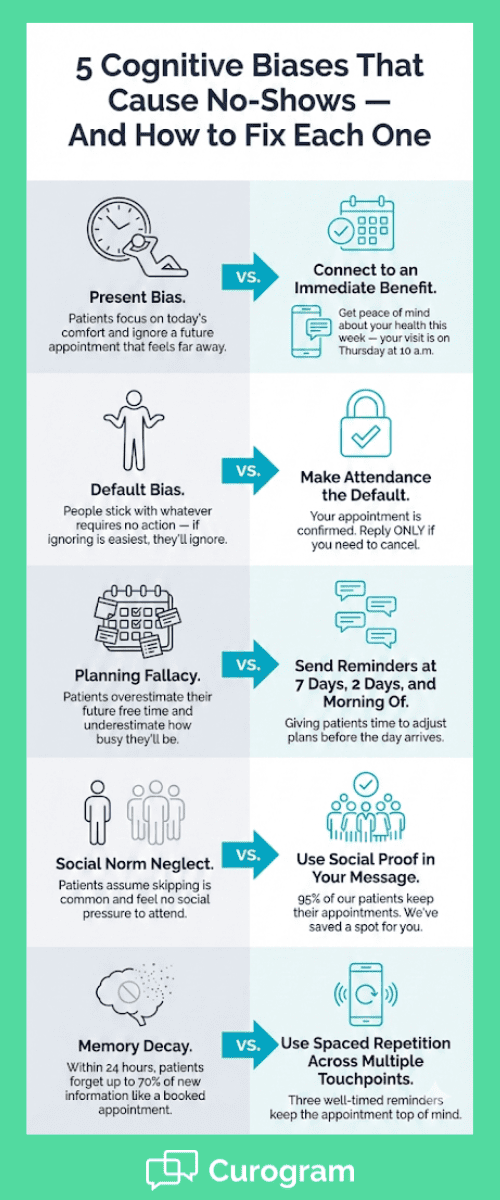
The first barrier is memory decay. People forget things fast. Research on forgetting curves shows that within 24 hours, we lose up to 70% of new information.

A patient who books a visit three weeks out may not even recall it by the time the day arrives. A single reminder the day before may come too late if the patient already made other plans.

The second issue is cognitive overload. Your patients are busy. They're juggling work, kids, bills, and dozens of daily decisions. An appointment reminder that blends in with all their other texts and emails gets lost in the noise. If the message doesn't stand out, it won't stick.

Then there's the lack of felt consequences. Most patients don't think about what happens when they miss a visit.

They don't see the cost to the practice. They may not even connect the missed visit to their own health. Without a sense of what's at stake, there's little push to act.

Finally, many reminder systems create too much friction. The patient gets a message but has no easy way to confirm or cancel. They have to call the office, sit on hold, or navigate a clunky portal.

When it's hard to respond, many patients just don't bother. That's why reducing barriers is a core part of appointment attendance psychology.

Behavioral Economics Principles for Healthcare Reminders

Behavioral economics in healthcare offers proven ideas that can make your reminders far more effective. These are not complex theories. They're simple patterns in how people make choices, and you can use them right away.

Loss aversion is one of the strongest forces in decision-making. People feel the pain of losing something about twice as much as the joy of gaining it.

In practice, this means a reminder that says "You will lose your reserved appointment slot" hits harder than "Don't forget your visit." Framing the message around what the patient stands to lose creates urgency.

Default bias means people tend to stick with whatever option requires no action. If showing up is the "default" and canceling takes effort, more patients will show up.

You can set this up by saying, "Your appointment is confirmed. Reply only if you need to cancel." This makes attendance the path of least effort.

Social norms also play a big role. People want to do what others do. A message like "9 out of 10 patients at our practice keep their appointments" gives patients a reason to follow the crowd. This taps into social proof, a well-studied driver of behavior.

Commitment devices work by getting patients to say they'll do something. When you ask a patient to reply "YES" to confirm, they've made a small promise. That promise makes them more likely to follow through. It shifts them from passive to active.

Present bias is the tendency to focus on what feels good right now instead of what matters later. A dental cleaning next Tuesday doesn't feel urgent today.

Reminders that connect the visit to an immediate benefit, like "Get peace of mind about your health this week," can help patients see the near-term value.

Infographic showing five cognitive biases that cause patient no-shows with reminder tactics to counter each

The Timing Psychology: When Reminders Actually Work

Sending the right message at the wrong time can be just as bad as sending no message at all. The timing of your reminders shapes how well patients remember and act on them. Understanding this is key to your reminder strategy.

The best approach uses multiple touchpoints. A single reminder is easy to miss or forget. But a series of well-timed messages creates what psychologists call "spaced repetition." This means the brain stores the information better when it's repeated over time rather than all at once.

A strong timing pattern looks like this: send the first reminder one week before the visit, a second one two days before, and a final one the morning of the appointment.

The first message plants the seed. The second one helps the patient plan their day. The third one serves as a final nudge when the visit is close.

Time of day also matters. Research on decision fatigue shows that people make worse choices later in the day. Sending reminders in the morning, when patients have more mental energy, tends to get better results. An 8 a.m. text is more likely to prompt action than a 7 p.m. one.

You should also account for the planning fallacy. People tend to think they have more free time in the future than they actually do. When a patient books a visit for next month, they feel confident they'll make it.

But as the day gets close, their schedule fills up. Early reminders give patients time to adjust their plans before it's too late.

Message Framing: Loss Aversion vs Gain Framing

The words you choose in a reminder can change whether a patient shows up or skips. Message framing is one of the most studied topics in patient behavior and appointment reminders. There are two main approaches: loss framing and gain framing.

  • Loss-framed messages focus on what the patient will miss or give up. For example: "If you don't attend, your appointment slot will be given to another patient." Or: "Missing this visit may delay your treatment plan." These messages tap into loss aversion, the idea that losing something feels worse than gaining something of equal value.

  • Gain-framed messages focus on the positive outcome of showing up. For example: "Keep your health on track by attending your visit on Tuesday." Or: "Your provider is looking forward to seeing you." These feel warmer and less urgent, which can be the right fit for certain patient groups.

So which one works better? Studies in suggest that loss-framed messages tend to drive higher show-up rates, especially for patients with a history of missed visits.

However, gain-framed messages work well for patients who are already engaged in their care. New patients or anxious patients may respond better to a positive tone.

The smartest approach is to test both. Run an A/B test where half your patients get loss-framed reminders and half get gain-framed ones.

Track which group has fewer no-shows over 30 to 60 days. Many practices find that a mix works best: gain framing for first-time patients and loss framing for those who have missed visits before.

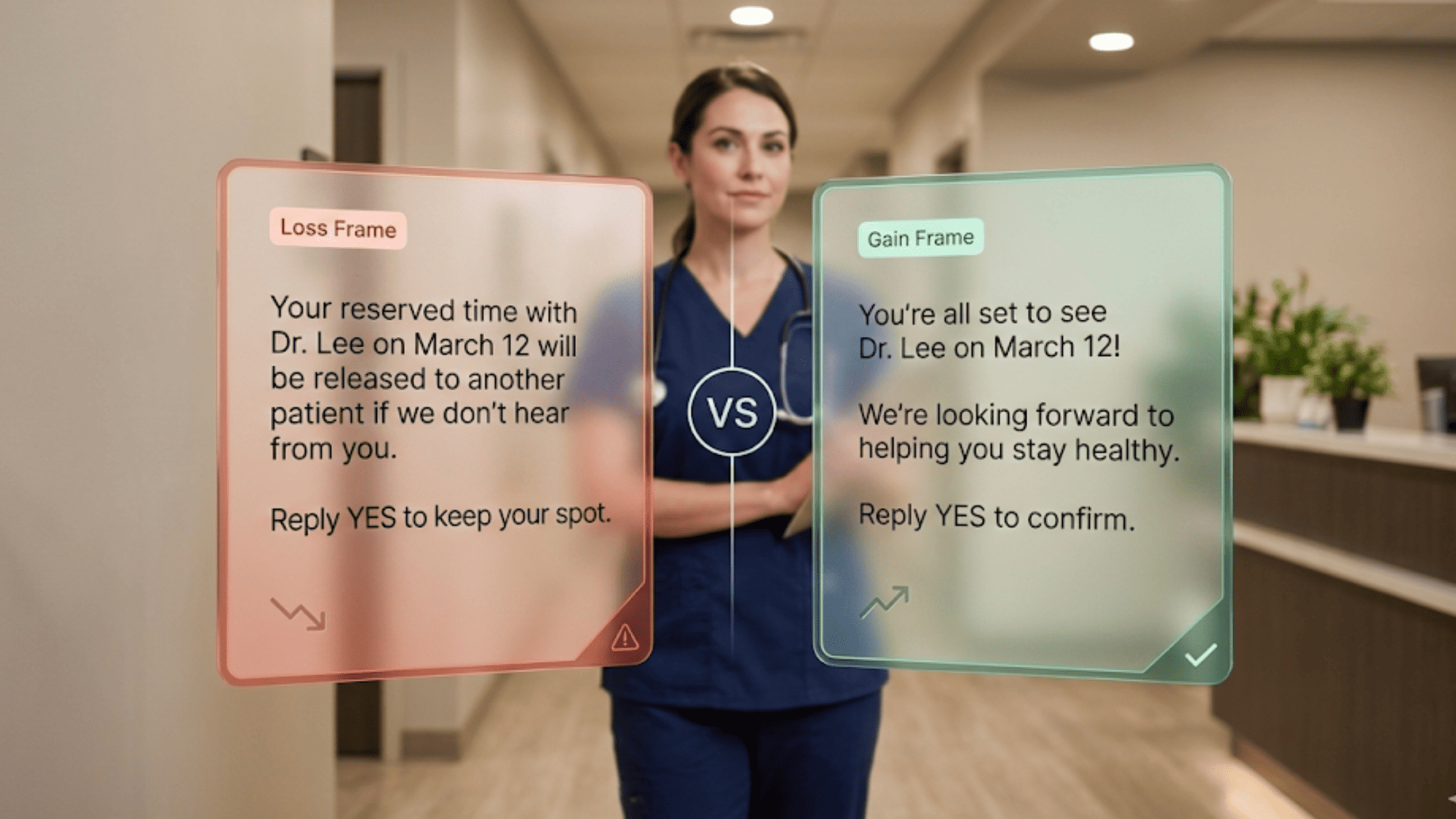
Here are two side-by-side examples to compare:

  • Loss: "Your spot with Dr. Lee on March 12 will be released if we don't hear from you. Reply YES to keep it."

  • Gain: "You're all set to see Dr. Lee on March 12. We're looking forward to helping you stay healthy."

Both are clear and simple. The key is matching the frame to the patient and the context.

Receptionist at medical practice with floating message bubbles showing patient commitment confirmation

Social Proof and Commitment Devices in Reminders

Two of the most effective tools for shaping patient behavior come from social psychology: social proof and commitment devices. Both are easy to add to your reminders and can make a big impact on attendance.

Social proof works because people look to others when making choices. If most patients at your practice show up, tell them.

A message like "95% of our patients keep their scheduled appointments" sets a clear standard. It tells the patient that showing up is the normal thing to do. This can reduce the feeling that "everyone cancels" and push them toward following the majority.

You can also use social proof in more specific ways. For example: "Most patients in your age group complete their annual wellness visit on time." The more relevant the comparison group, the stronger the effect.

Commitment devices work by getting the patient to make a small, active choice. When you ask someone to reply "YES" to confirm their visit, you create what researchers call an "implementation intention." The patient has now stated a plan, and people are more likely to follow through on stated plans.

One study found that asking patients to write down their appointment time themselves, rather than just hearing it, reduced no-shows by 18%. The act of writing or typing engages a deeper level of commitment. You can mimic this in digital reminders by asking patients to confirm and then reply with their planned arrival time.

The reciprocity principle adds another layer. When patients feel that the practice has gone out of its way for them, like offering a personalized reminder or a helpful prep message, they feel a social pressure to return the favor by showing up.

A message like "We've reserved 30 minutes just for you with Dr. Patel" makes the patient feel valued and obligated.

Practices that combine social proof with commitment devices often see the biggest gains in attendance.

The Two-Way Confirmation Advantage

There's a big difference between telling patients about their appointment and asking them to respond.

Two-way confirmation turns a passive reminder into an active exchange. This matters because the psychology of commitment is built on action, not just awareness.

When a patient replies "YES" to confirm, something shifts in their mind. They've made a small promise.

Even tiny acts of commitment, like tapping a button, can increase follow-through. The patient now sees themselves as someone who has agreed to attend, and that self-image drives behavior.

Passive reminders, where the patient just reads a message and does nothing, don't create this effect. The patient may see the text and think, "I'll deal with it later."

Without a required action, the message fades from memory. Active engagement keeps the appointment top of mind.

The data supports this. Practices that use two-way text reminders report lower no-show rates than those that use one-way calls or messages.

The response itself becomes a data point, too. If a patient doesn't reply, your staff can follow up early and offer to reschedule. This turns a likely no-show into a filled slot.

For best results, keep the confirmation process simple. A one-tap reply is ideal. Avoid asking the patient to log in, click multiple links, or call the office. The easier the response, the higher the reply rate.

Reducing Friction: Making It Easy to Confirm or Cancel

Even the best-crafted reminder will fail if the patient can't act on it quickly. Friction is the silent killer of attendance. Every extra step between reading a message and responding is a chance for the patient to give up or get distracted.

One-click confirmation is the gold standard. When a patient can tap a single button to confirm their visit, you remove nearly all barriers.

Compare this to a system that asks them to call the office, wait on hold, and speak with a staff member. The first option takes five seconds. The second takes five minutes, and most patients won't bother.

Easy rescheduling matters just as much as easy confirmation. If a patient knows they can't make their visit, they should be able to pick a new time right from the reminder.

When rescheduling is simple, patients do it instead of just skipping. This keeps your schedule full and the patient engaged.

Mobile-friendly design is critical. Over 85% of text messages are read on a phone. If your confirmation link opens a page that's hard to read or navigate on a small screen, you'll lose people. Make sure buttons are large, forms are short, and load times are fast.

Here's a simple test: Try going through your own reminder and confirmation process on your phone. Count the number of taps, pages, and seconds it takes. If it's more than three taps or ten seconds, look for ways to cut steps.

The practices that make it easiest for patients to respond see the best results in appointment attendance psychology.

Personalization and Patient Psychology

A reminder that feels personal gets more attention than one that feels like a mass text blast. Personalization taps into a basic human need: the desire to be seen and known. When done well, it can turn a routine message into something the patient actually cares about.

The simplest form is using the patient's first name. "Hi Sarah, you have a visit on Thursday at 10 a.m." feels very different from "You have an upcoming appointment."

Studies show that using someone's name in a message increases open rates and response rates. It signals that the message is meant just for them.

Including the provider's name adds another layer. "Your visit with Dr. Martinez is coming up" reminds the patient of the human relationship behind the appointment.

It's not just a slot on a schedule. It's time with someone who knows their health story. This personal touch increases the sense of obligation to show up.

You can go further by tailoring the message to the appointment type. A reminder for a routine checkup might say, "Time for your yearly wellness visit." A reminder for a follow-up after a procedure might say, "Dr. Chen wants to check on your recovery." Each version speaks to the patient's specific situation and makes the visit feel more relevant.

For practices with diverse patient groups, adjusting the message based on the patient's age, language, or visit history can also help. Older patients may prefer a phone call along with a text. Younger patients often respond best to a short, casual text.

Patients who have missed visits before might need a stronger nudge, like a loss-framed message. This kind of targeted approach puts reminder effectiveness psychology into daily practice.

Case Studies: Psychology-Based Reminder Strategies That Worked

Theory is helpful, but results speak louder. Here are three examples of how practices used psychology-based reminder strategies to cut no-shows and improve patient flow:

Practice A: Loss-Aversion Messaging

A mid-size family practice with a 22% no-show rate rewrote their reminder texts. The old message said, "Reminder: You have an appointment on Friday at 3 p.m." The new version said, "Your reserved time with Dr. Adams on Friday at 3 p.m. will be released to another patient if you don't confirm.

Reply YES to keep your spot." Within 60 days, their no-show rate dropped to 14%. The key change was framing the appointment as something the patient could lose.

Practice B: Commitment Devices

An orthopedic clinic started asking patients to reply with their planned arrival time when they confirmed. Instead of just "Reply YES," the message said, "Reply with the time you plan to arrive (e.g., 2:45 p.m.)."

This small extra step made patients think about the logistics of attending. Over three months, their no-show rate fell from 19% to 11%. The act of typing a specific time created a stronger sense of commitment.

Practice C: Social Proof

A dental practice added a social norm message to their reminders: "97% of our patients kept their appointment this month. We've saved a spot for you on Wednesday at 9 a.m." This made showing up feel like the expected behavior. Their no-show rate dropped from 17% to 10% in the first quarter.

Across all three cases, the common factor was a shift from generic reminders to messages grounded in how people actually think.

The results also show that no single strategy is best for every practice. Testing and combining approaches tends to deliver the strongest outcomes.


Implementing Behaviorally-Informed Reminder Systems

Now that you understand the psychology, it's time to put it into action. You don't need to change everything at once. A step-by-step approach lets you test what works for your patient base and build from there:

Step 1: Audit your current reminders. Pull up the last five reminder messages your practice sent. Ask yourself: Do they use any of the principles covered in this article? Are they personalized? Do they create a sense of commitment? If the answer is no, you have room to improve.

Step 2: Choose one or two strategies to test first. Don't try to add loss framing, social proof, commitment devices, and personalization all at once. Pick the two that seem most relevant to your no-show patterns. If your no-show rate is high among repeat offenders, start with loss framing. If your patients are generally engaged but forget, try better timing and personalization.

Step 3: Set up an A/B test. Split your patient list into two groups. Send your current reminder to one group and the new version to the other. Run the test for at least 30 days to get enough data. Track the no-show rate for each group.

Step 4: Measure the results. Look at your no-show rate, confirmation rate, and same-day cancellations. Compare the two groups side by side. Even a 5% drop in no-shows can translate to real savings in lost revenue and wasted staff time.

Step 5: Refine and repeat. Once you know what works, roll it out to all patients. Then pick the next strategy to test. This cycle of testing and improving is how the best practices stay ahead. Over time, you'll build a reminder system that reflects real appointment reminder best practices psychology rather than guesswork.


Conclusion

The gap between a patient booking a visit and actually showing up is where most practices lose money and momentum. But that gap isn't random. It's shaped by how people think, feel, and make decisions every day.

The good news is that you don't need to guess. The science behind why patients miss appointments is clear, and the fixes are practical. Small changes in wording, timing, and process can shift patient behavior in a big way.

Loss framing shows patients what's at stake. Social proof shows them what others do. Commitment devices get them to say "yes" out loud. Personalization makes the message feel relevant. And reducing friction makes it easy to follow through.

You don't have to apply every idea at once. Start with one change. Test it. Measure the results. Then add the next. Over time, you'll build a system rooted in real reminder effectiveness psychology, not just habit.

The practices that treat reminders as a science, not an afterthought, are the ones that fill their schedules and keep patients engaged. Every no-show you prevent is revenue saved, staff time protected, and a patient who gets the care they need.

Your patients want to show up and your reminders just need to help them get there. Book a demo now to see how Curogram's smart appointment reminders can reduce your no-shows.


Frequently Asked Questions

How does loss framing reduce no-shows in medical practices?
Loss framing tells patients what they'll lose by missing a visit, such as their reserved time slot. This creates urgency because people react more strongly to potential losses than to gains.
Why do two-way text reminders work better than phone calls?
Two-way texts require patients to take action, like replying "YES." This small commitment builds a sense of obligation and keeps the visit top of mind more than a passive voicemail.
How many reminders should a practice send before an appointment?

Three is the sweet spot: one a week before, one two days before, and one the morning of the visit. This spaced pattern helps patients remember and plan without feeling overwhelmed.

Why does including a provider's name in reminders improve attendance?

It shifts the appointment from an abstract event to a personal meeting. Patients feel a stronger social bond and obligation when reminded that a specific person is expecting them.

How can small practices start using behavioral science in their reminders without expensive software?

Start by rewriting your reminder text to include the patient's name, a loss-framed message, and a simple "Reply YES" confirmation. You can test this with a basic HIPAA-compliant texting platform.


Automated Reminders: Boost Revenue & Cut No-Shows in Healthcare

Automated Reminders: Boost Revenue & Cut No-Shows in Healthcare

💡 Automated medical reminders deliver a measurable revenue impact by cutting no-show rates by up to 75% and reducing manual reminder call costs by...

Read More
20+ Proven Ways on How to Remind Patients of Appointments

20+ Proven Ways on How to Remind Patients of Appointments

Missed appointments are a significant drain on resources, revenue, and operational efficiency for healthcare practices. Understanding how to remind...

Read More
Transform Your Practice: The Ultimate Guide to an Appointment Reminder Service for Doctors

Transform Your Practice: The Ultimate Guide to an Appointment Reminder Service for Doctors

An appointment reminder service for doctors is the single most effective tool for tackling one of the most persistent and costly problems in...

Read More