


Curogram vs. Klara: Automation ROI vs. Walled Garden Cost
💡 When comparing patient communication tools, the subscription fee rarely captures the full cost. For practices outside the ModMed ecosystem,...
One clinic in our internal data cut its no-show rate from 14.20% to 4.91% in three months. The only change was automated text reminders patients could answer from their own phone. For a small practice, that gap is rent, payroll, or a second front-desk hire.
Texting patients sounds simple until compliance walks in. A staff member replying from a personal cell isn't covered, even with the best intentions.
HIPAA texting platforms for small practices close that gap with a signed Business Associate Agreement, encrypted storage, consent tracking, and a number patients can text back without installing anything.
Most roundups rank tools built for hospital IT departments. A five-provider family clinic or a two-room imaging center doesn't need on-call scheduling across 400 nurses.
It needs secure messaging that goes live in days, fits a small budget, and reaches an older patient base that will never install an app.
We've watched practices lose weeks to platforms that demanded an IT project before the first text went out. So we ranked these seven tools by what matters at that size: setup speed, transparent pricing, app-free patient texting, and real HIPAA coverage.
Curogram lands first for most small medical practices, though the honest answer depends on whether you're a solo provider, a small group, or an imaging center. We'll show where each tool fits, and the trade-offs that come with it.
Enterprise checklists don't map to a small practice. The patient messaging systems worth shortlisting all clear the same six criteria, and the order you weight them matters. Setup and reach come before bells and whistles.
Go-live time is the first filter. A small practice can't spare a week of staff hours for onboarding calls and number registration.
The tools worth a shortlist turn on in days, and the vendor handles 10DLC registration and the signed BAA, not your office manager.
Ask one blunt question in any demo: who does the setup work, us or you? If the answer involves your staff mapping EHR fields or standing up a server, keep looking. Reminders should fire inside the first week, with the front desk trained in an afternoon.
Two costs sink small practices: the sticker price and the hidden one. Transparent per-user pricing you can read on a page beats 'contact sales' when you're comparing vendors.
Falkon SMS publishes plans from $14.99 per user monthly on annual billing; Spruce lists basic messaging near $24. Enterprise tools quote custom pricing that runs past a small budget.
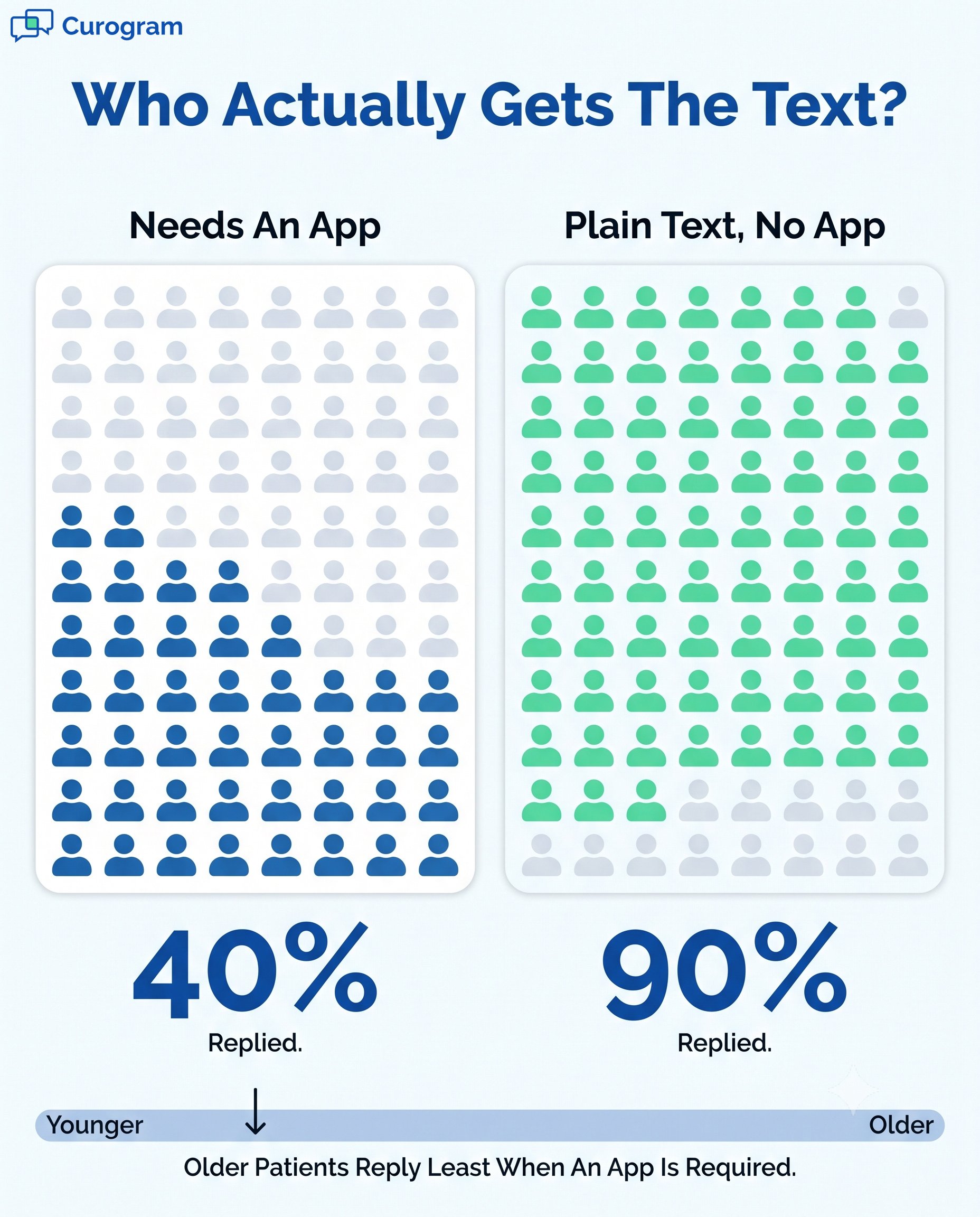
The hidden cost is patient friction. If your tool only works when the patient installs an app, half your panel never sees the message. App-free texting matters most for older patients,
Medicaid populations, and anyone who won't create another account. A patient who has to download something is often a patient who just doesn't reply.
HIPAA compliance runs deeper than a single checkbox. You want a signed BAA, encryption in transit and at rest, audit logs, and consent capture for opt-in and opt-out.
SOC 2 Type 2 shows a vendor's controls held up over months, not just on paper. Ask whether the BAA comes standard or only on the top plan.
EHR integration reads like an enterprise-only feature, yet small practices gain too. When confirmed appointments write back to the schedule and reminders pull from real visit data, no one texts a patient who already cancelled.
Protected health information should move between systems without a staffer retyping it. For radiology practice communication, that sync ties an imaging slot to its prep reminder.
Seven tools, side by side. Setup speed and app-free patient texting are the columns small practices scan first, so those lead. Each tool's full write-up, with trade-offs, follows below.
|
Tool |
HIPAA / SOC 2 |
Setup speed |
App-free texting |
Best for |
|---|---|---|---|---|
|
Curogram |
BAA, SOC 2 Type 2 |
Days |
Yes |
Small practices overall |
|
Spruce |
BAA, SOC 2 Type II |
Days |
SMS yes; secure app-based |
Solo providers |
|
Klara |
BAA |
Moderate |
App for full use |
Patient collaboration |
|
Weave |
BAA |
Moderate |
Via phone system |
Phone plus text bundle |
|
TigerConnect |
BAA, SOC 2 |
Longer |
Staff app |
Hospital care teams |
|
Emitrr |
BAA |
Days |
Web / SMS |
Front-office automation |
|
Falkon SMS |
BAA, SOC 2 Type I |
Days |
Yes |
Keep your own number |

Curogram is a HIPAA-compliant patient communication platform built around two-way texting patients answer from a normal phone. No app, no portal login. For a small or radiology practice, that removes the biggest reason patients ignore a message.
One setup covers a lot: automated reminders and confirmations, mass texting for recalls, e-forms, online scheduling, telehealth, and text-to-pay, plus EHR integration so confirmations write back to your schedule. Compliance includes a signed BAA, SOC 2 Type 2, and TCPA consent tracking.
The figures behind the ranking come from our internal data across clinical settings:
|
Metric |
Result |
|---|---|
|
No-show rate at one clinic |
Fell from 14.20% to 4.91% in three months |
|
No-show rate vs industry |
53% lower across specialties |
|
Appointment confirmation |
Above 75% average |
|
Recall reactivation |
1,240 patients rebooked at 35% reconversion |
|
Revenue lift |
10% to 20% from recovered slots |
The workflow behind those numbers is plain. A patient books, and Curogram sends a confirmation text they reply Y or N to.
Two days out, a reminder fires with the visit time and any prep note. If they don't confirm, staff sees the gap on one screen and fills it from the recall list.
The honest limitation: Curogram carries more features than a single-provider office will use in month one. A solo doctor who only wants reminders may find e-forms and text-to-pay sitting idle at first, ready when the practice grows.
For small practices and radiology centers that want enterprise capability without enterprise setup, it's our top pick.
Spruce Health is popular with solo providers and small practices that want phone, text, fax, and telehealth in one inbox. It carries a BAA, SOC 2 Type II, and HITRUST certification, so the compliance floor is solid.
The trade-off is the patient experience. Patients can text your Spruce number by standard SMS, but the fully secure, encrypted thread runs through the Spruce patient app they must install and sign into.
For a younger panel that's fine; for an older base, the app step costs you replies. Pricing starts near $24 per user monthly, rising to about $49 for integrations; see our Curogram vs Spruce comparison.
Klara centers on patient collaboration: messaging, workflow automation, and EHR connectivity pulled into one thread, so front-desk back-and-forth drops.
Practices with repeatable patient journeys, like a specialty clinic running intake and recall the same way every week, get the most from it.
Two cautions for a small office. Full functionality leans on patients using the Klara app or web account rather than plain SMS, and onboarding takes more setup effort than a days-live tool.
Budget for a longer ramp, and confirm your EHR is supported before signing. For the details, see our Curogram vs Klara comparison.
Weave makes sense when you want a phone system and texting bundled together. It ties two-way patient messaging to the office phone line, with reminders, reviews, and payments layered on. Front desks that live on the phone tend to like the single dashboard.
Weigh two things. Weave's texting depth and compliance scope are built around its phone-first design, so patient messaging can feel secondary to call handling.
The bundle price can also outrun a small practice that only needs secure messaging. If phone plus text in one tool is the goal, see our Curogram vs Weave comparison for the texting side by side.
TigerConnect (formerly TigerText) was built for hospitals: secure messaging, voice, and video among nurses, physicians, and on-call teams, with role-based routing that pages the on-call cardiologist by role instead of by name. It's SOC 2 certified and runs across thousands of large organizations.
That heritage is the catch for a small practice. Patient-facing texting sits behind staff-to-staff messaging, setup runs longer, and pricing is custom enterprise, which rarely pencils out for a five-person office that mostly wants reminders. Run a clinic, not a health system, and much of what you'd pay for goes unused.
Emitrr targets front-office automation for small to mid-sized practices: reminders, recalls, review requests, and two-way texting from your existing number, with a wide integration list. Teams that want to automate routine outreach without a heavy build tend to land here.
The trade-offs are feature depth and fit. Emitrr covers the communication basics well, but a practice wanting telehealth, e-forms, and text-to-pay in the same tool will find those lighter or absent, depending on plan.
Confirm the integrations you need are live, since coverage varies by system. For a small clinic focused on reminders and reviews, it's a reasonable, budget-minded option.
Falkon SMS text-enables the phone number you already use, whether landline, VoIP, toll-free, or Microsoft Teams, so patients reach you at the same number they call. No new hardware, no number change. It's HIPAA-compliant and SOC 2 Type I certified, with a signed BAA on the Pro plan.
The platform runs automated appointment reminders, follow-ups, and two-way conversations that cut front-desk call volume, plus a shared inbox for the whole team.
Secure file sharing, message templates, MMS, and opt-in and opt-out management round it out, and a mobile app lets staff text from anywhere. Its customer base spans mental health, homecare and hospice, chiropractic, dental, and pharmacies.
Pricing is transparent: a free trial with no card, Essential at $17.99 per user per month, and Pro (HIPAA with signed BAA) at $29.99, dropping to $14.99 and $24.99 on annual billing.
For a small practice that wants to keep its current number and pay per seat, it's worth a look on the Falkon SMS site.

Radiology carries risks a primary care text plan doesn't. A prep failure wastes a scanner slot, and an empty MRI hour costs far more than a missed 15-minute office visit. Secure texting earns its keep here on two fronts: prep and no-show control.
An imaging appointment usually comes with rules: nothing to eat after midnight, stop a medication, arrive early for contrast screening. Patients skip a voicemail and read a text. Send the prep steps by secure message a day out, and let patients reply with questions instead of guessing.
Contrast studies raise the stakes. A patient who ate breakfast before a fasting scan, or didn't flag a kidney issue, can force a reschedule that blocks the slot. A pre-visit screening text, tied to protected health information already in the record, catches that before the patient is on the table.
A missed imaging slot can cost over $1,000, and the scanner sat idle the whole hour. Reminder cadence matters more here than anywhere.
Confirm at booking, remind two days out, and send a same-day nudge, which gives the front desk time to backfill from a waitlist.
The math is simple: recovering a handful of imaging no-shows a month covers the platform many times over. Pair reminders with a recall list for overdue follow-up imaging, and the slot rarely stays empty. For the deeper playbook, see HIPAA texting for radiology practices.
Start from your setup: solo, small group, or imaging center. Three quick profiles cover most small practices, with one must-have that settles each.
Solo provider: you want the fastest, simplest secure messaging with a BAA and app-free texting. Spruce or Falkon SMS fit, and Curogram works if you'd rather grow into reminders and e-forms later.
Small multi-provider group: you're juggling shared inboxes, reminders across several schedules, and recalls.
Curogram's automation and EHR sync earn their keep here; Klara suits you if your workflows repeat the same way each week.
Radiology center: prep instructions and no-show cost per slot dominate. Prioritize reminder cadence, prep templates, and a recall list, and check any tool against your PACS or RIS before signing. Curogram is our pick for imaging.
Before you sign, confirm the vendor clears these:
Miss two of these and the tool was built for someone bigger than you. This roundup is the small-practice cut of our full ranking of HIPAA-compliant texting platforms; we keep separate lists for clinics and large practices.
The tool that wins for your practice is the one your oldest patient can use without calling the front desk to ask how. That single test rules out anything app-gated and most enterprise platforms.
For most small medical practices and radiology centers, it points to Curogram: app-free two-way texting, reminders and recalls that fill slots, and compliance that holds up, live in days.
Run the math on your own no-shows before you decide. One clinic in our internal data cut its no-show rate from 14.20% to 4.91% in three months, with automated text reminders as the only change.
At a small practice, a handful of recovered slots each week covers the platform many times over. Recalls do the same work in reverse, pulling overdue patients back onto the schedule.
The competitors each own a lane. Spruce fits a solo provider comfortable with an app, and Weave suits practices that want phone and text as one purchase.
TigerConnect serves hospital care teams, while Emitrr and Falkon SMS handle lean, number-keeping automation on a tight budget. None of that changes the small-practice math: fast setup, plain-SMS reach, a real BAA, and pricing you can read.
Radiology centers carry a sharper version of the same problem. A single missed MRI slot can top $1,000, and the scanner sits idle the whole hour.
Prep instructions and a same-day nudge, tied to the imaging slot in your record, keep those hours booked. Pair that with a recall list for overdue follow-up imaging, and the empty-slot problem mostly takes care of itself.
Before you sign anything, confirm the BAA comes on the plan you're buying, and your EHR or imaging system sits on the supported list, in writing.
That check takes one email and saves a bad quarter. Once it clears, the choice comes down to fit, and for most small practices that fit is app-free texting patients answer from the phone in their pocket.
Bring us the specifics of your panel and your EHR, and we'll show you exactly how the workflow runs for your schedule.
Book a Curogram demo and we'll map reminders, recalls, and confirmations to your visit types. You'll see the no-show and revenue numbers on your own data before you commit.
Transparent plans run from about $15 to $50 per user per month. Falkon SMS starts near $14.99 annually, and Spruce sits around $24. Enterprise tools quote custom pricing that usually exceeds a small budget.
App-based threads keep the whole conversation inside encrypted software, which some vendors prefer for security. App-free tools like Curogram send compliant SMS to a normal phone, so older patients reply without installing anything.
You need a signed BAA with the vendor, encryption, audit logs, and documented patient consent. A staffer texting from a personal phone without those safeguards isn't compliant, even with good intent. Our explainer covers what HIPAA-compliant two-way texting is.
Prep-instruction delivery, like NPO and contrast screening, and the no-show cost per imaging slot. A single missed MRI can top $1,000, so reminder cadence and prep templates matter more than in a standard office.
The strongest small-practice tools launch in days, not months, with the vendor handling 10DLC registration and the BAA. Front-desk training usually takes an afternoon once reminders and templates are set.
💡 When comparing patient communication tools, the subscription fee rarely captures the full cost. For practices outside the ModMed ecosystem,...
💡 Switching from Klara to Curogram is about more than changing a messaging tool. Most practices using Klara also rely on separate vendors for...
💡 Curogram and Klara both support medical practices, but they are built for different scopes of work. Klara is a messaging-first platform designed...