
.jpg) Mira Gwehn Revilla
Mira Gwehn Revilla
1 min read
HIPAA-Compliant Texting for Physician Groups
 Jo Galvez : 7/21/26, 4:00 PM
💡 HIPAA-compliant texting for physician groups is secure, two-way patient messaging that meets HIPAA rules while syncing with your EHR. Curogram...
A missed office visit costs a few minutes of a provider's time. A missed CT slot burns an hour of scanner time that was booked, staffed, and never billed. That gap is why radiology schedules feel so fragile. One no-show, and an expensive machine sits idle while the waitlist keeps calling.
Most of that risk traces back to how patients get reached. Prep instructions for contrast studies land in a voicemail nobody checks. A confirmation call goes unanswered, so the front desk can't tell if the 2:00 MRI is really coming. Referring offices play phone tag over approvals.
Every one of those loops runs on calls, and calls are where imaging appointments break down. HIPAA texting for radiology practices closes those loops with messages patients open. Based on our internal data, Curogram clients hold an average confirmation rate above 75%. Their no-show rates run 53% lower than the industry average.
For a practice built around scanner time, that's the difference between a full schedule and a machine running half empty. This page walks through where imaging messaging breaks, how secure two-way texting fixes each gap, and what to check on compliance before you send a single message that carries PHI.
We'll cover prep automation by exam type, reminders that guard high-cost slots, and results follow-up. We'll also show how Curogram stacks up against TigerConnect, Spruce, and Emitrr.
An MRI or CT no-show doesn't just lose a copay. It loses a block of scanner time that was already staffed with a tech and, for contrast work, a nurse.
High-cost imaging slots rarely refill on short notice, because the next patient on the list needs authorization, prep, and a ride. When a 45-minute MRI opens at 9 a.m., filling it by 9:15 almost never happens.
Radiology prep is easy to get wrong over the phone. NPO windows before sedation. Metformin holds before a contrast CT. Metal screening before an MRI.
Each one depends on the patient hearing and recalling a voicemail. Miss one, and the scan gets canceled at check-in, after the slot was already lost to everyone else. A patient who ate breakfast before a contrast study, or wore an underwire to an MRI, becomes a same-day hole in the schedule.
Radiology practice communication runs both ways at once. Patients call to reschedule and land in voicemail. Referring offices chase approvals and reports.
Front-desk staff spend the morning returning calls instead of booking scans. Every returned call is a minute not spent filling the day's open slots.
Patients get a text from your practice number, tap reply, and confirm or ask a question. There's no portal login and no app install, which is the barrier that kills patient messaging systems for older imaging patients. A reply like "running 10 late" reaches the front desk as a message, not a voicemail to transcribe.
When a contrast CT is booked, the matching prep goes out on its own: hydration steps, the metformin hold, and the creatinine reminder. An MRI booking triggers the metal-screening questions and a claustrophobia note.
Your tech isn't reading the same script over the phone forty times a day. The message library does it, and every patient gets the same accurate instructions.
Curogram's Automated Appointment Reminders send confirmations and prep on a schedule you set, then process each reply in real time. A patient who confirms drops off the call-back list. A patient who taps to cancel opens the slot early enough to refill it.
Based on our internal data, Atlas Medical Center cut its no-show rate from 14.20% to 4.91% in three months with this kind of automated confirmation flow, roughly three times better than the industry average.
Covina Arthritic Clinic confirms more than 1,100 appointments a month the same way, with no added front-desk hours. For imaging, that reclaimed slot is scanner time you rebook instead of eat.
After a scan, results-ready notifications and follow-up instructions go out securely, with a link to schedule the next study. There's no phone tag to book a six-month follow-up MRI.
Recall works the same way. Based on our internal data, an SMS recall campaign brought back 35% of overdue patients within a month. From recall messages alone, 1,240 patients were seen.
Appointments and patient details sync between Curogram and your records. Texts then fire off live scheduling data, not a separate list someone has to keep updating. That keeps protected health information in one governed place, not a spreadsheet on the front desk.
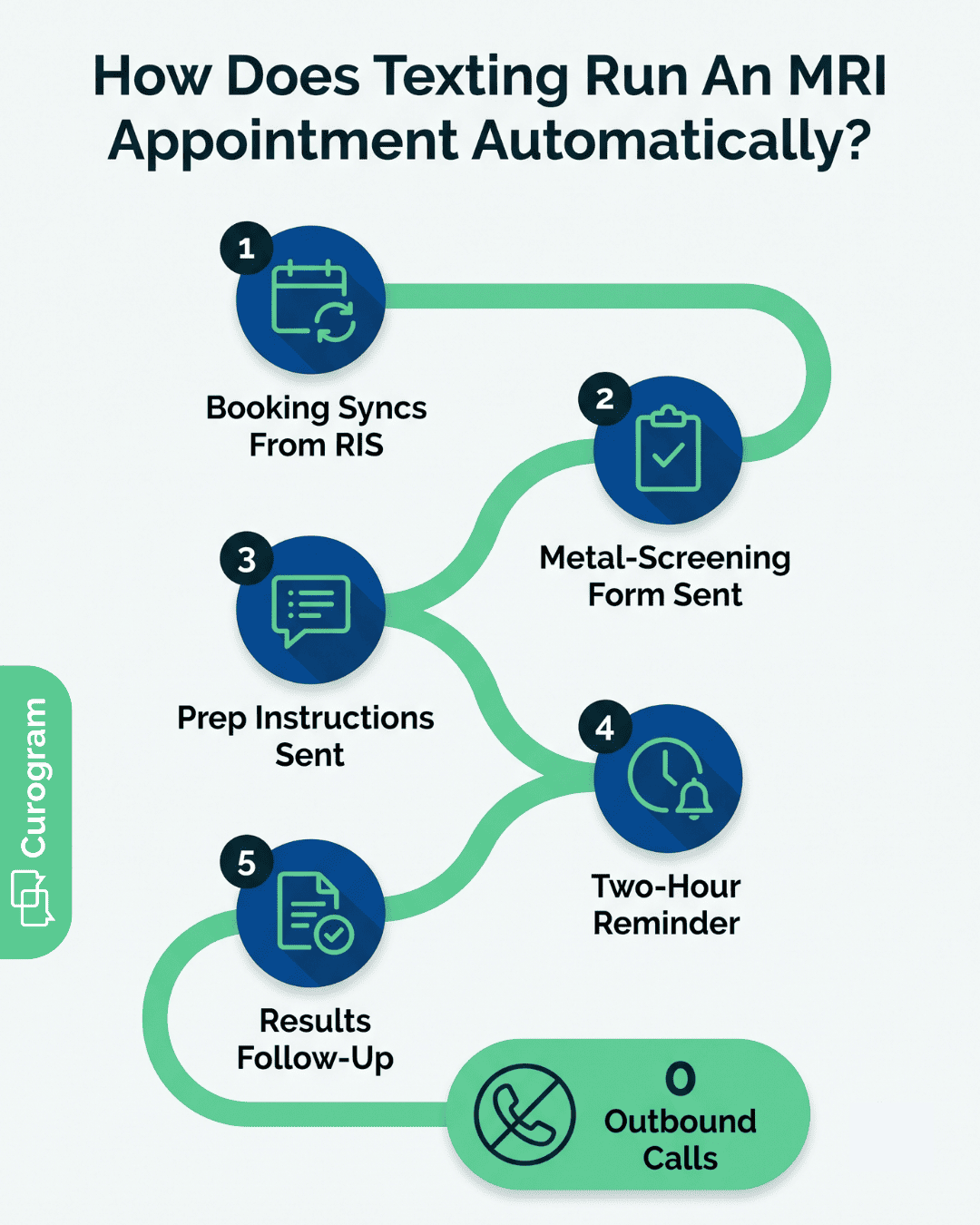
Walk a brain MRI with contrast through the system:
That's five touchpoints, zero outbound calls, and a complete audit trail.
|
Feature |
What it does for imaging |
|
Two-way and mass texting |
Recalls, prep, and reminders to one patient or a full waitlist |
|
Templated prep by modality |
Right instructions for CT, MRI, ultrasound, or X-ray, sent automatically |
|
Online scheduling and e-forms |
Intake and MRI safety questionnaires completed before arrival |
|
Secure image and file exchange |
Send and receive documents inside secure messaging |
|
Consent and opt-out (TCPA) |
Documented opt-in and a one-word opt-out on every thread |
Encryption is the part everyone names first, but it's one control among several. HIPAA texting for radiology practices has to cover who can see a message, where it's stored, and whether there's a record of every send.
Curogram encrypts messages in transit and at rest. It also logs each send, ties access to named staff logins, and keeps protected health information inside the platform instead of on a personal device. Those pieces together are what make a text defensible in an audit, not encryption on its own.
A Business Associate Agreement (BAA) is the contract that lets a vendor handle PHI on your behalf. Curogram signs one before any patient data moves through the system, which puts the platform under the same safeguards you follow.
The common workaround, a staff member texting prep from a personal phone, has no BAA behind it and no way to prove what was sent. With a governed platform, every message with protected health information lives in one place your compliance officer can review.
When a patient asks who saw their imaging details, you need an answer. Audit logs record each message, the sender, and the timestamp, so there's a trail for every prep instruction and results note.
Access ties to individual logins rather than a shared inbox, so a new front-desk hire and a lead tech don't share one anonymous account. Role-based access keeps staff to the threads their job needs. When someone leaves, you revoke one login instead of chasing a personal number.
HIPAA isn't the only rule in play. The TCPA governs how you text patients at all, and it turns on consent.
Curogram captures a documented opt-in, so there's proof a patient agreed to messages. A one-word reply like STOP opts them out and halts future texts on that thread. For a radiology practice sending prep and recall at volume, that documented consent is what keeps mass texting inside the lines.

Compare the two misses. A skipped 15-minute office visit loses a slice of provider time. A skipped MRI loses 45 minutes of staffed scanner time, on a machine that costs six figures to keep running. The tech is still paid, and for contrast work, so is the nurse.
As an illustrative example, if that slot bills at $1,000 and you run 12 MRIs a day, a 10% no-show rate is more than one lost scan daily. Over a month, that's real revenue walking out on equipment you already bought.
An office slot can fill from the waiting room. An imaging slot usually can't. The next patient on the list needs an order, insurance authorization, prep time, and often a ride. So a 9 a.m. MRI that cancels at 8:45 tends to stay empty.
Contrast and sedation studies add prep windows that make same-day swaps even harder. This is why prevention beats scramble. A reminder that lands the day before, with one-tap reschedule, catches the cancellation while there's still time to fill it.
There's a real gap between a patient who vanishes and one who moves to Thursday. Curogram's reminder gives patients a one-tap path to reschedule instead of going silent.
When a slot does open, mass texting reaches your waitlist in a single send. The 2:00 that freed up at noon can be offered to twenty overdue patients at once, often filling before the end of the day.
Based on our internal data, Curogram clients keep no-show rates 53% lower than the industry average. Each recovered appointment adds straight to revenue, and practices see a 10 to 20% revenue lift as empty slots get filled.
Atlas Medical Center cut its no-show rate from 14.20% to 4.91% in three months, roughly three times better than the industry average. For imaging, where one slot carries the cost of the whole machine, that recovery lands harder than it would in a primary-care clinic.

A quick read to compare HIPAA texting platforms for practices, and where a radiology practice feels the gap.
TigerConnect built its name on secure messaging between clinicians. It's a staff-facing app for care teams inside the hospital. That's a different job than reaching the patient who needs NPO instructions tonight.
Curogram is patient-facing and app-free, so the person getting the CT doesn't download anything to confirm, ask a question, or fill out a screening form.
Spruce handles general practice texting well. But radiology runs on prep by exam type and tight RIS sync. Curogram automates prep by exam type and syncs appointments from your record system, so reminders fire off real scheduling data. See the full breakdown on Curogram vs Spruce.
Emitrr and Curogram overlap on two-way texting. The depth gap shows up in imaging. You get automated prep by exam type, mass recall for overdue studies, and MRI safety e-forms in one platform, not three tools pieced together.
Radiology runs on scanner time, and scanner time is the one thing a phone-based schedule can't protect. Prep gets lost in voicemail.
A confirmation call goes unanswered, so nobody knows if the 2:00 MRI is real. By the time the front desk catches the gap, the slot is gone and the waitlist has moved on.
Texting fixes the part of the problem you can actually control: reach. Patients open a text and answer it, so prep lands, confirmations come back, and a cancellation turns into a rebooking while there's still time to fill it.
Based on our internal data, that reach is why Curogram clients hold confirmation rates above 75%. Their no-show rates run 53% below the industry average.
For imaging, where one empty slot carries the cost of the whole machine, that recovery is worth more than it would be in a primary-care clinic.
The safeguards matter as much as the reach. A signed BAA, encryption, audit logs, and documented consent do the rest. They let your team text prep and results without moving protected health information onto a personal phone.
For small medical practices running imaging, that mix keeps the schedule full and the compliance officer calm.
See it against your own exam types and prep rules, not a generic demo script. Book a demo. We'll walk your RIS sync, prep templates, and reminder timing on a live schedule, so you watch a real MRI booking move start to finish before you decide.
1 min read
Jo Galvez : 7/21/26, 4:00 PM
💡 HIPAA-compliant texting for physician groups is secure, two-way patient messaging that meets HIPAA rules while syncing with your EHR. Curogram...
1 min read
💡 Radiology scheduling software books, confirms, and manages imaging visits for CT, MRI, X-ray, ultrasound, and nuclear medicine. It swaps phone...
-featured.png)
1 min read
.jpg?width=30&name=square-formal-photo%20(1).jpg) Mira Gwehn Revilla : 7/31/26, 5:00 PM
Mira Gwehn Revilla : 7/31/26, 5:00 PM
💡 The best patient texting platforms for radiology imaging centers in 2026 are Curogram, Dialog Health, and Luma Health, with DoctorConnect and...