

Professional Text Communication in Healthcare: A Complete Guide
💡 Professional text communication in healthcare refers to the use of secure, HIPAA-compliant patient texting to manage appointments, share...

A patient texts your front desk number to ask if she should stop her blood thinner before an imaging scan. The reply she needs carries her name, her medication, and her appointment. Sent over plain SMS from a personal phone, that message sits unencrypted on two carriers and two devices, with no log and no agreement behind it. The clinic just moved protected health information across a channel HIPAA never cleared.
That gap is why HIPAA-compliant two-way texting exists. It gives patients the reply-from-your-phone experience they already expect, while keeping the practice inside the privacy and security rules that govern protected health information.
The confusion is common. Many practice managers assume any texting tool marketed to clinics is compliant, or that a privacy notice on the website covers them. Neither is true. Compliance is a set of specific controls, and a tool either has them or it doesn't.
We work alongside front desks and billing queues every day, and the same pattern repeats. Staff want to text because patients answer texts, but nobody can say what makes one texting tool safe and another a liability. This article settles that question for the people who have to choose the tool.
We'll define what compliant two-way texting actually requires, separate one-way reminders from real back-and-forth messaging, and lay out what small and specialty practices should check before signing anything. By the end, you'll be able to read a vendor's security page and know within a minute whether it clears the bar.
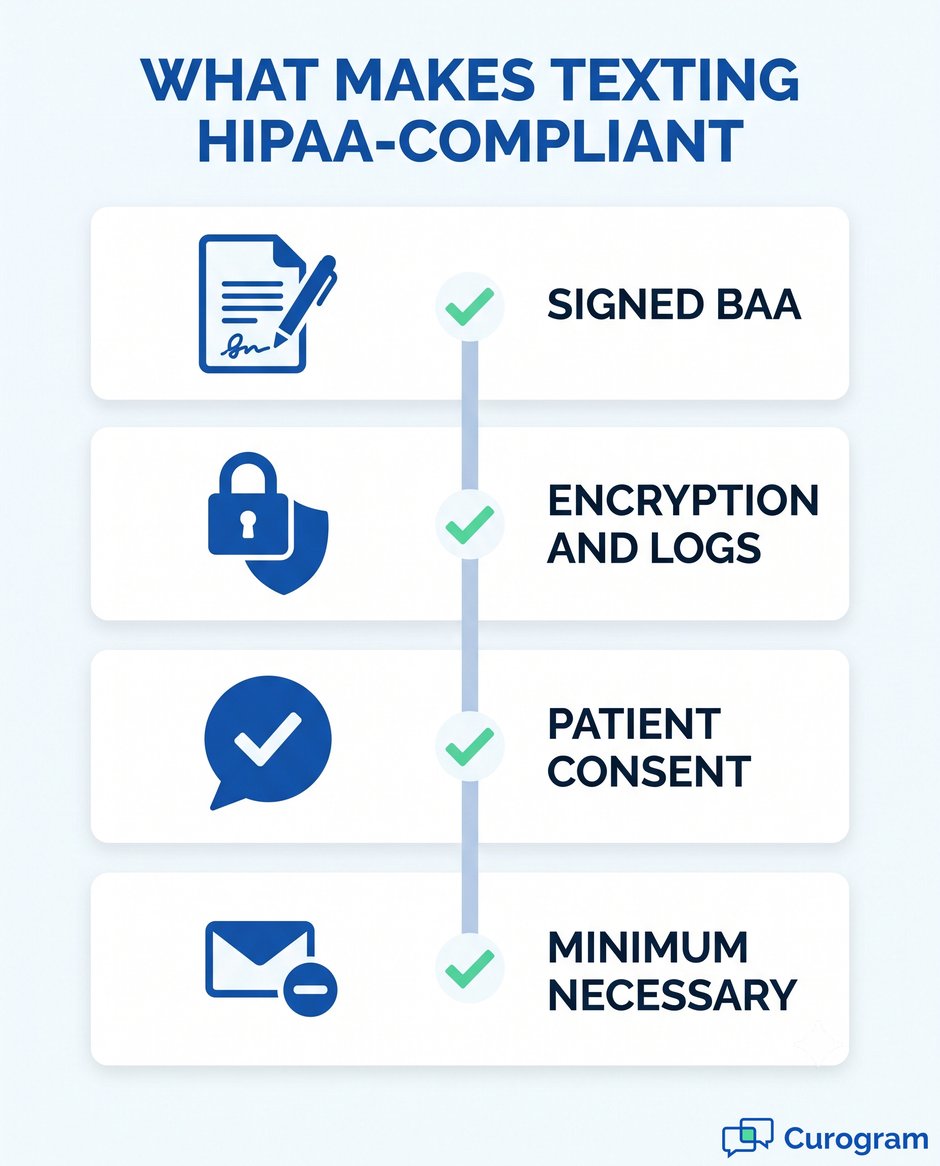
Four things turn ordinary messaging into secure messaging a practice can defend. Miss any one and the tool is not compliant, whatever the marketing says.
A BAA is a signed contract between your practice and the texting vendor. It names the vendor a business associate under HIPAA and spells out how they store, protect, and handle patient data on your behalf. Without it, any protected health information the tool touches is unprotected in the eyes of the law. If a vendor won't sign one, the conversation ends there.
A real BAA states where data lives, how breaches get reported and inside what window, and what happens to your data when you leave. Ask to see it before a demo, not after. A vendor that treats the BAA as an afterthought is telling you how they treat compliance.
Messages must be encrypted both while stored and while moving between phone and server, so an intercepted text stays unreadable. Access controls limit who on staff can open a thread, usually by role, so the billing clerk and the physician don't share one view. Every open, send, and edit gets written to an audit log with a name and a timestamp.
A SOC 2 Type 2 report is an outside auditor's confirmation that those controls held up over months, not just on the day of the check. HIPAA doesn't require it, but it's the closest thing to proof you'll get short of an audit of your own. Ask the vendor for the report and check its date.
HIPAA governs the health data. The Telephone Consumer Protection Act governs whether you're allowed to text the patient at all. You need documented consent before the first message and a working way for patients to opt out. A compliant platform captures that consent and records the opt-out, so you're covered on both laws at once.
Send only what the moment requires. A reminder can name the date and the clinic without listing the procedure. HIPAA's minimum-necessary principle means a text should carry the least data that still does its job. Good tools make that the default by keeping clinical detail out of the message body.
Standard SMS has no BAA behind it, no encryption you control, and no audit trail. Consumer chat apps tell the same story dressed up nicer. They were built for personal use, and they skip every control HIPAA asks for. Convenience is not compliance.
A single misdirected text with a diagnosis in it can trigger a reportable breach. Enforcement isn't theoretical, and a practice that texted PHI over a personal phone has no BAA to point to when regulators ask. The tool that felt free carries the real bill.

Both send a text. Only one lets the patient answer, and that difference decides how much the tool actually does for a busy front desk.
|
Factor |
One-way |
Two-way |
|---|---|---|
|
Direction |
Practice to patient only |
Patient can reply |
|
Best for |
Reminders, alerts |
Questions, rescheduling, intake |
|
Reply handling |
Ignored or bounced |
Lands in a staff inbox |
|
Effect on phone volume |
Little change |
Fewer inbound calls |
One-way messaging pushes information out: an appointment reminder, a prep instruction, a closure notice. It's simple, and it works for broadcasts. Patients get the text and act on it, and the practice never has to watch for a reply.
The moment a patient wants to confirm, reschedule, or ask a question, one-way sends them back to the phone. Staff still fields the call. You've automated the easy half and left the half that eats time untouched. For anything past a notice, the ceiling is low.
When patients can answer a text, they answer. A confirmation prompt that they can respond to with one word gets a response that a voicemail never would. Across our clients, automated reminders and two-way texting help hold appointment confirmation rates above 75%, based on our internal data. Replies are the reason.
Every reschedule that happens by text is a call that never rings the front desk. One clinic cut no-shows from 14.20% to 4.91% in three months using automated reminders and confirmations, based on our internal data. Recovered slots turn into booked visits instead of dead air.
The strongest two-way tools need nothing from the patient. They reply from the same messaging app they already use, with no account to create and no app to install. That matters most for older patients and anyone who won't set up one more login for one more clinic.
Every download request loses people. A patient who has to install and register before answering a simple prep question often just doesn't. Dropping that step is why app-free texting sees replies the app-gated tools miss. The channel only works if patients actually use it.
A tool that fits a hospital can bury a five-person clinic in setup. Small and specialty practices have their own checklist, and radiology adds a few items all its own.
Small practices don't have an IT team to run a three-month rollout. Ask how long until the first patient text goes out, measured in days. A tool that needs heavy configuration before it does anything is the wrong fit for a lean front desk.
When the texting tool syncs with your EHR, reminders fire off the real schedule, and replies attach to the right chart. No one retypes phone numbers or copies confirmations by hand. Curogram connects with systems used across radiology and specialty care, so the schedule drives the texts on its own.
You shouldn't track texting consent in a side spreadsheet. The platform should capture it at intake, store it with the patient record, and honor an opt-out the second it arrives. That keeps the TCPA side clean without adding a task to anyone's day.
A new radiology patient books online and checks the consent box on intake, and the platform logs that consent against her record. Two days before her scan, she gets a prep text, replies with a question about contrast dye, and a technologist answers in the same thread. If she ever texts STOP, the system halts messages and records the opt-out. One auditable trail runs from consent to opt-out, no spreadsheet and no missed step.
Imaging depends on prep. Fasting before a scan, drinking contrast, and holding a medication: a patient who misses the instruction wastes a slot and a machine. A texted prep reminder the patient can reply to for clarification beats a voicemail nobody hears. Radiology practice communication lives or dies on whether that instruction lands.
Scans often come in a series or need a follow-up read. Two-way texting lets a practice confirm the next imaging appointment and answer the one question standing between the patient and showing up. For a modality-heavy schedule, that back-and-forth is the difference between a full day and gaps.
Curogram's two-way texting gives patients a plain reply-from-your-phone experience and gives the practice the controls HIPAA asks for. There's no app for the patient to download and no login to create. They text the way they already text, and staff work every thread from one secure inbox.
Behind that simple experience sit the four criteria from earlier. Curogram signs a BAA, encrypts messages, limits access by staff role, and logs activity for audit. Consent is captured at intake and opt-outs are honored automatically, so the TCPA side stays clean without extra work.
Because the platform connects with the EHR and practice-management systems small and specialty clinics run, reminders fire off the live schedule and replies attach to the right record. The results show up where it counts. One clinic cut no-shows from 14.20% to 4.91% in three months, and clients hold appointment confirmation rates above 75%, based on our internal data.
If you're weighing options, compare the leading HIPAA-compliant texting platforms before you commit to one.
For more background, read why clinics struggle with patient communication and see our roundup of texting tools built for small practices.

Compliant two-way texting comes down to four checks: a signed BAA, real encryption and access controls with audit logs, documented patient consent, and the discipline to send only what a message needs. A tool that clears all four lets patients reply from their own phones while the practice stays defensible. One that skips any of them is a plain SMS liability wearing a healthcare label.
The mistake we see most often is treating compliance as a badge on a website rather than a set of controls you can inspect. Ask a vendor where messages are stored, who can read them, and how a STOP reply gets logged. A confident answer to those three questions tells you more than any marketing page. A vague one tells you plenty too.
For a small or specialty practice, the payoff is concrete. Fewer inbound calls, prep instructions that actually get read, and no-show numbers that move. The channel patients already prefer becomes one the practice can trust.
Radiology groups feel the difference fastest. A single missed fasting instruction empties a scanner slot that costs real money to leave dark, and a patient who can text a question back gets the answer before the scan is at risk.
The same holds for behavioral health, primary care, and any specialty where a reminder alone leaves the front desk fielding callbacks. The tool that gets used is the one patients answer without a login and staff run without retyping a schedule.
So the choice is less about features and more about fit. Pick the platform that syncs with the EHR you already run, captures consent without a side spreadsheet, and gives you an audit trail you could hand an auditor tomorrow. That combination is what turns a convenient text into a defensible one.
See it against your own workflow. Book a Curogram demo and watch how consented, two-way texting fits your schedule, your EHR, and your front desk.
Frequently Asked Questions
Ask for two documents before a demo: a signed BAA and a current SOC 2 Type 2 report. If the vendor hesitates on either or can't say where data is stored, treat that as a no.
Reminders only push out a date. Two-way texting lets patients confirm or reschedule with a single reply, so slots get resolved by text instead of ringing the front desk or going silent until the day of.
You capture documented consent before the first text, usually at intake, and give patients a working opt-out. A compliant platform stores that consent with the record and honors a STOP reply automatically to satisfy TCPA.
It has no BAA, no encryption you control, and no audit log. A single text carrying a diagnosis to the wrong number can become a reportable breach, with nothing on file to show regulators you protected the data.
Send the prep instruction as a text that the patient can reply to, so questions about fasting or contrast get answered in the same thread. That cuts missed prep, which otherwise wastes both a slot and a machine.
💡 Professional text communication in healthcare refers to the use of secure, HIPAA-compliant patient texting to manage appointments, share...
💡 HIPAA-compliant texting means using a secure platform to send patient health information by text while meeting HIPAA's Privacy and Security...
💡 HIPAA compliant messaging refers to any digital message system that meets federal rules for protecting patient health data. To be compliant, a...