

Spruce Health Alternatives for Medical Practices (2026)
💡 The top Spruce Health alternatives in 2026 are Curogram, OhMD, Klara, Weave, and TigerConnect. Curogram connects with more than 20 EMR and...
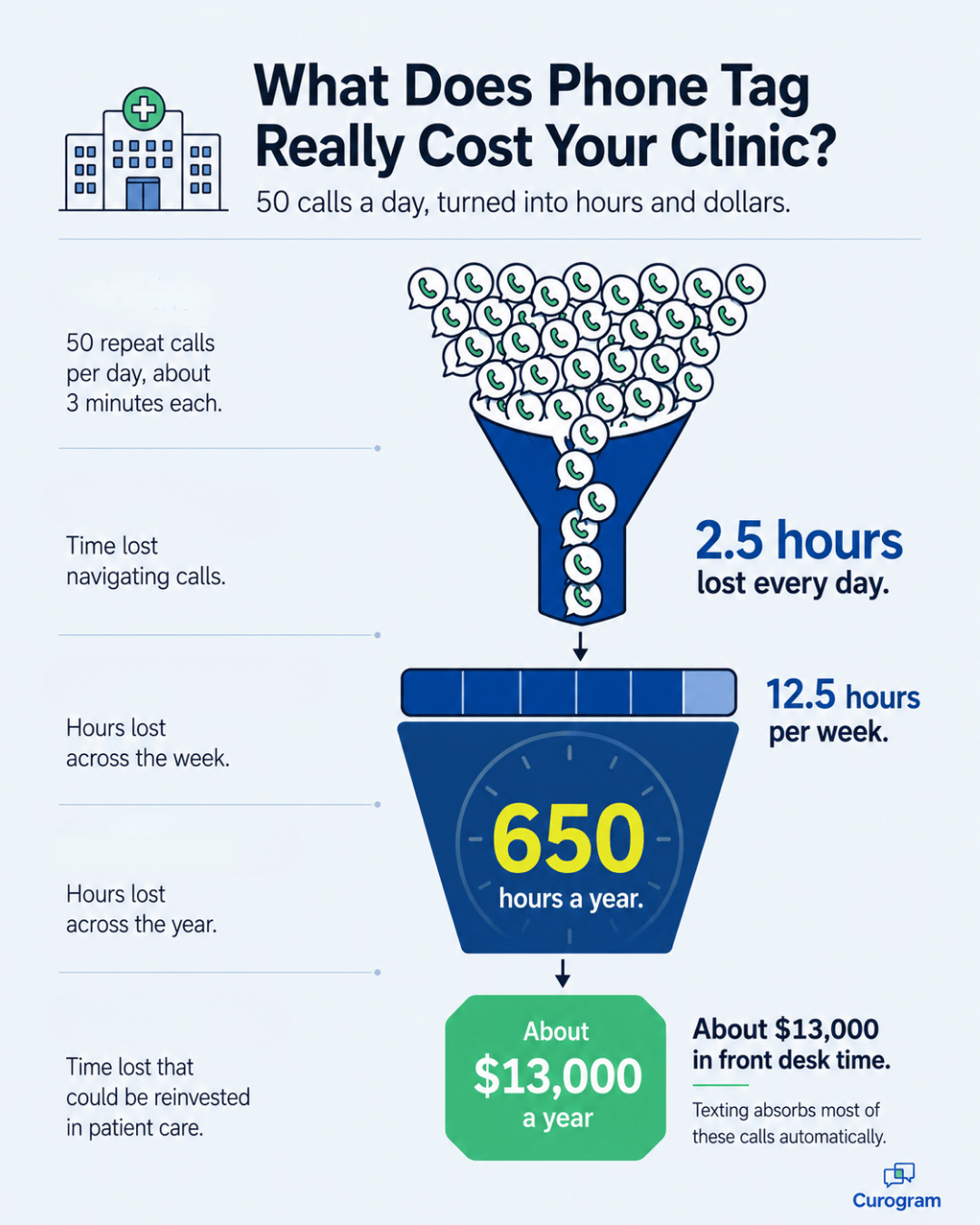
Your front desk answers the same handful of calls fifty times a day. "Can I confirm my appointment?" "What time was that again?" "Do I need to bring anything?"
Each call sounds small, but stacked together they quietly consume hours your team will never recover.
Meanwhile, the patients who never call are often the same ones who never show. A missed reminder becomes an empty chair, and an empty chair becomes revenue you had already counted on.
Texting solves most of this, because patients read a message within minutes and reply without ever picking up the phone.
No wonder so many practices are hunting for the right HIPAA texting platforms for clinics, and studying our master guide to the best HIPAA texting platforms to sort through a crowded field.
But here is the catch that trips people up. Almost any tool can send a text, yet far fewer can do it securely, synchronize with your chart, and let patients reply in plain SMS without downloading anything.
That gap is where clinics get stuck. They buy a texting tool, then discover it lives in its own isolated tab, disconnected from the chart. Staff copy and paste between systems, errors creep in, and the promised time savings quietly evaporate.
This guide cuts straight through the marketing noise. We compare the platforms clinics genuinely use, judged on what actually matters: security, EHR integration, patient experience, and transparent pricing.
We ranked six options and named a clear winner. You will see which one fits a solo office, which suits a busy physician group, and which to skip entirely.
The short version? Curogram takes the top spot for most clinics, blending real security with native integration and texting that patients never have to install.
Now let's look at how we scored and ranked each contender.
Every vendor claims to be HIPAA-compliant. That word alone tells you almost nothing.
So we scored each platform on six things that change how it feels day to day. Here is what we looked for.
One more thing shaped every score. We favored tools that cut work instead of adding a new tab your staff has to babysit. A platform that saves ten minutes but creates twenty is not a win.
Want the fast version?
This table lines up all six on the criteria clinics ask about most.
| Platform | HIPAA / SOC 2 | EHR integration | App-free patient texting | Best for |
|---|---|---|---|---|
| Curogram | Yes / Yes | Native, two-way | Yes | Clinics and physician groups overall |
| Klara | Yes | Select EHRs | Yes, web-based | Patient collaboration |
| Spruce | Yes / Yes | Limited, varies by system | App-leaning | Solo and small clinics |
| Solutionreach | Yes | 400+ PM/EHR systems | Text via office number | Patient engagement suites |
| Updox | Yes | Many EHRs via API | Web-based | All-in-one inbox and fax |
| TigerConnect | Yes | Clinical, EHR and nurse call | Staff app | Hospital and clinical teams |
A pattern jumps out fast. Most tools clear the HIPAA bar. The real gaps show up in EHR integration and whether patients need an app. That is where Curogram pulls ahead, and where the rest split into clear lanes.
Curogram earns the top spot for one reason. It does the whole job in one place, without asking patients to download anything.
A patient gets a text from your clinic and replies like they would to a friend. No app, no portal login, no lost password. On your side, that conversation ties straight to the chart through native, two-way EHR integration.
From that same inbox, your team can handle nearly every patient touchpoint without opening another program:
In practice, that means one login replaces a whole stack of separate patient communication tools.
That consolidation is the point. Curogram is built for outpatient clinics and busy physician groups, where high call volume and no-shows quietly drain the schedule.
On compliance, it checks every box:
HIPAA-compliant, SOC 2 Type 2, a BAA included, and TCPA consent management baked in.
The honest trade-off? Curogram does a lot. A solo provider who only wants basic reminders may not touch every feature on day one.
The upside is room to grow without switching tools later.
The results back it up:
Those figures come from Curogram client data. For most clinics weighing HIPAA texting platforms for clinics, that mix of reach and results is hard to match.

The other five are all solid tools. They just fit different needs, and each has a catch worth knowing before you sign.
Klara is a strong, well-liked platform, and it earns its reputation. It connects to leading EHRs like athenahealth and DrChrono, and patients can reply without an app through a password-free web link.
Where it shines is collaboration. Shared inboxes, message routing, and team tools keep everyone on the same thread. For practices that live in patient messaging all day, that focus feels great.
The catch shows up in reviews. Some clinics report that EHR integration takes work to set up and runs unevenly by system. Support response times come up too.
Klara covers texting well, but it is narrower than an all-in-one platform. See our full Curogram vs Klara comparison for a side-by-side.
Spruce is a favorite among solo providers and small clinics, and for good reason.
It bundles a modern phone system, VoIP lines, phone trees, secure messaging, fax, and video into one HIPAA-compliant, SOC 2, HITRUST-certified package.
If your main pain is a clunky phone tree, Spruce is a clean fix. It swaps out old office phone gear and gives your team one inbox for calls and texts.
The trade-off is the patient side. Spruce leans on its own app for richer messaging, though plain SMS is available too. Its EHR integration also runs lighter than native chart sync, and depth varies by system.
For a small practice that wants phones and texting together, it is a solid pick. Read the Curogram vs Spruce comparison to see the gap.
Solutionreach has been in this game a long time. It connects to 400+ practice management and EHR systems and covers reminders, recalls, surveys, reviews, and two-way texting from one suite.
That breadth is the draw. Larger groups that want reminders, reputation, and self-scheduling under one contract often land here.
The downsides are familiar. Some clinics report sync glitches with certain systems and slow support, and pricing tends to start on the higher side. Texting is one module among many, not the core.
If you want a full engagement suite over a texting-first tool, it is worth a look. Compare it directly in our Curogram vs Solutionreach breakdown.
Updox, now part of CompuGroup Medical, is built around a single inbox that ties together secure text, e-fax, telehealth, forms, and reminders. For paper-heavy offices still drowning in faxes, that combo is a relief.
It links to many EHRs through its API, and patients can join a video visit or fill a form with no app to download.
Where it lags is texting depth. Updox treats messaging as one tool in a productivity suite, so two-way patient conversations feel lighter than on a texting-first platform. Fax and documents are the real center of gravity.
For a practice that wants faxing and messaging in one hub, Updox fits. See the Curogram vs Updox comparison for the details.
TigerConnect plays a different game. It is built for large hospitals and health systems that need secure staff messaging across departments, with voice, video, role-based routing, and nurse-call and EHR ties.
For care teams coordinating inside a hospital, it is powerful. Alerts reach the right on-call provider, and alarm management cuts through the noise.
But it is staff-facing by design. TigerConnect centers on clinician-to-clinician communication, not app-free patient texting. A small clinic that mainly wants to reach patients will find it heavier than it needs.
If you run a multi-site hospital network, it belongs on your list. For most outpatient clinics, it is more than the job requires.

The best platform depends on your size, your EHR, and how patients reach you today.
Start with your profile.
Then run every option through the same short checklist:
If a platform stumbles on any of these, keep it on the shortlist but weigh the gap honestly. The right secure messaging for clinics should erase steps, not add them.
Still deciding? Our guide on what HIPAA-compliant two-way texting really means breaks the basics down.
Strip away the feature lists and the choice gets simple. Clinics stay with Curogram because it removes phone calls instead of adding another screen.
Three things keep clinics from switching away:
Put together, those three erase steps instead of adding them, which is exactly what a busy front desk needs.
The result is fewer calls and more hours back. One clinic shows the pattern clearly.
River Valley Family Health Center cut phone call volume by 24% and now runs well below the industry-average no-show rate after moving to Curogram. — Curogram client data
That story repeats across Curogram clinics. Less phone tag. Fewer empty chairs. A front desk that spends its day on patients, not voicemail.
For clinics comparing HIPAA texting platforms for clinics, that blend of app-free reach, native integration, and one shared workflow is what tips the decision.
The gap between a calm clinic and a swamped one usually comes down to communication. Phones ring nonstop. Reminders slip through the cracks. Schedules develop holes that nobody meant to leave open.
The right texting platform closes that gap. It converts fifty repetitive daily calls into quick texts that patients actually read, fills empty slots before they cost you money, and returns the hours your front desk currently surrenders to voicemail.
Every platform in this guide can help, though each leans in a different direction. Klara shines for collaboration, while Spruce is a clean phone-and-text combination for smaller offices. Solutionreach and Updox pack broad engagement suites, and TigerConnect powers large hospital teams.
But for most clinics and physician groups, one option quietly handles the entire job without ever making patients download a thing.
Curogram pairs app-free two-way texting with native, bidirectional EHR integration, then layers on scheduling, forms, telehealth, and text-to-pay inside a single inbox.
That is precisely why it tops our list. It is not the flashiest tool. It is the one that eliminates the most work while keeping every message secure and compliant.
You don't have to take our word for it. Curogram clinics report a 98% text open rate, sharp reductions in no-shows, and measurable cuts in call volume. Those are not vanity numbers, because they translate directly into fuller schedules and calmer front desks.
If your team is worn down by phone tag and empty chairs, the next step is simple. See how Curogram fits your EHR and your daily workflow before you commit to anything at all.
Book a demo and watch it work with your own systems, your own patients, and your own front desk. No pressure and no gimmicks, just a clear look at what fewer phone calls could do for your clinic.
True HIPAA compliance takes more than encryption. The vendor must sign a business associate agreement, encrypt messages in transit and at rest, keep audit logs, and control access by user. SOC 2 Type 2 adds an outside check that those safeguards actually work day to day.
Most connect to common EHRs, but the depth varies a lot. Some offer native, two-way sync that writes back to the chart. Others bolt on through third-party tools that only push data one way. Always confirm your exact system before you buy.
With the best options, yes. Curogram, Klara, and Updox let patients reply in plain SMS or a simple web link with no download. Spruce leans on its own app for richer features. App-free texting almost always drives higher response rates.
Two-way texting solutions power real back-and-forth chats, like a patient asking a question and your staff replying. Mass texting sends one message to many patients at once, ideal for recalls, closures, or flu-shot reminders. Strong platforms do both from the same inbox.
It depends on the platform and your EHR. Simpler tools launch in days, while deeper integrations may take a few weeks. Clinics without dedicated IT should ask about setup time and training up front, since a smooth onboarding saves real money later.
💡 The top Spruce Health alternatives in 2026 are Curogram, OhMD, Klara, Weave, and TigerConnect. Curogram connects with more than 20 EMR and...
💡 Curogram uses a bi-directional API to write intake, confirmations, and insurance data directly into structured EHR fields. Spruce focuses on...
💡 The best secure texting platforms for small clinics in 2026 are Curogram, OhMD, Spruce Health, Klara, Weave, Falkon SMS, TigerConnect, and...