

12 min read

Best Texting Platforms for Behavioral Health Practices (2026)

Best Texting Platforms for Behavioral Health Practices (2026)
 💡 The best HIPAA-compliant texting platforms for behavioral health practices in 2026 are Curogram, OhMD, and Spruce Health, with Paubox strongest on encrypted email and TigerConnect at hospital scale.

Stigma makes a plain SMS more usable than a portal login, and substance use programs answer to 42 CFR Part 2, under active OCR enforcement since February 16, 2026.

Curogram ranks first for practices wanting reminders, two-way texting, intake forms, text-to-pay, and review requests alongside any behavioral health EHR.

Client confirmation rates average above 75%, with no-show rates 53% below the industry average. Solo therapists working alone should price Spruce Health first.

Behavioral health has the worst attendance problem in outpatient medicine. A VA pragmatic trial covering more than 38,000 appointments found missed-visit rates of 18.0% to 21.9% in mental health clinics. Primary care clinics in the same trial ran 10.5% to 12.1%. Substance use programs sit higher still.

Portal reminders are the standard answer. They also assume a client will log in, and national data says most will not do it often. ASTP/ONC reported that 34% of adults were frequent portal users in 2024, meaning six or more logins across the whole year.

Front-desk math makes the gap concrete. At $150 a session and 40 booked slots a week, a 20% no-show rate costs roughly $1,200 weekly per clinician. That figure is illustrative, so run it on your own rate and schedule.

So the criteria change. Picking a texting vendor for a psychiatry group or an opioid treatment program runs on consent language, message-body discipline, and thread-level access controls, not on feature counts.

42 CFR Part 2 is the criterion most roundups leave out, and it now carries real enforcement risk. Stigma changes the job too, because a message that names a program can out someone on a shared phone screen.

We ranked nine platforms against nine criteria. Curogram comes first, and we build Curogram, so check our entry against the named case studies we cite.

Where someone else is stronger, we say it: Paubox on encrypted email, TigerConnect at hospital scale, Spruce Health on solo pricing.

One assumption holds throughout. Keep your EHR. A texting layer belongs next to Osmind, Valant, TherapyNotes, or Netsmart, never in place of them.

Why Behavioral Health Texting is Different

Three things separate this category from general medical texting: visit cadence, stigma, and a federal confidentiality rule that most vendor pages never mention.

The Engagement Gap is Widest Where Care is Most Fragile

Weekly cadence is what makes behavioral health different operationally. A client in weekly therapy has 52 chances a year to fall out of care. A dermatology patient has one or two.

First visits are the most fragile point of all.  Research on that population also links missed initial psychiatric appointments to more frequent hospitalizations and emergency department visits.

Reminder timing carries more weight here than in general medicine. Depression drains follow-through, and executive-function difficulty makes a three-week-old calendar entry nearly invisible.

A confirmation request sent 48 hours out leaves enough room to refill the slot from a waitlist, which a same-morning reminder cannot do.

Discretion Works as an Access Feature

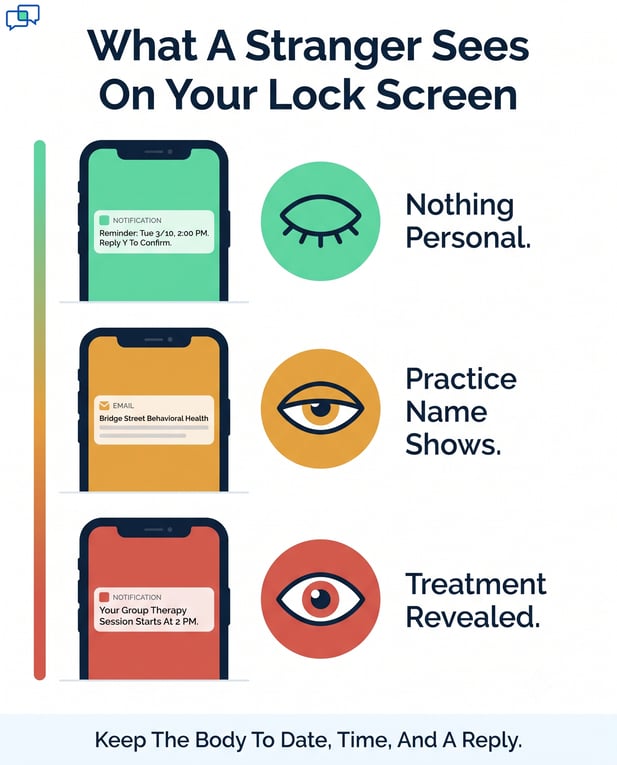
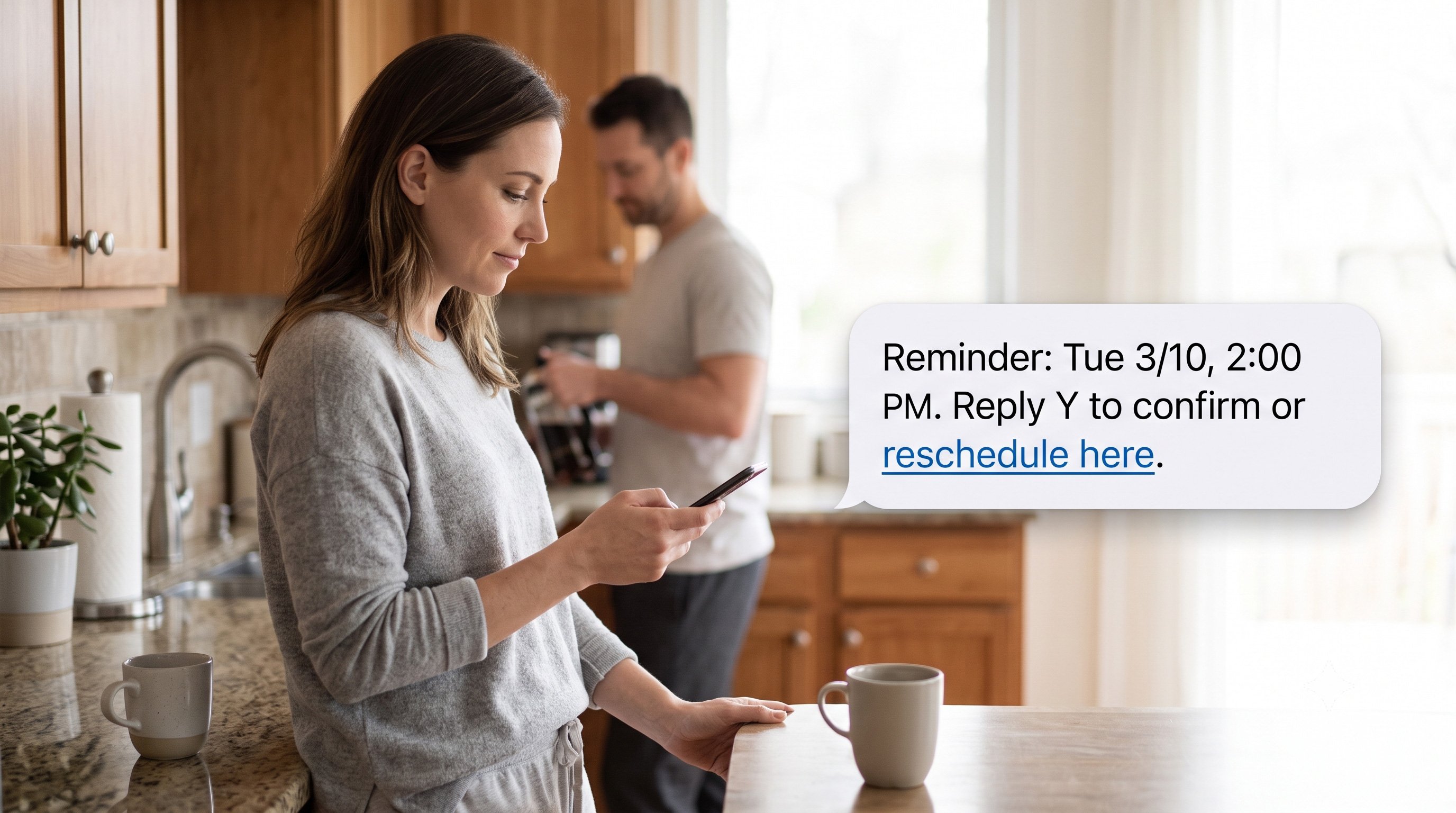
Consider what shows on a lock screen. A text reading "Reminder: Tue 3/10, 2:00 PM. Reply Y to confirm, C to cancel" looks like every other text.

A portal notification email puts the practice name in the sender field, where a partner or a parent can read it.

Plenty of clients share phones or family plans. For an opioid treatment program, a program name in the sender line can end treatment.

We write reminder bodies with no clinician name, no program name that signals service type, and no diagnosis.

Practices push back that this strips useful context. It does. Context belongs in the secure thread a client opens after replying, not in the notification itself.

42 CFR Part 2 Sets the Rules for SUD Program Messaging

HHS finalized changes to 42 CFR Part 2 in February 2024, aligning it more closely with HIPAA while keeping stronger protection for substance use records.

Compliance was required by February 16, 2026. OCR announced a civil enforcement program on February 13, 2026 and began accepting complaints three days later.

Three parts of the rule touch texting directly.

• A single consent can now cover treatment, payment, and health care operations, so the intake packet should name SMS as a channel instead of leaving consent implied.

• Notices of Privacy Practices had to be updated, and that requirement reaches HIPAA covered entities that merely receive Part 2 records, beyond SUD programs themselves.

• Restrictions on using records in legal proceedings still hold, which makes your vendor's message archive discoverable material you should be able to search and export.

Enrollment in a Part 2 program is itself protected information, so the message body cannot imply it. This only works if your consent form names texting. A general consent to contact does not cover it.

How We Ranked These Platforms

Nine criteria, weighted toward what a behavioral health front desk actually touches. We checked vendor documentation and public pricing pages in July 2026.

Reconfirm every capability below with the vendor before you sign, because plans and compliance postures move fast.

Criterion

What we checked

1. HIPAA compliance and BAA

Signed BAA at every plan tier, encryption in transit and at rest, audit logging

2. Part 2-aware workflow support

Locked logistics-only templates, thread-level access control, consent capture, retention and export

3. Two-way texting with no app

Clients reply from the native SMS app with no account or portal login

4. Reminders and confirmations

Scheduled sends, reply parsing, cancellation handling, reporting

5. Caseload and mass messaging

Closures, clinician departures, group session changes, recall lists

6. Workflow breadth

Intake forms, text-to-pay, review requests, telehealth links

7. EHR compatibility

Runs alongside any behavioral health EHR, not just a published partner list

8. Pricing model

Per user, per provider, or flat, and whether pricing is public

9. Verified outcomes

Named client results with real numbers, not vendor adjectives

Two Criteria Reshuffle a Behavioral Health Shortlist

Part 2-aware workflow support does most of the sorting. Almost nobody markets it, so ask directly.

Can we restrict who opens threads tied to the SUD program? Can we lock a reminder template so a staff member cannot paste a program name into it?

EHR compatibility does the rest. Behavioral health runs on a long tail of systems, and a partner list built for primary care rarely covers Welligent, Sigmund, or Notenetic. We scored higher for platforms that work alongside any system rather than a named set.

Pricing model matters more than headline price. Per-provider pricing punishes an agency with 60 clinicians. Flat and per-seat pricing usually land cheaper past roughly a dozen users.

What We Left Out of the Scoring

Integration counts, message volume caps, and software-directory star ratings stayed out. A 200-integration list means nothing if your EHR is not among them, and star ratings tend to reflect whoever ran the most recent review campaign.


Comparison showing increasing levels of medical privacy on phone lock screens

Quick Comparison Table

Nine platforms, five columns. Read the Part 2 controls column first if you run a SUD program. "Ask" means the vendor does not document it publicly, which is not the same as saying it is missing.

Platform

Best fit

Two-way SMS, no app

Part 2 controls

Published pricing

Curogram

Any BH practice keeping its EHR

Yes

Configurable

By quote

OhMD

Small groups, reminder-led volume

Yes

Ask

By quote

Spruce Health

Solo therapists, two-person practices

Partial

Ask

From $24/user

Paubox

Clinical email at volume

Secondary

Ask

Public tiers

TigerConnect

Hospital BH service lines

Yes

Ask

By quote

Klara

Private groups under ten providers

Yes

Ask

By quote

Emitrr

Price-sensitive small practices

Yes

Ask

Public tiers

iPlum

A clinician's second line

Yes

Ask

From $14.99/user

Falkon SMS

Texting an existing landline

Yes

Ask

From $14.99/user

1. Curogram

Curogram is a communications layer that sits on top of the system you already run. It sends automated reminders, handles two-way SMS from your practice number, collects intake forms, takes payment by text, and requests Google reviews. HIPAA and SOC 2 Type II both apply.

Verified results across the client base: confirmation rates average above 75%, and no-show rates run 53% below the industry average. Atlas Medical Center cut no-shows from 14.20% to 4.91% within three months.

Covina Arthritic Clinic averages more than 1,100 confirmed appointments a month. SMS recall brought 1,240 clients back at a 35% reconversion rate, and one multi-location practice collected 1,064 new five-star reviews in three months.

Those named clients sit outside behavioral health, and we would rather say that than let the numbers imply otherwise. The 53% no-show figure is measured across specialties, based on our internal data.

Two honest gaps. Data syncs one way, from your EHR into Curogram, so confirmation status does not post back automatically. Curogram sends text and email but not automated voice calls, so a practice that wants voice drops needs a second tool.

Verdict: The strongest full-suite option for a behavioral health practice that wants reminders, intake, payments, and reviews running alongside any EHR without switching systems.


2. OhMD

OhMD lets a practice text from the office number clients already have, with no app or account on the client side.

Reminders fire from EHR appointment data, and reply routing sends questions to the right staff member instead of a shared inbox.

Volume and reporting are where it thins out. Independent reviews describe a smaller integration set than enterprise platforms and limited analytics, and it suits appointment-driven messaging better than caseload campaigns. Best for a 3 to 15 clinician group whose scheduling already lives in a supported EHR.

Verdict: The simplest route to two-way texting when reminders and follow-ups make up most of your message volume.


3. Spruce Health

Spruce Health bundles a phone number, texting, phone trees, fax, video visits, and broadcast messaging into one app.

Pricing starts at $24 per user per month, with a Communicator tier at $49. A dedicated mental health product page and built-in clinical questionnaires show real attention to therapy workflows.

One limitation matters more here than in general medicine. Secure messaging requires the client to create a Spruce account, and clinicians report clients who text the number and never sign up.

That reintroduces the login step SMS was meant to remove. Published SOC 2 status is inconsistent across third-party writeups, so ask for the current report.

Verdict: Best value for a solo therapist or two-person practice that wants a professional line and video visits on one subscription.


4. Paubox

Paubox built its reputation on encrypted email that lands in the inbox without a recipient portal. It carries HITRUST certification, full audit trails, and role-based access.

On compliance content, it outranks most patient engagement vendors, including for therapy-practice searches.

Texting sits second to email in the product. Reminder automation, confirmation parsing, and caseload messaging are not the center of gravity. Best for a practice sending clinical correspondence, records requests, and coordination email at volume.

Verdict: A strong email compliance layer to pair with a texting platform, not a substitute for one.


5. TigerConnect

TigerConnect serves more than 7,000 healthcare organizations and 700,000 care team members. Role-based routing, HITRUST certification, message lifecycle controls, and a 99.995% uptime commitment come standard, and patients can message without downloading an app.

Cost and complexity are the barrier. Pricing is quote-only, implementation is a project, and users report that reducing licenses later proved harder than the sales conversation suggested.

Best for hospital-based behavioral health service lines and crisis teams that need on-call routing across departments.

Verdict: The right call at health system scale, and oversized for a 10-clinician outpatient group.


6. Klara

Klara centralizes client and team messaging with strong triage and routing, integrations into systems such as athenahealth and DrChrono, eForms, and appointment reminders.

Automation runs thin by comparison. Reviewers note that client questions land on staff rather than an automated first response, and per-provider pricing climbs as a group adds clinicians. Best for a private practice under roughly ten providers with front-desk capacity to answer threads manually.

Verdict: A clean choice for small groups that value routing over automation.


7. Emitrr

Emitrr combines texting, calling, reminders, and AI workflow automation with published pricing, aimed squarely at small businesses including healthcare practices.

Behavioral health specificity is where it stops. No public documentation addresses Part 2 handling or SUD thread controls, so that answer has to come from a sales call and belongs in writing. Best for a practice weighing automation depth against a transparent monthly price.

Verdict: Worth a shortlist slot on price and automation, with Part 2 questions asked up front.


8. iPlum

iPlum gives a clinician a second phone line with HIPAA compliance, a signed BAA, voicemail transcription, call recording with consent announcements, and ten-year archiving of texts and recordings.

Scope is the limit. This is a phone product, so there are no intake forms, no review automation, and no text-to-pay. Best for a therapist in private practice who wants a professional number kept separate from a personal one.

Verdict: A solid clinician phone line rather than a practice engagement platform.


9. Falkon SMS

Falkon SMS text-enables an existing landline, so clients keep the number they already recognize. Pricing starts near $14.99 per user per month, both HIPAA and SOC 2 apply, and multi-number management suits organizations running several sites.

Clinical workflow depth is lighter. Reminder automation leans on integrations rather than native scheduling logic. Best for an agency that wants texting live on its main line quickly, at a low per-seat cost.

Verdict: The cheapest credible way to start texting from the number clients already have.


Which Platform for Your EHR?

Every platform above claims EHR compatibility. What that means in practice varies by system, and behavioral health runs on a long tail that primary care partner lists ignore. Find the system you already use below.

Psychiatry and Outpatient Mental Health

Osmind serves psychiatry and interventional practices, where a texting layer adds reminder and recall automation on top of the clinical record. See texting alongside Osmind for the setup details.

TherapyNotes is common among solo and small group therapy practices, and client messaging with TherapyNotes covers where the native tools stop.

Valant leans on outcome measures and structured psychiatry workflows, and we walk through how Valant compares on client communication.

Opus EHR spans behavioral health and treatment centers, with reminder workflows for Opus EHR practices written for programs running both.

Agencies, CCBHCs, and Public Sector Programs

Larger agencies carry heavier documentation loads and thinner front-desk staffing. Start with front-desk messaging for Welligent teams, reminder setup on Sigmund, or messaging for InSync and Qualifacts users.

For enterprise human services deployments, read agency texting on Netsmart and what SmartCare implementations need. Smaller agency stacks are covered in configuring EHR Your Way and mobile documentation teams on Notenetic.

Addiction Treatment Programs

Part 2 obligations land hardest here, and the messaging build differs from an outpatient therapy practice. Our writeup on how Kipu compares for client outreach covers consent capture and thread permissions.

For the cross-specialty view, see our broader guide to HIPAA-compliant texting platforms.

What the Portal-Only Status Quo Costs a Behavioral Health Practice

Start with the phone. A mid-size behavioral health group fields call volume that swallows the front desk before lunch: intake questions, insurance checks, reschedules after a clinician calls out sick.

Based on our internal data, replacing routine calls with two-way SMS cuts call volume by as much as 50% and lifts staff productivity by more than 30%.

Friction then shows up as tasks that never happen. The review request does not go out on Tuesday because three clients need rescheduling and the phone will not stop.

Recall lists sit untouched for a month. Waitlist slots stay empty because refilling one takes four calls and two voicemails.

Revenue follows. Take a clinician billing $150 a session across 40 slots a week. A 20% no-show rate costs about $1,200 weekly, roughly $5,200 a month, and that is one clinician out of your roster. Those numbers are illustrative and shift with your rate, payer mix, and cancellation policy.

Clinical cost never appears on a P&L. Missed initial psychiatric appointments are associated with more frequent hospitalizations and emergency department visits.

A missed session in behavioral health is often a symptom of the condition being treated, which puts the reminder channel inside the care plan rather than beside it.

A woman checking a private, text-only appointment reminder on her phone

How to Choose

Three practice shapes, three different answers.

Solo Practices and Groups Under Five Clinicians

Budget decides most of this. Spruce Health at $24 per user, iPlum for a second line, or Falkon SMS on your existing number all clear the HIPAA bar.

Your EHR's native tools may be enough if all three of these hold. You send fewer than roughly 200 client messages a month, your clients already respond to portal notifications, and you do not run a Part 2 program. If any one fails, add a texting layer.

Groups of Five to Forty Clinicians

Automation earns its cost at this size. Look for reminder sequences with reply parsing, caseload messaging for closures and clinician departures, and intake forms that arrive by text before a first session.

Per-provider pricing starts to hurt around fifteen clinicians, so price flat and per-seat options against each other before shortlisting. Curogram, Klara, and OhMD are the realistic candidates.

CCBHCs, Agencies, and Public Sector Programs

Access controls and scale drive this decision. Ask every vendor how thread-level permissions work for SUD program caseloads, how the archive exports for a records request, and what happens to message history when a client moves between programs.

Enterprise routing from TigerConnect fits systems with crisis and on-call coverage. Agencies keeping their existing EHR usually land on a platform that runs alongside it instead of one with a fixed partner list.

Conclusion: Where This Leaves Your Shortlist

Behavioral health is the segment where texting stops being a convenience and works as an access channel. Clients who will not log into a portal will reply to a text in under a minute, and that reply is what lets the front desk refill the slot.

Rank your own shortlist on three questions:

  • Can clients reply from their native SMS app with no account?

  • Can you lock reminder templates so no program name ever reaches a lock screen?

  • Does it run alongside the EHR you already use?

We put Curogram first because it answers all three and carries the workflow breadth that keeps a small front desk off four separate tools.

Confirmation rates above 75% and no-show rates 53% below the industry average are the numbers we stand behind. Atlas Medical Center's drop from 14.20% to 4.91% happened inside three months.

One caution about vendor claims. Every platform on this list says it is HIPAA compliant, and a BAA is table stakes rather than a differentiator.

Ask instead which actions the platform blocks for a staff member without admin rights, then get that answer in the contract.

Part 2 enforcement went live in February 2026, which moves consent language and thread permissions from a nice-to-have into a documented requirement. Whatever you pick, have the answers in writing before signing.

Want to see how this runs against your EHR and your caseload? Book a demo with our team. We will walk through reminder templates, Part 2 consent handling, and what setup looks like on the system you already use.


Frequently Asked Questions

How do practices text therapy clients without violating HIPAA?

Sign a BAA with the platform, capture written consent that names SMS at intake, and keep message bodies to logistics only. Clinical detail belongs in the secure thread a client opens after replying.

What did the 42 CFR Part 2 final rule change for substance use programs that text?

Compliance was required by February 16, 2026, and OCR now accepts complaints. A single consent can cover treatment, payment, and operations, while Notices of Privacy Practices need updating to carry Part 2 language.

Why does Curogram rank first among HIPAA-compliant texting platforms for behavioral health practices?

It runs alongside any EHR and covers reminders, two-way texting, intake, payments, and reviews in one tool. Client results include confirmation rates above 75% and no-show rates 53% below the industry average.

How do you keep a reminder from revealing that someone is in mental health treatment?

Strip the clinician name, program name, and service type out of the body. Send date, time, a neutral practice reference, and a reply instruction, then move any detail into the secure thread.

How does a texting platform fit with an EHR like TherapyNotes, Netsmart, or Osmind?

It layers on top, pulling appointment data to trigger reminders while your clinical record stays where it is. Ask whether confirmation status writes back or reports separately, since many platforms sync one way.


Spruce Health Alternatives for Medical Practices (2026)

Spruce Health Alternatives for Medical Practices (2026)

💡 The top Spruce Health alternatives in 2026 are Curogram, OhMD, Klara, Weave, and TigerConnect. Curogram connects with more than 20 EMR and...

Read More
Best Secure Texting Platforms for Small Clinics (2026)

Best Secure Texting Platforms for Small Clinics (2026)

💡 The best secure texting platforms for small clinics in 2026 are Curogram, OhMD, Spruce Health, Klara, Weave, Falkon SMS, TigerConnect, and...

Read More
Best HIPAA Texting Tools for Small Practices (2026)

Best HIPAA Texting Tools for Small Practices (2026)

💡 The best HIPAA texting platforms for small practices in 2026 are Curogram, Spruce, Klara, Weave, TigerConnect, Emitrr, and Falkon SMS....

Read More