
7 min read

TherapyNotes Client Texting | Why Portals Fail in Behavioral Health

TherapyNotes Client Texting | Why Portals Fail in Behavioral Health
💡 TherapyNotes client communication texting behavioral health solves a real gap that hurts therapy, psychiatry, and counseling practices every day.

TherapyPortal asks clients to visit a website, recall a login, and find a message just to confirm a session. For clients managing anxiety, ADHD, or depression, that load is too heavy. They skip it.

Curogram closes the gap with secure SMS. Clients get a text, tap to confirm, and reply with ease. No app. No password. No portal.

Based on our internal data, practices using Curogram see no-show rates 53% lower than industry averages. When you meet clients on the channel they already use, they show up.

A client books a first therapy session and feels brave for doing it. The next day, they get an email saying a message waits inside TherapyPortal. They open the link, blank on the password, try a reset, and never finish.

That tiny stall is not laziness. It is cognition under pressure. For clients living with anxiety or ADHD, each extra step is a fresh decision.

Each decision is a chance to turn away. The session slot you saved sits empty the next morning.

This is the heart of TherapyNotes client communication texting behavioral health work. Your charting tool is built for clinical notes, not client outreach.

TherapyPortal exists, but most clients never open it. Front desk staff fill the gap with calls, voicemails, and personal cell phones.

The fix is simpler than it sounds. Clients already check their phones. They already read texts from friends, dentists, and pharmacies. A secure SMS layer over TherapyNotes meets them on familiar ground.

This piece walks through three things. First, why portals quietly fail in behavioral health and what that costs your practice.

Second, how secure 2-way texting plugs the gap without touching your TherapyNotes setup. Third, what changes when clients can confirm a session in five seconds.

The story is less about new tech and more about removing barriers that should not be there in the first place.

Your work removes barriers in the session. The space between sessions deserves the same care. 

The Villain: The Portal Paradox

TherapyPortal looks fine on paper. It offers secure messaging, intake forms, and a place to share documents.

The trouble starts the moment a client tries to use it. Three small steps stand between them and a reply, and each step is a place to give up.

The Three-Step Trap That Stalls Clients

To read a portal message, a client must visit a URL, log in, and find the thread. Healthy adults breeze through it.

Anxious or distracted clients often do not. They forget the password, get pulled into another tab, or close the laptop with the task still open.

This is not a tech preference debate. It is a clinical reality. TherapyPortal client engagement problems show up most in the people your practice serves first.

The Cognitive Load Most Portals Ignore

Executive function struggles are common in ADHD, depression, and trauma recovery. Each click adds load. Each login is friction. A small effort for one person can feel like a wall to another.

The Voicemail Loop That Follows

When a client ghosts the portal, staff fall back on the phone. They call. They leave a voicemail. The client sees the missed call, feels anxious about calling back, and waits.

The Real Cost to Your Practice

Behavioral health client communication barriers add up fast. Industry no-show rates run 20% to 23%. A piece of that is not forgetfulness. It is the friction that the practice has built without meaning to.

The math is painful. A 10-clinician practice loses tens of thousands each month to unfilled slots. Staff burns 2 to 3 hours a day on calls.

Trust between sessions matters most for the clients who skip portals the most.

Here is a quick view of the gap:

Channel

Average Open or Reply Rate

Client Effort

Works for High-Anxiety Clients?

TherapyPortal message

Low

High (URL, login, search)

Rarely

Voicemail

Very low

Medium (callback fear)

Rarely

Email

Mixed

Medium (inbox clutter)

Sometimes

Secure SMS

High

Very low (read and reply)

Yes


Your practice does not have a
messaging problem. It has a channel problem. The message system works fine for the staff who built it. It fails the clients who need it most.

That is the Portal Paradox. The tool exists. The reach does not.

Chart showing behavioral health practice no-show rates decreasing 3X with Curogram

The Guide: The Client Connector

The fix is not another app. It is a channel your clients already trust. Curogram acts as the secure SMS layer that TherapyNotes never built.

It plugs in beside your charting tool, not into it, so nothing in your clinical workflow has to change.

What Zero-Download Communication Looks Like

A client gets a normal text. It says, Your session with Dr. Lee is tomorrow at 2 PM. Reply YES to confirm or CHANGE to reschedule.

They tap a reply. The session is locked in. That is the whole flow.

No app store visit. No new login. No portal hunt.

This is the heart of text messaging for therapy clients who freeze at extra steps. The reply runs through a HIPAA-compliant channel, so you stay safe, and they stay calm.

One Thread for Every Touchpoint

Confirmations, billing notes, intake links, and short clinical follow-ups all live in one text thread. Staff see the full chat history inside a clean dashboard. Clients see a normal conversation on their phone.

Templates That Keep Staff Fast

Pre-built message templates let staff send a reminder, a recall, or a billing nudge in seconds. Each template can be tuned for tone, since behavioral health needs softer language than urgent care. SMS vs portal for mental health practices stops being a debate once staff feel the speed gap.

Why This Beats a TherapyNotes Portal Alternative for Clients

A full TherapyNotes portal alternative for clients would mean another login, another download, and another thing to learn.

That just moves the wall. The smarter path is to skip portals for outreach and keep TherapyNotes for what it does best.

Curogram sits next to TherapyNotes. You keep your clinical notes, billing, and scheduling where they live now. You add a client-friendly communication TherapyNotes layer that meets people on their phones.

No API hookup is needed, which matters since TherapyNotes does not offer one.

For clients with ADHD or depression, this swap is huge. They do not feel like they are managing software.

They feel like they are texting a person who cares. That shift in feel changes whether they show up at all.

A short way to think about it: TherapyNotes is for your clinical work. Curogram is for your client’s peace of mind. Both stay in their lane. Both do their job well.


The Success: Meet Clients Where They Already Are

The shift to secure SMS feels small from a tech view. The effect on the practice is anything but small. When you remove the portal step, the whole client journey gets lighter.

The Numbers Behind the Shift

Based on our internal data, Curogram practices see no-show rates 53% lower than industry averages. For a behavioral health practice with an average of 20% no-shows, that drop is the difference between a busy week and a half-empty one.

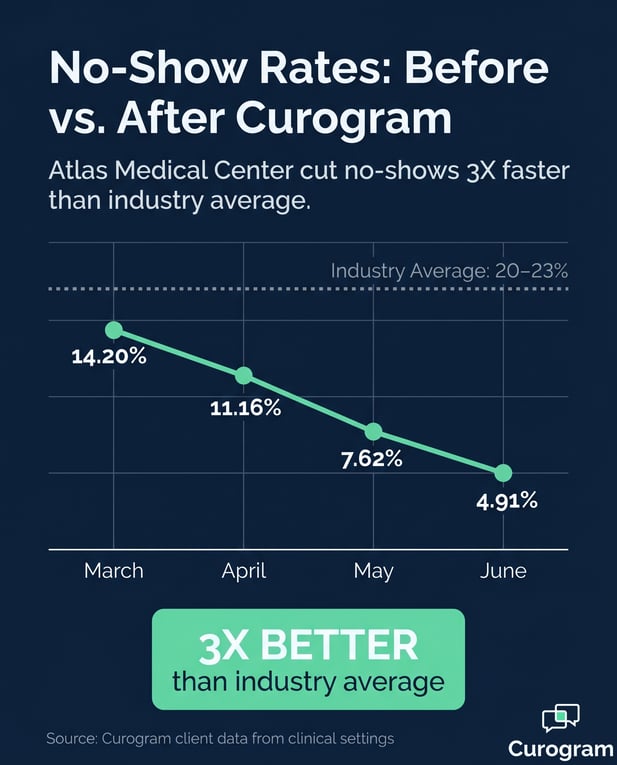
Atlas Medical Center cut its no-show rate from 14.20% to 4.91% in three months, which is 3X better than the industry average.

Among Curogram clients, more than 75% of appointments get confirmed on average. Covina Arthritic Clinic confirmed over 1,100 sessions a month through SMS alone.

The pattern holds across specialties, and behavioral health gains the most because the channel fix is the biggest.

Revenue You Stop Leaving on the Table

Each recovered session is real money. A 10-clinician behavioral health practice can recapture tens of thousands per month in lost revenue.

That is not a soft metric. It hits the bank account in the first 30 days.

Staff Hours You Get Back

Staff stop chasing voicemails. They stop dialing 50 to 80 calls a day. They start handling true client needs instead of reminder loops. Most teams reclaim 2 to 3 hours per staff member per day.

The Friction-Free Client Story

Picture a new client with social anxiety. Instead of a portal email, she gets a warm text from her new practice.

The text has a link to her intake forms, which open on her phone. She fills them out in 8 minutes while sitting on her couch.

The day before her first session, she gets a confirmation text. She replies YES in five seconds. She walks in calm, prepared, and ready to use the hour for what matters. That is the difference a channel change can make.

The takeaway is simple. The portal asks clients to come to it. Texting goes to them. One of those approaches matches how behavioral health clients actually live.

Close-up of a person using a secure patient messaging app on a smartphone at home

ConclusionYour Clients Already Have Their Phones

You did not become a therapist or practice owner to chase voicemails. You built a practice to help people heal. Every minute spent fighting a portal is a minute pulled away from that work.

The Portal Paradox is not a TherapyNotes flaw. TherapyNotes is excellent at what it was built for, which is clinical notes and billing.

It was never meant to be your outreach engine. That gap is real, and it grows louder in behavioral health than in any other specialty.

The clients who need your help most are the ones least likely to log into a portal. They are the ones most likely to skip a callback.

They are also the ones most likely to read a text the second it arrives. Where you reach them matters as much as what you say.

Secure 2-way SMS is not a fancy upgrade. It is a basic kindness.

It says to a client, We know your day is full, your mind is busy, and your bandwidth is thin. We will come to you.

That message lands long before the first session ever starts.

The proof is in the numbers. No-show rates drop. Confirmation rates climb. Staff get hours back each day. Clients stay engaged between sessions, which is exactly when continuity counts most.

You do not need to leave TherapyNotes. You do not need to rebuild your workflow. You just need to add the channel TherapyNotes never built. Curogram fits beside your current setup and starts working in days, not months.

Stop losing clients to friction that they were never able to push through. Meet them on the channel they already use, the one in their pocket, the one they check without thinking.

Watch what happens to retention, satisfaction, and revenue when the barrier disappears.

Book a free demo today and see how Curogram pairs with TherapyNotes to keep clients connected between sessions.


Frequently Asked Questions

How do clients opt out of text messages if they want to?

Clients can reply STOP at any time, and Curogram handles consent management in line with TCPA rules. The opt-out is instant and logged for your records.

In practice, opt-out rates stay very low because clients prefer texting over portal messages or phone calls. Most clients ask why your practice did not text them sooner.

Why do behavioral health clients skip portals more than other patients?

Many behavioral health clients live with conditions that strain executive function, like ADHD, depression, and anxiety. Each portal step, from URL to login to thread, is a fresh choice point where attention can break. Texting removes those steps and meets clients where their focus already lives. The result is higher engagement and fewer dropped touchpoints.

How does Curogram stay HIPAA-compliant if it sends regular text messages?

Curogram is HIPAA-compliant and SOC 2 Type II certified, with encrypted messaging and consent workflows built in. Practices control message templates so only safe, approved details ever go out by text.

For practices subject to 42 CFR Part 2 for substance use confidentiality, Curogram supports the consent steps needed for safe outreach.

Why does Curogram work without a TherapyNotes API?

TherapyNotes does not offer a public API, so Curogram runs as a parallel channel rather than a direct hookup. Your team still uses TherapyNotes for clinical notes, billing, and scheduling, while Curogram handles client outreach by SMS.

The two tools work side by side without any data swap, which puts compliance at risk. Most practices are live within days.

How fast do practices see results after switching to SMS-based outreach?

Most practices see confirmation rate gains in the first two weeks. No-show drops tend to show up by the end of the first month, and the lift grows from there. Atlas Medical Center hit a 4.91% no-show rate in just three months, a 3X improvement over the industry average. Staff time savings start on day one since the call volume drops right away.