

AdvancedMD Text Routing | Route Patient Messages to the Right Team
💡 Curogram's Smart Routing automates AdvancedMD patient text message routing to billing, scheduling, and clinical departments. When a patient sends...
9 min read
Jo Galvez
:
June 1, 2026
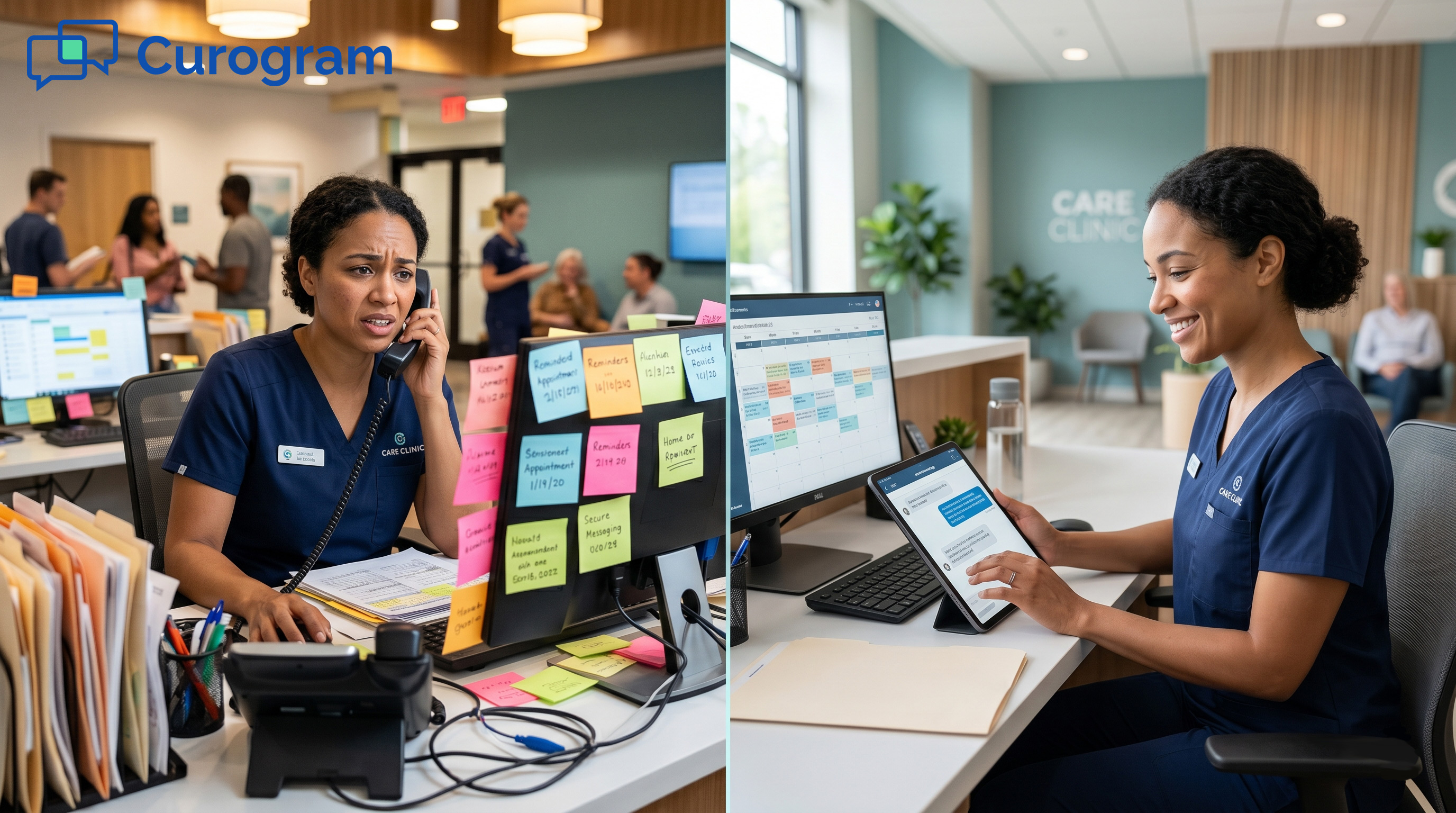
It is 9:14 a.m. on a Monday. Your practice manager has not finished her first coffee. She has already left seven voicemails. None will be returned before lunch.
This is the daily reality at most TherapyNotes practices. Staff burn 2 to 3 hours a day on outbound calls just to confirm sessions. They chase intake forms. They relay billing notes. They leave more voicemails.
TherapyNotes is a strong charting tool. The therapy note templates are clean. Billing is tight.
But it was not built as a communication platform, and the TherapyPortal goes mostly unread by clients managing anxiety, ADHD, or depression.
So the phone fills the gap. And the phone never stops ringing.
Front-desk staff at growing practices make 50 to 80 calls a day. Each call eats 3 to 4 minutes. Most lead to a voicemail that no one returns.
Meanwhile, the schedule has holes, intakes sit half-done, and the billing queue grows.
Practice owners feel stuck. Switching EHRs to fix one missing feature would break everything else that works.
So the workaround becomes a full-time job, and a $35,000 to $45,000 yearly hire just to manage call volume starts to look normal.
It is not normal. It is a tax on the wrong thing.
There is a simpler fix. Add a secure SMS channel that runs next to TherapyNotes. Let clients text the way they already text everyone else. Give the front desk one inbox instead of one hundred phone calls.
This guide shows how a TherapyNotes front desk SMS workflow for behavioral health staff replaces phone tag with a managed text inbox.
You will see the workflow, the metrics, and the real shift in how the front desk spends its day.
Phone tag is not a habit. It is the side effect of a missing feature. TherapyNotes does many things well, but outbound SMS is not one of them.
Once you see the gap, the daily chaos starts to make sense.
TherapyPortal offers email alerts and portal messaging. The problem is that behavioral health clients rarely log in. Anxiety, ADHD, and depression make portal logins one more task on a long list.
So messages sit unread. Staff cannot trust the portal to confirm a session. They pick up the phone instead. That single workflow choice drives most of the day's busywork.
Texts get read within minutes. Portal messages can sit for days. The reduced phone calls TherapyNotes practice goal starts here, with meeting clients where they already are.
A single confirmation call takes 3 to 4 minutes. Dial, wait, leave a voicemail, log the attempt. Multiply by 60 calls, and you have lost half the day to one task.
Let us put hard numbers on it. The table below shows a typical day for a mid-size TherapyNotes practice. The pattern repeats every week.
|
Front-Desk Task |
Daily Volume |
Time Cost |
|
Confirmation calls |
50–80 calls |
2.5–4 hours |
|
Voicemails left |
60–70% of calls |
30+ minutes |
|
Intake follow-ups |
10–15 calls |
45 minutes |
|
Billing inquiries |
8–12 calls |
30 minutes |
|
Total daily phone time |
— |
4–6 hours |
That is one staff member, gone, on the phone. The behavioral health front desk automation many owners hope for cannot start while the phone owns the calendar.
Most practices try to fix call volume by adding staff. A new admin hire runs $35,000 to $45,000 a year. For a 10-clinician practice, that cost stacks fast as each provider adds more client touches.
And it does not solve the root issue. Two people doing phone tag is still phone tag. The TherapyNotes office manager communication tools you really need are not on the dialer.
The practice manager who should be onboarding clinicians and tuning the schedule is stuck taking messages.
Burnout follows. Turnover follows that. The cycle keeps the practice running, but it never lets it grow.
Phone tag does not just burn hours. It costs revenue. When confirmations slip, no-shows climb. Behavioral health no-show rates already sit at 20% to 23% industry-wide.
For a 10-clinician practice, that math gets ugly fast. Tens of thousands of dollars a month leak out of the schedule. The phone is not just loud. It is expensive.

The fix is not a bigger phone team. It is a smarter channel. A managed SMS inbox lets staff handle confirmations, scheduling, and billing in a fraction of the time. Curogram serves as that layer for TherapyNotes practices.
Curogram gives the front desk a single inbox for every client text. Confirmations, reschedules, billing questions, and intake nudges all land in one place. Staff replies with a few taps.
Clients answer because texts feel normal. Read rates jump. The SMS workflow for therapy practice staff shifts from chasing voicemails to clearing a queue.
This is not a blast tool. Clients reply, and replies route to the right person on the team. The thread stays organized, so nothing slips.
Curogram was shaped by watching real front desks at work. The interface is plain on purpose. If your staff can text on a personal phone, they can use this in 10 minutes.
Most practices lose time to the wrong person reading the wrong message. Curogram fixes that with departmental routing.
Billing questions go to the billing coordinator, scheduling changes to the front desk, and clinical notes to the clinician.
No more sticky notes on a monitor. No more forwarded voicemails. Each thread sits with the person who can act on it, which is the heart of TherapyNotes staff productivity texting in practice.
Every message has a clear owner. That cuts the back-and-forth that drains a team.
All messages are logged. Owners and timestamps are visible. That helps with both compliance and coaching.
Curogram runs alongside TherapyNotes, not inside it. There is no API call to set up. No data migration. Your clinical workflow stays exactly where it is.
Staff keep using TherapyNotes for charting and billing. They open Curogram for client texts. That split keeps each tool doing what it does best, which is the real TherapyNotes administrative efficiency play.
Behavioral health adds weight to every message. A client in crisis may text, "Today was hard, I need to move my session." A voicemail box cannot meet that moment.
A managed inbox can. Staff see the message right away and reply with care. That single shift keeps the therapeutic bond strong between visits.
It also respects boundaries. Texts get logged. Consent is captured. Opt-outs are honored with a STOP reply. The platform stays compliant while feeling human.
The point of switching off the phone is not a smaller phone bill. It is a different kind of workday.
When confirmations move to text, the front desk gets time and focus back. Here is what that shift looks like in real practices.
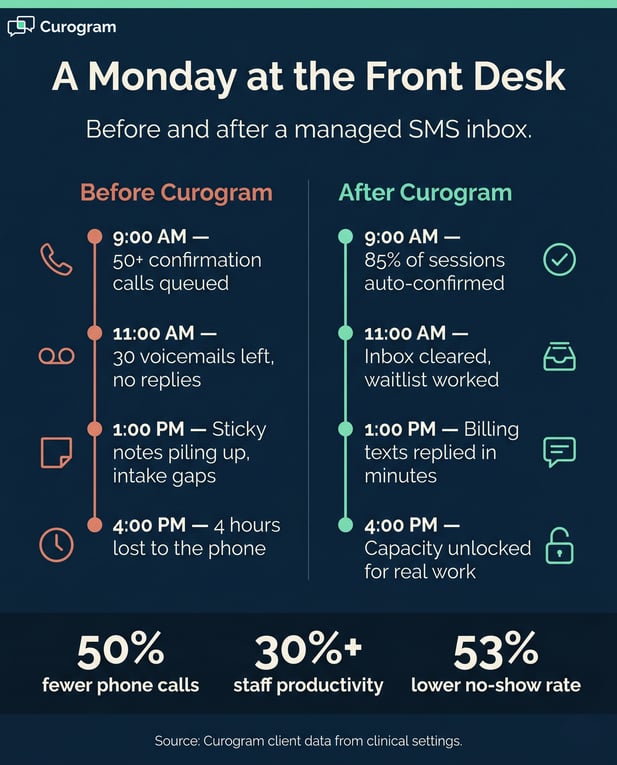
Curogram client data from clinical settings shows a clear pattern. Phone call volume drops by up to 50%.
Staff output rises by 30% or more. No-show rates fall to 53% below industry averages.
Covina Arthritic Clinic confirms more than 1,100 appointments a month through automated SMS workflows. That volume would be impossible to hit by phone. Atlas Medical Center cut its no-show rate from 14.20% to 4.91% in just three months.
Among Curogram clients, more than 75% of appointments now confirm automatically. The front desk only handles the exceptions, which is where their judgment actually matters.
One multi-location practice saw 35% of patients who got an SMS recall book a follow-up within a month. That is 1,240 visits from recall texts alone.
The real shift is what staff start doing with the recovered time. The phone stops owning the day. Higher-value work moves to the front of the queue.
Schedules get tighter. Waitlists get worked. Intake gaps close before they cost a session.
This is the practical version of TherapyNotes administrative efficiency that owners hope for but rarely see.
Picture the same Monday from the start of this article. Same practice, same team. New tools.
Your practice manager opens the Curogram dashboard at 9:00 a.m. Friday's automated texts already confirmed 85% of Monday's sessions.
Three clients rescheduled over the weekend by text. The waitlist filled those slots automatically.
The billing coordinator reviews a queue of payments collected through text-to-pay links sent last Thursday. The phone rings now and then, not nonstop. Staff can think, plan, and breathe.
This pattern shows up across behavioral health, primary care, and specialty practices. The reason is simple.
Text is how patients already talk to family, friends, and every other service in their lives.
Once the front desk meets clients there, the rest follows. Confirmation rates climb. Schedules tighten. Revenue that used to leak through no-shows comes back.
|
Metric |
Typical Result |
|
Phone call volume |
Down up to 50% |
|
Staff productivity |
Up 30% or more |
|
No-show rate vs. industry |
53% lower |
|
Confirmation rate |
More than 75% |
|
Staff training time |
Under 10 minutes |
These are not aspirational numbers. They are what Curogram client data from clinical settings shows when practices flip the switch on a managed SMS workflow.

TherapyNotes is a strong charting platform. It captures sessions, supports billing, and keeps the clinical record clean. None of that needs to change.
The piece that has always been missing is the way clients talk to your practice between visits. That is the gap a TherapyNotes front desk SMS workflow for behavioral health staff is built to close.
Think of it as a clean split. TherapyNotes captures the clinical story. Curogram captures the client conversation. One tool for the chart, one tool for the chat.
Your staff keeps their charting habits. They just stopped running a manual call center on the side.
The headline gains are real. Up to 50% fewer phone calls. Staff output up by 30% or more. No-show rates 53% lower than industry averages.
But the deeper win is human. Your practice manager stops drowning in voicemails. Your billing coordinator catches up. Your clinicians stop walking out to ask the front desk if a client got the new intake form.
The whole practice feels lighter. That is the real return on a switch like this.
Curogram was shaped by watching how real front offices actually run. That is why the interface is simple. That is why training takes minutes.
Your team will not need a long change-management project. They will need a short walkthrough and a few days of small tweaks. Then it just runs.
If any of this sounds like your Monday, you have a clear next step. Book a personalized demo. Fifteen minutes is enough to see Curogram's managed inbox running next to TherapyNotes with no commitment.
You will see the inbox, the routing, and the reminder flows. You will see how staff handle a full day of client texts without picking up the phone.
Bring your practice manager. Bring your billing coordinator. Let them ask the hard questions. That is the fastest way to know if it fits.
Every month spent on phone tag is a month of lost capacity. A behavioral health practice with a 20% no-show rate loses tens of thousands of dollars in the same window.
That math does not get better on its own. The phone will not start ringing less. Clients will not start checking the portal more.
Meeting clients on text is not a trend. It is how care already works in every other corner of their life. Your practice can either match that or keep paying the tax.
Your practice manager deserves more than three hours of daily phone tag. Your team deserves a calmer Monday. Your clients deserve a faster reply.
Book your demo today. See how a managed SMS inbox can give your front desk the time, the focus, and the breathing room it has been missing.
Curogram encrypts every message, logs every action, and provides a BAA. The platform is SOC 2 Type II certified, which covers the security controls most practices need.
For practices that handle 42 CFR Part 2 substance use information, the consent workflow keeps each thread on the right side of the rule. Compliance runs in the background so staff can focus on the conversation.
Most front-desk staff are comfortable within 10 minutes. The interface was built to feel like a familiar phone texting app. There is no command line, no complex menu tree, and no long training video. If your team can text a friend, they can run Curogram.
Texts arrive in the same inbox as every other message in a client's life. There is no login, no app, and no extra step. Portal messages, by contrast, sit behind a password that anxious or busy clients rarely return to. Meeting clients on text is the simplest way to lift response rates.
Curogram runs as a separate tool that lives next to TherapyNotes, not inside it. Your team keeps using TherapyNotes for scheduling, charting, and billing. They open Curogram for the client's text inbox. There is no integration build, no data migration, and no risk to your clinical workflow.
Behavioral health no-show rates average 20% to 23%, which is high compared to most other specialties. Each missed session is lost revenue and lost continuity of care.
Based on our internal data, Curogram practices see no-show rates 53% below industry averages. For a 10-clinician practice, that swing can recover tens of thousands of dollars each month.
💡 Curogram's Smart Routing automates AdvancedMD patient text message routing to billing, scheduling, and clinical departments. When a patient sends...
💡 When patients are referred to an imaging center for an MRI or CT scan, prep questions come up fast. Can they eat? Is their metal implant safe?...
💡 Practice Fusion patient texting powered by Curogram lets patients text their doctor's office for scheduling, billing questions, prescription...