8 min read

HIPAA-Compliant Two-Way Texting for Osmind | Beyond the Patient Portal

HIPAA-Compliant Two-Way Texting for Osmind | Beyond the Patient Portal
💡 HIPAA-compliant two-way texting for Osmind interventional psychiatry practices is available through Curogram, a patient engagement platform that adds direct SMS messaging alongside Osmind.  

Patients reply through standard text—no app download, no portal login, no password to remember.        

Curogram delivers a 52% reduction in psychiatry no-show rates (11.03% vs. the 23% industry average). Every message stays encrypted, auditable, and BAA-backed across ketamine, TMS, and Spravato programs.

This serves as a secure patient messaging alternative to Osmind's app-only workflows. Clinical documentation stays in Osmind, while routine conversations move to text.


Your first infusion slot tomorrow is at 8 AM. Your coordinator sent a confirmation through the patient app yesterday afternoon. By close of business today, there is still no reply.

This is the part of running an interventional psychiatry practice that the brochures never mention. You built a clinic around treatments designed to restore executive function—ketamine, TMS, Spravato.

Yet your daily patient communication depends on the same executive function those treatments are meant to repair.

The reminder is sitting in an app. The app requires a download. The download requires a login. The login requires a password the patient may have set during their last depressive episode.

Five steps stand between your reminder and a confirmed appointment.

Meanwhile, the same patient checks their SMS inbox 40 times a day without thinking about it.

This gap—between the clinical sophistication of your treatments and the communication friction your patients face—is where revenue quietly leaks. Across a four-chair infusion suite, a 23% no-show rate translates to $24,000 to $48,000 in missed monthly revenue.

For TMS protocols billed across 36 sessions, a single mid-course dropout can cost you $6,000 to $8,400.

There is a simpler way to close that gap. HIPAA-compliant two-way texting for Osmind interventional psychiatry practices keeps clinical documentation inside Osmind, while giving patients a secure text line that does not require an app, a portal, or a memorized password.

Below, we break down how the gap forms, why most fixes never quite work, and what shifts when your communication infrastructure finally matches the treatment protocol your clinic runs on.

When the App Becomes the Barrier Between You and Your Patients

Let's be honest about something first. Osmind earns its reputation for a reason. The infusion charting is sharp. The outcome tracking is built for measurement-based care. The superbill workflow saves your billing team real hours every week.

The app is not the problem.

The problem is that routine patient communication—appointment confirmations, pre-treatment screening reminders, post-procedure check-ins—runs through the same app that requires patients to download, register, and actively log in.

A Five-Step Path Where One Text Would Do

Walk through what happens when a patient gets a confirmation request for tomorrow's ketamine infusion.

The app forces them down this path:

  • Locate the Osmind app on their phone (assuming it's still installed)
  • Remember their login credentials
  • Navigate to the message thread
  • Read the confirmation request
  • Type and send a reply

For someone managing treatment-resistant depression, anhedonia, or PTSD, every step is a small wall. Cognitive fog and low motivation are not personality quirks. They are clinical symptoms—the same ones that brought the patient to your clinic in the first place.

So patients skip the app. They call the front desk instead. Or they don't respond at all, and you find out at 8:05 AM tomorrow.

The Front Desk Pays the Hidden Tax

Now multiply that breakdown across an average day. Front desk teams at busy infusion clinics field 40 to 80+ inbound calls daily—patients confirming infusion times, asking about pre-treatment fasting rules, double-checking ride arrangements for after a ketamine session.

Each call eats roughly 3 to 5 minutes of staff time.

At 60 calls a day, that is 3 to 5 hours of phone work your team could have spent on insurance verification, prior authorization, or actually greeting patients walking through the door.

What the No-Shows Actually Cost

Here is where the financial damage gets specific. Ketamine infusion sessions run $400 to $600.

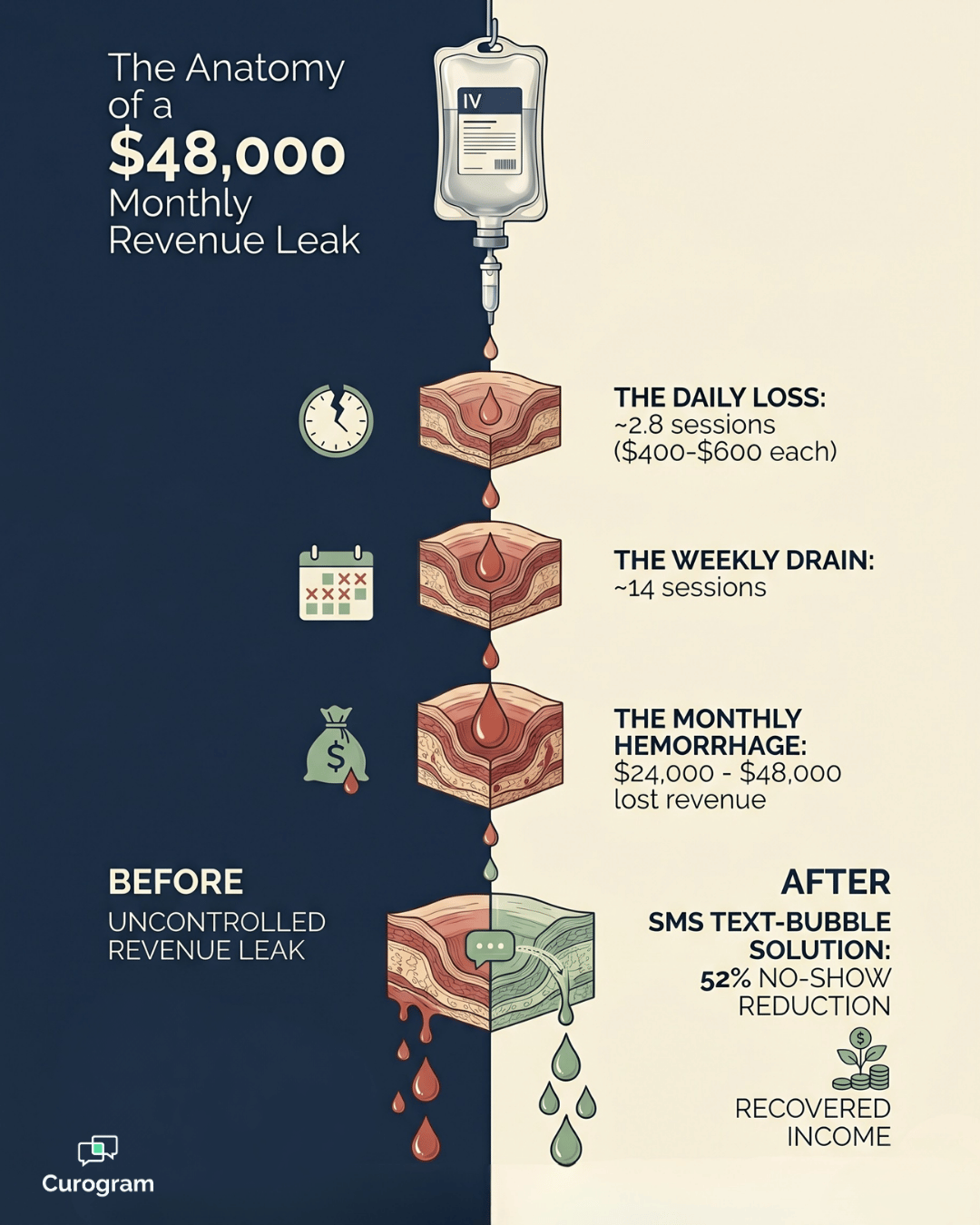
Across a four-chair suite with a 23% no-show rate, you are looking at roughly 3 to 4 missed sessions per day.

Practice Scenario Daily Lost Revenue Monthly Lost Revenue
4-chair ketamine suite (23% no-show) $1,200 – $2,400 $24,000 – $48,000
Single TMS dropout (after session 12 of 36) $6,000 – $8,400 in protocol loss
Spravato REMS missed observation slot $700 – $900 $14,000 – $18,000

These are not theoretical numbers. This is the cost of forcing a vulnerable population through an app-gated workflow when SMS would have worked the first time.

The Frustration Is Specific

You did everything right on the clinical side. You picked a specialty-grade EHR that understands interventional psychiatry. You invested in safety protocols, monitoring equipment, and trained staff.

Then you watch patients drop off mid-protocol—not because the ketamine stopped working, but because the system around it could not hold them. That is a hard thing for any clinician-owner to sit with.

A Secure Text Channel That Works Alongside Osmind

Here is the shift. You do not need to replace Osmind. You need a parallel communication layer that meets patients where they already are.

That layer is two-way SMS, encrypted, logged, and built for HIPAA from the ground up.

How the Direct Text Line Works

Curogram opens a HIPAA-compliant SMS channel for ketamine clinics, TMS centers, and Spravato programs that runs alongside your Osmind EHR. Patients receive messages on their regular phone, through standard SMS. They reply by typing. That's the whole patient experience.

Your team manages every conversation from a single unified dashboard. Every message is encrypted in transit and at rest, every conversation is timestamped, and every exchange is fully auditable for compliance review.

No app for the patient to download. No portal for them to log into. No password for them to forget.

Vertical infographic showing how 23% no-shows cause a $48,000 monthly revenue leak at ketamine clinics

What You Can Actually Send

The Osmind patient texting integration through Curogram covers the daily communication that fills your schedule—and your front desk phone lines:

  • Appointment confirmations for infusion or TMS sessions
  • Pre-treatment instructions (fasting rules, ride requirements, medication holds)
  • Post-procedure safety check-ins
  • Protocol adherence reminders mid-course
  • Quick patient questions answered through SMS instead of phone tag

Each of these conversations happens in the channel patients already check constantly. That alone shifts response rates—and confirmation rates—dramatically.

How It Sits Alongside Your EHR

Let's address the integration question directly, because it matters.

Osmind has limited third-party integration architecture. There is no public API and very few documented integrations. We will not pretend otherwise.

Curogram is designed to operate as a parallel communication layer, not a write-back integration.

The division of labor is clean:

  • Osmind handles: infusion notes, assessment scores, outcome tracking, charting, superbills
  • Curogram handles: appointment confirmations, two-way patient texts, automated reminders, audit-ready message logs

This is intentional. It means your team keeps their clinical workflow inside Osmind exactly as it is, while gaining a communication layer that does not depend on Osmind's integration limits.

Why This Fits Interventional Psychiatry Specifically

Look at how interventional protocols actually run:

  • Ketamine infusion series: 6 sessions across 2–3 weeks
  • TMS course: 36 sessions across 6–9 weeks
  • Spravato REMS program: observed administration with mandatory monitoring windows

Every one of those touches generates communication. Confirmations. Screening questions. Safety check-ins. Adherence nudges.

For Osmind two-way text communication TMS practices use, that frequency is the entire point.

You need a channel fast enough for same-day exchanges, secure enough for clinical content, and simple enough that patients with executive function deficits can actually reply.

For Spravato programs, the Osmind HIPAA texting Spravato clinic workflow handles REMS-related reminders and observation prep without forcing patients through a portal between visits.

This is the kind of patient texting platform for interventional psychiatry on Osmind that you would have built yourself if you had a software team and three years to spare.

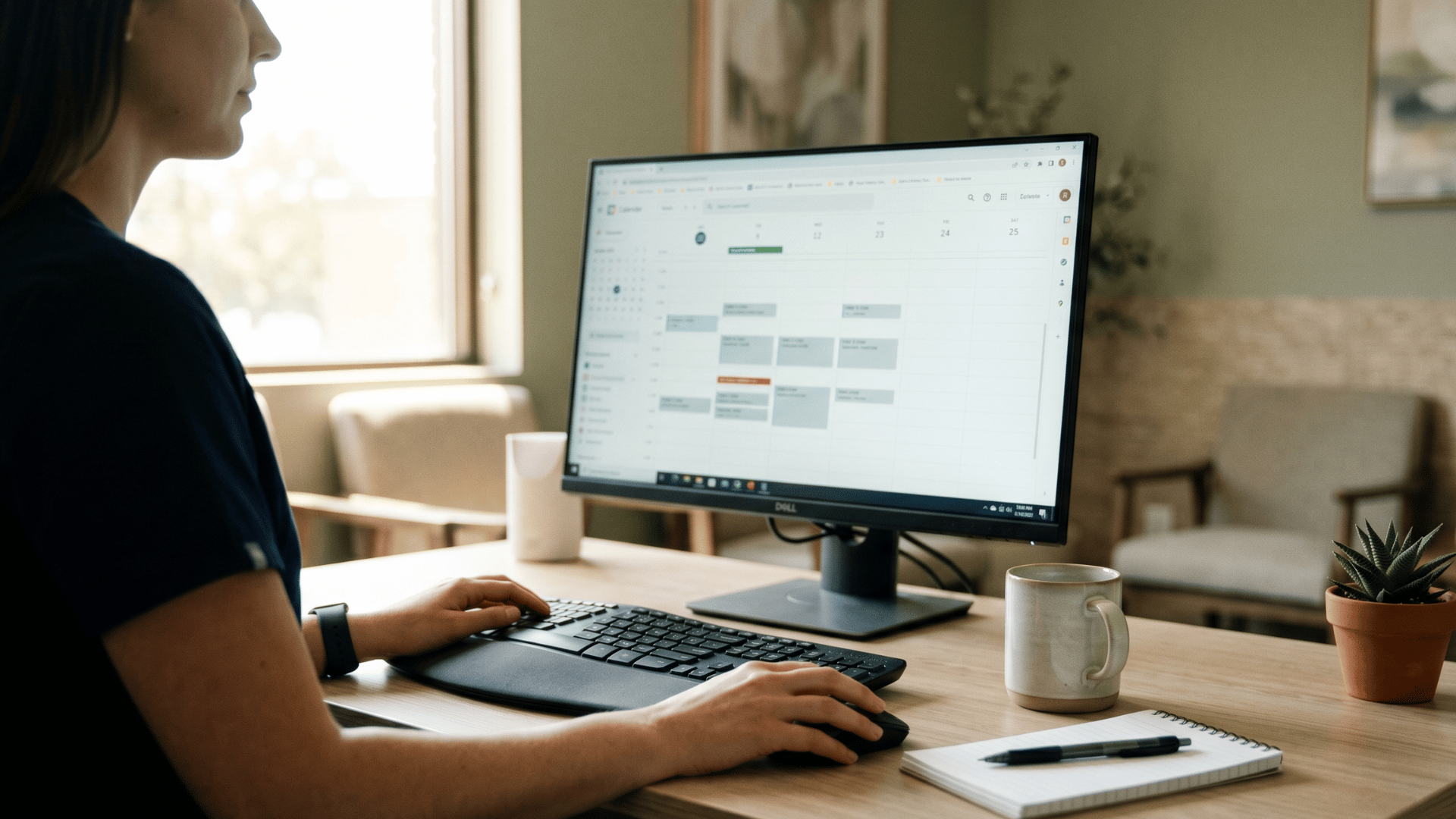
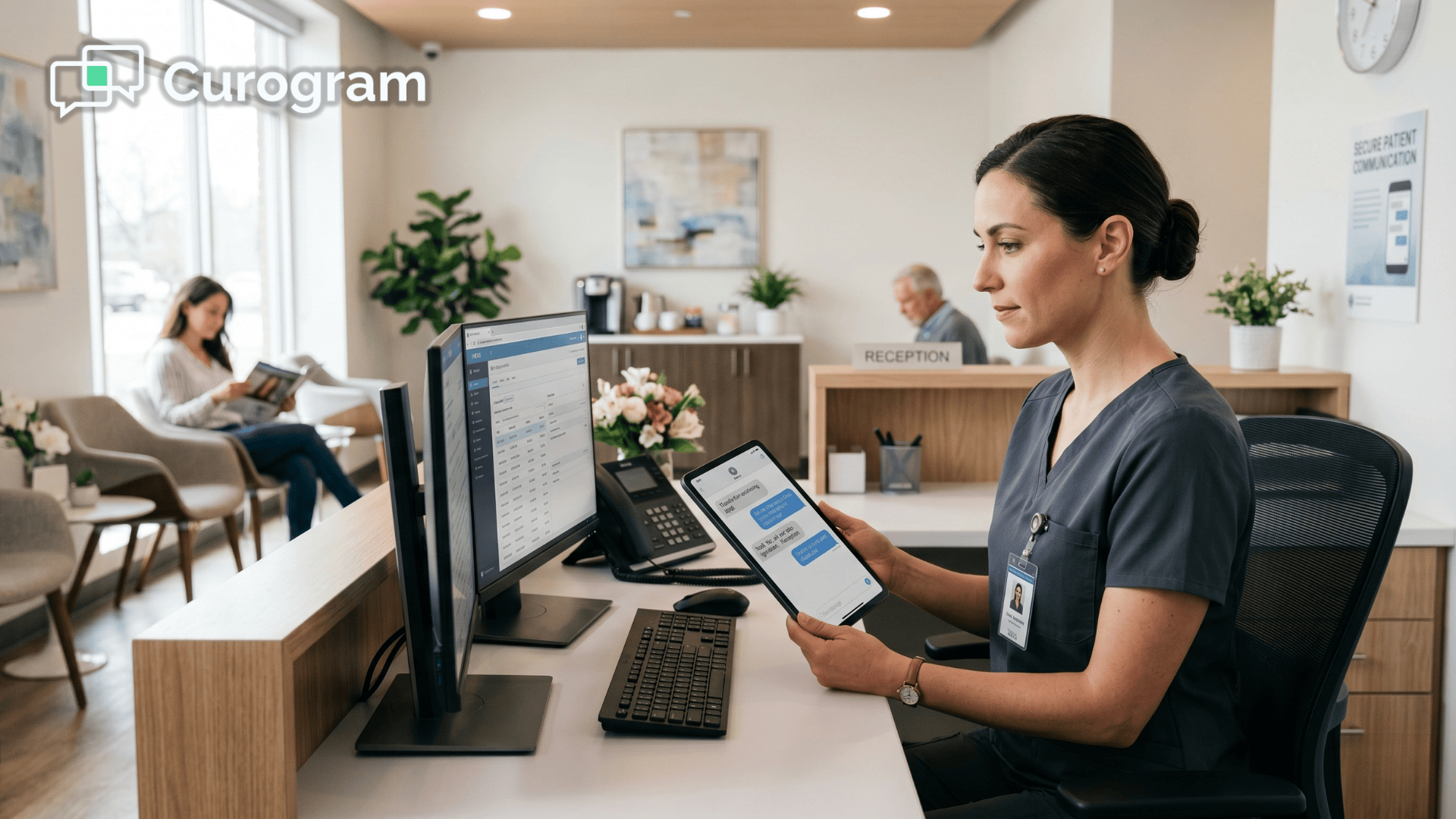
Clinic coordinator reviewing the day's appointment schedule at an interventional psychiatry workstation

What Happens When Your Communication Catches Up With Your Clinical Workflow

The numbers tell a clear story.

The Headline Metric

Curogram's psychiatry clients run at an 11.03% no-show rate. The industry average for psychiatry sits around 23%. That is a 52% reduction in patients who do not show up.

Atlas Medical Center, one of Curogram's clients, reduced no-shows from 14.20% to 4.91% within three months of implementation. That is not a slow-build result. That is a quarter.

52% no-show reduction

Curogram clients run at an 11.03% no-show rate vs. the 23% industry average — the gap that decides whether your infusion chairs stay full this month.

The Front Desk Transformation

Phone volume drops sharply when patients can text instead of call. Curogram clients consistently report a 50% reduction in inbound phone calls.

In practice, that means your coordinator stops playing voicemail tag and starts processing confirmations in batches. A 20-message exchange takes about 8 minutes through SMS. The same exchange through phone calls takes 60 to 90 minutes across a workday.

For your team, that's an hour of clinical prep work returned to them every single day.

The Patient-Side Picture

A ketamine patient texts back to confirm tomorrow's infusion within four minutes of receiving the reminder. A TMS patient on session 22 of 36 replies with a thumbs up the night before. A post-infusion check-in goes out two hours after a session—your patient replies that they're home safe and resting.

What Your Schedule Looks Like Tomorrow

The infusion chairs stay full. The TMS schedule stays on track. The protocol runs the way it was designed to run.

Your front desk isn't chasing voicemails at 8:05 AM. Your coordinator isn't apologizing to the next patient because the chair before them sat empty. Your clinical workflow finally has a communication layer that matches its standard.

Match Your Communication to the Treatment You Deliver

Your patients chose your clinic for a reason. They came for treatments most psychiatry practices cannot offer—ketamine, TMS, Spravato—because they were ready to do the hard work of recovery.

You owe them a communication experience that meets the moment.

Right now, that experience often depends on patients downloading an app, remembering a login, and navigating a portal to confirm a simple appointment.

For a patient population with treatment-resistant depression, PTSD, or chronic pain, that is asking them to use the very executive function your treatments are designed to restore.

There is a better fit. HIPAA-compliant two-way texting for Osmind interventional psychiatry practices keeps your clinical workflow exactly where it is and adds a direct text line your patients can actually use. The same channel they use for everything else in their life.

No app. No password. No friction.

The financial case is plain. A 52% drop in no-shows. A 50% reduction in inbound phone calls. Front desk hours returned to your team daily.

The clinical case is even cleaner. Patients who can respond easily are patients who complete protocols. Protocol completion is where outcomes—and your reputation—are built.

You did not invest in a specialty EHR to lose patients at the confirmation step. You built this clinic to treat the hardest cases in psychiatry, and the technology around your patients should support that, not work against it.

Schedule a Demo. See exactly how Curogram fits alongside your Osmind EHR in a workflow walkthrough built for your infusion and TMS schedule. No disruption to your current setup. No clinical workflow changes.


Frequently Asked Questions

Is two-way texting through Curogram HIPAA-compliant, and how does it protect patient data in a behavioral health setting?

Yes. Curogram is fully HIPAA-compliant and SOC 2 certified. Every message is encrypted, and every conversation is logged in a secure, auditable system that satisfies HIPAA requirements for ePHI. We execute a Business Associate Agreement (BAA) with every practice before going live.

Will adding Curogram create double entry or conflict with my existing Osmind workflow?

No. Curogram runs as a parallel communication layer alongside Osmind. Your clinical documentation, charting, and outcome tracking stay entirely inside Osmind.

Your team manages text conversations from the Curogram dashboard while patient records remain in your EHR. There is no duplicate data entry, no chart conflicts, and no clinical workflow disruption. This setup is intentional—it means Osmind's limited third-party integration architecture does not block your team from adopting a modern texting layer.

Do patients need to download an app, and can they opt out of text messages?

No app download is required. That is the entire point of using SMS as the channel.

Patients communicate through standard text on whatever phone they already use. No new software, no portal credentials, no setup needed on their end. Patients can opt out anytime by replying STOP, in full compliance with TCPA regulations.

How long does it take to get Curogram up and running alongside Osmind?

Most interventional psychiatry practices are live on Curogram within one to two weeks. There is no clinical migration required—your Osmind data stays exactly where it is.

Staff training runs about 10 minutes per user—the dashboard is designed to feel like any standard messaging app. You do not pause patient care to onboard. Texting can be turned on for a single provider or chair first, then rolled out across the practice once your team is comfortable.

Can Curogram automate the recurring touchpoints in a ketamine series or TMS protocol?

Yes. Curogram supports automated message sequences tied to appointment types, so you can build out the recurring communication a treatment protocol requires—without your front desk doing it manually each time.


Reduce Front Desk Phone Calls in Osmind Practices | Two-Way Texting

Reduce Front Desk Phone Calls in Osmind Practices | Two-Way Texting

💡 You can reduce phone calls at your Osmind ketamine clinic by replacing manual confirmations with a two-way texting workflow. Curogram automates...
Read More
Veradigm EHR HIPAA Texting | Beyond the Portal Wall

Veradigm EHR HIPAA Texting | Beyond the Portal Wall

💡 Veradigm EHR two-way HIPAA texting gives ambulatory practices a secure, portal-free communication channel that reaches every patient — not just...

Read More
Automated Appointment Reminders for Osmind | Keep Infusion Chairs Full

Automated Appointment Reminders for Osmind | Keep Infusion Chairs Full

💡 Curogram delivers automated appointment reminders for Osmind ketamine TMS practices through SMS — not app push notifications. Patients confirm,...

Read More