

9 min read

Veradigm EHR HIPAA Texting | Beyond the Portal Wall

Veradigm EHR HIPAA Texting | Beyond the Portal Wall
💡 Veradigm EHR two-way HIPAA texting gives ambulatory practices a secure, portal-free communication channel that reaches every patient — not just the 20–35% who use FollowMyHealth.      

Curogram integrates with Veradigm's open API to deliver encrypted two-way messaging without requiring patients to log in or download an app.

For the 60–80% of your panel who never adopted FollowMyHealth, text messaging becomes their first real digital communication channel.  

Curogram is not a FollowMyHealth replacement. It is the text-first layer that covers the patients your portal cannot reach — and keeps your phone lines clear in the process.

Think about your front desk at 9:00 a.m. on a Monday.

The phones are already ringing. One patient wants to confirm their appointment. Another needs a refill status update. A third is asking why they never got their intake form. And someone is already on hold.

Here is the uncomfortable truth:

Your practice already has a patient communication platform. FollowMyHealth is built into your Veradigm EHR. It has messaging, scheduling, telehealth, and care plans.

On paper, it should be handling all of those calls before they ever reach your staff.

But it isn't.

Patient portals only work for the patients who actually use them.

In most ambulatory practices, that is somewhere between 20–40% of your panel. The other 60–80% are not opening FollowMyHealth notifications. They are calling you — every single time.

That is not a flaw in the platform. FollowMyHealth is genuinely powerful for patients who are enrolled.

The problem is that portal adoption has stayed stubbornly low across ambulatory settings for years, and no amount of reminder emails or onboarding nudges seems to change it.

Most patients will not download another app. They will not create a new login or navigate a portal to confirm an appointment they could settle with a ten-second text.

This is the gap that Veradigm EHR two-way HIPAA texting is built to fill — not by replacing FollowMyHealth, but by reaching the patients your portal never could.

If your practice runs on Veradigm, including those that migrated from Allscripts Professional, this article will show you what that gap actually costs, why the portal alone cannot close it, and how a text-first approach changes the picture entirely.

Your panel is bigger than your portal reach. It is time to communicate with all of it.

Why Most of Your Patients Are Still Calling Instead of Messaging

The 20–40% Problem

FollowMyHealth is a genuinely comprehensive patient engagement platform — and that description is not marketing language.

Scheduling, secure messaging, health records, telehealth, remote patient monitoring, care plans, and medical translation in more than 240 languages through Voyce. For patients who download the app, create credentials, and log in regularly, it is a powerful tool.

The problem is not the platform. The problem is who is actually on the other side of it.

Patient portal adoption in ambulatory settings averages 20–40%.

For a Veradigm practice with 5,000 active patients, that means 3,000 to 4,000 patients have no active digital communication channel with your office.

They call for everything — confirmations, refill requests, referral checks, insurance questions, and billing inquiries.

That is not a minor inconvenience. That is the day-to-day operating reality for most Veradigm practices right now.

The 80-Call Morning

Your front desk fields 80 or more inbound calls on a typical day. Most of them are tasks FollowMyHealth was built to handle — but only for the patients who are actually logged in.

The rest land in your call queue:

  • Appointment confirmations and same-day scheduling changes
  • Prescription refill requests and medication questions between visits
  • Insurance verification follow-ups and referral status checks
  • Outstanding balance questions and billing clarifications

Each call averages 3–5 minutes. That is 4–7 hours of staff time per day absorbed by phone volume from patients who either do not know about the portal, tried it once and gave up, or simply will not use it.

Meanwhile, the 30% enrolled in FollowMyHealth submit those same requests digitally in seconds. Same task. Completely different cost to your team.

When the Portal Itself Becomes the Problem

User reviews of FollowMyHealth reveal a recurring pattern of friction:

"Message Delivery Failure" errors, settings that re-enable after software updates without user consent, and staff needing to delete and resend patient invitations because EHR sync did not complete properly.

Each failure chips away at patient confidence — in the platform and in your practice.

Patients who tried the portal and hit a wall rarely try again. They become permanent phone callers. In practice, they are often harder to re-engage digitally than patients who never attempted it at all.

These FollowMyHealth messaging limitations form a real gap in patient reach — one that cannot be solved by sending more portal invitation emails.

The patients who bounced are gone from that channel. You need a different one.

The Hidden Revenue Cost

Patients you cannot reach digitally leave a financial footprint that is easy to miss until you add it up.

Think about what each unreachable patient is not doing:

  • Confirming their appointment — so your first warning is an empty slot
  • Completing intake forms before their visit — so staff scramble at check-in
  • Paying balances promptly — so your cash cycle stretches by weeks or months
  • Leaving a Google review — so your online reputation stalls while competitors grow theirs

Consider a 20-provider practice with 10,000 active patients. If 65% have no digital communication channel, that is 6,500 patients reachable only by phone.

At a modest no-show rate of 8%, that is 520 missed appointments per month — each one a lost slot and a billing opportunity gone.

At an average visit value of $175, that is more than $90,000 in monthly revenue exposure from no-shows alone.

That is the cost of the portal wall, and it compounds every single day.

The Communication Layer That Reaches Patients Your Portal Misses

Two-Way Texting That Works Without an App

When practices start noticing the FollowMyHealth adoption gap, many search for a FollowMyHealth alternative that reaches their full patient panel. The better answer is not a replacement — it is an extension.

Curogram provides a direct, HIPAA-compliant two-way text messaging channel between Veradigm EHR practices and their patients.

No portal enrollment, no app download, no credentials required.

A patient texts the practice phone number. Staff respond from a centralized, encrypted dashboard. Every conversation is logged, timestamped, and stored in line with healthcare data retention standards.

This is what Veradigm patient engagement without app download looks like in real practice. Not a workaround — a purpose-built, SOC 2 Type II certified platform that signs a Business Associate Agreement with every practice at onboarding.

For the 60–80% of patients who have never had a digital channel with your office, this is often the first one.

And it works precisely because it asks nothing from them.

Patient reading appointment confirmation text in a medical waiting room

One Dashboard, Every Conversation

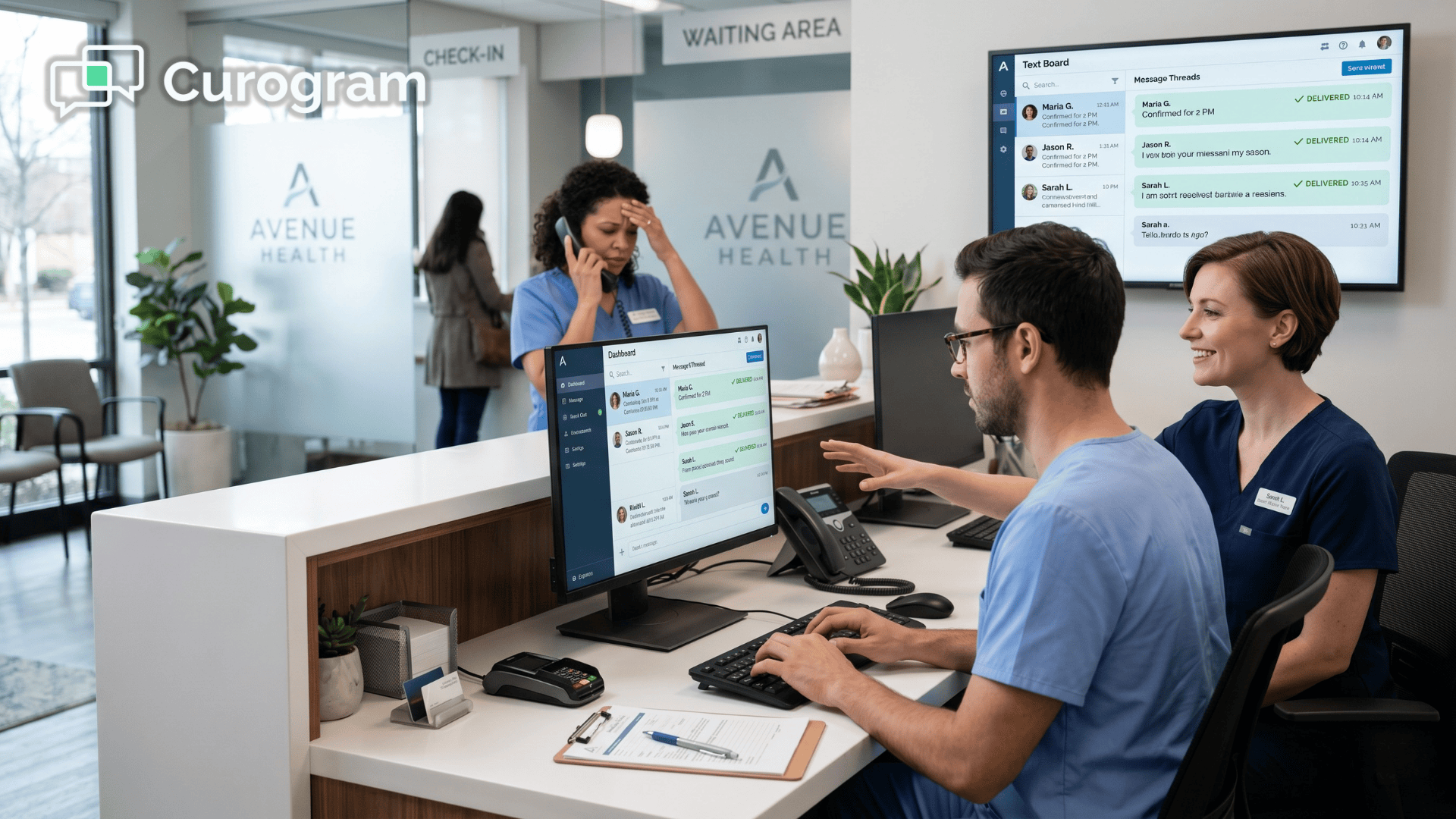
Curogram consolidates all patient text conversations into a single HIPAA-encrypted dashboard accessible to authorized staff across locations.

From that one screen, your team can:

  • View all incoming patient texts across every site in real time
  • See patient name, appointment context, and relevant EHR details alongside each message thread
  • Handle multiple simultaneous conversations without switching between systems
  • Assign threads to specific team members for follow-up or escalation

For a multi-location practice, that last point matters more than it sounds.

Right now, communication fragmented across locations means someone is always asking,

"Did the other office already respond to this patient?"

With a unified inbox, that question disappears.

Built Into the Veradigm Ecosystem You Already Use

Curogram connects through Veradigm's open API architecture — the same App Expo ecosystem that supports Luma Health, Inbox Health, Cedar, and other widely used third-party tools.

Patient contact information and appointment data sync from Veradigm EHR to Curogram automatically. Text conversations can be logged back to the patient record.

No custom development. No IT project. No months-long implementation.

This matters for practices that previously ran on Allscripts Professional before the Veradigm rebranding — the API architecture is familiar, and the App Expo pathway makes Curogram one of the more straightforward additions to that environment.

HIPAA compliant texting for Veradigm ambulatory practices should not require an infrastructure overhaul to stand up. With Curogram, it does not.

Meeting Every Patient Where They Actually Are

Multi-specialty ambulatory practices serve widely different patient populations.

Each with different technology habits and communication preferences:

  • Cardiology patients managing complex medication regimens who need quick answers between visits
  • Orthopedic patients coordinating pre-surgical clearances across multiple providers and locations
  • Pediatric parents juggling appointments for multiple children, often with limited time to log in anywhere
  • Internal medicine patients with chronic conditions who interact with your practice every few weeks

What every one of these patients shares is a phone — and the habit of reading a text message within minutes of receiving it.

Text message open rates average 98%, compared to 20–30% for portal notifications and email.

That is not a marginal difference. It is the difference between a confirmation that happens and an empty slot on your schedule.

Patient reading appointment confirmation text in a medical waiting room

What Your Practice Looks Like When the Whole Panel Is Reachable

The Numbers Behind a Text-First Strategy

Curogram clients average more than 75% appointment confirmation rates via text — compared to portal-dependent confirmation rates constrained by 20–35% adoption. The math is clear once you put the two side by side.

Communication Channel Open/Read Rate Avg. Confirmation Rate Requires App or Login
FollowMyHealth Portal Notification 20–30% ~25–30% of panel Yes
Email Reminder 20–30% Variable No
Curogram Two-Way Text ~98% >75% of full panel No

For a practice with 1,000 monthly appointments, moving confirmation rates from 30% to 75% means 450 additional confirmed appointments every month. If 30% of previously unconfirmed slots would have been no-shows, that is roughly 135 recovered appointments — worth $20,000 to $34,000 per month at an average visit value of $150 to $250.

Stop playing phone tag! Reduce your call volume by 50% with Curogram's HIPAA-compliant 2-way texting platform.  

The no-show data from Curogram clients reinforces the picture.

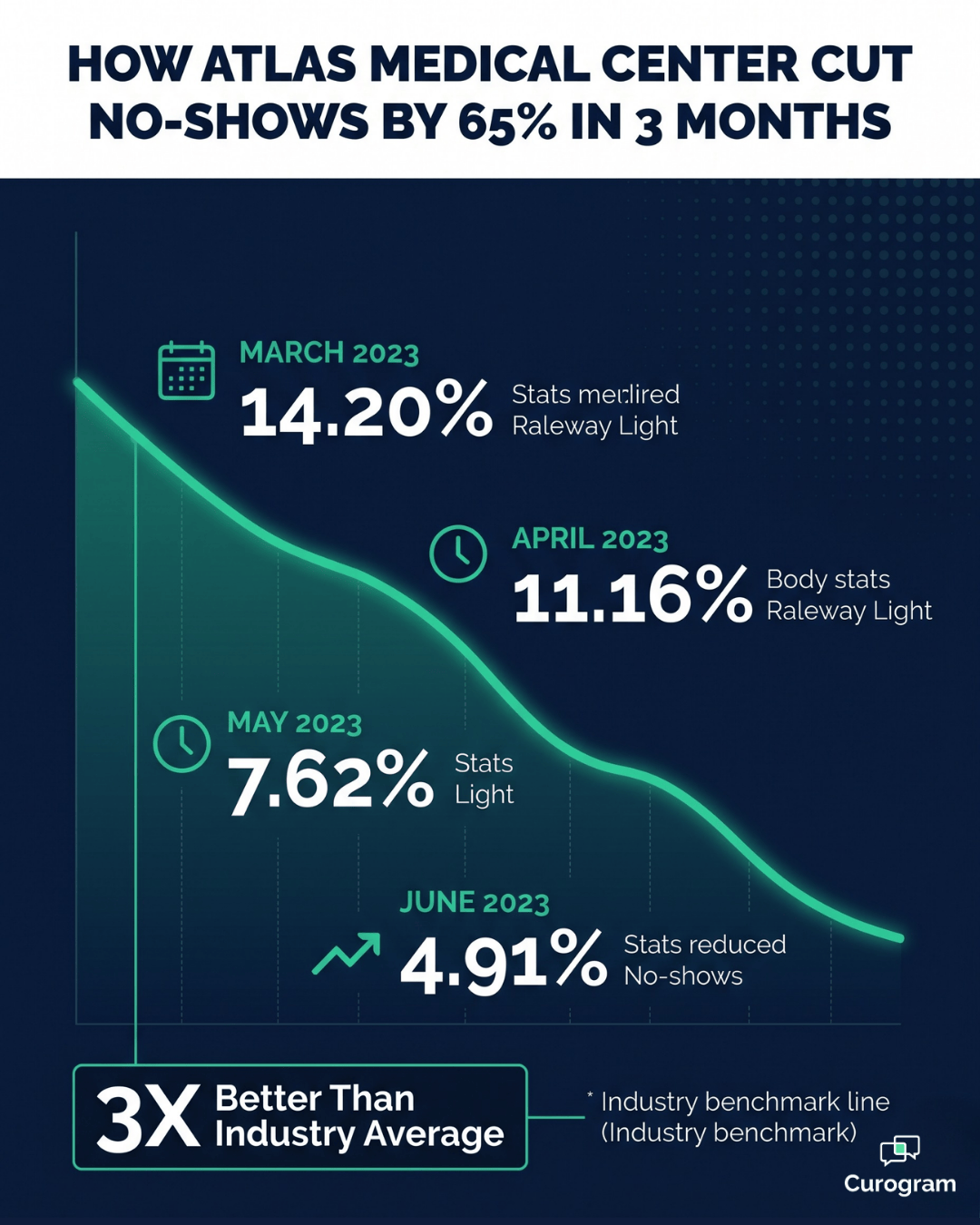
Atlas Medical Center reduced their no-show rate from 14.20% to 4.91% in just three months using Curogram's text-first approach — a 65% reduction that was 3X better than the industry average.

That is what happens when your confirmation message reaches every patient, not just the third who are logged into the portal.

From Portal-Dependent to Panel-Complete

A Veradigm EHR practice text-first communication strategy does not ask you to choose between tools. It asks you to stop treating one tool as though it covers everyone — when the data shows it covers about a third. Here is how the two channels divide the work in practice:

FollowMyHealth handles:

  • Portal messaging, health records access, and digital scheduling for enrolled patients
  • Telehealth visits and care plan management
  • RPM data collection and medical translation for engaged users

Curogram handles:

  • Appointment confirmations and intake forms for the 70% who will not log into the portal
  • Real-time two-way text for prescription questions, scheduling changes, and billing reminders
  • Post-visit review requests and patient recall outreach across your full panel

This is what FollowMyHealth portal alternative text messaging looks like in a working Veradigm practice.

Not a replacement. A complement that closes the gap and gives the rest of your panel a digital communication channel — often for the first time.

What Monday Morning Looks Like Now

Picture Monday morning at your multi-location Veradigm practice.

FollowMyHealth users confirmed their appointments through the app and submitted intake forms over the weekend.

Curogram texted the remaining 70% — confirmations came back, intake links were clicked, and a handful of prescription questions were answered before 8:00 a.m.

Your front desk handled 15 calls instead of 80. Your confirmation rate across the full patient panel is 78% — not 28% of portal users. Your schedule is full and your staff is focused on patients in the building, not fielding calls from people who never got a reminder.

Covina Arthritic Clinic confirmed more than 1,100 appointments per month through Curogram's automated text workflow — without adding staff or changing their Veradigm EHR setup.

For a team that was previously managing confirmation calls manually, that shift shows up immediately on the schedule and in monthly revenue.

Stop Waiting for the Portal. Start Reaching Your Full Panel.

FollowMyHealth is an excellent patient engagement platform. For patients who are enrolled, it delivers real value — scheduling, telehealth, health records, and care plans. The tool itself is not the problem.

The problem is coverage.

A portal serves the patients who adopt it. A text message reaches every patient with a phone — and in ambulatory care, that is virtually your entire panel.

The patients on the other side of the portal wall are not disengaged because they do not care about their health.

They are unreachable because the channel you are using requires a step they simply will not take.

Patient communication without portal dependency is not a future feature request. It is a practical solution that Veradigm practices can add right now through the App Expo ecosystem — without a custom IT build or a months-long rollout.

Curogram is SOC 2 Type II certified, fully HIPAA compliant, and signs a BAA with every practice at onboarding.

Every conversation is encrypted, logged, and auditable. Your staff works from one dashboard. Your patients text a number they already recognize.

Think about what it costs your practice every day to leave 65% of your panel unreachable. Missed confirmations. Preventable no-shows. Blank intake forms at check-in. Balances sitting unpaid until paper statements go out. Reviews that never get written because no one followed up.

Now think about what happens when that gap finally closes.

Practices that lead on patient communication are not always the ones with the most portal features. They are the ones that reach their full panel — through the channels their patients will actually use.

Ready to see how it works in your specific setup? Schedule a demo with Curogram and see how two-way HIPAA texting integrates with your Veradigm EHR through the App Expo ecosystem — and starts reaching the patients your portal cannot.


Frequently Asked Questions

Does Curogram replace FollowMyHealth?

No. Curogram complements FollowMyHealth by reaching the patients who have not adopted the portal. FollowMyHealth continues to serve enrolled patients with its full feature set — scheduling, records, telehealth, and care plans. Curogram adds a text-first communication channel for the 60–80% who will not download the app. Two layers. Complete coverage. Your portal-engaged patients keep their full experience, and the rest of your panel gains a digital communication channel — often for the first time.

How does Curogram integrate with Veradigm EHR?

Curogram connects through Veradigm's open API architecture — the same App Expo ecosystem that supports Luma Health, Inbox Health, Cedar, and other third-party tools. Patient contact information and appointment data sync from Veradigm EHR to Curogram automatically. The integration is designed to work within Veradigm's existing infrastructure without custom IT development or a lengthy setup process.

Is text-based patient communication really HIPAA compliant?

Yes. Curogram is SOC 2 Type II certified and fully HIPAA compliant. Every text conversation is encrypted in transit and at rest, automatically logged with timestamps and user attribution, and stored in compliance with healthcare data retention requirements. Curogram executes a Business Associate Agreement with every practice at onboarding. Unlike standard phone texting, Curogram's platform is purpose-built to meet the same security standards as your EHR.

What kinds of patient interactions can be handled through Curogram's two-way texting?

Most of the conversations that currently tie up your phone lines. Appointment confirmations and scheduling changes, prescription refill requests, pre-visit intake forms, insurance questions, balance reminders, and post-visit follow-ups can all move through text. Staff respond from the same dashboard, so there is no need to switch between systems or maintain separate communication logs. For interactions that require a clinical conversation, staff can escalate directly — the text thread stays intact as part of the record.

How long does it take to get Curogram running with Veradigm EHR?

Implementation is typically fast because Curogram connects through Veradigm's existing App Expo API infrastructure — there is no custom development required. Patient contact information and appointment data sync automatically once the integration is configured. Staff training averages around 10 minutes, which means your team can be handling patient text conversations within days of going live, not weeks.