10 min read
Veradigm Staff Text Dashboard | End the 80-Call Day
Aubreigh Lee Daculug
:
April 23, 2026
Curogram integrates with Veradigm's open API to give front desk teams a single dashboard where all patient text conversations are visible across every location.
Staff can manage 10 or more simultaneous text conversations while still checking in walk-ins.
FollowMyHealth works well for engaged portal users. But with portal adoption rates averaging just 20–35%, the majority of your patients still rely on the phone. A HIPAA-compliant text dashboard fills that gap.
It's 8:07 AM.
Your front desk staff haven't had their coffee yet, and the phone is already ringing.
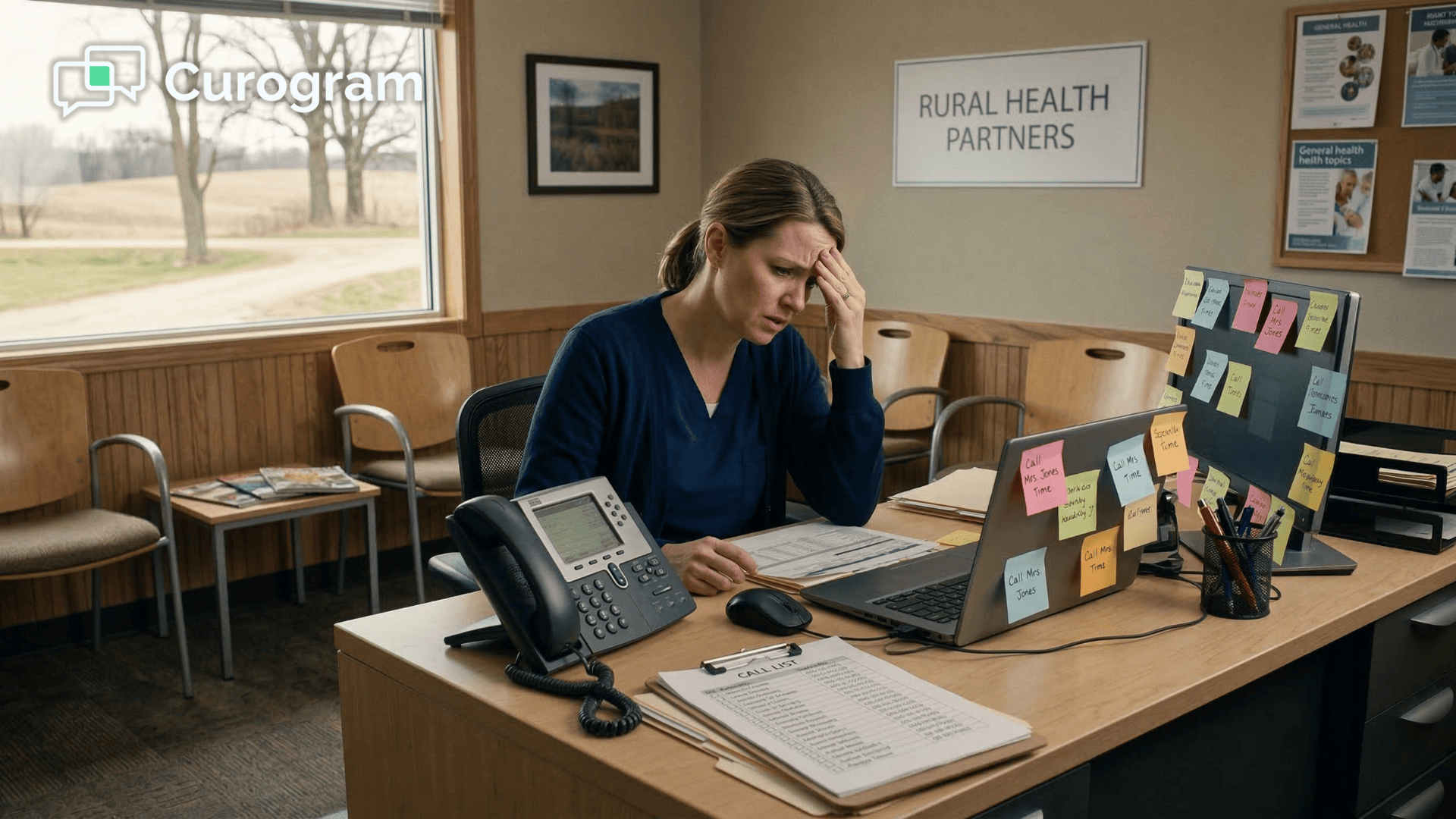
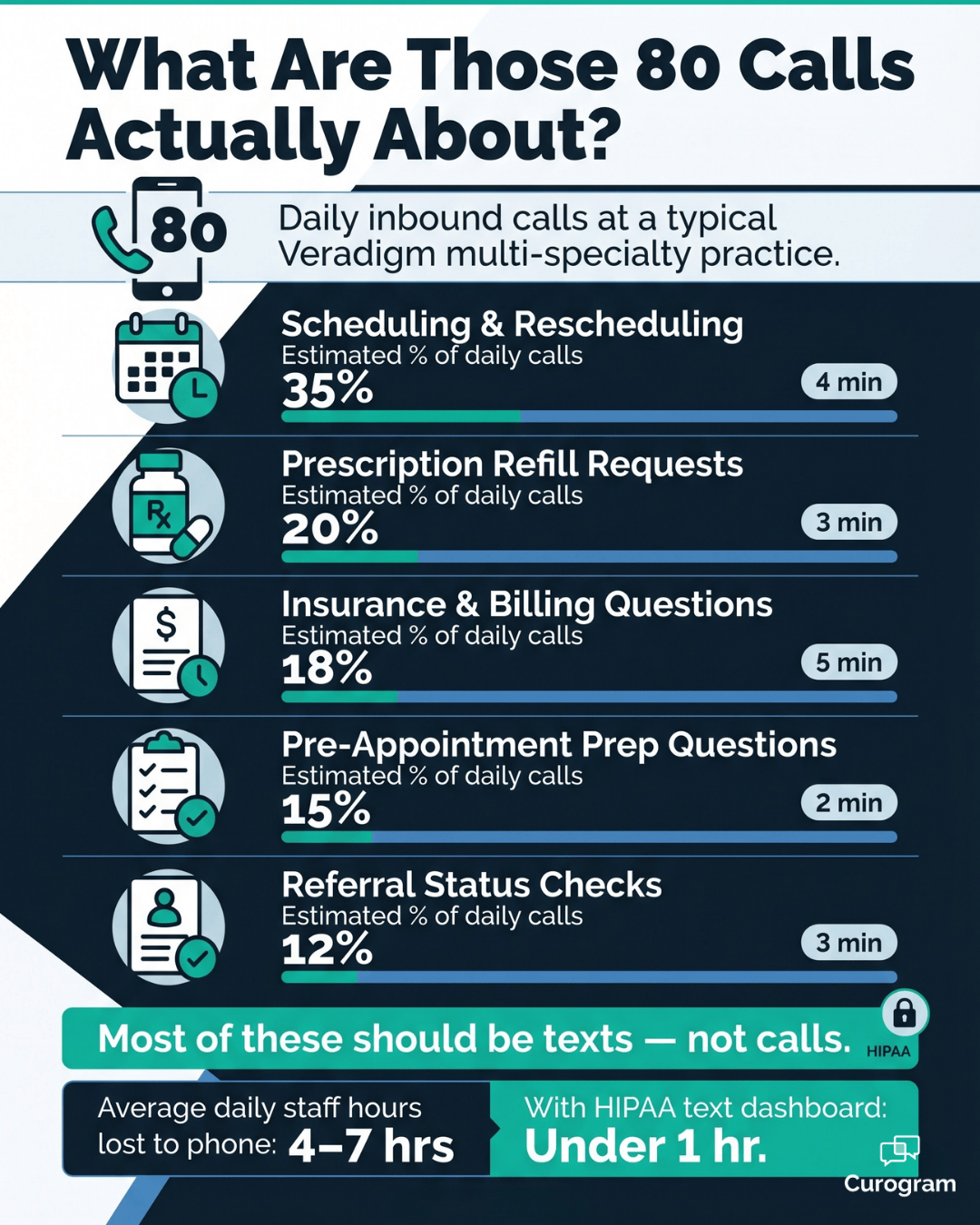
A patient wants to reschedule. Another is asking whether they need to fast. A third is calling about a referral that may or may not have gone through. By 9:00 AM, hold times are already stretching past two minutes.
This isn't a bad morning. This is every morning.
If your practice runs on Veradigm EHR, you already know the problem. FollowMyHealth is the built-in patient portal — and it works well, for the patients who actually use it.
But here's the hard truth:
Most of your patients don't. Portal adoption across multi-specialty ambulatory practices typically sits at 20–35%. That means for every 10 patients on your panel, six or seven have no reliable digital channel to reach you.
So where do they go? They call.
Every question that could take 15 seconds over text becomes a 3–5 minute phone call.
A staff member picks up, pulls up the chart, answers the question, documents the interaction, and hangs up — only to immediately pick up again for the next one.
Multiply that 80 times a day, across two or three locations, and you're not running a medical practice anymore. You're running a call center.
The cost goes beyond frustration. It shows up in overtime hours, missed tasks, and staff who eventually burn out and leave. Training a replacement takes months.
The institutional knowledge they carried? Gone.
Here's what makes this problem particularly stubborn:
FollowMyHealth errors compound it. Message delivery failures push patients back to the phone. Settings that reset after updates. Sync issues requiring manual re-enrollment.
Every portal failure confirms what most patients already believe — that calling is the only reliable way to reach your practice.
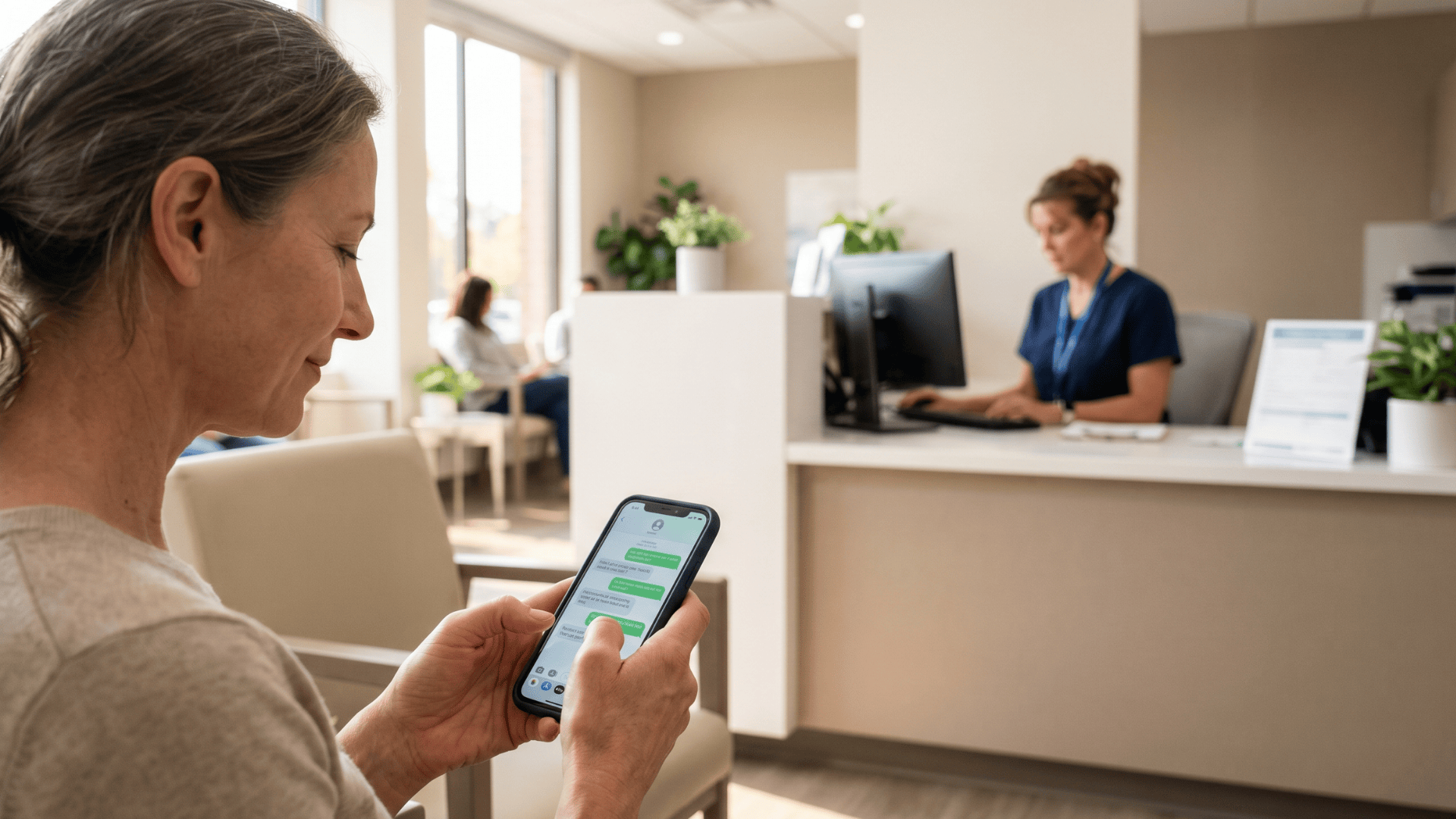
There is a better path. It doesn't require patients to enroll in anything, download anything, or remember a password.
It uses the one communication tool they already have mastered: their phone's built-in text messaging app.
This article breaks down exactly why the 80-call day keeps happening, why FollowMyHealth alone can't solve it, and how a Veradigm EHR front desk staff HIPAA texting dashboard changes the math entirely.
The Real Reason Your Phones Won't Stop Ringing
The Portal Gap Is Bigger Than You Think
Let's run the numbers on a practice with 5,000 active patients and a 30% FollowMyHealth adoption rate. That means 3,500 of your patients have no digital communication channel with your office — none.
No secure messaging. No appointment updates. No way to reach you except by dialing your main line.
Every question from those 3,500 patients becomes a phone call.
Think about what those calls actually sound like:
"Can I move my Thursday appointment?"
"Has my referral been submitted?"
"Do I need to fast before my labs?"
These are not complex clinical conversations. They are 15-second questions that eat 3–5 minutes each because they have to travel through a phone queue.
At 80 calls a day, your front desk is spending roughly 4–7 hours on the phone — every single day — answering questions that could be resolved in seconds over text.
3–5 minutes. |
| That's how long the average patient phone call takes from pickup to wrap-up. A text resolves the same question in 15–30 seconds. |
The handle time difference alone is significant. But the bigger gap is capacity.
A phone call ties up one staff member for one patient at a time — there's no way around it. A text conversation lets that same staff member manage 10 or more patients simultaneously. Not sequentially. At the same time.
And here's what most practices don't fully register: text messaging requires zero enrollment from the patient.
No portal login. No app download. No password. The message lands on the phone they already carry everywhere.
Your Staff Are Doing Five Jobs at Once
Here's what makes the phone volume problem especially damaging: your front desk team isn't just answering calls.
On any given morning, they're managing all of this at the same time:
- Checking in patients at the window
- Processing insurance verifications and eligibility
- Managing referral submissions and follow-ups
- Coordinating scheduling across locations
- Handling walk-ins and urgent patient requests
Each of those tasks demands real attention.
When 80+ phone calls layer on top of that workload, something breaks. Hold times climb. Patients hang up and call back, which means the same call counts twice.
Urgent questions get buried in the queue. Staff start creating workarounds that introduce compliance risk.
The phone doesn't just slow your team down. It crowds out everything else.
FollowMyHealth Can't Bridge This Gap on Its Own
FollowMyHealth is a capable portal. For your enrolled patients, it handles scheduling, records access, secure messaging, and telehealth.
But its communication features only work for patients who completed enrollment — and kept their credentials.
When enrollment rates stall at 20–35%, the portal becomes a communication tool for a minority of your panel.
The rest still reach for their phone. And when FollowMyHealth generates a "Message Delivery Failure" error or requires a patient to re-enroll after a platform update, you don't just lose a digital interaction.
You reinforce the habit of calling.
For multi-location Veradigm practices, the problem multiplies. Each location handles its own call volume, with no shared visibility into patient conversations across sites.
A patient calling Location A about a referral to Location B creates confusion, duplicated effort, and sometimes dropped follow-up.
That's not a patient experience problem. That's an operations problem — and it has a different kind of solution.
The Dashboard That Gives Your Team Their Day Back
One Inbox, Every Patient, Every Location
Curogram connects to Veradigm through the same open API architecture that powers the App Expo marketplace.
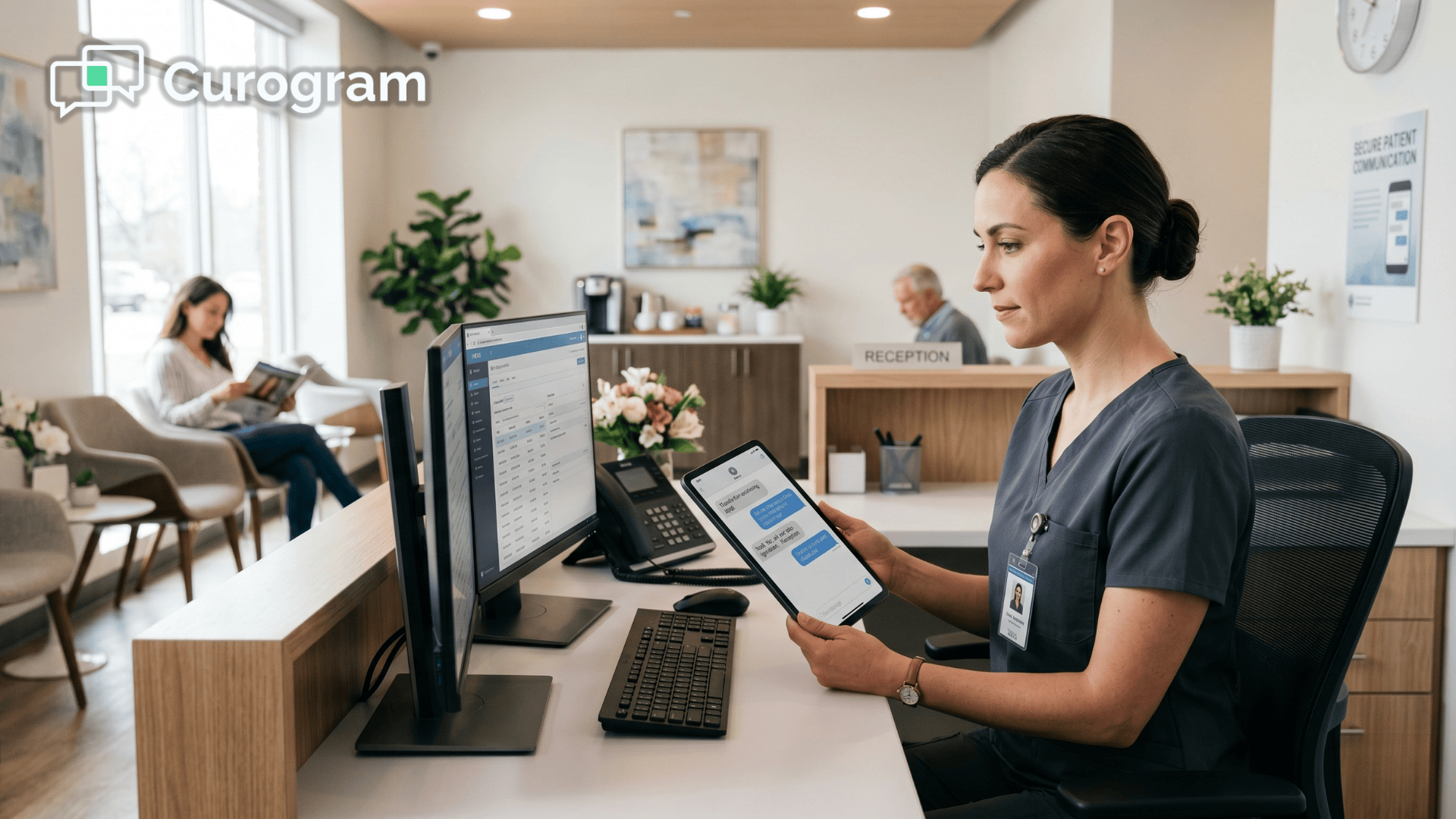
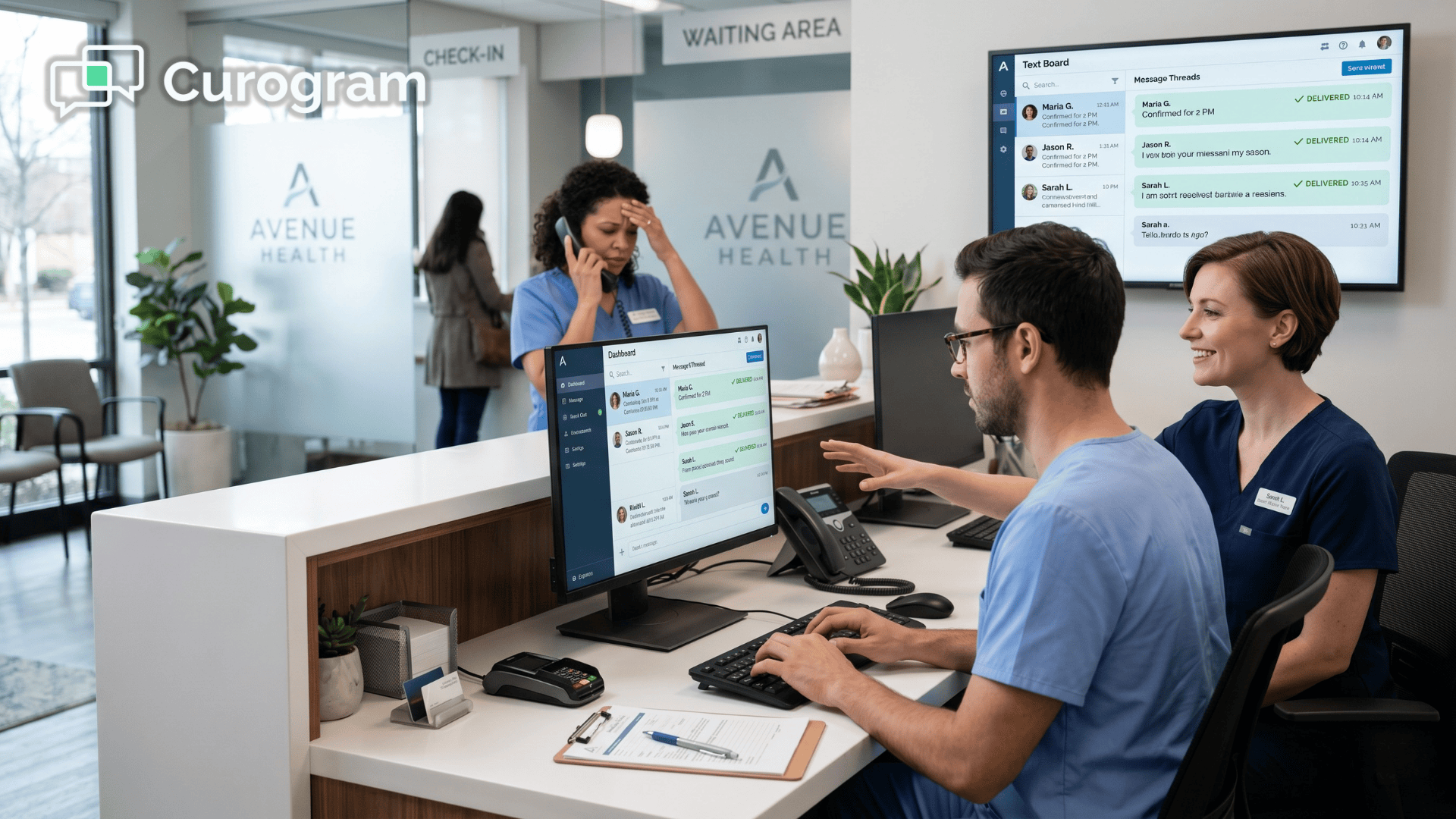
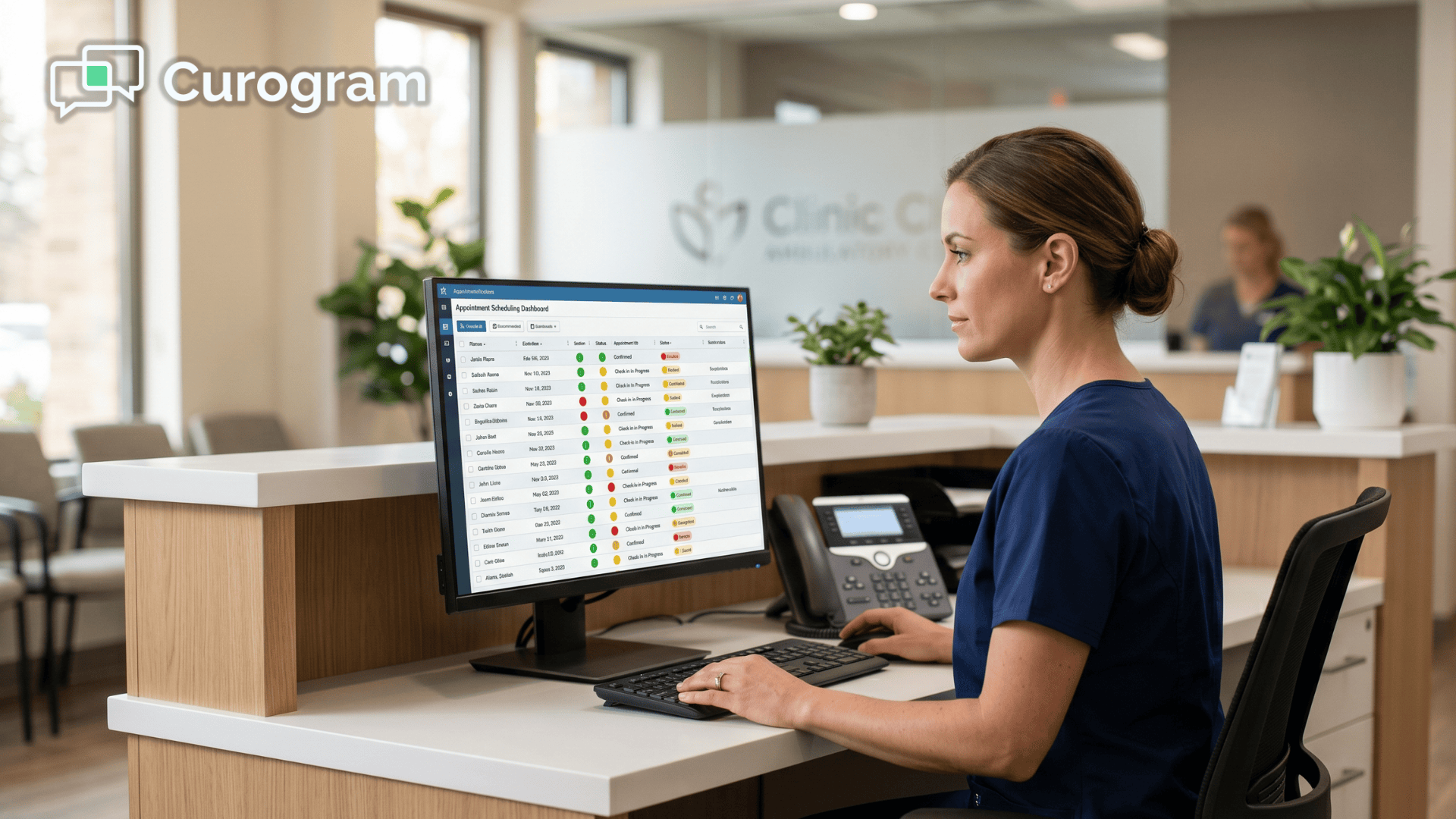
Once integrated, it gives your front desk a single HIPAA-encrypted text dashboard where every patient conversation appears alongside that patient's appointment details, contact information, and relevant chart context pulled from Veradigm.
Staff don't switch between systems. They don't re-enter patient data. They see who's texting, what their upcoming appointment looks like, and what they need — all in one screen.
For multi-site practices, this matters even more. Curogram's dashboard consolidates patient communication across all your Veradigm locations.
A patient texting your main location about a referral to a satellite clinic is visible to both teams. Office managers can see message volume, response times, and staff workload across the entire organization — not just their own front desk.

Parallel Conversations, Not Serial Ones
This is the shift that changes everything.
A phone call is serial by nature:
One staff member, one patient, one conversation, three to five minutes.
There's no way around it. You can't pick up a second call while you're on the first one without putting someone on hold.
Text is parallel. One staff member can handle a scheduling change, confirm an insurance card photo, answer a prep instruction question, and respond to a refill request — all within the same two-minute window.
That's not an exaggeration. It's how the workflow actually functions once your team is comfortable in the dashboard.
Your front desk capacity doesn't increase because you hired more people. It increases because your team can handle more conversations at once.
No New Learning Curve for Your Staff
Staff adoption is often the hidden barrier to new tools. Curogram is designed around the same interface logic as personal text messaging. Most front desk staff are comfortable in the dashboard within their first day — no multi-day training, no certification required.
Unlike FollowMyHealth — which spans scheduling, records, messaging, and telehealth workflows — Curogram does one thing exceptionally well: two-way texting with full HIPAA compliance. That simplicity is a feature, not a limitation.
It Works Alongside the Tools You Already Have
Curogram doesn't require you to replace anything currently running in your Veradigm environment.
It connects as an additional layer through the App Expo ecosystem. Whether your medical practice already uses Luma Health, Inbox Health, or other connected tools, Curogram fits in without friction or conflicts.
Think of it as filling the gap your current stack leaves open — not competing with what's already working.
What the Numbers Look Like After the First Week
Phone Volume Drops Fast
Practices using Curogram's text dashboard report a 40–60% reduction in inbound phone volume after implementation.
At 80 calls a day, that's 32 to 48 fewer calls your team has to field — every single day.
Over a five-day workweek, a 60% reduction means your team gets back 20–35 hours that were previously spent on the phone. That's nearly a full-time equivalent in recovered productivity — every single week.
Those hours don't disappear. They get redirected to tasks that actually require human attention: complex insurance conversations, sensitive clinical coordination, and the face-to-face patient interactions that build trust and loyalty.
Confirmation Rates Tell the Whole Story
Portal-dependent confirmation systems — which require patients to log in to confirm appointments — see confirmation rates limited by whatever adoption rate you're working with.
At 30% FollowMyHealth enrollment, your maximum reachable population for portal-based confirmations is 30% of your panel.
Curogram clients average over 75% appointment confirmation rates via text. Because the message goes directly to the patient's phone as a standard SMS, it doesn't require any enrollment to receive or reply to.
The difference between 30% confirmation reach and 75% confirmed appointments isn't a small optimization. It's the difference between running a full schedule and managing last-minute gaps.

What Monday Morning Actually Looks Like
Picture this: your patient access lead opens the Curogram dashboard at 7:45 AM.
Before the phones even turn on, here's what's already been handled:
- Overnight patient texts answered by the auto-responder
- Morning confirmation messages sent, with YES replies already coming in
- A new insurance card received as a patient photo text
- An appointment reschedule request logged and resolved
- An early arrival confirmation for intake paperwork on file
All of that — before the first phone rings at 8:00 AM.
Your front desk is ahead of the day. Not scrambling to catch up to it.
What Happens to Staff Retention
This one is harder to put in a table, but it matters just as much.
Office managers and patient access leads at multi-location practices describe a consistent pattern: good staff leave when the phone volume becomes unsustainable.
Not immediately — but six months in, a year in, after enough mornings of non-stop calls layered on top of everything else.
Replacing a trained front desk coordinator costs an estimated $5,000–$15,000 when you factor in recruiting, onboarding, and the months it takes for institutional knowledge to rebuild.
If reducing phone volume by 50% is the difference between keeping a strong staff member and losing them, the ROI on a communication platform becomes straightforward.
Your Portal Reaches 30%. Your Text Dashboard Reaches Everyone.
This is the clearest way to frame it.
Two Tools. Two Very Different Jobs.
FollowMyHealth provides a powerful engagement experience for the patients who enrolled and stayed enrolled. It handles scheduling, records, secure messaging, and telehealth for that segment of your panel — and it does it well.
But it was never built to be your front desk's primary communication tool. It was built for patient self-service. Those are different jobs, and they require different solutions.
FollowMyHealth is a portal. Curogram is a communication layer. Treating one as a substitute for the other is how practices end up back where they started — with a phone queue that never shrinks.
The Layer Your Panel Is Missing
Curogram is not a portal replacement. It sits between your Veradigm EHR and the 65–80% of patients who will never log into a portal to send you a message.
It meets them where they already are — in their text messages — and routes every conversation to your front desk through a HIPAA-compliant, multi-location dashboard.
Your Veradigm EHR handles clinical documentation. FollowMyHealth serves your portal-engaged patients.
Curogram serves your front desk team — and through them, every patient on your panel.
Practices that implement this combination stop reacting to phone volume and start managing it. The 80-call day doesn't disappear overnight, but it shrinks fast. And as it shrinks, your staff get time back. Your schedule fills more reliably. Your team shows up Monday with a little less dread.
Stop Handing Staff Hours to the Phone Queue
There's a certain point where a communication problem stops being an inconvenience and starts being a structural drag on your practice. For many Veradigm offices, that point has already passed.
Eighty phone calls a day isn't a volume problem you can hire your way out of. You can't train staff fast enough to outpace it, and you can't schedule your way around it.
The only real fix is changing the communication channel itself — moving routine patient contact off the phone and onto a medium that doesn't require serial handling.
That's what a HIPAA texting dashboard does.
It doesn't add more work to your front desk. It converts the same workload into a format your team can actually manage at scale.
Think about the downstream effects: fewer staff hours lost to the phone means more time for check-in, prior authorizations, and the face-to-face moments that define patient experience.
Better confirmation rates mean fuller schedules and less revenue lost to last-minute no-shows. Reduced call volume means lower stress and better retention for the staff who hold your practice together.
None of these outcomes require a major overhaul. Curogram connects to Veradigm through the App Expo ecosystem, and most teams are comfortable in the dashboard within the first day of use.
The phone volume reduction starts in the first week.
Your portal works for the patients already in it. Now it's time to build a communication channel for the rest.
Schedule a demo with Curogram and see what your front desk looks like when 40–60% of today's phone calls become texts instead. Connect through the Veradigm App Expo and watch the change happen in real time — not in a quarterly review, but by Friday.
Frequently Asked Questions
Not in any meaningful way. Curogram's dashboard is built around a single text inbox with patient context from Veradigm displayed alongside each conversation. Staff who can text from a personal phone can use Curogram. Most front desk teams are comfortable with it within their first day — no multi-day training, no certification process. Unlike FollowMyHealth, which spans scheduling, records, messaging, and telehealth, Curogram focuses on one workflow: two-way HIPAA-compliant texting. That simplicity keeps the learning curve low.
Yes. Curogram provides multi-location visibility from a single dashboard. Staff at any location can see and manage patient conversations for their site, while practice administrators get a consolidated view of communication volume and response times across all locations. Each location maintains its own phone number and conversation history, but the administrative layer is unified. This is designed specifically for the multi-site ambulatory organizations that make up Veradigm EHR's core user base.
Curogram is platform-independent. It integrates with Veradigm's current open API structure but isn't locked to any single EHR vendor's roadmap. If Veradigm modifies its API — as happened during the Allscripts-to-Veradigm transition — Curogram's integration team updates the connection. Your patient communication continues without interruption. For practices that have questions about Veradigm's longer-term corporate direction, Curogram provides a communication layer that travels with your practice regardless of what changes on the EHR side.
Curogram uses HIPAA-encrypted messaging — not standard SMS. From the patient's side, the experience feels like a regular text. But on the back end, every conversation is encrypted, access-controlled, and logged in a way that meets HIPAA requirements. Your front desk communicates through the secure dashboard, not personal devices or unencrypted channels. That means no BAA gray areas, no compliance workarounds, and no staff texting patients from their own phones to get around the phone queue.
Most practices start seeing a measurable reduction within the first week. The shift happens quickly because patients don't need to learn anything new — they receive a text and reply to it. As more routine questions get resolved over text, fewer patients reach for the phone by default. The auto-responder handles after-hours inquiries overnight, so your team arrives to a partially cleared queue before the day begins. The full 40–60% reduction typically stabilizes within the first few weeks as patients and staff settle into the new communication pattern.