HIPAA Texting for Athenahealth: No Portal or App Download Needed
💡 Athenahealth patient texting through Curogram lets every patient reach their practice by SMS — no portal login, no app download, no hold time. ...
6 min read
Aubreigh Lee Daculug
:
June 24, 2026
The phone never stops. At a busy behavioral health agency, the front desk answers call after call all day long. And most of those calls are not emergencies at all.
People are asking for directions. They are confirming a time. They are checking whether a form went through.
It sounds manageable. It isn't.
One office can absorb that traffic. A 20-location network cannot. Every minute spent on a routine call is a minute the team does not spend on insurance, intake, or a patient who needs real help. That is the exact problem Curogram's Welligent integration was built to solve.
Here is what often gets missed. Phone volume is not just background noise. It is a tax on your whole operation, and it grows with every site you add.
Open another location and you do not just add patients. You add phones, hours, and one more front desk fighting the same flood.
When you want to reduce phone calls in a behavioral health setting on Welligent, the instinct is to add more staff to the front desk. That treats the symptom, not the cause.
The cause is that calling is the only easy way patients have to reach you.
Give them a better way to reach you, and the calls drop on their own.
This article walks through where the call burden really comes from, why two-way texting cuts it instead of just adding another inbox, and what your front desk does with the hours it gets back. We will use real numbers from a network that made the switch, so the impact stays concrete.
You will see how the math scales, what a rollout looks like, and where the time actually goes once the phone stops ruling the day.
The goal is simple. Fewer calls, more care.
A prospect put it plainly:
"Our front desk is fielding 80+ calls a day just for directions and confirmations."
For one location, that is annoying but workable. Across a large network, it becomes a structural problem.
The math is what makes it real. Each call eats 2 to 4 minutes of front desk time. Multiply that by volume and the cost stops looking small.
| Network size | Calls per day | Front desk time per day |
|---|---|---|
| 1 location | 80 | ~3–5 hours |
| 20 locations | 1,600 | ~53–107 hours |
That bottom row is the part leaders feel. A 20-location agency can lose the equivalent of several full-time shifts every single day to calls that never needed a human.
And that count assumes every call is even answered. During peak hours, callers hit busy signals and voicemail, so some give up, miss the appointment, or simply call back later.
The time you can measure is only the part you can see.
The cost is not only time. When staff are stuck on the phone, they cannot verify insurance, process intake paperwork, or triage urgent patient needs. The phone becomes the gatekeeper for the entire operation, and routine traffic sets the pace for everything else.
There is a quieter cost, too. A front desk that reacts to the phone all day rarely gets to do the work it was hired for.
Over time that pressure wears people down and feeds turnover, which carries its own price tag in hiring and training.

Curogram does not ask patients to learn a new app or call a new number. It meets them where they already are, then quietly removes the reasons they used to call.
Here is how that works across a network of behavioral health clinics and FQHCs.
Patients text the same number they would have called. The channel feels familiar, so adoption is fast and you skip the awkward
"here is our new texting line" rollout.
Appointment confirmations, form acknowledgments, and basic office details can be handled automatically. Staff only step in when a message actually needs a person.
Patients who used to call about paperwork now get an intake link by text. They complete it before they arrive,
Which removes a whole category of "did you get my form?" calls.
Automated reminders let patients confirm with a quick text reply. That replaces the confirmation calls that flood the front desk in the first place.
Every site gets two-way texting from day one. Phone volume drops across the whole agency at once, not site by site over months.
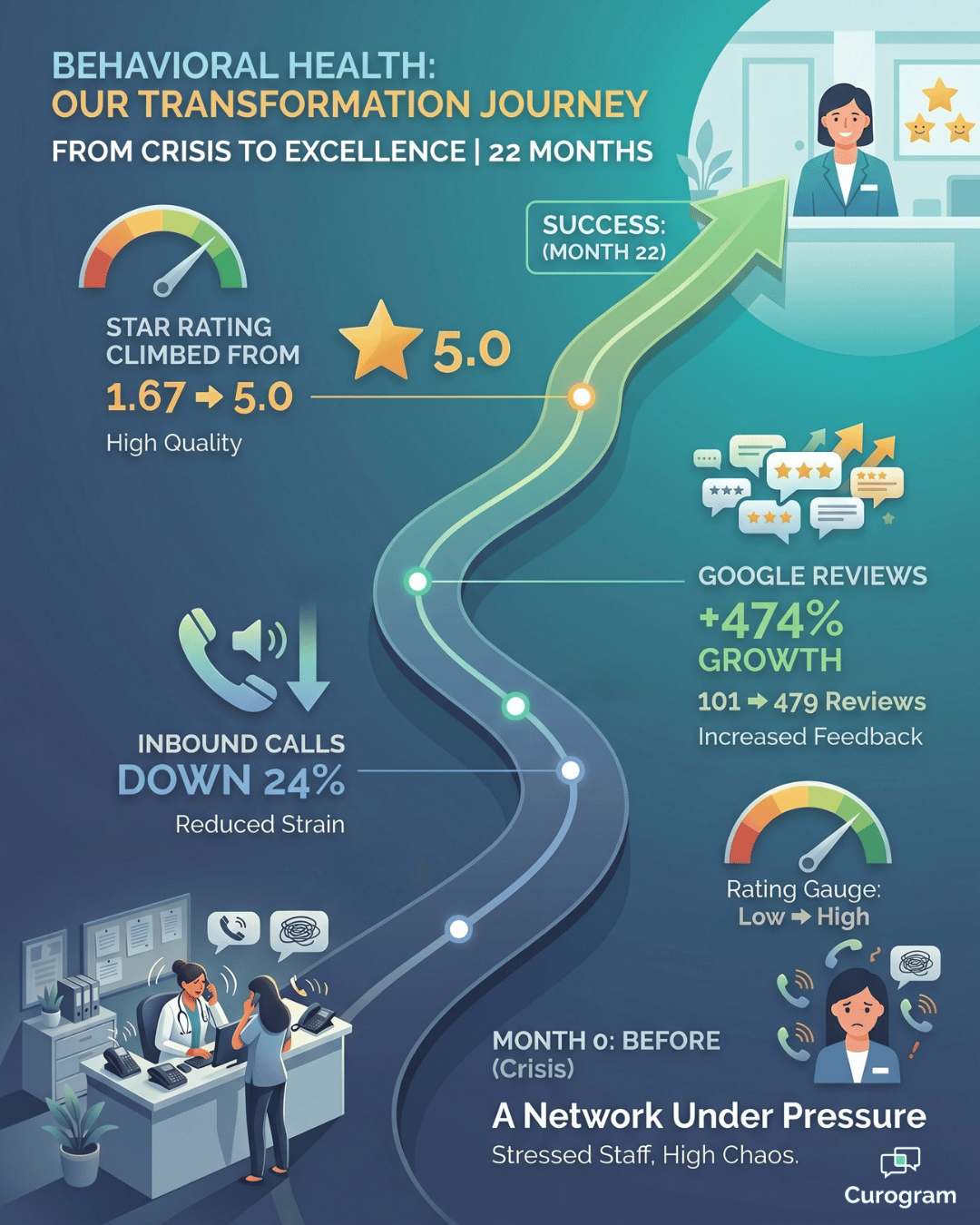
The results back this up. At River Valley, the 24% call reduction came alongside Google reviews climbing from 101 to 479, a 474% jump, and a star rating that rose from 1.67 to 5.0 over 22 months.
COO Jessica Sweet noted that fewer calls let the front desk focus on higher-value patient interactions instead of routine traffic.
None of these features carry the load alone. Working together, they strip away the most common reasons patients dial in, which is why the drop in volume holds steady instead of fading a few weeks after launch.

Cutting calls is only half the story. The real win is what your team does with the hours it gets back.
That time flows straight into the work that actually moves patients through care.
Scale that across a 20-location network at a 24% call reduction, and the recovered time is not a rounding error. It can add up to hundreds of hours a month, moved off the phone and onto work that strengthens both revenue and care.
Translate those hours into outcomes and the value sharpens. Faster insurance verification means fewer denied claims. More complete intake means fewer day-of delays.
Each recovered hour quietly protects revenue that phone traffic used to put at risk.
Getting started is faster and lighter than most agencies expect.
There is no rip-and-replace and no long onboarding slog for your staff.
Most networks are fully running within 2 to 4 weeks. From there, the call volume starts to fall on its own as patients shift to the channel they prefer.
Your team does not have to manage that shift blind. Curogram tracks adoption as patients move to texting, so you can watch call volume drop location by location. After that, it is mostly a matter of letting the new habit settle in.
The phone will keep ringing as long as calling is the easiest way patients have to reach you. Change that, and the pressure eases everywhere else. It is the difference between a team that reacts to the phone all day and one that runs ahead of the work.
This is not about working your front desk harder.
It is about removing the work that never needed a person in the first place. Confirmations, directions, and form questions can move to text, where they take seconds instead of minutes.
The payoff shows up fast. A 24% drop in calls is not a small tweak. Across a 20-location network, it is roughly 380 fewer calls a day and potentially hundreds of staff hours a month returned to higher-value work.
Think about what that time is worth to you.
More insurance verified before the visit. More intake completed on time. More attention for the patients who genuinely need a person on the line.
And it compounds. River Valley did not just cut calls. They watched their reputation climb, with reviews growing from 101 to 479 and a rating that reached a perfect 5.0. When the front desk has room to breathe, the whole patient experience improves.
You do not have to guess at the results. The numbers above came from a real network, not a brochure. You can see how the system works against your own call volume and your own locations.
That is the fastest way to know if this fits your network. Watch two-way texting handle the routine traffic, and see what your team could do with the time it frees up each day.
Ready to reduce phone calls across your behavioral health network on Welligent? Book a Demo and see Curogram handle the routine traffic in action.
It gives patients a faster channel than calling. Two-way texting, automated reminders, and digital intake handle the routine requests that drive most inbound calls, so patients stop dialing the front desk for confirmations, directions, and form questions.
In most cases, yes. Texting is easier than waiting on hold, and Curogram uses each location's existing number, so it feels familiar. River Valley Family Health Center saw a 24% drop in calls after the switch, which shows patients adopt it quickly when it is offered.
Yes. Curogram's two-way texting is built for HIPAA-compliant patient communication, so behavioral health agencies can message patients securely without exposing protected health information.
Most networks are live within 2 to 4 weeks. Curogram's team handles the Welligent integration and configures texting, reminders, and intake across every site, so all locations launch together rather than one at a time.
They shift to higher-value work. That includes insurance verification, intake processing, and supporting patients with complex needs — the tasks that phone volume usually crowds out during a busy day.
💡 Athenahealth patient texting through Curogram lets every patient reach their practice by SMS — no portal login, no app download, no hold time. ...
💡 The best 2-way texting add-on for Welligent is Curogram. It lets case managers text clients by SMS with no app or portal login needed. Clients...
💡 A Veradigm EHR HIPAA texting dashboard lets staff handle patient needs via secure text—no portal login. Cuts calls 40–60% and saves up to 7 staff...