Welligent (now part of ContinuumCloud) is a BH-native EHR designed for large behavioral health organizations — CMHCs, IDD providers, foster care agencies, residential facilities, and multi-program SUD networks.
Welligent handles the operational complexity general-market EHRs cannot: multi-program service tracking across IDD, foster care, and behavioral health within a single instance, bed census management for residential programs, Medicaid billing for state-funded services, and compliance documentation for CCBHC and other accreditation requirements. For agencies managing 10, 20, or 50+ locations with distinct program types under one organizational umbrella, Welligent is the centralized clinical infrastructure that keeps operations running.
The EHR understands that a foster care case note is different from an IOP group therapy note, and it structures the record accordingly. That's the strength of a large-agency EHR: managing clinical complexity at scale.
The gap is in patient-facing communication — reminders, texting, intake, recall, and reputation — which Welligent was not designed to automate. Every location develops its own local workarounds, and the aggregate burden compounds across the network.
.png)
 Multi-Location Communication Automation.
When a Behavioral Health agency operates 15 or 30 locations, communication inefficiencies don't just add up — they multiply. Each location manages its own reminder calls, its own intake paperwork, its own patient follow-up. Staff at each site develop local workarounds: personal cell texts, paper logs, ad hoc phone trees. Welligent centralizes the clinical record. It doesn't centralize or automate the patient communication layer.
"Our front desk is fielding 80+ calls a day just for directions and confirmations."— BH agency practice manager · Curogram discovery

 Phone Call Volume Reduction.
Large BH agencies run high-volume front desk operations. Every call for an appointment confirmation, directions, or form status is a call that could have been a text. River Valley FQHC measured a 24% reduction in inbound phone calls after implementing Curogram's two-way texting. For agencies with dozens of locations, that percentage translates to thousands of hours of recovered staff time per year.
24% Phone call reduction at River Valley FQHC · scaled across a 20-site network = 1,000s of hours/yr. SRC · Curogram client data · River Valley
 Patient Recall Across IDD and Foster Care Programs.
IDD and foster care populations have distinct recall needs. IDD clients may require caregiver-mediated communication. Foster care cases involve coordination with caseworkers, guardians, and sometimes multiple agencies. Welligent tracks these service lines clinically but doesn't automate outreach to patients or caregivers who've lapsed from scheduled services — outreach that requires sensitivity and specificity a generic phone call cannot deliver.
"Foster care follow-up is a patchwork — our staff spend hours on calls that could have been texts to the right caregiver."— BH agency · Curogram discovery

 Network-Wide Reputation Management.
A BH agency's Google profile is often fragmented — each location has its own listing, its own review count, its own star rating. Without centralized, automated review requests across all locations, the online presence is inconsistent: some sites have strong ratings; others have two reviews and a 3.0 average. The network brand suffers even when individual programs deliver excellent care.
721% Review growth at Optima Medical — 993 → 8,159 reviews in 16 months · 90% 5★ SRC · Curogram client data · eCW

.png?width=1500&height=1942&name=Welligent+Curogram%20Integration%20Spec%20(1545%20x%202000%20px).png)
Two-Way HIPAA Texting — Per-Location Routing
Each site keeps its own phone number; messages route to that site's queue. Front-desk staff only see the conversations for their location. Every message is encrypted, logged, and BAA-covered. Clients text the number they already know — no portal, no app, no login.
Reminders by Program & Service Line
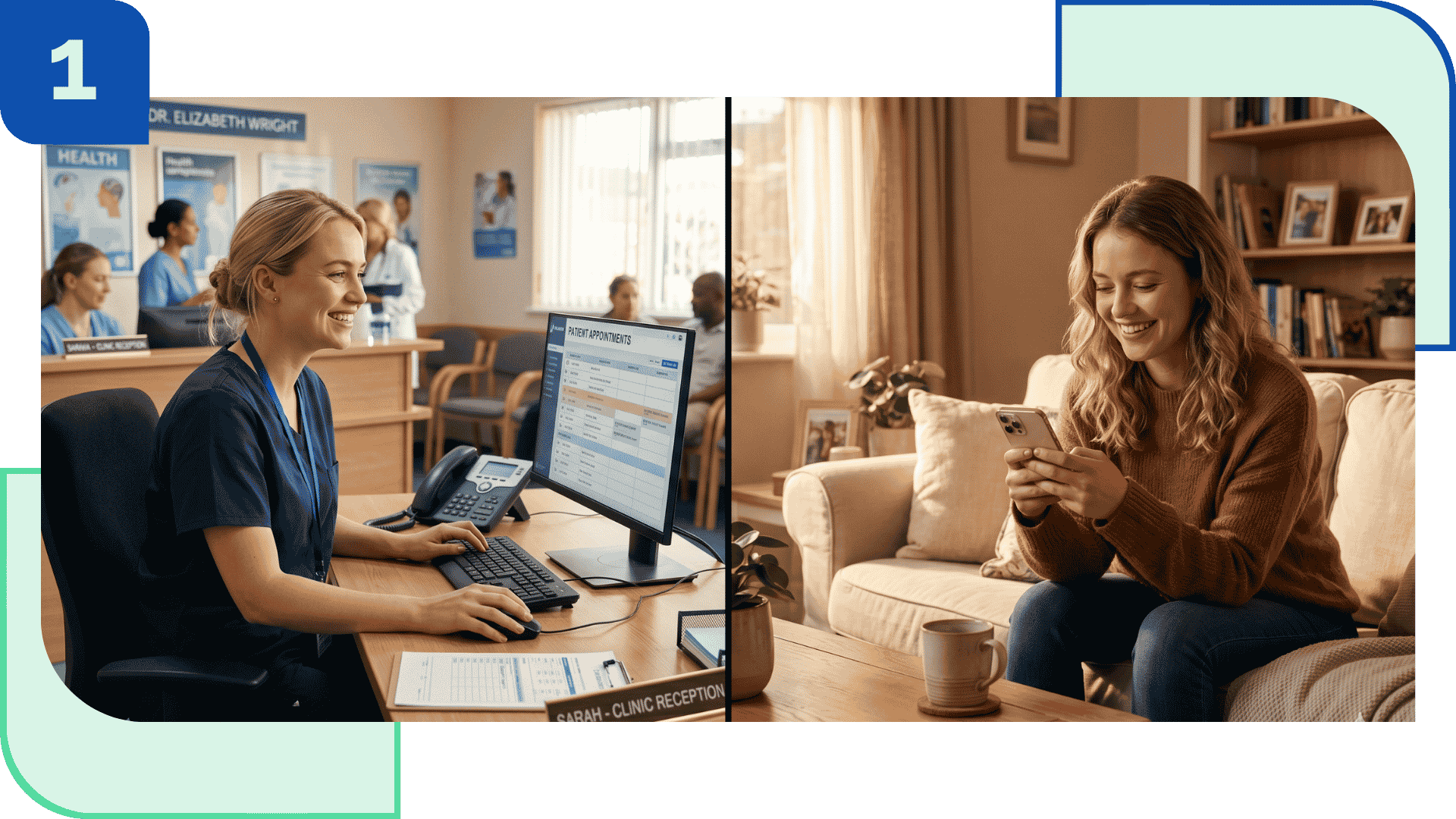
Configurable reminder cadences for IDD services, foster care check-ins, SUD counseling, psychiatric med-management, IOP groups, and residential visits. Route to the caregiver or case manager when that's the right contact. Two-way confirmation via SMS reduces no-shows network-wide.

Digital Intake — Per Program & Per Site
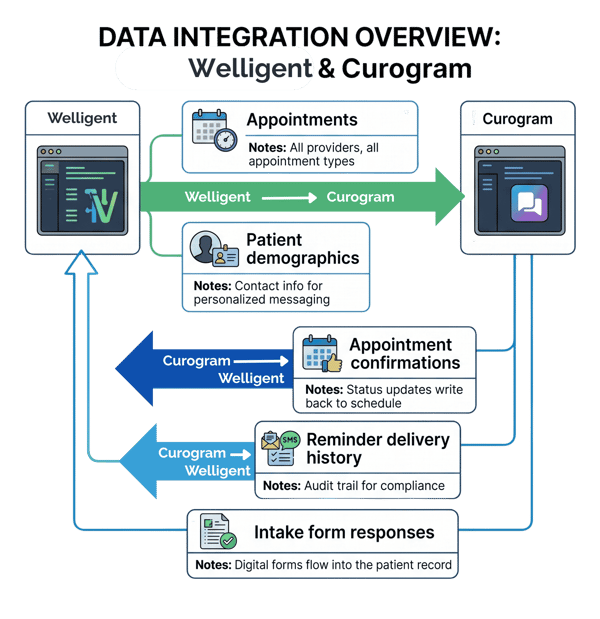
Distinct intake packets for BH, IDD, foster care, and residential intakes — sent via text before the first visit. Consent forms, screeners, and demographics complete on the client's phone. Responses sync to the Welligent client record at the correct location.

Network-Wide Recall Campaigns
Automated SMS recall across the entire network — reach clients who've lapsed from scheduled services, segmented by program, location, and provider. Campaign oversight at the agency level; execution respects each site's contact protocols and consent preferences.

Reputation Management — Every Location
Automated post-visit review requests across every site in the network. Each location's Google profile accumulates reviews in proportion to the care delivered there. Optima Medical grew 993 → 8,159 reviews in 16 months — a 721% increase with 90% five-star ratings.