How to Reduce Front Desk Call Volume with CollaborateMD
💡 Practices that want to reduce front desk call volume with CollaborateMD can cut phone traffic by up to 50% using 2-way texting through Curogram.
10 min read
Mira Gwehn Revilla
:
July 1, 2026
Your front desk is not slow. It is buried under a phone system with one setting: ring.
In a CureMD practice, patients have two ways to reach you. They log into a portal, or they call the office directly. Most skip the portal and just call. So the same questions land on your desk all day, one ring at a time.
That is the trap behind front desk phone tag. A patient calls to confirm a visit. Another calls to ask about a form. A third leaves a long voicemail you must return. Each call takes only minutes, but the minutes stack into hours.
For an office manager, this is the heaviest part of the day. You start behind and stay behind all morning. You measure success in calls cleared, not patients helped. Hiring more staff feels like the only fix, but it is not.
The real gap here is simple. CureMD never lets patients text back. There is no two-way lane, so every routine question turns into a call. The phone becomes a hard ceiling on how many patients you can serve.
Curogram closes that gap for good. It adds HIPAA-compliant two-way texting right beside CureMD. Your team answers, confirms, and reschedules by text, all from one shared screen. Several threads finish in the time one call used to take.
This article shows how CureMD two-way texting for front desk phone call reduction works in practice. You will see where the calls come from and how to turn them into quick text threads.
The goal is not a new system to learn. It is a calmer front desk that serves more patients with the same small front-desk team. Based on our internal data, a comparable practice cut phone volume by 24%. Your staff can feel that same shift too.
Every CureMD front desk runs into the same wall. Patients want to reach you, but they only have hard channels. So they pick up the phone. Here is why that wall keeps your team stuck in phone tag.
CureMD gives patients a portal and an AI contact line. Both are useful tools on their own. But neither lets a patient send a quick text and get a quick reply. A portal needs a login and a password. An AI line still routes back to a call.
So the easy path is always the phone. When patients cannot text back, they call. That single gap drives most of your front desk phone volume. CureMD practices feel it every single morning.
Most patients already text family, friends, and stores. They expect the same option from your office. When you do not offer it, they fall back on calling. The phone becomes the default, not the choice.
Look at the calls that flood a typical front desk. Most fall into a few simple buckets:
None of these need a nurse or a doctor. They need a quick, clear answer. Yet each one rings your phone and pulls a staff member away. That is the heart of the one-way wall.
Walk through a normal start to the day. Three voicemails wait before you even unlock the door. The first caller wants to confirm a 9 a.m. visit. The second caller asks the exact thing you just answered on line one.
A fourth patient sits on hold while you dig through the schedule. None of these calls are hard. They are just constant. This is phone tag, and it never really ends.
Say your desk fields 80 calls a day. Each one runs about three minutes with hold and notes. That is four hours of staff time, gone, every single day.
Add a sick day or a busy Monday, and the line backs up fast. You cannot grow patient volume without adding people. The phone becomes a hard ceiling on your CureMD practice. This is the kind of phone tag staff workload that quietly caps your growth.
|
Daily calls |
Minutes each |
Staff hours lost |
|
40 |
3 |
2 hours |
|
80 |
3 |
4 hours |
|
120 |
3 |
6 hours |
For the office manager, this shapes the whole day. You start behind and you stay behind. You measure the day in missed calls, not patients helped. Good staff burn out on tasks a simple text could solve.
The cost is more than time, though. Long hold times frustrate patients too. Some hang up and never call back. A missed call can mean a missed visit and lost revenue.
It also hides your real numbers. You rarely know how many callers gave up. You cannot see how many booked elsewhere. The phone is a leaky channel, and the leaks stay invisible. The problem is not your team. The problem is one missing channel.
You do not need a bigger team. You need a second lane for talking to patients. That lane is text. Curogram opens it right beside CureMD, so your front desk stops chasing the phone.
Most calls to your desk are simple ones. "Am I still on for Tuesday?" Or, "Can I move my visit?" Or, "Did you get my form?" These do not need a live voice. They need a fast, clear reply.
Curogram lets your staff send that reply by text in seconds. Your front desk shifts from outbound callers to patient coordinators. Instead of dialing back voicemails, they clear quick threads. The work feels lighter because it moves faster.
Your team can answer, confirm, and reschedule by text from one screen. One staff member can run several text threads at once. That is the time one phone call used to take.
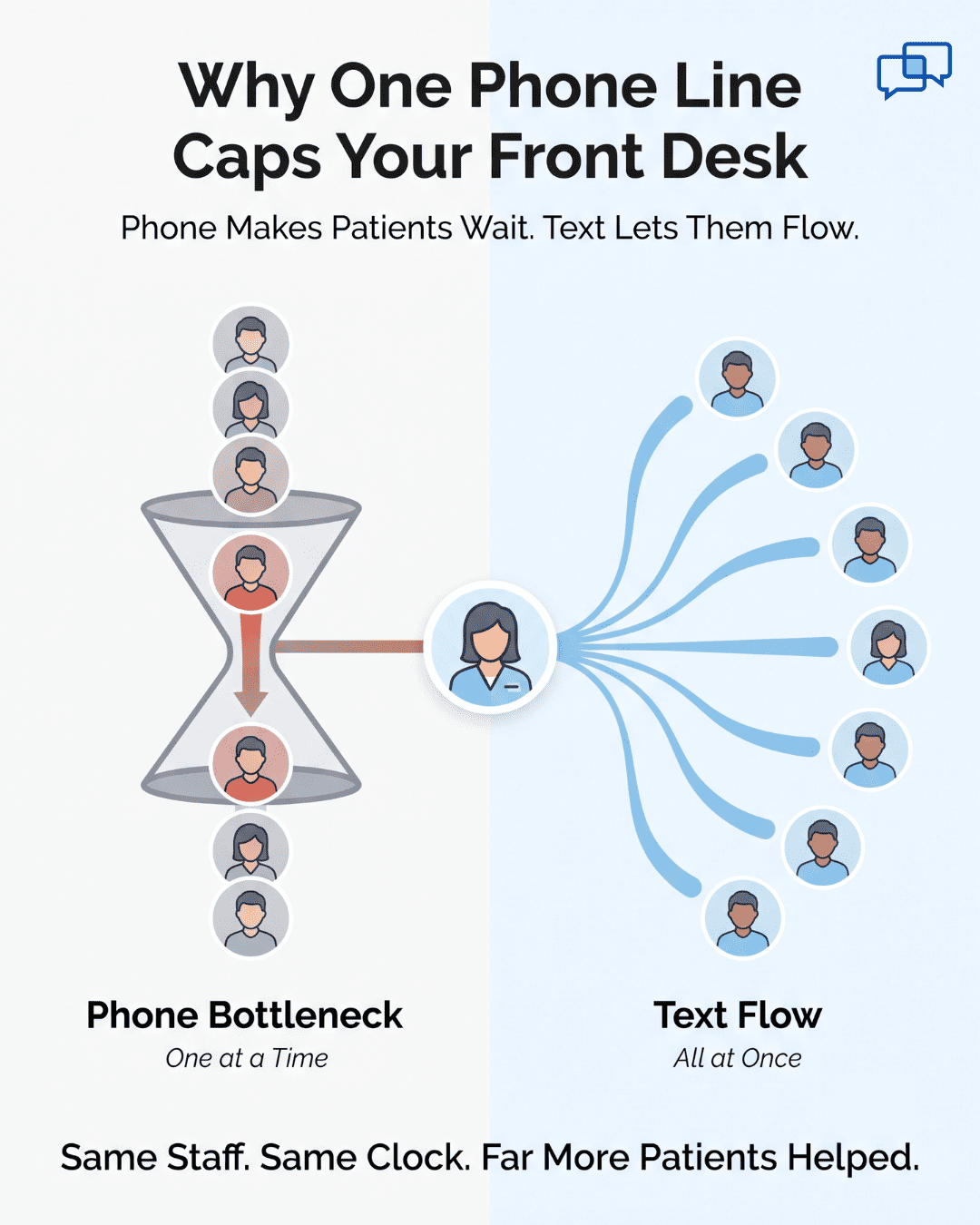
Picture the difference side by side. A phone call holds one person hostage for three minutes. In those same three minutes, a texter can clear five short threads. The math favors text every time.
Every message is secure, encrypted, and logged. You get a clear record for each patient. There are no sticky notes and no lost callbacks. This is a real front desk text messaging workflow built around CureMD.
All of this lives in one place. Your team works from a single CureMD staff texting dashboard, not a stack of apps. They see open threads, recent replies, and who needs a follow-up. New staff learn it in minutes, because it looks like normal texting.
There is no patient app and no portal login to explain. You can also automate patient replies for your CureMD practice. Common questions then get instant, correct answers, day or night. Here are a few replies your team can automate:
Automation does the routine work first. Then your staff step in only when a patient needs a real answer. That split keeps the easy stuff off the phone for good. It also keeps your team focused on the hard, human tasks.
Walk through one quick example. A reminder text goes out two days before a visit. The patient replies, "Can we do Friday instead?" Your staff check CureMD, offer a Friday slot, and lock it in. The whole thread takes under a minute, with zero ringing.
You can also reach many patients with one message. Say a provider calls in sick and you must move ten visits. One mass text can offer each patient a new time. Replies come back, and the schedule is fixed in minutes. By phone, that same task could eat a whole afternoon.

Curogram runs alongside CureMD. You do not swap systems or retrain your whole office. Staff keep CureMD for charting, scheduling, and records.
They use Curogram for the conversations that used to clog the phone. The two work side by side, with no rip-and-replace. For the CureMD office manager, patient communication finally feels organized, not scattered. One dashboard holds every thread in plain view.
Setup is light, too. There is no new server and no months-long project. Your team can start texting in days, not weeks. The learning curve is short because the tool feels familiar.
Every reply is time-stamped and saved. If a patient says no one called, you have the thread. That clarity protects both your staff and your practice.
Per-user access keeps things tidy and safe. Each team member signs in with their own login. You can see who handled which thread. Nothing runs through personal cell phones.
This shift helps any busy desk, but specialty clinics gain the most. In rheumatology or GI, each confirmed slot carries real value. A no-show there is harder to refill on short notice. Two-way texting clears the confirmation queue without adding headcount.
Patients reply to a reminder with one tap, and the slot is locked. A canceled slot can be filled with one mass text to a recall list.
Your high-value schedule stays full, and your staff stay calm. To reduce front desk phone volume, CureMD practices do not need more lines. They need an open one, and Curogram provides it.
When the text lane opens, the front desk feels different fast. Calls drop. Threads move. Staff end the day clear. Here is what that shift looks like, in numbers and in practice.
Based on our internal data, a comparable multi-site practice cut phone volume by 24%. That alone returns hours to a busy desk each week. Many Curogram practices see even more over time, with up to half of routine calls moving to text. The exact number depends on your call mix.
|
Front desk metric |
Before texting |
After texting |
|
Routine calls per day |
80 |
40 to 60 |
|
Voicemails to return |
High |
Low |
|
Slots confirmed |
By hand |
Automatic |
But the direction is always the same: down. Picture a desk that drops from 80 calls to 50. That is 30 fewer calls a day. At three minutes each, that is 90 minutes back, every single day.
Over a five-day week, that adds up fast. Your team reclaims more than seven hours. That is nearly a full shift returned to patient care. And it happens without one new hire.
The old model was synchronous. One staff member, one caller, one line, all at the same moment. Texting is asynchronous instead. Your team handles many threads at their own pace.
A reminder goes out, replies come back, and the schedule fills itself. This is the conversation loop, and it never traps anyone on hold. The rhythm of the day finally calms down. Work flows instead of stacking up.
The real win is capacity. Your front desk handles more patients without new hires. The phone stops being a ceiling on growth. Staff finish the day without a wall of voicemails.
They spend their energy on patients in the lobby, not patients on line two. Morale rises when the phone stops ruling the day. Burnout drops when the busywork moves to text. Happier staff tend to stay longer, too.
When patients can text, they reply more often. That lifts confirmations and trims no-shows. Based on our internal data, Curogram clients keep no-show rates 53% below the industry average.
Confirmation rates also run above 75%. Fewer empty slots means steadier revenue. Think about one recovered slot a day. Over a month, that can be 20 or more saved visits.
Each saved visit protects real income for your practice. And all of it comes from the same staff and the same schedule. There is no extra cost, just a smarter channel. The phone tag simply fades on its own.
The office manager feels this shift most of all. The day no longer starts with a wall of voicemails. It starts with a clean dashboard and a short list of threads. You stop counting missed calls and start counting patients helped.
That change spreads through the whole office. Calmer staff give warmer service. Patients notice the faster replies and feel cared for. The front desk was never broken. It was just missing a channel, and now it has one.

Most front desk tools add steps. Curogram removes them. It gives your CureMD practice one simple thing the portal cannot: a real text reply.
At the center is Curogram Two-Way Texting, a HIPAA-compliant channel built for busy front desks. Patients text the office like they text a friend. Your staff answer from one shared screen. There is no app to download and no portal login to walk anyone through.
Here is how it lifts the load each day. A reminder goes out by text before each visit. The patient taps to confirm or reschedule the slot. That reply updates your team without a single phone call. The slot is locked, and the line stays quiet.
Your staff can also reach many patients at once. Need to fill a canceled slot? Send a quick text to a recall list. Need to share a form? Drop the link in the thread. Each task that once meant a call now takes seconds instead.
Every message is encrypted and logged under a signed business associate agreement. You get a clean, auditable record for each patient. Per-user access keeps the right staff on the right threads. Safety and speed live in one tool, not on personal phones.
Best of all, nothing about CureMD changes at all. Your team keeps charting, scheduling, and billing where they always have. Curogram simply handles the conversations that used to ring the phone all day. The two run side by side, with no rip-and-replace.
The result is a front desk that breathes. Calls drop, threads move, and staff focus on care. For practices tired of phone tag, this is the missing channel. It turns the busiest part of the day into a few quick taps. That is exactly the open line that your CureMD front desk has long waited for.
Your phone problem was never a people problem. Your team is capable and hard-working. They are just stuck behind a channel that only rings.
CureMD does its core job very well. It holds your schedule, your charts, and your records. But it was not built for quick back-and-forth with patients. That gap is why the calls pile up. Patients want a fast reply, and the phone is their only option.
Curogram fills that gap for you. It adds two-way texting right beside CureMD. Think of it this way: CureMD is for your schedule and your charts. Curogram is for their conversations, the ones clogging your lines. Each system does what it does best, and the two work together.
The change for your front desk is real and quick. Routine calls become short text threads. Voicemails shrink, and confirmations climb. Based on our internal data, a comparable practice cut phone volume by 24%, and clients keep no-shows well below average. Your busy staff finally get their hours back each week.
Best of all, you do not rip out a single thing. Curogram runs alongside your current setup. There is no painful switch and no long training. Your team keeps CureMD and gains an open text line right on top of it.
So take the routine calls off your front desk's plate. Give them the channel patients already prefer. Let them spend the day on real care, not on hold music. The fix is one open channel, and your patients already want it.
Ready to see it work? Book your Curogram demo today and we will show how that exact call becomes a simple text thread.
Patients text simple questions instead of calling. Your staff reply from one dashboard in seconds. Reminders, confirmations, and reschedules all happen by text, so most routine calls never reach your phone line at all.
Portals need a login and a few clicks, which many patients skip. Texting feels instant and familiar. When the only easy option is a phone call, patients call, and your front desk fields the whole load.
Texting is asynchronous, so one person runs several threads at once. Common replies can be automated. This frees real time compared to one-call-at-a-time phone tag, letting your team help more patients with the same hours.
Curogram texting is HIPAA-compliant, with encryption, a signed business associate agreement, and per-user access controls. Every message stays logged and auditable. Your staff communicate safely from one secure dashboard, never from personal phones or unsecured apps.
Most practices see routine calls drop almost right away, once reminders and confirmations move to text. Based on our internal data, a comparable practice cut phone volume by 24% as everyday calls became simple text threads.
💡 Practices that want to reduce front desk call volume with CollaborateMD can cut phone traffic by up to 50% using 2-way texting through Curogram.

💡 Reducing front desk phone volume in Modmed practices with two-way texting is possible through Curogram, a HIPAA-compliant SMS platform that runs...
💡 Tebra front desk texting powered by Curogram's unified inbox helps practices reduce phone calls by up to 50%. Here's what it does: Gives...