Text-to-Pay in StreamlineMD: Faster Collections for Imaging Clinics
💡 Text-to-Pay in StreamlineMD lets imaging and vascular practices collect payments faster through secure text messages. Patients get a direct...
10 min read
Mira Gwehn Revilla
:
February 17, 2026
Your front desk phone rings again. A patient wants to confirm an appointment. Another patient is on hold asking about a balance. A third left a voicemail about an insurance card update. Meanwhile, the waiting room is full and check-ins are backing up.
This is the daily reality for most medical offices. The phone never stops, and your team never catches up. Medical office phone fatigue is not just annoying. It is a real drain on your time, your team, and your bottom line.
Here is the problem in plain terms: Every phone call locks one staff member into one task for 3 to 5 minutes. They cannot help anyone else during that time. They cannot check in the patient standing in front of them. They cannot work a claim denial or fix a billing error. That time is gone.
Now, picture a different workflow. Instead of calling, you send a quick text. The patient replies in seconds. No hold time. No phone tag. No wasted minutes. That is what happens when you reduce front desk call volume with CollaborateMD and Curogram working together.
Practices using 2-way texting through Curogram report up to 50% fewer phone calls. CollaborateMD staff productivity jumps by 30% or more.
Tasks that used to eat up your morning, like insurance checks, appointment reminders, and balance follow-ups, now happen through simple text threads.
This article breaks down the math behind why phone calls cost you so much. It shows how asynchronous texting works inside your CollaborateMD workflow.
And it walks through real scenarios where a 30-second text replaces a 5-minute call. If your team is tired of being tied to the phone, keep reading. There is a better way to run your front desk.
Most practice owners know that phone calls take up time. But few sit down and count the real cost. When you do the math, the numbers are hard to ignore.
A phone call creates a strict one-to-one ratio. One staff member can only serve one patient at a time. There is no way around it. While your front desk team member is on the phone, every other patient has to wait.
Think about a typical morning. Your office gets 80 calls before noon. Each call lasts about 4 minutes on average. That is 320 minutes of phone time, or more than 5 hours.
If you have two people at the front desk, they are spending most of their morning just on the phone. That leaves almost no time for check-ins, form handling, or claim work.
|
Now, consider the cost: If a front desk team member earns $18 per hour, those 5 hours of phone time cost about $90 per day. That adds up to roughly $1,800 per month just for routine calls that a text could handle in seconds. Front desk burnout also increases when staff spend all day on the phone, leading to higher turnover and more hiring costs. |
Not every minute on the phone is spent talking. A large chunk of it is dead air. Staff dial a number and wait through 4 or 5 rings. They listen to a voicemail greeting. They leave a message. Then they wait for a call back that may not come for hours, or at all.
This is what it looks like to eliminate phone tag in a medical practice gone wrong. You call. They miss it. They call back. You are busy. They leave a message. You try again.
This cycle can stretch a single task across an entire day. A simple request, like getting an updated insurance card, can take 3 or 4 rounds of phone tag before it is done.
Meanwhile, your team is juggling real-time tasks at the desk. Every ring of the phone pulls their focus. Every voicemail they leave is a loose thread they have to track and follow up on later.
For billing teams, phone calls are even more costly. Every minute a biller spends on the phone chasing down a date of birth, a policy number, or a mailing address is a minute they are not working a denied claim. And denied claims are where the real money is.
|
Let's say your RCM team handles 200 claims per week: About 10% of those, or 20 claims, get denied and need follow-up. Each denial could be worth $150 to $500 or more in lost revenue. If your biller spends 2 hours a day on the phone collecting patient info, that is 2 hours not spent on appeals and resubmissions. |
Over the course of a month, that adds up fast. You could be leaving thousands of dollars on the table simply because your billing staff is stuck on calls that do not need to happen.
The phone was never built for the pace of a modern medical office. It forces a slow, one-at-a-time approach to tasks that could be batched and handled in parallel. Every call is a small bottleneck. Stack enough of them together, and your whole workflow slows down.
The good news is that most of these calls do not require a live voice. Balance questions, appointment changes, form requests, and insurance updates can all move to text. When they do, your team gets their time back, and your practice gets faster.
The fix is simple in concept. Move routine calls to text. What makes it powerful is how it works inside your CollaborateMD setup with Curogram.
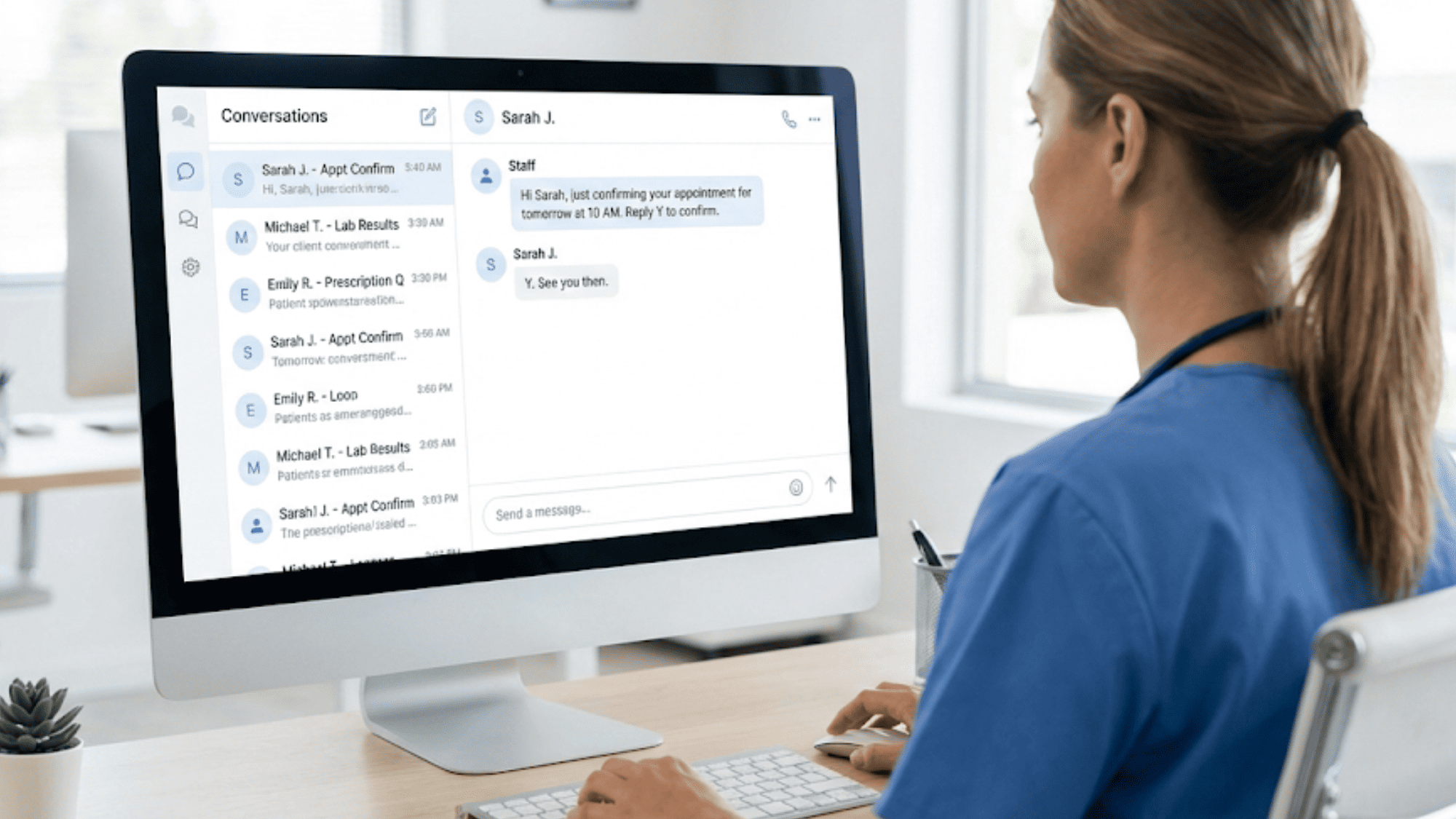
On a phone call, one staff member talks to one patient. With texting, one staff member can juggle 5 to 10 conversations at the same time. Curogram gives your team a dashboard view of all active text threads. It works like email but with the speed of SMS.
|
Picture this: Your front desk person is checking in a patient while also replying to three text threads. One patient is confirming an appointment. Another is asking about a copay. A third is sending over a photo of their insurance card. All three get handled in minutes without a single phone call. |
This kind of multitasking is what drives CollaborateMD staff productivity up by 30% or more. Your team does more with the same number of people.
You do not need to hire extra staff to keep up with growing patient volume. Asynchronous patient communication lets your team respond when they have a free moment, not the instant the phone rings.
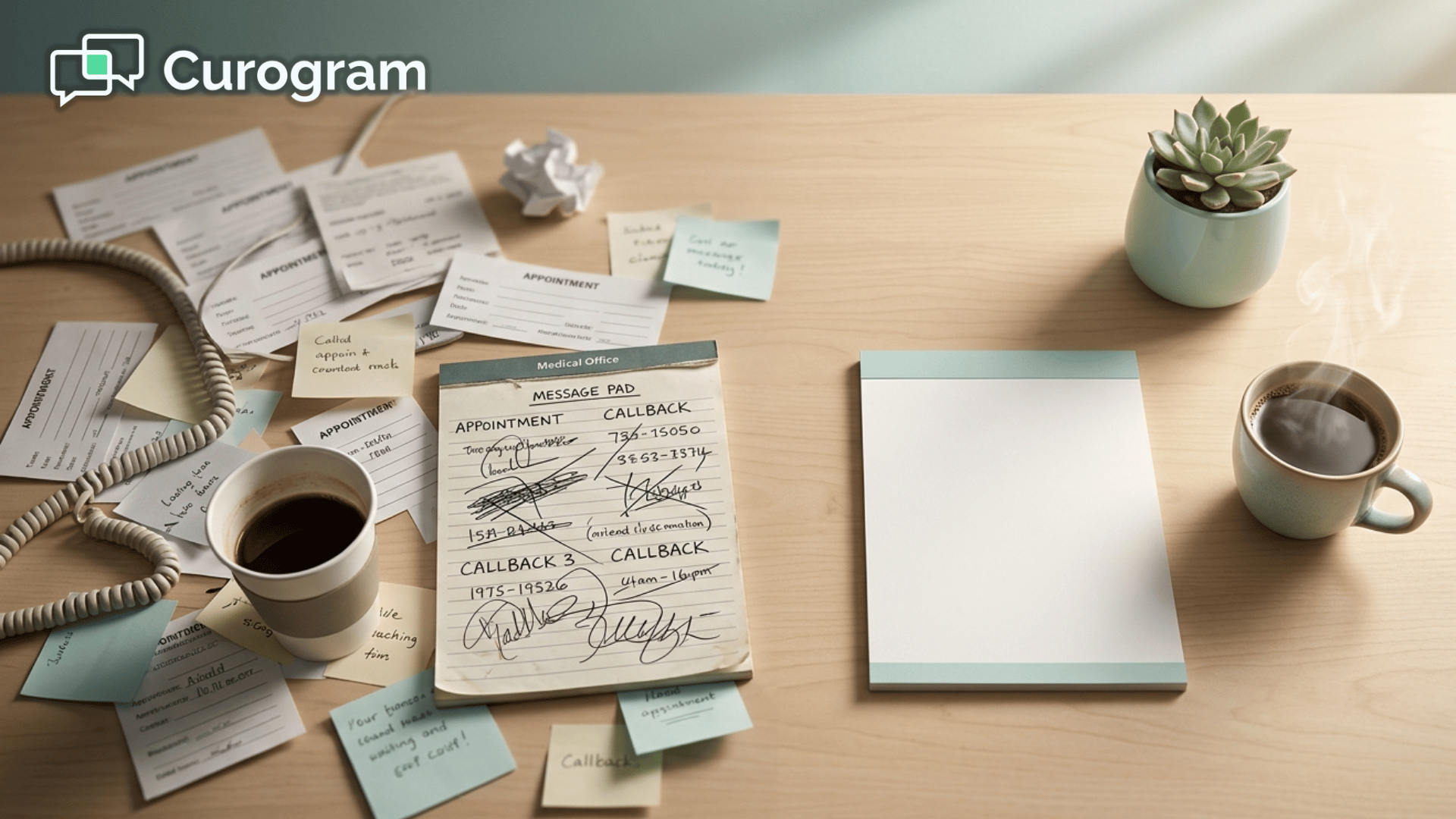
Think about how voicemails work right now. Someone calls, leaves a message, and your team has to listen to it, write down the details, and then call back. Half the time, the patient does not pick up. Now you are stuck in another round of phone tag.
With Curogram, voicemails become a thing of the past. Instead, your team sees a simple inbox of patient texts. Each message is tied to the CollaborateMD schedule, so staff can see who the patient is, when their next visit is, and what they need, all in one place.
Everything is in writing, time-stamped, and easy to search later. This alone saves the average practice 30 to 45 minutes per day in voicemail management.
One of the biggest time wasters in a medical office is call transfers. A patient calls the main line. The front desk answers and figures out the patient actually needs billing.
They put the patient on hold. They try to reach the billing team. If billing is busy, the patient waits or hangs up and calls again later.
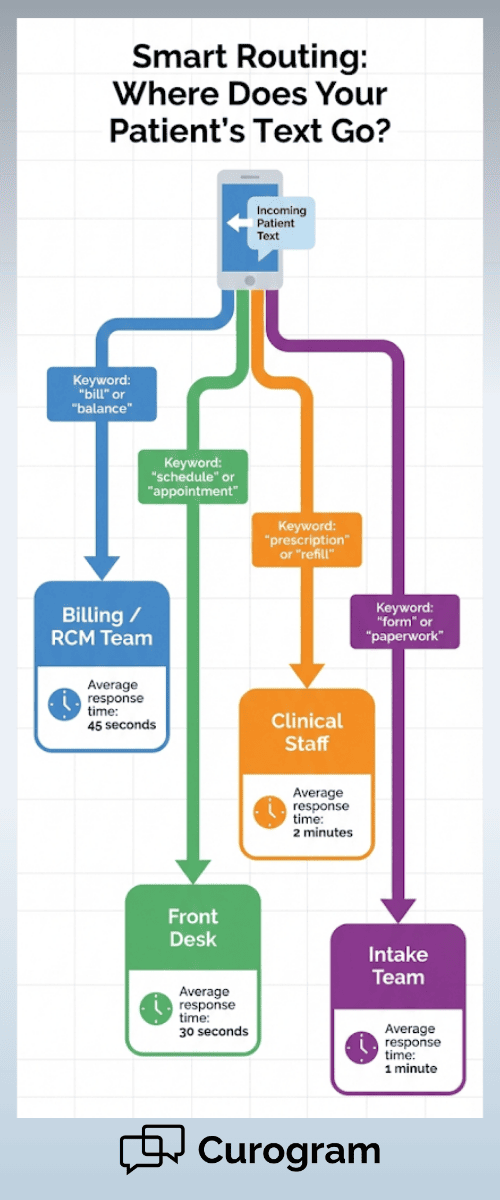
Curogram's smart routing removes this friction. When a patient sends a text, keywords in the message trigger automatic routing. If the text mentions "bill" or "balance," it goes straight to the RCM team. If it mentions "schedule" or "appointment," it goes to the front desk.
The right person sees the right message from the start. This is especially useful for larger practices with separate billing and scheduling teams.
Smart routing also helps with after-hours messages. If a patient texts at 8 PM about rescheduling, the message sits in the scheduling queue ready for your team the next morning.
All of this happens inside a workflow that connects to your CollaborateMD system. Patient data, schedules, and communication stay linked. Your team does not have to bounce between platforms or re-enter data.
The shift from phone to text is not just about saving a few minutes here and there. It is about changing how your office runs.
When routine tasks move to text, your team has the breathing room to focus on high-value work like resolving claim denials, managing complex patient cases, and running a smoother front desk. That is how you scale without adding headcount.

Theory is great. But the best way to see how texting saves time is through real examples. Below are common scenarios that play out in medical offices every day:
This one happens constantly. A patient shows up for their visit, and the insurance on file is outdated. Maybe they switched plans. Maybe their employer changed carriers. Either way, the claim will get denied if you do not fix it before or after the visit.
|
The usual way looks like this: Your front desk calls the patient after the visit. The phone rings four or five times, then goes to voicemail. Your team leaves a message asking the patient to call back with updated insurance info. Hours pass. The patient calls back, but your staff member is on another call. The patient leaves a voicemail. Your team tries again the next day. When they finally connect, the patient reads the numbers off the card over the phone. Your staff types them in, but one digit is wrong because verbal dictation is prone to error. Total time: 2 to 3 days and 15 to 20 minutes of staff time |
|
The new way is fast and simple: Your team sends a secure text through Curogram asking the patient to snap a photo of their new insurance card. The patient sees the text, takes the photo, and sends it back. The image is clear, accurate, and ready to upload. No typos. No back and forth. Total time: under 1 minute |
That is not a small improvement. That is a complete shift in how this task gets done. Multiply this across 10 or 15 insurance updates per week, and you are saving hours of staff time every month.
A patient is stuck in traffic and will be 10 minutes late. In a busy practice, that delay can ripple through the entire schedule if no one knows about it.
|
The old way: The patient calls the main line. They sit on hold while the front desk handles check-ins. After a minute or two, someone picks up. The patient explains they are running late. The staff member checks the schedule, confirms it is okay, and hangs up. The whole exchange took 3 to 4 minutes of phone time, and it pulled a team member away from the patient standing right in front of them. |
|
The new way: The patient texts "Running 10 mins late." Curogram sends an auto-reply that says "Got it, see you soon." Or it alerts the front desk with a quick pop-up. No phone call. No hold time. No disruption to the check-in flow. Total time: about 5 seconds for the patient and zero active time for your staff |
You cannot scale a busy practice or a billing service on phone calls alone. It is not possible. Every call locks a team member into one task for minutes at a time.
Every round of phone tag wastes hours across your week. And every voicemail that goes unreturned is a loose end that costs you money.
A phone call takes 3 to 5 minutes. A text takes 30 seconds or less. One staff member on the phone can help one patient. One staff member on Curogram's texting dashboard can handle 5 to 10 at once.
When you shift routine tasks to text, your CollaborateMD workflow moves as fast as your staff can think. Insurance card updates happen in under a minute.
Balance questions get answered in seconds. Appointment reminders go out on autopilot. Your front desk can finally focus on the patients in front of them instead of being chained to a ringing phone.
This is not about replacing all phone calls. Some conversations do need a live voice. But the vast majority of daily calls, the ones about appointment times, form requests, and billing questions, do not. Those are the calls that create medical office phone fatigue and push your team toward front desk burnout.
Why Curogram Is the Right Fit for CollaborateMD Practices
Curogram was designed for medical offices that want to work smarter, not harder. It connects directly with CollaborateMD so your team does not have to learn a brand-new system or change how they work.
It is fully HIPAA-compliant. Every text, every photo, every form link your team sends is encrypted and secure. You do not have to worry about patient data being exposed through regular SMS.
Curogram is built around the front desk. The dashboard is clean and easy to use. Staff can see all open text threads, reply in seconds, and move on to the next task. It feels natural, like texting from a phone, but with the power and structure of a practice management tool behind it.
Our platform also goes beyond basic texting. It includes automated appointment reminders so patients stop calling to ask when their visit is. It offers digital intake forms so patients fill out paperwork from their phone before they arrive.
It provides text-to-pay links so billing teams can collect balances faster. And it automates review requests so your online presence grows without extra effort from your staff.
For practices that want to eliminate phone tag and end the cycle of missed calls, Curogram delivers a clear path. It turns slow, one-at-a-time phone workflows into fast, parallel text-based workflows. Your team handles more patients in less time with less stress.
The result is a front desk that runs smoother, a billing team that focuses on claims instead of calls, and a patient experience that feels modern and easy. Curogram helps your CollaborateMD practice move at the speed your patients expect.
Every medical office reaches a point where the phones become too much. Your team is stretched thin. Patients are on hold. Voicemails pile up. And the work that actually drives revenue, like fixing denied claims and keeping the schedule full, gets pushed to the back burner.
It does not have to be this way. When you reduce front desk call volume with CollaborateMD and Curogram, you are not just saving time.
You are changing the way your office works from the ground up. Tasks that took 5 minutes now take 30 seconds. Staff who felt buried under calls now have space to focus on what matters.
The shift to asynchronous patient communication is not a trend. It is the new standard for how medical offices run. Patients prefer texting.
Staff prefer texting. And the numbers prove that it works, with up to 50% fewer calls and 30% more output from the same team.
If your front desk is stuck in a cycle of ring, hold, voicemail, repeat, it is time to break free. Texting gives your team the tools to keep up with patient demand without burning out or falling behind.
You owe it to your staff, your patients, and your bottom line. Book a demo now to see how Curogram is built to work hand-in-hand with CollaborateMD.
With Curogram's dashboard, one team member can manage 5 to 10 active text threads at once. That is 5 to 10 times the output compared to one phone call at a time.
Curogram reads keywords in the patient's text and sends it to the right team. A message about a bill goes to the RCM team. A message about scheduling goes to the front desk. No transfers needed.
Regular SMS is not HIPAA-compliant, which puts patient data at risk. Curogram encrypts every message and keeps a full audit trail, so your practice stays protected while still using the speed and ease of texting.
💡 Text-to-Pay in StreamlineMD lets imaging and vascular practices collect payments faster through secure text messages. Patients get a direct...
💡 HIPAA compliant texting for CollaborateMD lets billing teams replace slow phone calls with instant, secure SMS. Curogram plugs into your RCM...
💡 Secure patient communication in Allscripts cuts phone chaos while keeping patients valued. By using HIPAA-compliant texting, you can: Shift...