
Multi-Location Automation for Large BH Agencies on Welligent
 Aubreigh Lee Daculug : Jun 27, 2026, 9:00:00 AM
Replace site-by-site workarounds with centralized communication automation across your entire Welligent network.
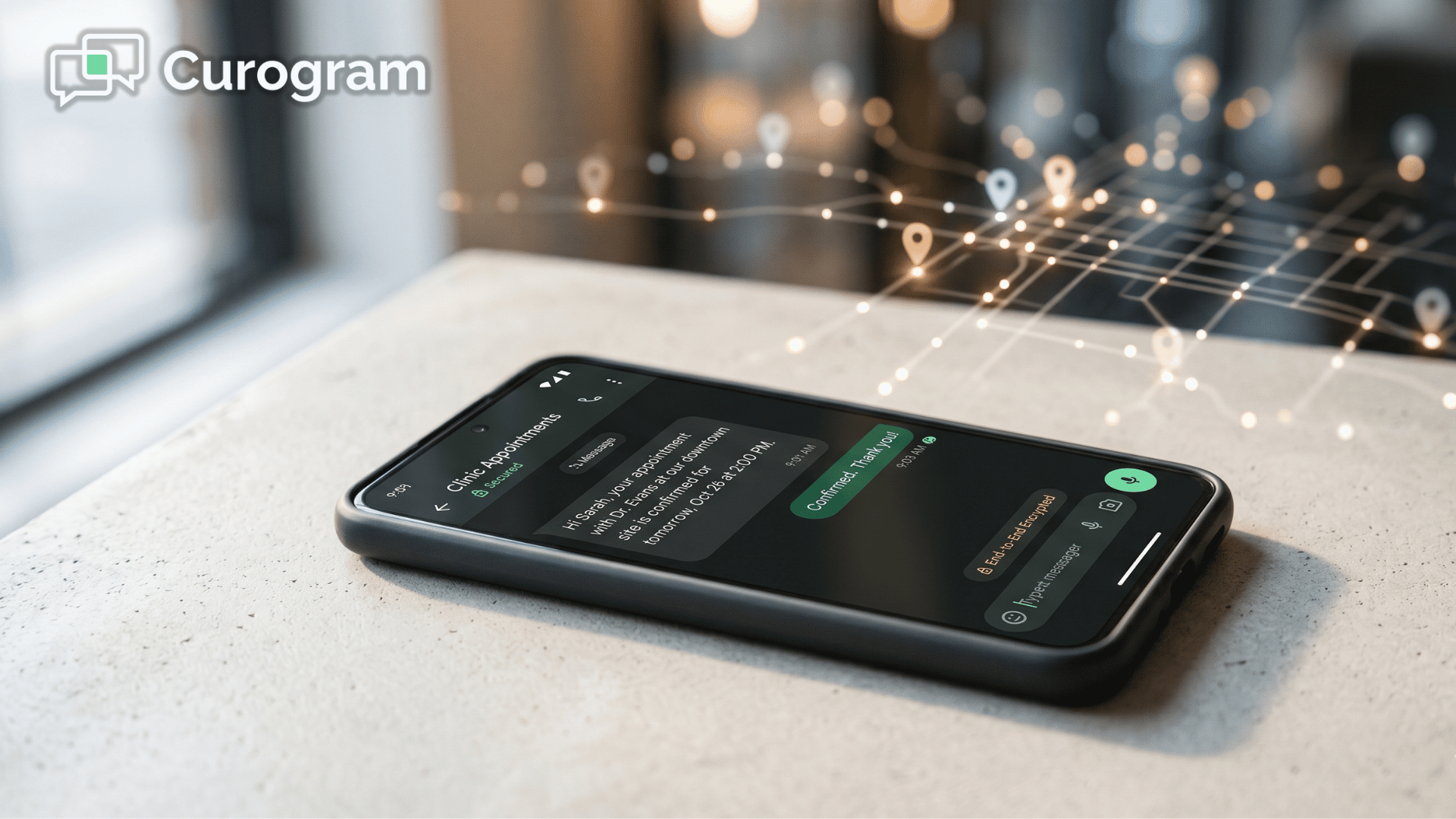
Your front desk just texted a patient from a personal cell phone. It felt harmless. It wasn't.
Across a growing behavioral health agency, small habits like that stack up fast. One site texts from a staff member's phone. Another leans on a consumer app. A third has a one-way reminder tool nobody else uses.
Curogram for Welligent brings order to that sprawl with HIPAA two-way texting built for BH agencies running on Welligent.
Here is the uncomfortable part.
Every one of those workarounds is a compliance gap. The more locations you add, the more gaps you carry without recognizing them.
Think about what happens after a reminder goes out. A patient replies with a question. On a one-way system, that reply lands nowhere and your team never sees it. The patient feels ignored, and the message slips into a void.
That is not a rare edge case. It is the everyday reality of a one-way system at scale, and it steadily erodes the trust your programs depend on.
Now multiply that by every location you run. A 5-site agency has five quiet failure points. A 30-site agency has thirty. Each one stays invisible to your compliance team until something goes wrong.
That gap is more than an operational headache. It puts patient trust, your accreditation standing, and your reputation at risk.
The good news is that the fix is clean. You do not need a different tool at every site. You need one secure platform that works the same way everywhere, with full visibility for the people who answer for compliance.
This article shows what that looks like in practice. We will cover where the risk hides, what compliant texting really requires, and how it changes daily life for your staff and your patients.
Large behavioral health agencies share a quiet problem:
Each location invents its own way to talk to patients. Some staff text from personal phones. Some use iMessage or WhatsApp.
A few sites have a one-way reminder tool, but it changes from place to place.
None of these are HIPAA compliant. Personal phone texts are not encrypted, not logged, and not covered under a Business Associate Agreement, or BAA. Consumer apps like iMessage and WhatsApp are flatly off-limits for protected health information.
The trouble is that each shortcut feels reasonable in the moment. A staff member just wants to answer a patient quickly, so the habit spreads before anyone stops to question it.
Here is what makes this so risky at scale.
The danger grows with every location you add. Five sites mean five sets of informal habits, and thirty sites mean thirty. Each one runs its own way, and most stay invisible to agency leaders until there is an incident.
Remember that patient reply that lands nowhere?
In a single clinic, that is an annoyance. In a multi-location network, that void becomes a compliance blind spot you cannot see or measure.
Run the math another way. If just two staff members at each of 20 sites text patients from personal phones, that is 40 unmonitored channels carrying PHI every day.
None of them show up on a report, and none can be reviewed if a complaint ever lands.
This means the bigger your agency gets, the harder it is to prove you communicate safely. And in behavioral health, where sensitive information is the norm, that proof is everything.
Compliant texting at agency scale is not one feature. It is a short list of things that all have to be true at once, at every location.
.png?width=1080&height=1350&name=HIPAA%20two%20way%20texting%20BH%20agency%20Welligent%20-%20mid%20(1).png)
Here is what the standard really requires:
That last point matters more than it looks. Central does not mean one giant shared inbox. It means consistent rules with local control.
Notice that these are not features you pick from a menu. Miss any one of them and the whole chain breaks. An encrypted message with no audit trail still leaves you unable to prove what was said, and central oversight means little if one site quietly keeps using a personal phone.
When all five of these are in place, your agency stops leaning on trust and starts leaning on proof. That is the difference between hoping you are compliant and knowing you are.
So how does this work in the real world?
Curogram delivers HIPAA two-way texting across your whole Welligent network from a single platform, with views tuned to each role.
Every location gets two-way texting from the phone number it already uses. Patients text the number they know, and your staff handle replies right there. Nothing changes for the patient, and nothing gets reinvented site by site.
This matters because patients rarely notice the technology behind a text. They notice whether someone replies. Keeping each location's familiar number lets you upgrade the back end without retraining a single patient.
Agency leaders see network-wide numbers — message volume, response times, reminder delivery rates — without reading individual patient chats. You get oversight, and patients keep their privacy.

Appointments and patient records sync straight from Welligent. That powers tailored messages and automatic reminders, and confirmation status writes back to the schedule. No double entry, no guesswork.
Setup stays consistent too. Reminder templates and message formatting look the same across the network, while each site can still tweak them for its own programs.
One number tells the rollout story.
Curogram users report a 94% user adoption rate (G2 Spring 2026, third-party verified), which reflects a 10-minute staff training step.

For a network rolling out across dozens of sites, fast adoption is not a nice extra. It is what makes the rollout finish on time.
Here is why that number matters in practice.
A tool only protects you when people actually use it. If even a handful of staff slip back into old habits, the compliance gap reopens — so reaching near-universal use quickly is the entire point.
Wondering how this stacks up against other tools?
Here is a quick look at Curogram vs Klara:
| What matters at agency scale | Curogram | Klara |
|---|---|---|
| EHR flexibility | EMR-agnostic; works with BH-native systems like Welligent | Focused on athenahealth and Veradigm |
| BH-native support | Yes | Welligent not supported |
| Multi-location rollout | Single platform across all sites | Built around AI patient routing |
In plain terms, Klara is built for a different stack. If your agency runs on Welligent, Curogram is the option that actually fits.
Switching to one secure platform does more than check a compliance box. It reshapes how your agency runs day to day.
Here is what changes:
Consider what that means over a year. If centralized texting saves each front desk just 30 minutes a day on chasing confirmations and retyping appointment details, a 20-site network reclaims roughly 2,600 staff hours annually. That is time your people can spend with patients instead of phones.
For your team, that adds up to less worry and less cleanup. For your patients, it means a clinic that feels organized and responsive.
And for your agency, it means walking into an audit with answers already in hand.
Let's bring this back to where we started.
A text from a personal phone felt harmless, but it was a crack in your compliance wall. Across a multi-location agency, those cracks multiply faster than anyone can track.
The fix is not more rules or more reminders. It is one secure system that works the same way at every site, with full visibility for the people who answer for compliance.
HIPAA two-way texting for BH agencies on Welligent gives you exactly that. You get encrypted, auditable messages from each location's own number. Reminders pull straight from Welligent. A central dashboard shows leaders what they need without exposing what they should not see.
Think about the time your team spends today patching together personal phones, consumer apps, and one-off reminder tools.
Now picture all of it replaced by a single platform your staff can fully learn in 10 minutes. That is not a small upgrade. It is a different way of working.
The payoff is real on every front. Patients stop getting ignored when they reply. Staff stop improvising on their own. And your compliance team stops bracing for the next surprise.
Most agencies expect a rollout like this to drag on for months. In practice, initial deployment runs about 2 to 4 weeks. Curogram's team configures the Welligent integration and sets up each location with its own message queue.
That short timeline matters, because every week your locations stay on personal phones is another week of exposure you cannot fully account for.
You have seen the risk, the requirements, and the results. The next step is seeing it run on your own network.
Book a Demo to watch Curogram's HIPAA two-way texting work across your Welligent-based agency, all from a single platform built for behavioral health.
 Aubreigh Lee Daculug : Jun 27, 2026, 9:00:00 AM
Replace site-by-site workarounds with centralized communication automation across your entire Welligent network.

 Jo Galvez : Jun 18, 2026, 3:00:00 PM
Meet psychiatry patients on their phones with HIPAA-compliant two-way texting that complements Valant's portal.
 Jo Galvez : Jun 10, 2026, 10:00:01 AM
Replace personal-phone workarounds with HIPAA-compliant two-way texting for your ketamine or TMS practice.