

7 min read

Multi-Location Automation for Large BH Agencies on Welligent

Multi-Location Automation for Large BH Agencies on Welligent
💡 Multi-location automation for behavioral health agencies on Welligent replaces the patchwork of reminder tools, phone calls, and personal-phone texting that builds up site by site.   

It runs reminders, two-way texting, intake, and recall from one platform, while each location keeps its own queue and phone number. 

Curogram connects to Welligent through proprietary connectors and HL7 v2 sync.

Appointments, patient records, and confirmations move across every site automatically, and leadership sees network-wide metrics in a single view.
 

The result is a consistent patient experience at every office, far fewer manual calls, and one HIPAA-compliant system instead of dozens of disconnected workarounds. New sites plug in with their own number and templates in days, not months.


Your agency runs on Welligent. Your patient communication runs on duct tape. And that mismatch quietly works against you at every site, every day.

One location uses a one-way reminder service. Another still calls every patient by hand. A third has a staff member texting from a personal phone, because that is what works there. None of these tools talk to each other, and none of them write back to Welligent.

That gap is where money and goodwill leak out. Curogram's Welligent integration was built to close it, giving every site one shared system instead of a dozen private ones.

Here is the part most agencies underestimate.

The problem is not any single location. It is that every location solved the same problem in a different way.

So your front desk teams are all busy, your patients get a different experience depending on which office they walk into, and leadership has no clear view of what works. Multiply one office's workload by twenty, and the cost stops being an annoyance. It becomes a budget line.

This is the case for multi-location automation for behavioral health agencies on Welligent. Not as a nice-to-have, but as the thing that lets a growing network stay consistent without hiring a small army to manage it.

Done right, it pays for itself in recovered hours.

In the next few minutes, you will see why these workarounds form, what centralized automation looks like in practice, and how it deploys across a Welligent network. You will also see real numbers from a real client.

The goal is simple. By the end, you should be able to picture your own network running on one platform, and know roughly what that would save you. No hype, just a clear before-and-after.

So let me get specific about all of it.

Why Every Office Ends Up With Its Own System

Large behavioral health agencies on Welligent often run 10, 20, or 50+ locations. Each site has its own front desk, its own patient mix, and its own informal habits for reaching people. Nobody planned for fragmentation. It just grew.

It is easy to see how. When there is no single system handed down from the top, each front desk reaches for whatever gets patients in the door.

A reminder app here, a phone tree there, a personal cell when nothing else is set up. Every choice is reasonable on its own.

Walk three offices in the same network and you will likely find three different setups:

  • Location A leans on a one-way reminder service that cannot accept replies.
  • Location B still confirms appointments by phone, one call at a time.
  • Location C runs on a staff member texting from a personal phone.

Each of these "works" in isolation. None of them connects to the others, and none of them feeds confirmations back into Welligent. So the same patient can get reminded twice at one site and not at all at another.

Now look at the volume. One agency leader put it plainly:

"Our front desk is fielding 80+ calls a day just for directions and confirmations." That is one office.

Stretch that across a 20-location network and the math turns ugly fast. Eighty calls a day per site becomes roughly 1,600 calls a day across the agency. At about three minutes each, that is near 80 staff-hours every single day spent on the phone.

Over a 250-day work year, that is around 20,000 hours. For your team, that is the equivalent of several full-time roles doing nothing but confirmations and directions. This means the real cost is not the tools. It is the thousands of hours and the uneven patient experience hiding behind them.

There is a quieter risk, too.

That staff member texting from a personal phone is not just inefficient.

Those messages are not logged, not encrypted, and not covered by a business associate agreement.

Across a 20-location network, that is a compliance gap you cannot even see, let alone fix.

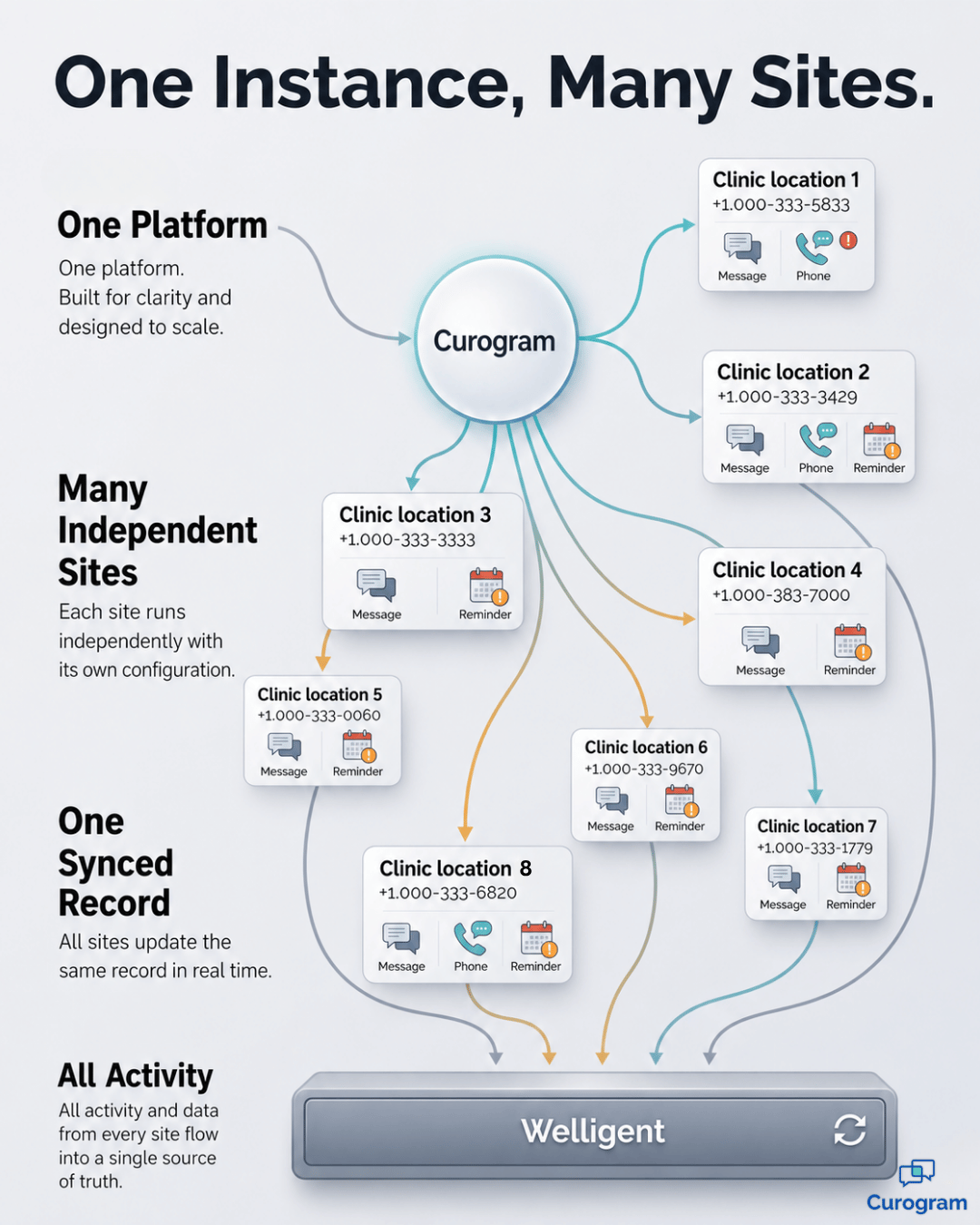
Hub-and-spoke infographic showing Curogram syncing multiple clinic sites to one Welligent system

What One Connected System Actually Looks Like

Centralized does not mean rigid. It means every location plays from the same sheet of music while keeping control of its own day.

One platform, location-level views

Agency leadership sees the whole network at a glance:

Reminder delivery rates, confirmation rates, and no-show trends across every site.

Meanwhile, each front desk manages only its own patient queue. You get oversight without micromanaging.

That split matters more than it sounds. Leadership stops chasing status updates from twenty offices, and each site stops waiting on headquarters to act. Everyone works from the same live picture.

A consistent patient experience

Every location sends reminders with the same timing, the same formatting, and the same two-way texting. The message is shaped by program type, not by which staff member happened to remember the call.

Patients get the same clear experience whether they visit your oldest office or your newest one.

101 → 479

Google reviews earned after River Valley FQHC put every site on the same connected communication.

Compliance that travels with you

Every text, every reminder, and every intake form across every site is encrypted, logged, and BAA-covered. It all runs on one HIPAA-compliant foundation, so compliance is not something each location has to reinvent. That is one less thing to worry about as you grow.

Put simply, the day-to-day at the front desk barely changes, but the structure underneath it does.

Each site still owns its own patients and its own schedule. The difference is that they are all building on the same foundation instead of their own.

Care coordinator warmly greeting an arriving client in a bright behavioral health clinic lobby

How Curogram Rolls Out Across Your Welligent Network

Curogram links to Welligent through proprietary connectors and HL7 v2 sync. That keeps appointments, patient records, and confirmations aligned across all locations, with no manual re-entry between systems.

The deployment model is simple.

Curogram runs as one instance, and each location gets its own setup configured inside that same platform:

  • Its own phone number
  • Its own communication queue
  • Its own reminder templates

For agencies with 20+ sites, a phased rollout works best: start with three to five pilot sites, validate the workflows, then expand network-wide.

None of this asks your teams to abandon Welligent. The integration runs alongside it, syncing in the background while staff keep working the way they already do. There is no rip-and-replace, and no months-long migration to survive first.

Worried this means a long, painful enterprise project? It doesn't have to.

Here is how Curogram compares to a more traditional enterprise option:

  Curogram Relatient
Built for Behavioral health agency networks Large enterprise health systems
Deployment style Location-level customization from day one Complex, multi-phase rollouts
Typical timeline 2–4 weeks per location group Longer enterprise cycles

You can dig into the full breakdown on the Curogram vs Relatient comparison.

Real-world proof helps here. River Valley FQHC runs two separate systems, Medical and Dentrix, and both were integrated with Curogram from day one. The clearest win showed up exactly where the manual workload was heaviest:

↓ 24%

Phone call volume at River Valley FQHC over 22 months.

For your team, River Valley is the proof point that matters: multi-system, multi-location deployment working at full clinical scale. If it holds up across two EMRs and many sites there, it can hold up across yours.

The takeaway for a Welligent network is not the exact numbers. It is the pattern.

Give every location the same tools, let automation absorb the repetitive work, and the gains tend to show up in call volume, reviews, and reputation at the same time.

What Shifts Once Everything Runs in One Place

When communication is centralized, three things change almost immediately:

  1. Leadership gets real visibility. COO-level dashboards show which locations carry the highest no-show rates, which lag on patient recall, and where phone volume is still too high. You manage by data, not by gut feel.
  2. Staff stop relearning the wheel. A new hire at any office trains on the same platform in about 10 minutes. There are no location-specific workarounds to memorize, which makes onboarding far less painful.
  3. Growth gets easier. When you open a new location, Curogram simply adds it with its own number and queue. No new system to evaluate, no new integration to build.

Put those together and the pattern is clear. The bigger your network gets, the more a single platform pays off, because every new site inherits a proven setup instead of inventing its own.

In practice, that is the difference between scaling smoothly and scaling into chaos.

There is a financial side to this, too. Every call your team does not have to make by hand is time handed back to patient care. Spread across a 20-location network, even a modest drop in call volume can free up thousands of staff hours a year.

For your team, that is capacity you can redirect instead of headcount you have to add.

Ready to See It on Your Own Welligent Instance?

You do not have to overhaul your whole network on day one.

For most agencies, the smart path is a phased rollout. You start with three to five pilot sites, confirm the workflows fit how your teams actually work, then expand. Initial locations are usually live in two to four weeks, with a full network rolling out over four to eight weeks.

That timeline matters, because it means you can prove the value before you commit the whole organization. You are not betting the agency on a big-bang launch. You are testing, learning, and scaling on your own terms.

Here is what changes once you do.

Your front desk teams stop reinventing the same reminder process at every site. Your patients get the same clear experience at every office. And your leadership finally sees one dashboard instead of twenty inboxes.

The River Valley results are a useful preview. A 24% drop in call volume, a review count that grew from 101 to 479, and a rating that climbed to a perfect 5.0. Those numbers came from giving every location the same connected tools and letting automation handle the repetitive work, day in and day out.

If you run a behavioral health network on Welligent, the question is not whether your sites need this. It is how much the current patchwork is quietly costing you each month, in staff hours, missed visits, and uneven patient experience.

So let's put real numbers against your own network. See how Curogram serves behavioral health clinics, then bring your specific setup to the conversation.

Book a Demo, and we will walk through exactly how multi-location automation for behavioral health agencies on Welligent would map to your locations and your programs. You bring the network; we'll bring the numbers.


Frequently Asked Questions

Can Curogram really run across 20 or 50 locations on one Welligent instance?

Yes. Curogram deploys as a single instance, and each location gets its own phone number, queue, and reminder templates inside that same platform. Leadership sees the whole network, while each site manages only its own patients.

Will it write confirmations and updates back into Welligent?

It will. Curogram syncs with Welligent through proprietary connectors and HL7 v2, so appointments, patient records, and confirmations stay aligned across every site. Your staff are not re-keying data between two systems.

How long does setup actually take?

Initial locations typically go live in two to four weeks. For large agencies, a phased rollout across the full network usually lands in the four-to-eight-week range, starting with a few pilot sites first.

Is patient texting HIPAA-compliant across all sites?

Yes. Every text, reminder, and intake form is encrypted, logged, and BAA-covered on one HIPAA-compliant foundation. Compliance is built into the platform, so each location does not have to manage it separately.

What happens when we open a new location?

You add it to the existing platform with its own number and communication queue. There is no new system to evaluate and no new integration to build, so new sites launch with a proven setup from day one.


Reducing Phone Call Volume for Welligent-Based Networks

Reducing Phone Call Volume for Welligent-Based Networks

💡 To reduce phone calls for a behavioral health network running on Welligent, give patients a channel that is faster than the front desk: two-way...

Read More
Veradigm Staff Text Dashboard | End the 80-Call Day

Veradigm Staff Text Dashboard | End the 80-Call Day

💡 A Veradigm EHR HIPAA texting dashboard lets staff handle patient needs via secure text—no portal login. Cuts calls 40–60% and saves up to 7 staff...

Read More
Notenetic Portal vs. SMS: Why Clients Choose Text

Notenetic Portal vs. SMS: Why Clients Choose Text

💡 Looking for a Notenetic client portal alternative? SMS messaging for mental health clients works because it meets people where they already are —...

Read More