1 min read
Remote Patient Engagement SMS: Best Practices for Virtual Clinics
💡 Remote patient engagement SMS allows virtual clinics to send secure, timely reminders, updates, and follow-ups directly to patients’ phones. Using...
6 min read
Gregory Vic Dela Cruz : Updated on September 28, 2026
After-hours calls are mostly routine, which is exactly why they get lost. A parent wants to move a morning sick visit. A patient needs a refill before the weekend. Someone new to town is calling three offices to see who answers.
Each of those callers needs two things: proof the office got the message, and a clear next step. Without both, the rebooking, the refill, and the new patient drift somewhere else.
Our position is simple. Most practices should fix missed-call texting and voicemail handling before they buy an AI voice agent. The first is cheap, logged, and ready today. The second is improving fast, and it arrives with consent and disclosure rules attached.
In a 2024 Commonwealth Fund survey, only half of older Medicare patients who needed off-hours care could get it. Just two in five could book a sick visit within two days. The same brief links better off-hours access to less improper emergency room use.
Only that last group needs clinical judgment tonight. The rest need a logged request and a callback when the office opens.
Sorting those four by morning is the whole job. Missed calls in the first three groups cost you a visit. Missed calls in the fourth can cost far more, which is why the emergency path comes first in any setup.
Unanswered after-hours calls cost visits, trust, and staff time. The numbers people quote about them are shakier than they look.
Two figures show up on almost every page about this topic. One says 62% of calls go unanswered. That number comes from a 2016 test by the marketing firm 411 Locals. It covered 85 small businesses across 58 industries, and none were medical offices.
The other claims 45% of calls to dental offices occur outside standard business hours. We couldn't trace that one to any published study, so treat it as an estimate. Your own phone system's call report is a better baseline.

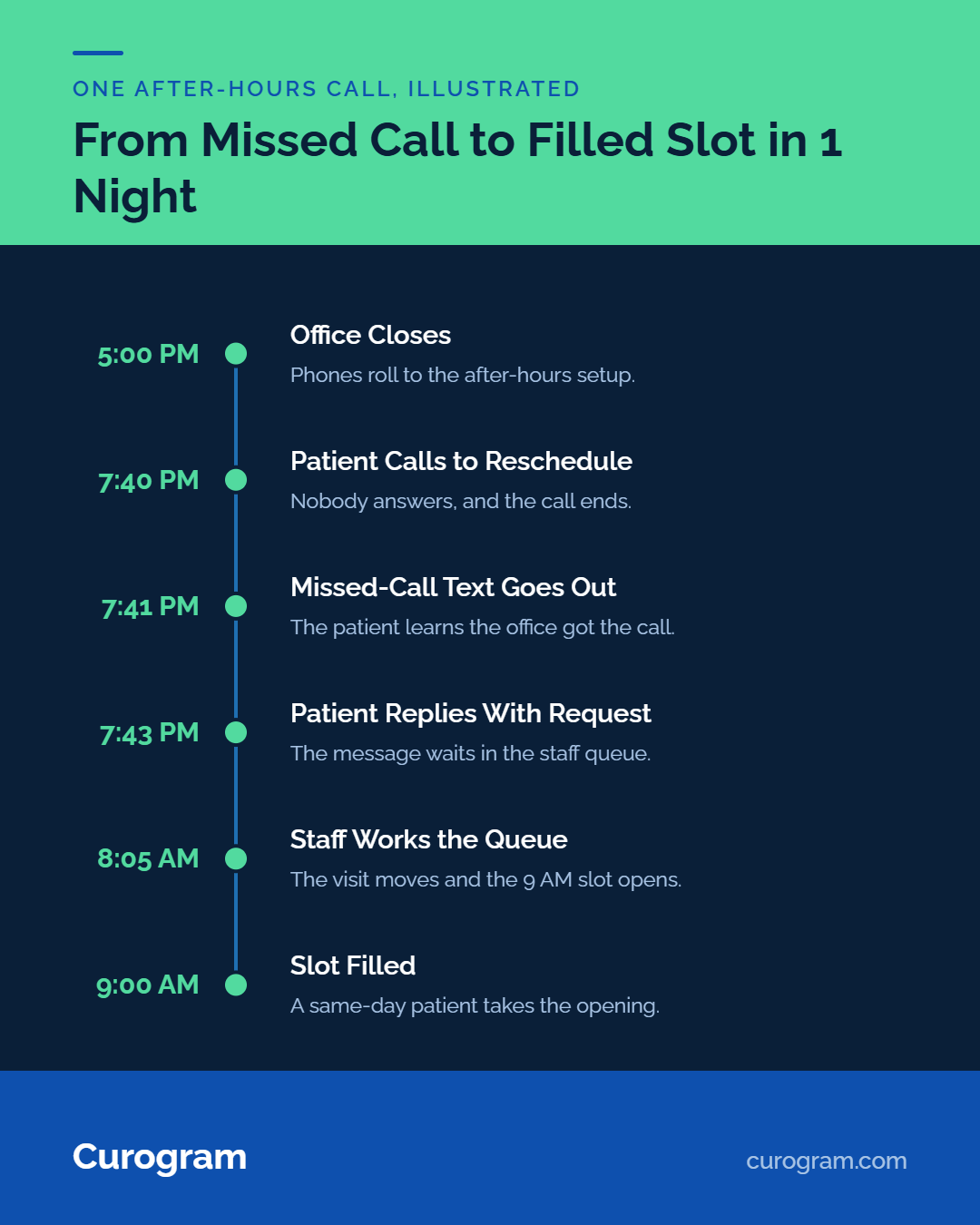
Run one call through three setups. At 7:40 p.m. on a Tuesday, a patient calls to move Wednesday's 9:00 a.m. visit. The example is illustrative.
|
Setup |
What the patient gets |
What staff find at 8 a.m. |
|---|---|---|
|
Voicemail only |
A greeting and a beep, with no sign anyone will hear it |
A message to play, write down, and return by phone, often after the 9:00 slot is already lost |
|
Answering service |
A live operator who takes a message |
A written note that still needs a callback, plus a monthly bill for the service |
|
Missed-call text and auto-reply |
A text within a minute saying the office got the call |
A text thread with the request, ready to rebook before 9:00 |
The text path works because the reply confirms the call landed and gives clear subsequent actions. A solid version reads: "Thanks for calling Maple Street Family Medicine. We open at 8 a.m. and will text you back then. For a medical emergency, call 911."
Keep it free of clinical detail, since standard SMS isn't encrypted. Templates like this one sit inside HIPAA-compliant texting workflows in NextGen clinics, next to the escalation step for urgent messages.
AI voice agents answer the phone in a natural voice, ask what the caller needs, and book or route the request. For routine calls, that removes the voicemail step.
In February 2024, the FCC ruled that AI-generated voices count as artificial under the TCPA, so outbound AI calls need patient consent. Recordings and transcripts from any AI call are PHI, which keeps HIPAA compliance and a signed BAA on the checklist.
Better after-hours patient care pays off the next morning, in the schedule and at the front desk. Patients feel it the same night.
Voice AI is moving fast, and so are the rules. California's AB 3030 requires a disclaimer on AI-generated messages about clinical information unless a licensed provider reviews them. Since January 1, 2026, Texas has required providers to disclose AI used in patient care.
Whatever you add should sync with your EMR, as Curogram does with eClinicalWorks, so an overnight request lands on the real schedule. For most practices, 24/7 patient communication means every contact reaches a place staff will check by morning, and urgent calls get routed right away.
Curogram Highlight: Missed Call and Voicemail to TextCurogram's Missed Call and Voicemail to Text covers the after-hours gap today. When a call goes unanswered, the patient gets an automatic text and can keep the conversation going without holding. Voicemails are transcribed and appear in the staff dashboard, where the team can text the patient back. After hours, an automated reply confirms the call came in and says when to expect a follow-up. It works with VoIP systems including RingCentral and Dialpad. Every thread lives on a platform that's HIPAA compliant and SOC 2 Type II certified. See how missed-call texting works. |
After-hours patient communication is mostly a sorting job. Acknowledge fast, capture the request, and escalate the rare urgent call. Practices that get missed-call texting and voicemail handling right already have most of the benefit.
Buying live answering before that base is in place mostly moves the backlog, since someone still has to act on each request the next morning. When you do add voice AI, check three things first. Look at how it handles consent, what its disclosure script says, and whether it writes to your schedule.
Book a Curogram demo to see missed-call texting and after-hours auto-replies running on your own phone system.
Standard SMS isn't encrypted, so symptoms, drug names, and test results don't belong in an automated text. Keep the reply generic, and move anything clinical to secure messaging where the patient verifies identity first.
1 min read
💡 Remote patient engagement SMS allows virtual clinics to send secure, timely reminders, updates, and follow-ups directly to patients’ phones. Using...
1 min read
💡Conversational AI for patient follow-up and engagement sends two-way texts that patients answer with a word or a tap. A YES or STOP is handled at...