
1 min read
What Is Patient Experience in Healthcare (and Why It Matters)
💡Patient experience in healthcare is the sum of every interaction a person has with your practice. It covers booking, reminders, check-in, wait...
5 min read

Three letters arrived in the same week. Cardiology on Tuesday, the lab on Wednesday, physical therapy on Friday.
The patient is 78 and does not drive. She calls to combine them into one trip. The phone tree sends her to each department in turn.
Nobody did anything wrong. Every department followed its own process, and the process never asked her what she needed.
That gap is what the term describes. Patient-centric healthcare puts the patient's stated priorities into the decisions, rather than around the edges of them.
Our position is that most programs flying this flag measure the wrong thing. They count satisfaction scores when the real test is whether a decision changed.
What follows: the definition, where it came from, how it is scored, and the six elements to build.
The phrase has a specific origin and a specific meaning. Both are older and sharper than the marketing version.
In 2001, the Institute of Medicine published Crossing the Quality Chasm. It named six aims for a better health system.
Care should be safe, effective, patient-centered, timely, efficient, and equitable. Patient-centered means care that is respectful of and responsive to individual preferences, needs, and values.
The second half of that aim is the part people skip. Patient values are meant to guide clinical decisions. The tone of the visit is a separate matter.
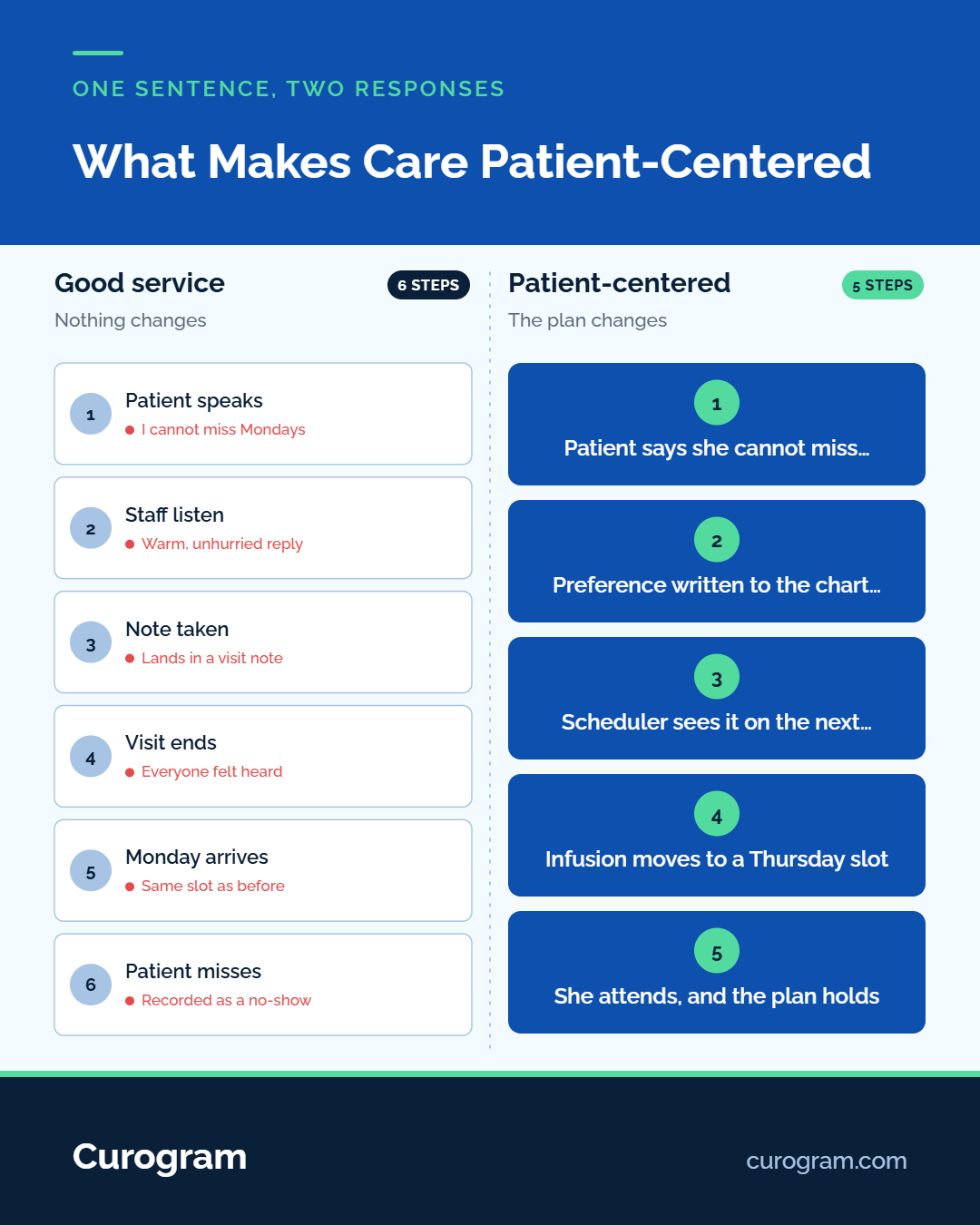
A warm front desk is good service. It becomes patient-centered when a stated priority changes something clinical.
A patient says she cannot miss work on Mondays, so the infusion schedule moves. A man says he will not take a drug that affects his balance, so the team picks another.
If no decision changed, nothing patient-centered happened. That is the question worth asking of any program carrying the name.
The term has a scoreboard. It is measured, scored, and attached to payment, and the amount just changed.
HCAHPS is the standard hospital survey. It asks discharged patients about communication with nurses and doctors, responsiveness, and whether they understood their care at home.
Those answers are public, and they feed federal quality programs. A patient experience score is not a soft number once it reaches a payment formula.
For Medicare Advantage plans, CMS cut patient experience, complaints, and access measures from a weight of 4 to 2. That began with the 2026 Star Ratings.
Average overall ratings moved too. MA-PD plans averaged 4.14 in 2023, 3.95 in 2025, and 3.98 in 2026.
So the financial signal for a patient-centric approach got weaker, not stronger. Practices still building for it are doing so for retention and outcomes, which is the more durable reason anyway.
Six elements turn the definition into something a practice can staff and schedule.
Decisions get made with the patient, not reported to them afterward. That means offering real options and recording which one they chose.
Write the stated preference in the chart where the next clinician will see it. A preference nobody can find is a preference nobody will honor.
One care plan, visible to every clinician involved. The alternative is three specialists ordering the same panel because none can see the others.
A plan the patient can read matters as much. If they cannot explain it back, it is documentation rather than a plan.
Recovery rarely runs to the schedule written at discharge. Responsive means the plan changes when the patient reports that it is not working.
That needs a channel they will actually use. A portal message sent on day four is useless if nobody reads it until day nine.
Transport, housing, food, and mental health shape whether a treatment plan survives contact with a real week. Ask the questions and route the answers somewhere. A screening tool with no referral path behind it just records a problem.
Cost to the patient includes the copay, the day off work, and the 90 minute round trip.
Radiology groups running virtual consults in RamSoft let a patient hear imaging results from home. The visit still happens, and the travel does not.
Continuity of care breaks at the handoffs, and most of them are invisible to the patient until something is missed.
Reaching people in the channel they already use holds the thread. Curogram client data from clinical settings shows 35% of patients who got an SMS recall booked within a month. That came to 1,240 patients seen from recall messages alone.
Clinics sending a Practice Fusion visit link by text keep older patients in the schedule. No app, no login. The ones who drop out are usually the ones who could not get in.
Technology helps here only when it removes a step for the patient. Adding one is how good intentions turn into a barrier.
A portal built for desktop asks an older patient to create an account, confirm an email, and remember a password. Three failed attempts can lock them out.
Practices fixing virtual visit access in Oracle Health usually find the drop-off happens before the visit starts. Nobody skipped the appointment. They could not reach it.
Curogram Highlight: The Patient's Side of the ScreenCurogram's Virtual Visits open from a text link in the phone browser. No download, no account, no password to reset two minutes before the appointment. Two-way texting runs in the same thread, so a patient can ask a question and get a person. Curogram's telehealth software connects with 70+ EMR and practice management systems. The schedule drives the message, so the right patient gets the right link without anyone retyping it. Curogram is HIPAA compliant and SOC 2 Type II certified. |
The definition is 25 years old and still the clearest one available. Care is patient-centered when the patient's values guide the clinical decisions.
Start with the test rather than the survey. Pick ten recent patients and ask what each of them said they needed, and what changed as a result.
If the answer is nothing, no score will fix it. If the answer is specific, you already have the program and just need to make it routine.
Then remove the steps standing between a patient and their care. A visit nobody can join is not patient-centered, whatever the care plan says.
CMS pays a little less attention to this than it did last year. Patients have not changed their minds about it at all.
See what a visit looks like when the patient taps one link and nothing else. Book a Curogram demo.
1 min read
💡Patient experience in healthcare is the sum of every interaction a person has with your practice. It covers booking, reminders, check-in, wait...

1 min read
💡 Patient engagement is important because engaged patients get better results, cost less to treat, and stay with a practice longer. When patients...
1 min read
 Carylee Gali : 4/4/22, 7:00 AM
💡 Telehealth enhances patient engagement by removing the friction that keeps patients from acting on their health. Video visits, secure texting,...