
No Data Analyst? Build Board-Ready Reports in Minutes
 Aubreigh Lee Daculug : 6/7/26, 9:00 AM
A COO built a custom referral source report in under 10 minutes — no analyst, no IT ticket — and redirected an entire marketing budget. Learn how.
19 min read

Two clinics sit on the same block. Same specialty, same insurance panels, similar wait times. One has 38 reviews and a 3.9-star average. The other has 900 reviews and a 4.8.
A new patient searching on their phone will not call both. They will call the second one and never learn the first exists.
That gap has almost nothing to do with quality of care. It has everything to do with whether someone built a system for collecting feedback. Online review management is that system, and it belongs right next to your other healthcare reputation management work.
Here is the uncomfortable part. Most practices are already doing review management. They are just doing it by accident, one forgotten ask at a time.
Your reputation is being written whether you participate or not. Every visit ends with a patient who could say something public and never does. Every unanswered one-star review sits there, on the first page of Google, speaking for you.
This guide covers the whole picture. You will learn what online review management actually involves, why it drives both trust and local search rankings, and how the review process works from the first patient interaction to the last piece of data you pull from it.
You will also get the practical parts. How to ask for reviews without being pushy. How to respond to a bad one without making it worse. How to tell whether a review management tool is worth paying for.
None of this requires a bigger marketing budget. It requires a repeatable process. Let's build one.
Online review management is a strategy, not a single task. It pulls together several activities that work in sequence, and each one shapes how the public sees your practice.
At its core, the work covers four things. You request reviews, you monitor what shows up across platforms, you respond to what patients write, and you use the patterns to fix real problems.
That last part gets skipped most often. Reactive damage control is not a strategy. The practices that get this right treat feedback as live business intelligence, not a scoreboard.
Done properly, online reviews management stops being a marketing chore. It starts informing scheduling decisions, staff training, and even how you design your intake process.
At its most fundamental level, the meaning of review management is the systematic process of overseeing and strategically influencing the online conversation about your business. It is the deliberate and organized framework that empowers a company to monitor all customer reviews, respond to both positive and negative feedback with speed and empathy, and actively solicit new reviews from its base of satisfied customers.
The true meaning of review management transcends the superficial boundaries of public relations;
It is an integral, inseparable component of world-class customer service, operational excellence, and strategic planning.
By systematically implementing a process for handling online reviews management, a business can pinpoint recurring operational issues, celebrate and reinforce employee and product successes, and powerfully demonstrate to both current and potential customers that their voice is not just heard, but is actively listened to and deeply valued.
This commitment to proactive engagement, a hallmark of superior review management, is precisely what separates market-leading businesses from those that stagnate and are ultimately left behind in the hyper-competitive digital marketplace.
An online review is a form of detailed customer feedback shared publicly on the internet, describing a person's direct experience with a product, service, or company.
These powerful testimonials can be posted across a wide range of platforms, including:
An online review typically includes two key elements:
This customer-generated content serves as the digital equivalent of word-of-mouth marketing, significantly influencing the purchasing decisions of consumers researching your brand.
An effective online review management strategy recognizes that every review is a valuable source of customer insight. Each one provides unique feedback on the customer journey, highlighting both positive experiences and areas that need improvement.
Neglecting online review management means overlooking a free, direct channel of communication with your target audience—and missing opportunities to strengthen your reputation, improve customer satisfaction, and drive future business.
In the complex and interwoven fabric of modern marketing, online reviews management has undergone a dramatic evolution, shifting from a niche, after-the-fact activity to an essential, non-negotiable, and central component of success. The digital revolution has fundamentally democratized influence, empowering the average consumer with a global platform to share their experiences with an audience of millions.
This paradigm shift has irrevocably changed how businesses must approach their marketing and communication strategies. Choosing to ignore the vibrant, ongoing conversation about your brand is no longer a viable option; it is a direct path to obsolescence. The collective voice of your customers, as expressed through online reviews, now holds significantly more sway and credibility than most forms of traditional, high-cost advertising.
Therefore, integrating a strategic, well-resourced approach to online review management is absolutely critical for building and maintaining a positive brand image, dramatically improving search engine rankings, and ultimately driving conversions in a marketplace that has never been more competitive or transparent.
The data supporting the influence of reviews is overwhelming and conclusive.
A significant majority of consumers—often cited as over 90%—now habitually read online reviews before making any substantial purchasing decision.
A consistent stream of recent, positive reviews can dramatically increase consumer trust and confidence in your brand, acting as powerful, unbiased social proof that validates the quality and reliability of your products or services.
These positive testimonials effectively de-risk the purchase for a new customer. Conversely, a collection of negative reviews, or even a conspicuous absence of recent reviews, can deter potential customers, creating a cloud of doubt and uncertainty over your business's credibility. A proactive online review management strategy provides the tools to amplify the voices of your advocates and expertly mitigate the impact of your detractors.
By responding to criticism with professionalism, empathy, and a clear path to resolution, you can frequently turn a negative experience into a powerful, public demonstration of your commitment to customer satisfaction.
This act of service recovery can not only win back a disgruntled customer but can also persuade prospective buyers, showing them that you confidently stand behind your offerings and value your clientele. This is online reviews management at its most strategic.
Search engines like Google are on a perpetual quest for fresh, relevant, and trustworthy content to provide the best possible results to their users. Online reviews are a goldmine of exactly this type of content. Each new review is a unique piece of user-generated content that signals to search engine algorithms that your business is active, legitimate, and relevant to consumer searches.
More importantly, the text within these reviews is often saturated with a wealth of long-tail keywords and semantic variations related to your specific products, services, and geographic location.
This user-generated language can significantly boost your visibility in the highly coveted local search results, such as Google's "Local Pack" or "Map Pack." A consistent velocity of positive reviews is now widely recognized as a direct and powerful ranking factor. An effective online reviews management program, which includes actively encouraging customers to leave detailed feedback, therefore directly contributes to a stronger, more resilient SEO performance.
This makes it substantially easier for new, high-intent customers to find you at the exact moment they are searching for what you offer. This synergy between online review management and SEO cannot be overstated.
|
Ask within one hour of checkout, by text, and everything else gets easier. Timing beats persuasion. A patient who just had a good visit is still in the parking lot, still holding their phone, and still feeling grateful. A survey that reaches them four days later by email arrives as homework. The numbers back this up. SMS carries a 98% open rate, and Curogram clients see appointment confirmation rates above 75% through the same channel. Email surveys rarely come close. If you change only one thing after reading this guide, change the timing and the channel. That single adjustment usually moves review volume more than any wording tweak ever will. |
Mastery here is not luck. It comes from combining a clear strategy, a real understanding of the payoff, and technology that removes the manual steps.
A scattered approach produces scattered results. Some months you collect twenty reviews, other months you collect two, and nobody can explain why.
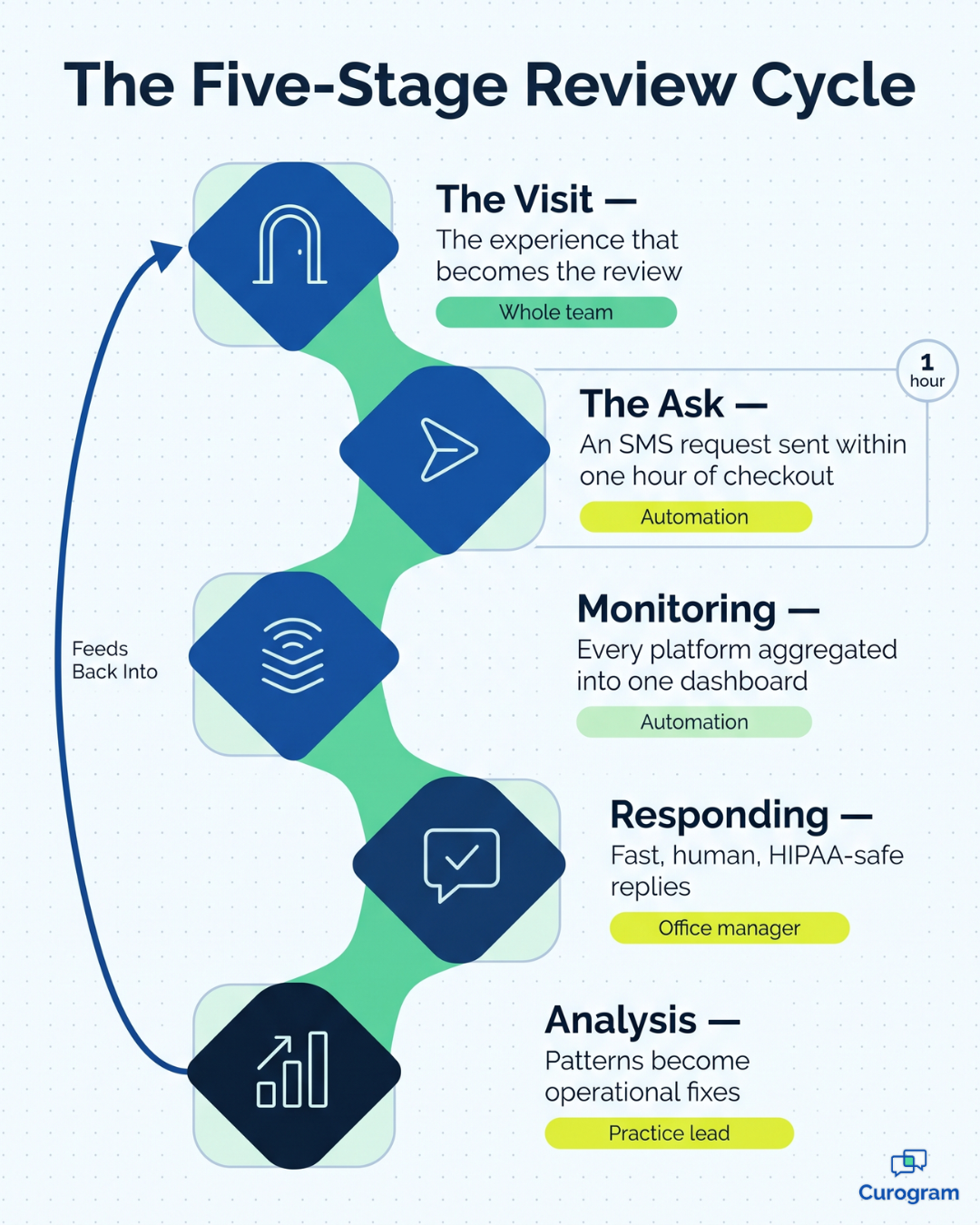
What you want is a documented workflow for every stage of the review lifecycle. Generation, monitoring, response, analysis. Each stage has an owner and a trigger.
The goal is a closed loop. Feedback comes in, improvements go out, and better experiences produce better feedback.
You cannot manage reviews that do not exist. So a steady request process is the foundation of everything else.
Hoping satisfied patients will remember on their own is not a plan. Most people intend to leave a review and then get on with their day.
Your job is to remove every ounce of friction. That means a one-click link, sent through the channel patients already use, at the moment they are happiest.
A few approaches that work well in practice:
The sentiment check deserves extra attention. Routing an unhappy patient to a private form is not about hiding problems. It is about hearing them first, so you can fix the issue before it becomes a public one-star review.
One note on ethics. Never offer anything in exchange for a review. Google prohibits incentivized reviews, and getting caught can cost you the reviews you already earned.
If your practice appears on six platforms, manually checking all six is not sustainable. Something always gets missed, usually the review that needed a reply the most.
A centralized review management system pulls everything into one dashboard. You see every new review in real time, from every site, in one place.
The practical benefits stack up quickly:
Here is what that looks like in numbers. The table below is illustrative, based on a single-location practice seeing 1,200 patient visits a month.
| Manual asks at checkout | Automated post-visit texts | |
|---|---|---|
| Patients seen per month | 1,200 | 1,200 |
| Review requests actually sent | ~300 | 1,200 |
| New reviews per month | ~12 | ~120 |
| New reviews per year | ~144 | ~1,440 |
| Staff time per month | ~6 hours | Under 1 hour |
Read the bottom two rows together. The automated version produces roughly ten times the reviews while giving your front desk about 5 hours back every month.
That is 60 hours a year, or a week and a half of staff time returned to work that actually needs a human. At a $22 hourly rate, that is close to $1,300 a year in recovered labor, before you count a single new patient.
These figures are examples, not client results. Your numbers will shift with visit volume and response rates, but the shape of the gap holds.
The market is crowded, and the tools range from simple monitoring services to full enterprise platforms. Price alone tells you very little.
Judge a review management tool on five things:
| What to check | The question to ask |
|---|---|
| Platform coverage | Does it monitor the sites that matter in your specialty, not just Google? |
| EMR integration | Can it trigger requests from real appointment data without double entry? |
| Ease of use | Can a front desk hire learn it in one short training session? |
| Sentiment routing | Does it separate happy patients from unhappy ones before anything goes public? |
| Reporting | Can you see review growth by location and provider over time? |
EMR integration is the one practices underrate. Without it, someone has to manually tell the system who was seen today, and that step will be skipped within a month.
The right tool automates the tedious parts of online reviews management. Your team keeps the parts that need judgment, like writing a thoughtful reply to a patient who had a rough visit.
A deep and granular understanding of the complete journey of an online review is absolutely crucial for managing it with precision and impact. The online review process is not a single event but a continuous cycle that begins long before a customer ever types their first word of feedback and continues to have an impact long after it has been published for the world to see.
For any business aiming for excellence, successfully navigating this intricate process means having a clearly defined and rehearsed plan for each distinct stage.
This ensures that you remain in control of your brand's narrative as much as possible. A well-documented internal process for your online reviews management guarantees consistency in your brand voice, exceptional timeliness in your responses, and maximum effectiveness in handling all forms of customer feedback, from the ecstatic to the irate.
Every single online review, without exception, has its genesis in a customer experience. Consequently, the single most important and impactful factor in generating a steady stream of positive reviews is the consistent delivery of an exceptional product, a seamless service, and memorable customer support.
It cannot be overstated:
No amount of clever online review management or slick PR can permanently mask or compensate for a fundamentally flawed or inconsistent customer experience.
This initial stage is your first, best, and most authentic opportunity to influence the final outcome of a review. A relentless focus on quality, a commitment to proactive customer service, and a culture of exceeding expectations will naturally and organically lead to a higher volume of positive, detailed feedback.
Every single interaction a customer has with your brand—from their initial Browse experience on your website to their post-purchase support interactions—is a potential catalyst for a powerful review. This is where the work of good review management truly begins.
As we have emphasized, proactively and politely asking for reviews is a critical and non-negotiable step. The prompt is the specific moment in the customer journey when you formally invite a customer to share their experience with the wider community.
The timing, the communication channel, and the wording of this request are all vitally important variables. The ideal moment to ask is almost always shortly after a positive interaction has occurred or a successful purchase has been completed, while the positive feelings are still fresh and potent in the customer's mind.
Your prompt should be polite, direct, and, above all, make the process incredibly simple for the customer.
Always provide a direct, single-click link to the specific review platform you are targeting (for instance, your Google Business Profile).
This simple action removes all friction from the process and will dramatically increase the conversion rate of your review requests. This moment is a pivotal and controllable juncture in the entire online review management cycle.
The instant a review is posted anywhere on the internet, you need to be aware of it. This is the critical function of monitoring.
For a truly comprehensive online review management strategy, you must maintain a vigilant watch over a multitude of platforms simultaneously.
This must include the major, high-traffic sites like Google and Facebook, but it must also extend to the dozens of industry-specific or niche review sites that are highly relevant to your particular business sector.
Employing a dedicated review management software tool to automatically aggregate all of these incoming reviews into one centralized feed is the only efficient and scalable way to stay informed. Without a diligent and technologically-powered monitoring system, you are flying blind.
You risk missing mission-critical feedback, allowing damaging negative reviews to fester unanswered for days or weeks, and completely failing to capitalize on glowing positive testimonials that could be repurposed for marketing.
Responding to reviews—encompassing the full spectrum from one-star to five-star—is arguably the most public and visible aspect of your entire online review management program. Your responses are not just for the original reviewer; they are public statements that serve as a permanent testament to your company's values, your commitment to customer satisfaction, and your overall professionalism.
The final and most strategic stage of the online review process is to meticulously analyze the vast repository of feedback you have collected and use it to make tangible, data-driven improvements to your business. Your complete collection of reviews is an incredibly rich and unfiltered source of raw business intelligence. Systematically look for recurring themes, common points of friction, frequently asked questions, and consistent praise.
Are your customers consistently complimenting a particular employee for their outstanding service? Acknowledge, reward, and learn from them.
Are there repeated complaints about a confusing feature in your software or a bottleneck in your service delivery? Use this direct feedback to guide your product development roadmap or to re-engineer your operational processes.
This final, analytical step is what transforms your online reviews management from a reactive, day-to-day marketing task into a proactive and powerful engine for strategic business growth, customer-centric innovation, and long-term success.
Effectively managing your online reputation is a broad and continuous discipline in which online review management plays a vital and starring role. Your comprehensive online reputation is the cumulative sum of all the digital information and content that exists about your brand online.
This includes not just reviews, but also social media mentions and tags, local and national news articles, blog posts from third parties, and discussions in online forums. A truly holistic approach is required to cultivate a positive, resilient, and accurate online presence.
This involves not only expertly managing what is being said about you but also proactively shaping the desired narrative through your own high-quality content and strategic actions. This is where review management meets content strategy and public relations.
Before you can effectively manage or improve your online reputation, you must first gain a crystal-clear and honest understanding of its current state.
You must conduct a thorough and systematic audit by searching for your brand name, your key products, and the names of your key executives on various search engines (using incognito mode to ensure unbiased results) and all major social media platforms.
What story do the first two or three pages of the search results tell?
Is the prevailing sentiment positive, negative, or neutral?
Meticulously identify all the platforms where customers are actively discussing your brand and perform a qualitative assessment of the general sentiment.
This critical initial audit will provide you with an essential baseline, a benchmark from which you can accurately measure the subsequent success and ROI of your online reviews management and broader reputation management efforts over time.
One of the most powerful and enduring strategies for managing your online reputation is to systematically dominate the search engine results pages (SERPs) for your branded search terms with high-quality content that you create and control.
This is the strategic use of "owned media." Your company website, your corporate blog, and your official social media profiles are your most valuable assets in this endeavor.
By consistently creating and publishing valuable, SEO-optimized content, you can strategically and ethically push down any negative or irrelevant third-party results, making them far less visible. A regularly updated blog that provides genuinely helpful articles, guides, and insights related to your industry can firmly establish your brand as a trusted authority and a thought leader.
This creates a positive and resilient digital footprint that you fully control. This proactive content strategy perfectly complements your reactive online review management activities.
For instance, creating valuable content and then including internal links to important pages, like a page about how to automate hospital processes, provides immense value and strengthens your site's authority.
Do not passively wait for the conversation about your brand to happen to you; be the one to start the conversation yourself. A proactive public relations strategy can help you generate a steady stream of positive press and credible third-party validation for your brand.
This could involve a wide range of activities, from issuing well-crafted press releases for new product launches and company milestones to sponsoring local community events or offering your key executives as expert commentators for industry publications and podcasts. Securing positive mentions, features, and backlinks on high-authority external news sites and blogs is an incredibly powerful way to bolster your online reputation.
These credible, third-party endorsements often carry significantly more weight and trustworthiness in the eyes of consumers than your own marketing messages.
They also serve as a strong, defensive buffer against potential negative feedback.
For external linking, always cite a trustworthy, non-competitor resource, like a major publication such as Forbes, to add credibility to your content.

Once the basics run smoothly, a few refinements separate a decent program from a strong one. These are the details that compound over months, not days.
Optimizing online review management means covering the whole feedback journey. That runs from the first request to the final analysis, with no manual gaps in between.
Start with the software. It should monitor a wide range of sites in real time and connect to your EMR so requests fire automatically.
Then train the team. Everyone who might write a reply should understand your tone, your response times, and your compliance limits.
The end goal is a repeatable workflow where every piece of feedback gets captured, answered, and used. Nothing should depend on one person remembering.
Improving your online reviews management process comes down to two moves. Automate the repetitive work. Then give your team better information for the parts that need a human.
Response templates help with speed and consistency, but always customize them. A reply that reads like a form letter is worse than no reply at all.
Add a tagging system inside your platform so you can sort feedback by provider, location, or service. Trends that are invisible in a list become obvious in a filtered view.
That is the difference between managing reviews and learning from them.

Review management is an underrated retention tool. It works because it creates a structured moment for patients to be heard.
A patient with a real complaint who gets a fast, empathetic resolution often becomes more loyal than a patient who never had a problem. Recovery builds a stronger bond than a smooth visit does.
Thanking patients for positive reviews matters just as much. Being acknowledged by name makes people feel seen, and that feeling brings them back.
Retention math makes this worth the effort. Keeping an existing patient costs a fraction of acquiring a new one, and your review workflow touches every patient you already have.
To ensure this guide is genuinely more valuable and comprehensive than competing articles, we will now explore several unique strategic angles that are frequently overlooked in standard discussions of this topic.
These sections are designed to provide highly actionable, expert-level insights that go far beyond the conventional advice, offering a much deeper and more nuanced understanding of the subtleties of world-class online review management.
Your growing collection of positive online reviews is a priceless and perpetually renewing treasure trove of authentic, high-impact marketing content. It is a strategic error to let these powerful testimonials languish only on the third-party review sites where they were born. You must actively and systematically repurpose your best and most compelling reviews throughout your entire marketing ecosystem to provide powerful social proof at key decision-making points in the customer journey.
For example,
You can and should feature standout quotes and five-star ratings prominently on your website's homepage, within your product and service pages, in your email marketing newsletters, and across all of your social media channels.
Create visually appealing, brand-aligned graphics that highlight your best ratings and the most persuasive customer feedback.
By strategically integrating this valuable user-generated content into your broader marketing strategy, you amplify the trusted voice of your happiest customers, making your online review management efforts work exponentially harder for your brand's growth and credibility.
Always remember to ask for permission before using a customer's full name or likeness in your marketing.
Exceptional online review management should never be a responsibility that is siloed within the marketing department or handled by a single individual.
Every single employee who interacts with customers, either directly or indirectly, plays a crucial role in shaping the very experiences that ultimately lead to online reviews. It is imperative to conduct regular, engaging internal training sessions to educate your entire organization—from frontline sales and customer service staff to back-end product development and logistics teams—on the profound importance of online reviews and their direct impact on the company's bottom line.
Teach them precisely how their specific roles and daily actions contribute to positive customer outcomes and review-worthy moments.
When your whole team is aligned with this vision and understands that providing a five-star experience is a shared, collective responsibility, you create a deeply ingrained customer-centric culture that will naturally and sustainably produce a better and more resilient online reputation.
While templates are undoubtedly useful for maintaining efficiency and a consistent brand voice, the most effective and memorable review responses are those that tap into the fundamental psychology of the customer. A truly exceptional response transcends a formulaic, robotic apology or thank you.
For handling negative reviews, using specific phrases that validate the customer's feelings—such as "I can certainly understand why that would be a frustrating experience"—can instantly de-escalate tension and build rapport.
For celebrating positive reviews, referencing a specific, delightful detail they mentioned in their feedback shows that you are genuinely listening and not just cutting and pasting a generic reply.
The ultimate goal is to forge a genuine, empathetic human connection.
This psychologically-informed approach to online reviews management can transform a simple, obligatory response into a memorable and positive brand interaction that resonates deeply not only with the original reviewer but with every single potential customer who reads that exchange for years to come.
Go back to those two clinics on the same block. The difference between them was never talent or effort. It was a system.
Online review management rewards consistency more than it rewards intensity. A practice that captures a handful of reviews every week will pass one that runs a big push twice a year, every single time.
You already have everything you need to start. Your patients are having experiences worth talking about, and most of them would say something kind if someone asked at the right moment.
The gap is the asking. That is the only part that has to change.
Start with the three moves that matter most. Set up an automated post-visit request that goes out by text within the hour. Pull every platform into one dashboard so nothing sits unanswered. Then read your reviews monthly and fix whatever keeps coming up.
The results compound quietly. One multi-location practice tied automated post-appointment surveys to Google Reviews. It collected 1,064 new five-star reviews in three months, and about 90% of responding patients left five stars.
That kind of volume changes where you appear in local search. More importantly, it changes what a nervous new patient sees when they finally look you up.
Your reputation is being built right now, with or without your input. The only real question is whether you are the one holding the pen.
Want to see what an automated review workflow looks like inside your existing EMR? You can request a demo of Curogram's reputation management platform and walk through the setup with someone who has built it for practices like yours.
Frequently Asked Questions
 Aubreigh Lee Daculug : 6/7/26, 9:00 AM
A COO built a custom referral source report in under 10 minutes — no analyst, no IT ticket — and redirected an entire marketing budget. Learn how.

Google review ratings help medical practices build a positive online reputation and achieve healthcare business goals.

Understand why patients trust 5-star reviews over anything you say, and learn the simple system that helps satisfied patients post them more...