12 min read

The Full Impact of Google Reviews on MD Systems Practice Growth

The Full Impact of Google Reviews on MD Systems Practice Growth
💡 The impact of Google reviews on MD Systems practice growth shapes how new patients find and choose your practice online.
  • Practices with 50+ fresh reviews rank higher in local search results
  • Google weighs review count and freshness when ranking the Map Pack
  • Patients with private-pay or PPO plans research providers more before booking
  • Curogram automates review requests through your MD Systems workflow
  • A strong review profile can boost new patient calls by 25–50%
Connecting Curogram with MD Systems turns every happy visit into a public trust signal. This drives steady growth without extra work from your front desk.

You have spent years earning trust in your town. Patients love you. Staff members go the extra mile. But here is the hard truth — none of that shows up when someone searches "doctor near me."

Right now, a patient just got a referral to your practice. What do they do first? They Google you. They see 12 reviews from six years ago and a 3.8-star rating.

Then they look at the clinic down the street. That one has 300 reviews and a 4.7 rating. Guess who gets the call.

The impact of Google reviews on MD Systems practice growth is the single biggest factor in turning online searches into booked visits. Google weighs review count and freshness when it decides which practices show up in its top local results. If your profile looks like a ghost town, you lose patients before they even pick up the phone.

This is not about vanity. It is about survival. Patients today choose doctors the same way they choose a place to eat — they read reviews first. And practices that ignore this reality are losing revenue every single day.

The good news? You do not need to beg patients for reviews. You do not need to hand out cards or send awkward emails. When you connect Curogram with MD Systems, the whole process runs on its own. Every visit becomes a chance to build your online presence.

In this article, we will show you why your current review profile is costing you money. We will explain how reviews drive your Google Map Pack ranking. Let's walk you through a simple plan to start attracting private pay patients who choose based on trust, not just location.

The Villain: The Best Kept Secret

You have been in practice for 15, maybe 20 years. Your patients send their friends and family to you. The local hospital knows your name. In every way that matters, you are a pillar of your health care community. But online? You might as well not exist.

This is the story of "The Invisible Expert." You are doing great work behind closed doors. But your Google profile tells a very different story.

It shows a handful of old reviews, a rating that does not reflect your true quality, and maybe a few blurry photos from 2017. To someone searching online, you look like a practice that has been left behind.

Here is what makes this so painful:

The new urgent care center three miles away opened six months ago. They have zero history in the community. But they already have 400 Google reviews and a 4.8 rating. When a patient types "primary care near me," that new clinic shows up first. Your practice does not even make the list.


This is not a fair fight. It has nothing to do with who is the better doctor. It is about who shows up online when patients are looking.

Think about your own habits. When you search for a plumber, a dentist, or even a new restaurant, do you pick the one with 8 reviews or the one with 250? Most people assume more reviews mean a better choice. Your future patients think the same way.

Let us put some numbers behind this:

Say, your practice sees 20 patients a day. If even 10% of those patients leave a review each month, that is 40 to 50 new reviews per month. After six months, you would have 250 to 300 fresh reviews on your profile. That kind of volume sends a clear signal to Google — and to patients.


Now, compare that to your current state. If you have 12 reviews from 2018, Google reads that as a stale profile. It will not rank you in the top results. Patients who do find you will wonder if you are still open or if those old reviews still hold true.

The cost of this gap is real:

Let us say you lose just five new patients a month to a rival with better reviews. If each new patient is worth $1,500 to $3,000 per year in revenue, that is $7,500 to $15,000 in lost income — every month. Over a year, that adds up to $90,000 to $180,000 walking out the door.


And the patients you are losing are not random. They are often the ones with private-pay or PPO plans. These patients have options. They do more research. They read reviews more closely. They pick the provider who looks the most trusted online. That means the impact of your digital silence is not just fewer patients — it is fewer high-value patients.

This is the villain your MD Systems marketing strategy needs to defeat. It is not a bad doctor down the street. It is your own quiet profile. You are the best kept secret in town, and that is the worst place to be in today's market.

The fix is not about changing who you are. It is about making sure the world sees what your patients already know. And it starts with a simple shift — turning the great care you already deliver into a steady stream of fresh, honest reviews that work for you around the clock.

Woman looking at her phone with a skeptical expression after receiving a doctor referral from a friend

The Guide: Reviews Are the New Referral

Word-of-mouth used to be simple. A happy patient told a friend. That friend called your office. Done. But the path has changed. Today, even a warm referral takes a detour through Google before it reaches your front desk.

Picture this:

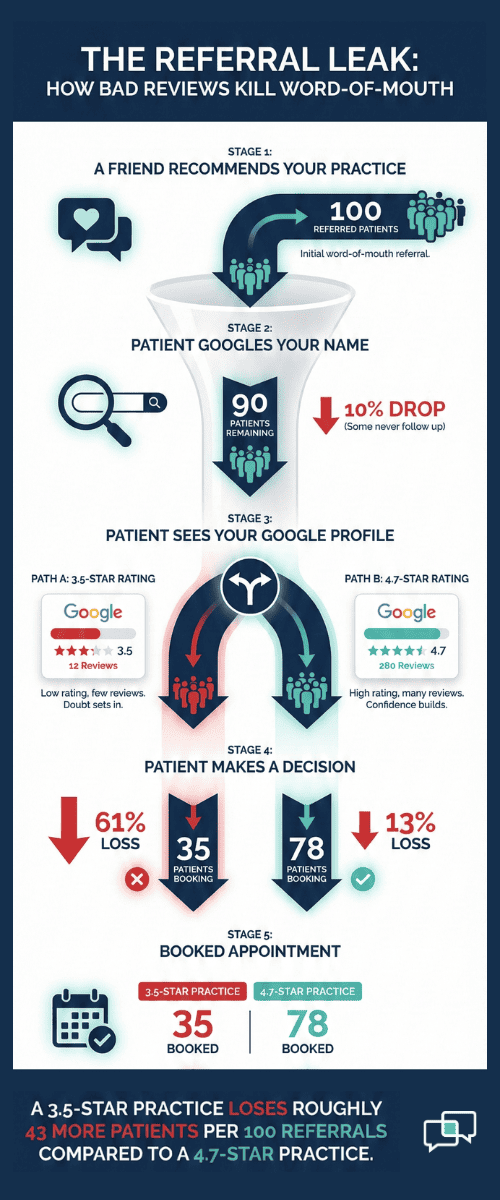
A loyal patient of yours tells her coworker, "You should see Dr. Martin — she is the best." That coworker pulls out her phone and types the doctor's name into Google. She sees a 3.5-star rating and only nine reviews. She pauses. Then she sees another doctor with a 4.7 rating and 200 reviews. That is who she calls.

Your referral just went to a stranger. Not because they are better. But because they look more trusted online.


This is why reviews have become the new referral. They do not replace personal trust. They confirm it. When your online profile matches your real-world care, the referral sticks. When it does not, the referral slips away.

Google also uses reviews to decide who shows up in local search results. Its system looks at three main factors for local SEO for medical practices: how close you are to the searcher, how relevant your profile is, and how well-known you are online.

Reviews drive that third factor — your online fame. More fresh reviews tell Google your practice is active and trusted. Fewer reviews, or old reviews, tell Google you might not be a strong match.

This is where Curogram changes the game. When you connect it with MD Systems, every patient visit can trigger a review request by text. The patient gets a quick, friendly message right after their visit. It takes them straight to your Google page.

This steady flow of fresh reviews does two things at once:

  • It builds your review count fast. A practice that sees 30 patients a day and converts just 15% into reviews gains over 100 new reviews each month. In 90 days, that practice goes from invisible to top-ranked.

  • It feeds Google fresh data. Google's system favors profiles that get new reviews every week. A burst of 50 reviews three years ago does not help. But 10 to 15 new reviews every week? That sends a strong signal. Google starts to rank you higher in the Map Pack, which is the box of three local results that shows up at the top of most "near me" searches.

Think of your review profile as a living thing. It needs to be fed. Curogram makes that feeding happen without any extra work from your team. Your front desk staff does not need to ask, remind, or follow up. The system does it all in the background while they focus on patient care.

The online reputation management ROI here is clear. You spend a few dollars a month on the tool. In return, you gain dozens of reviews that push you up the rankings, bring in new patients, and protect you against the rare bad review.

Because bad reviews will happen. Even the best practices get them. The key is volume. One bad review out of 300 does not move the needle. One bad review out of nine? That can sink your rating.

When you think about your growth plan, reviews should be at the center. They are not a nice-to-have. They are the engine that powers modern patient growth. And with Curogram plus MD Systems, that engine runs on its own.

Visual funnel showing the impact of Google reviews on MD Systems practice growth through lost referrals

The Success: Owning the "Map Pack"

When someone types "doctor near me" or "family clinic near me" into Google, the first thing they see is not a list of websites. It is a small map with three results pinned to it. This is the Google Map Pack. It is the most valuable real estate in local search — and it is where your practice needs to be.

The Map Pack sits above all other results on the page. It shows the practice name, star rating, review count, address, and hours. Most patients never scroll past it. Practices listed in the Map Pack get more clicks from people searching for local care. If you are not in that top three, you are fighting over the scraps.

So how do you get there? Google uses a mix of signals to decide which three practices earn a Map Pack spot. Your location matters. Your Google Business Profile details matter.

But one of the strongest signals is your review profile. The number of reviews, the average rating, and how recent those reviews are all play a role.

Let us walk through a real-world example:

Say, there are five family clinics within three miles of a patient's home.

  • Clinic A has 40 reviews with a 4.2 rating, last review from four months ago.

  • Clinic B has 280 reviews with a 4.7 rating, last review from two days ago.

Google is going to push Clinic B to the top almost every time. That freshness and volume tell Google this is an active, trusted choice.


This is where Google Map Pack ranking connects directly to revenue. If you are in the top three, you get seen. If you get seen, you get clicks. If you get clicks, you get calls. And those calls turn into booked visits.

Now, let us talk about the kind of patients who search this way. They are not random. They tend to be people who are actively looking for a new provider.

Maybe they just moved to the area. Maybe they are unhappy with their current doctor. Or maybe they need a specialist and are doing research on their own.

These are often the most valuable patients for your practice. Many of them carry private-pay or PPO plans. They have choices. They are not locked into a narrow network. They pick the provider who looks the best online.

This is why attracting private pay patients is closely tied to your review strategy. A strong Google profile is what makes these patients choose you over the next option.

Let us put a dollar figure on this:

Say, a new PPO patient visits your practice four times a year. Each visit brings in $200 to $400 in revenue. That is $800 to $1,600 per year from one patient. If your Map Pack presence brings in just 10 new patients a month, that is $96,000 to $192,000 in added yearly revenue.

And that number grows as those patients refer others — referrals that, as we covered, also start with a Google search.


The math is simple. The online reputation management ROI from strong reviews far exceeds the small cost of the tool that gets them. You are not spending money. You are planting seeds that grow every month.

But getting into the Map Pack is not just about piling up reviews. Quality matters too. Google looks at the words inside your reviews.

When patients mention things like "friendly staff," "short wait time," or "great bedside manner," those words help Google understand what your practice offers. They also help you show up for more types of searches.

For example, if dozens of reviews mention "pediatric care," Google may start showing your practice when someone searches "kids doctor near me," even if that phrase is not on your website. This is a hidden benefit of review volume that most practices overlook.

Curogram helps here in a subtle but powerful way:

Because it sends review requests right after the visit, patients tend to write about what just happened.

Their words are fresh and specific. They mention the front desk by name. They talk about the ease of check-in. They praise the doctor's manner. This kind of detail is gold for Google's search system.

Compare that to a practice that only gets a handful of reviews per year:

Those reviews are often vague — "Good doctor" or "Nice office." They do not give Google much to work with. And they do not give future patients much reason to choose you over someone else.


Here is another factor many practices miss. Google also looks at how you respond to reviews. When you reply to a review — even just a simple "Thank you for your kind words" — Google sees that as a sign of an active, engaged business. It helps your ranking.

Curogram makes this easy. You can manage and respond to all your reviews from one dashboard. You do not need to log into Google every day.

Your staff can handle replies in a few minutes each morning. This small habit alone can give you an edge over rivals who ignore their reviews.

Let us sum up the Map Pack formula:

  • Complete Google Business Profile with correct hours, photos, and contact info

  • Steady stream of fresh reviews — ideally 10 or more per week

  • Strong average rating, which a high volume of new 5-star reviews will protect

  • Respond to your reviews to show Google and patients that you are active


When all four of these pieces are in place, your practice climbs the rankings. You show up in the top three. Patients see your name first. They click. They call. They book. And your schedule stays full — not because of luck, but because of a system that works around the clock.

Your Google Profile Is Now Your Front Door

Think about the last time you chose a new service. A new dentist, a new mechanic, a new hair salon. You probably searched online first. You looked at ratings. You read a few reviews. You picked the one that felt the most trusted.

Your patients do the same thing. For most new patients, your Google profile is the first thing they see. It shows up before your website.

It loads before your social media. It is, for all practical purposes, your front door. And right now, that front door might be turning people away.

A stale profile with few reviews and a low rating tells patients to keep looking. It does not matter how skilled you are or how kind your staff is.

If the first impression is weak, the patient moves on. They never walk through the real door because the digital one already closed.

This is why your MD Systems marketing strategy has to include reviews as a core piece — not an afterthought. Every day without fresh reviews is a day your front door stays half shut. Every week without a response to feedback is a week Google ranks you lower.

The fix is not hard. It does not take more staff or more hours. It takes a system that turns the care you already give into proof the world can see. When your Google profile matches the quality inside your walls, patients stop scrolling. They stop comparing. They call.

Your front door should be wide open. Reviews are the key.


How Curogram Turns MD Systems Data Into a Review-Generating Machine


Your MD Systems EHR holds everything you need to build a powerful review profile. It tracks every visit, every patient, every contact detail. The problem is that data just sits there. Curogram puts it to work.

When you connect Curogram with MD Systems, the system pulls visit data in real time. After a patient checks out, Curogram sends a text message asking about their experience.

If the patient had a great visit — which most of your patients do — the text links them straight to your Google review page. One tap, one minute, one new 5-star review.

This is not a one-time blast. It is a steady drip. Day after day, visit after visit, your review count climbs. Your average rating stays strong because the system captures feedback from the majority of patients, not just the upset ones.

That is the core of a smart MD Systems marketing strategy — using the tools you already have to grow without adding extra tasks to your team's plate.

The return is easy to measure. Most practices see their review count double within 60 to 90 days. That jump alone can move you from page two of search results into the Google Map Pack. And once you are in the Map Pack, the traffic keeps coming.

Curogram also gives you a single dashboard to track reviews, respond to feedback, and spot trends over time. You can see which providers get the most praise, which days produce the best reviews, and where you might need to improve. It turns review data into a growth tool, not just a vanity metric.

For practices focused on local SEO for medical practices, this kind of setup is the edge that sets you apart from every other clinic in your zip code.

Conclusion: Reputation is Revenue

Your skills are not in question. Your patient care is not the issue. But if your Google profile does not reflect your quality, you are leaving money on the table — every single day.
In today's market, a strong online presence is just as vital as a clean waiting room.

Patients check your reviews before they check your credentials. They trust the star rating before they trust the referral. This is the new normal, and fighting it only costs you more.

The practices that thrive in this space are not always the biggest or the best. They are the ones that show up. They have fresh reviews. They have a strong rating. They respond to feedback. They look active, alive, and ready to serve.

You already do the hard part. You deliver great care, day in and day out. All that is missing is a system that turns that care into visible proof. That is exactly what Curogram does when paired with MD Systems.

Let the world see what your patients already know. Your next step is simple — schedule a demo and find out how many reviews your rivals have. Then let us build a plan to pass them.

The cost of waiting is not just lost time. It is lost patients, lost revenue, and lost ground to clinics that are already ahead. Every day without a review strategy is a day your practice stays invisible to the people who need you most.

Stop being the best kept secret in your market. Schedule a demo today and let us show you the gap between your practice and your top local rival — and how fast you can close it.


Frequently Asked Questions

How does responding to Google reviews improve your local search ranking?
Google treats review responses as a sign that a business is active. Replying to both good and bad reviews boosts your local ranking. Curogram lets you manage all responses from one place, saving time and keeping your profile fresh.
Why do patients with private-pay plans rely more on Google reviews when picking a doctor?
These patients are not locked into a network, so they shop around. They use star ratings and review volume to compare providers. A strong review profile helps your practice stand out as the trusted choice for this higher-value group.
How quickly can automated review requests change your Google rating?

Most practices see a major jump in review volume within 60 to 90 days. With 15 to 30 new reviews per month, your average rating climbs fast. The speed depends on daily patient volume and your text response rate.

Why is review freshness just as important as review count for Google rankings?

Google's system favors recent activity over old feedback. A profile with 200 reviews but no new ones in six months will rank lower than one with 100 reviews from the past 90 days. Steady, fresh reviews keep your listing at the top.

How does a low Google rating cause you to lose referred patients?

Even when a friend refers someone to your practice, that person will search your name first. If they see a low rating or few reviews, they often pick a rival instead. A strong review profile makes sure referrals actually convert into booked visits.


Automated Google Reviews for CollaborateMD: Get More 5-Star Ratings

Automated Google Reviews for CollaborateMD: Get More 5-Star Ratings

💡 Automated Google reviews for CollaborateMD practices boost local search rankings and bring in more new patients by sending review requests right...


Read More
How to Increase New Patient Volume With CollaborateMD

How to Increase New Patient Volume With CollaborateMD

💡 To increase new patient volume with CollaborateMD, use Curogram to automate Google review requests right after each visit. Automated reviews...

Read More
Medical SEO for Cerbo Practices: The Power of Review Automation

Medical SEO for Cerbo Practices: The Power of Review Automation

💡 Cerbo practices can boost their Google rankings by sending review requests right after patient visits. Curogram makes this easy by linking with...

Read More