
From 3.8 to 4.7: Scaling Google Reviews Automatically
 Aubreigh Lee Daculug : 5/31/26, 3:00 PM
Your Google rating drives patient growth. See how one practice grew from 993 to 8,159 reviews and raised its rating from 3.8 to 4.7.
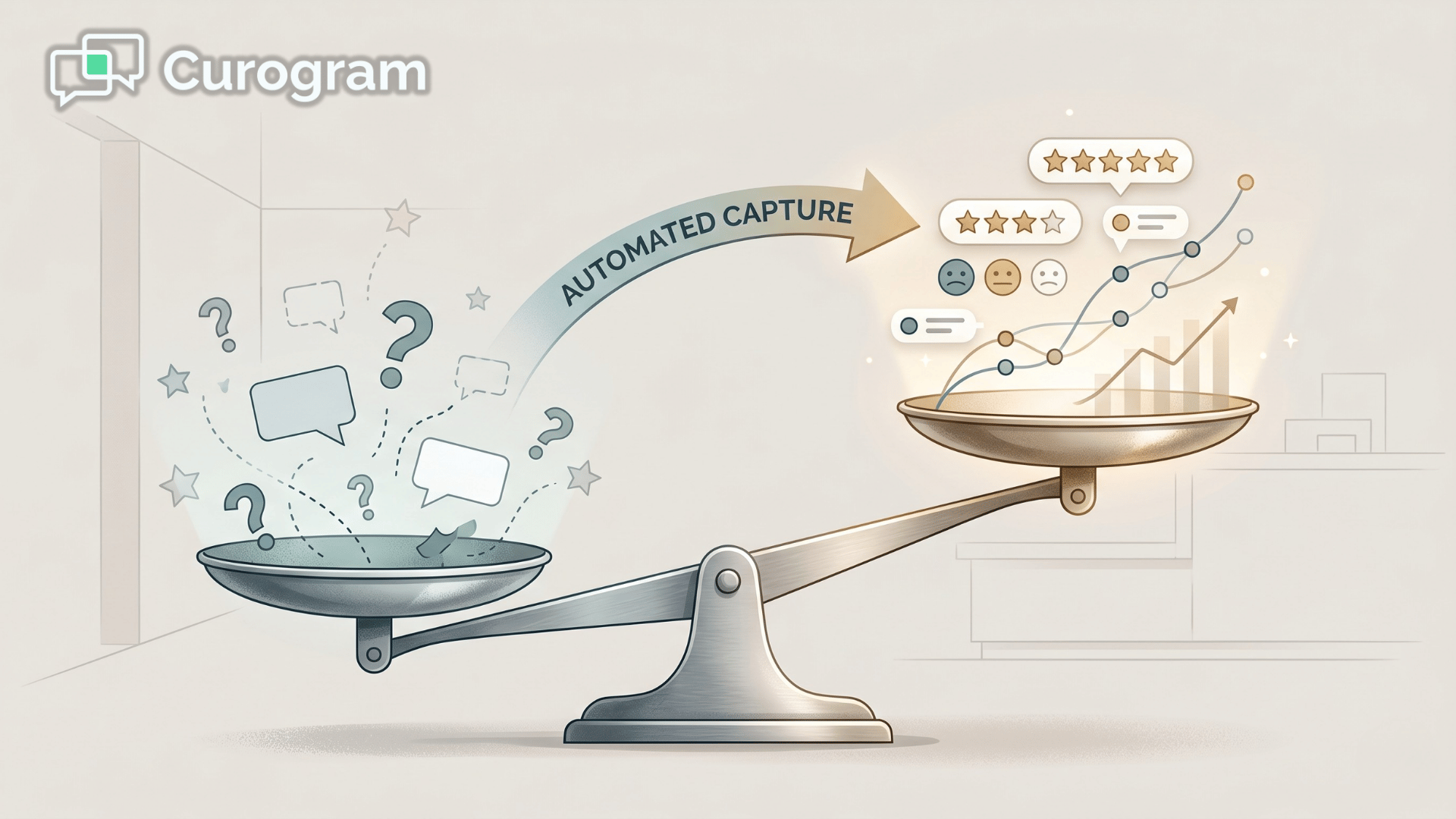
There's a number on your Google Business Profile that quietly decides how many new patients book this month. It's not your appointment count. It's not your average wait time. It's your star rating — and if it sits at 3.8, you're losing patients you'll never know about every single week.
A 3.8-star rating doesn't scream "stay away." It does something worse. It plants hesitation.
Prospective patients pause, scroll, compare you to the clinic two miles down the road, and quietly choose them instead. You never get the call. The lost appointment simply never appears.
The frustrating part? The 3.8 rating rarely reflects the quality of your care. Most practices stuck at this number deliver excellent visits every day.
But satisfied patients almost never leave reviews on their own. The unhappy ones do. Your public rating ends up built on a small, skewed sample — and it's holding back a clinic that deserves a far better number.
You can't fix this by trying harder. Verbal asks at checkout, QR codes on the wall, follow-up emails three days later — these tactics struggle because they fight human nature. By the time a patient gets home, the warmth of the visit is already fading. Writing a review feels like a chore.
The real fix is timing and friction. Catch patients while satisfaction is at its peak, and remove every step between "great visit" and a five-star review on Google. That single shift is what took one primary care clinic from 47 reviews and a 3.8 rating to over 300 reviews and a 4.7 rating in six months — with new patient volume climbing right alongside the score.
Here's exactly how the engine works, and how you can build the same one for your practice — without adding manual work for your front desk.
A 3.8-star rating sits in a strange middle ground. It's not bad enough to alarm you. It's not high enough to help you. Patients glance at it, hesitate, and start digging through your reviews looking for reasons to walk away.
That hesitation has a price. Below 4.0, prospective patients spend more time researching your practice before booking. They click through more reviews. They open competitor profiles in nearby tabs.
Many never come back. Your conversion funnel develops a slow leak — invisible in dashboards, but very real in your appointment numbers.
Most patients don't evaluate your rating in isolation. They compare it to the two or three other clinics that appear in the same search result. If your competitors sit at 4.5 or 4.6, your 3.8 looks worse than it actually is — even if your care is genuinely better. The relative gap is what drives the click, not the absolute number.
One primary care clinic ran into exactly this problem. Their marketing spend was steady. Their schedules had openings. Their team was hitting every operational target.
But new patient volume had plateaued, and nobody could pin down why.
The team blamed the website. They tweaked messaging. They reviewed call-handling.
They missed the most public variable on the entire patient journey: a 3.8 rating sitting on top of their Google Business Profile, undermining everything else they were doing.
Six months after putting an automated review system in place, that same clinic was sitting at 4.7 stars. New patient bookings rose in lockstep with the rating climb. The plateau wasn't a marketing problem. It was a trust problem — and the rating was the lever that fixed it.
What surprised the team most wasn't the rating change itself. It was how quickly the rest of their funnel improved without any other adjustments. Their website conversion rate ticked up. Their cost per acquired patient dropped. The same ad spend started producing more bookings — because the rating was no longer dragging the whole machine down.
That's the hidden lesson in most rating-driven plateaus. The fix isn't a bigger marketing budget or a sharper website. It's removing the silent friction sitting at the top of every Google search someone runs in your area.
The traditional ways most clinics try to grow Google reviews share one fatal flaw: bad timing. Asking at checkout puts patients on the spot. QR codes printed in the waiting room get ignored. Follow-up emails sent two days later land in inboxes when the visit feels distant and the request feels like a chore.
Patient satisfaction peaks during the visit and drops sharply within hours.
By the time most review requests reach a patient, the emotional warmth that would have powered a five-star review is already gone. The patient has moved on to the next thing in their day.
There's a second hidden cost most practices underestimate: staff burnout. Asking for reviews verbally is awkward, and front desk teams quickly stop doing it consistently. The practices that try hardest with manual asks often see the biggest drop-off after the first few weeks. Enthusiasm fades, the asking stops, and the rating stays flat.
This is the central reason why so many practices want to grow Google reviews without asking patients manually. Manual asks fight human behavior.
They depend on three things patients run short on the moment they leave your office:
Automated review generation healthcare workflows fix the timing problem. The system fires a one-question text message within minutes of the appointment closing. Patients tap a star rating.
Those who respond with 4 or 5 stars get routed straight to your Google profile through a single-tap link. No logging in. No writing from scratch. No friction.
From the patient's side, the whole interaction takes seconds. They get a quick text on the way out of the parking lot, tap a star, and either land on your Google profile or move on with their day. There's no awkwardness, no phone call to dodge, no email to ignore later. The system meets them where they already are.
When timing and friction both work in your favor, conversion rates change dramatically. Manual asks typically turn into reviews 3-5% of the time. Automated, immediate, single-tap routing converts at roughly 90% among patients who report high satisfaction.
That gap is the entire reason some clinics post 1,000+ new five-star reviews in three months while others scrape together a dozen.
Here's the simple way to think about it:
| Approach | Timing | Friction | Typical Conversion |
|---|---|---|---|
| Verbal ask at checkout | At peak satisfaction | High (manual write) | Low |
| QR code in lobby | Mixed | Medium-high | Very low |
| Email 2-3 days later | After satisfaction fades | Medium | 3-5% |
| Automated SMS within minutes | At peak satisfaction | Single tap | ~90% |
The takeaway is straightforward. If you want to increase Google reviews medical practice automatically, you need to win on timing and friction at the same time. Anything less leaves most of the satisfaction your team earns every day on the table.
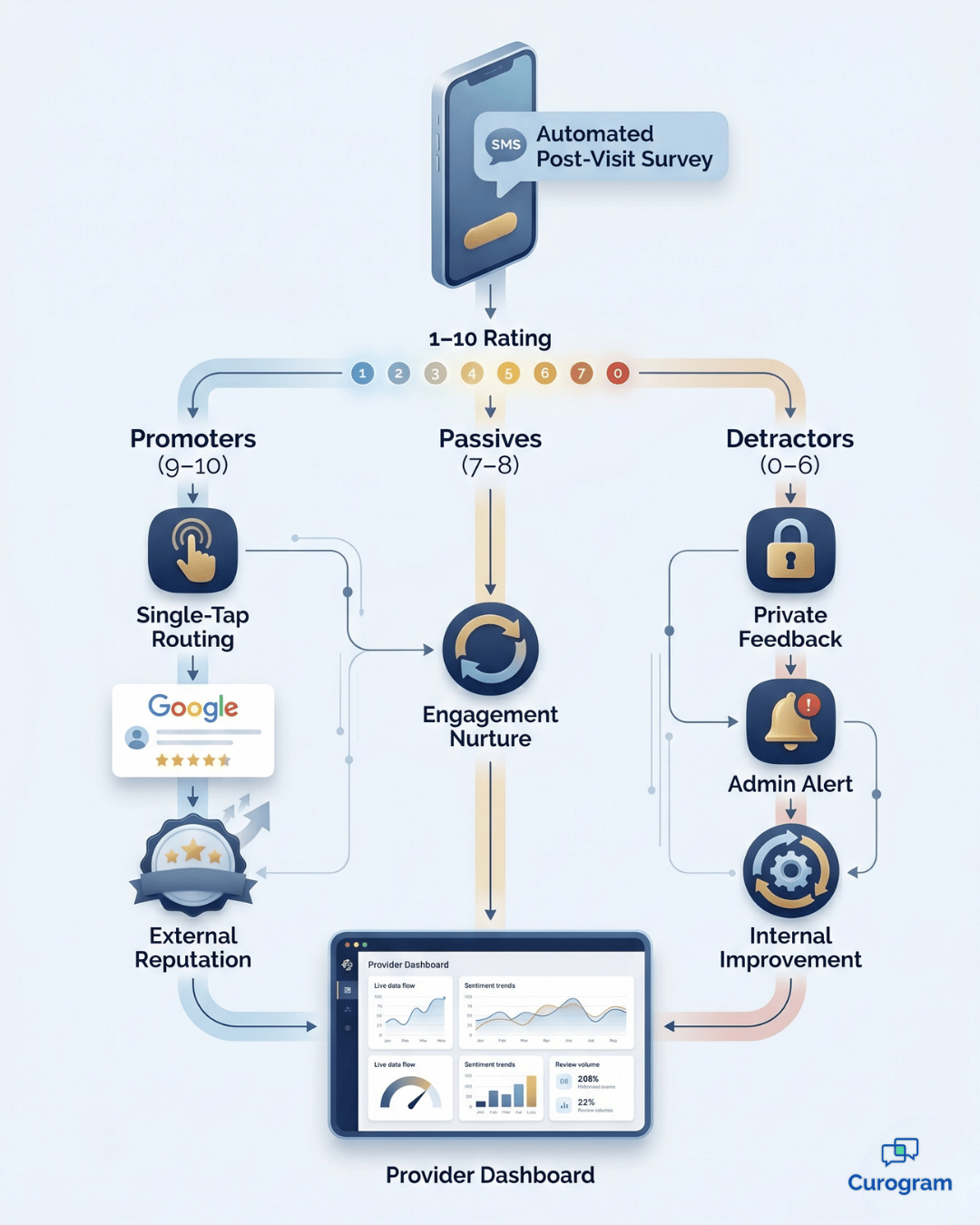
The clinic example above is one location. The math gets more interesting when you apply the same engine across a multi-site practice. One multi-location group grew from roughly 993 total reviews to 8,159 reviews between August 2023 and December 2024. That's a 720% increase over sixteen months.
Nothing about that growth was driven by extra staff effort. No location hired a "review coordinator." Administrators didn't run review campaigns. The system simply fired post-visit surveys at every appointment, at every location, and routed satisfied responses to Google automatically.
Group practices have a unique reputation problem that single locations don't face. One underperforming site can drag down search visibility for the entire brand, especially when patients search for the practice name plus a city. A 4.6-star location and a 3.7-star location operating under the same brand will not produce equal new patient flow. Patients judge each profile separately — and your weakest location is often the one shaping perception for new prospects.
Manual review programs can't compete with that scale.
To match it, you'd need:
Even with all that effort, conversion rates would still hover in the single digits because the timing problem doesn't go away when you put more humans on it.
There are also hidden costs in trying to manage all of this manually. Track what your front desk team would actually need to do across ten locations: remembering each patient, finding the right moment, navigating the conversation, and following up later. The labor cost alone often eats through any revenue gain from the few extra reviews collected. Automation removes that math problem entirely.
When practice leaders search online for how to get more 5-star reviews primary care offices can earn at scale, the answer almost always points to automation rather than headcount.
Every appointment becomes a chance for a review. Every satisfied patient becomes a public testimonial. The work scales because the system, not the staff, does it.
Here's a simple way to picture the difference.
If your group runs 15,000 appointments a month across 10 locations, even a 2% manual conversion rate gets you 300 reviews — spread across all sites.
A 90% conversion among satisfied patients (typically 70%+ of the visit base) gets you closer to 9,000+ review opportunities a month.
Most clinics cap how many they actually solicit, but the ceiling is dramatically higher.

Star ratings don't influence patient behavior in a smooth, linear way. They jump in zones.
Below 4.0, patients feel active skepticism. They dig through reviews looking for warning signs.
At 4.0 to 4.4, skepticism softens into neutrality. Patients still scan reviews to understand what they're getting, but they're not on alert.
Above 4.5, the dynamic flips entirely. Patients read reviews for confirmation, not evaluation. They've already decided to book.
That shift between 4.4 and 4.5 is where conversion changes the most. It's the line between "I'll consider this clinic" and "I'm booking this clinic." Crossing it does more for new patient volume than any other rating movement.
The zones aren't arbitrary marketing categories. They reflect how the human brain processes risk and reward when choosing a healthcare provider. Patients are wired to look for warning signs in low-rated profiles and confirmation in high-rated ones. Your rating doesn't just describe your clinic — it tells the patient what kind of evidence to look for next.
Here's how the zones break down:
| Rating Zone | Patient Reaction | Booking Behavior |
|---|---|---|
| Below 4.0 | Active skepticism | Reads reviews to find problems |
| 4.0 – 4.4 | Neutral curiosity | Reads reviews to understand fit |
| 4.5 and above | Active trust | Reads reviews to confirm choice |
The primary care clinic in our earlier example didn't just nudge its rating. It crossed both zones in the same six-month window — moving from 3.8 to 4.7. That double crossing is exactly why the new patient volume increase was measurable instead of marginal.
Medical practice Google rating improvement isn't a vanity metric. It's a conversion lever. Every tenth of a star you add inside the 3.8-to-4.7 range removes a friction point in the decision-making process of someone who is already searching for a clinic in your area.
The closer you get to 4.7, the less work your website, ads, and reputation have to do — because the rating is doing it for you.

Many practices stall in the 4.0 to 4.4 range and assume they've hit their ceiling. They haven't. That zone usually reflects a partial system — maybe automation is in place, but only some appointments trigger a survey, or the routing to Google adds a step or two of friction.
The clinics that break past 4.5 are usually the ones that close those small gaps, not the ones doing something dramatically different.
Google's local ranking algorithm doesn't only count reviews. It weighs how recent they are. A profile with 500 reviews accumulated over five years ranks lower than a profile with 300 reviews collected in the last twelve months. Freshness signals that patients are still showing up and still satisfied — not that you had a great year in 2021.
Reviews older than 12 to 18 months start to lose weight in local search rankings.
A profile that hasn't generated a new review in three months sends a quiet "is this place still active?" signal to both Google and to patients reading the page. Recency isn't a small factor. It's part of the core mechanism that decides whether your clinic shows up in the local map pack at all.
This is where automation creates a long-term advantage that legacy practices struggle to match. When reviews arrive continuously — week after week, every appointment cycle — Google sees a steady freshness signal. Your profile keeps gaining visibility instead of slowly aging out.
The growth pattern is easier to see when you map it step by step:
Each step feeds the next. The engine keeps building on itself once it's running.
Choosing the right review generation software medical practices can lean on means picking one that produces this steady drip of new reviews automatically — not one that depends on staff to remember each request.
Continuity is what makes the freshness signal reliable. Manual programs always run hot and cold. Automated programs don't.
Here's a simple way to think about durability.
If your practice runs 200 appointments a week and converts 60% to a five-star review through automation, that's roughly 120 fresh reviews flowing in every week. Even if a few aging reviews get buried in your timeline, the volume of new reviews keeps Google's algorithm seeing your profile as active and current.
The reverse is also instructive. Practices that pause their review generation, even for a quarter or two, see ranking slip before rating slips. Volume drops first, and visibility follows. By the time the rating itself begins to dip, the lost search exposure has already cost you weeks of new patient bookings — which makes consistency the most underrated growth lever you have.
Your rating isn't a vanity metric. It's a silent decision-maker working around the clock in the background of every Google search someone runs for a doctor in your area. A 3.8 quietly turns prospects into someone else's patients. A 4.7 turns searchers into bookings before they've finished reading the first review.
The gap between those two numbers isn't talent or effort. It's mechanism.
You can have the best providers in your city and still sit at 3.8 because the satisfied patients walking out of your clinic today won't think to leave a review tomorrow. They'll forget. They're busy. That's the default outcome of human behavior.
Automation flips the default. Instead of hoping patients remember, the system catches them in the small window when satisfaction is highest. Instead of asking them to navigate to Google and write something from scratch, it gives them a single tap.
The friction disappears. The reviews appear. Your rating climbs.
That climb compounds. A higher rating means higher visibility on Google. Higher visibility means more new patient clicks.
More clicks means more appointments. More appointments mean more reviews. The engine feeds itself once it's running.
If your rating sits in the 3.8 to 4.2 range, the cost of waiting another quarter is real and quantifiable in lost bookings. Every week your rating holds where it is, prospective patients are choosing other clinics — patients who would have stayed loyal for years.
You don't need to chase reviews. You need a system that captures them automatically while you focus on care.
Book a demo with Curogram today and see exactly how the automated review engine works for practices like yours. The walkthrough includes a detailed look at your current performance data and a clear projection of what the next six months could realistically deliver for your team.
Frequently Asked Questions
 Aubreigh Lee Daculug : 5/31/26, 3:00 PM
Your Google rating drives patient growth. See how one practice grew from 993 to 8,159 reviews and raised its rating from 3.8 to 4.7.

Master online review management in 2025. Learn how to monitor, analyze, and respond to reviews to build trust and strengthen your reputation.

Understand why patients trust 5-star reviews over anything you say, and learn the simple system that helps satisfied patients post them more...