
Why 5-Star Reviews Beat Any Ad Budget Your Practice Could Spend
Understand why patients trust 5-star reviews over anything you say, and learn the simple system that helps satisfied patients post them more...
5 min read

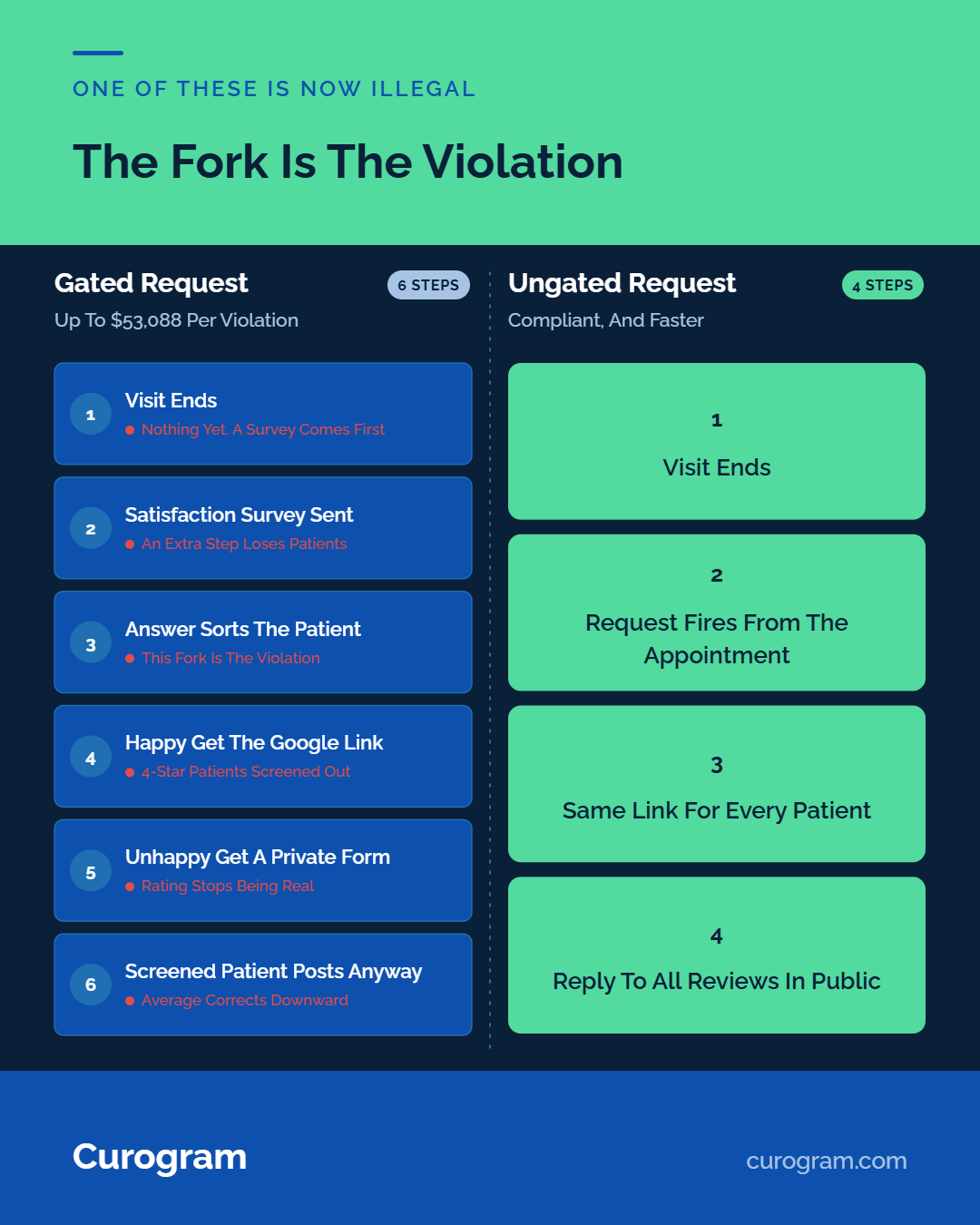
Medical marketing guides still recommend a workflow that is now a federal violation. Survey the patient after the visit, then send the happy ones a Google link and route everyone else to a private form. That fork has a name: review gating, and a price.
The FTC's Consumer Review Rule took effect in October 2024. In December 2025, the agency sent warning letters to 10 companies over it, noting civil penalties of up to $53,088 per violation.
The better news for anyone who has been doing it: dropping the filter usually raises your rating. Volume is what moves an average, and sorting patients is exactly what holds volume down. Below is the arithmetic, the compliant workflow, and how to answer a bad review without a HIPAA problem.
The rule is short, and the healthcare-relevant parts are narrower than most summaries suggest.
Review gating means asking only the patients you expect to be positive. In practice that means a satisfaction survey first, then routing by the answer. The FTC treats the result as a misrepresentation, because the public rating no longer reflects all of your patients.
Incentives tied to sentiment are out too. The FTC's December 2025 letters singled out companies offering incentives for 5-star reviews. A raffle entry for any review is a different thing from a raffle entry for a good one.
Asking every patient, with no filter, is fine. So is replying in public to a bad review. So is offering to fix the problem for anyone who complains. The line is routing. You cannot steer satisfied patients toward Google and unhappy ones somewhere private.
Most industries answer to one regulator here. Google reviews for medical practices answer to two, because the reviewer is a patient and your reply is a disclosure. A retailer can name a customer and reference the order. You cannot do either.
Set the rule aside for a moment. Filtering also works against you, because an average moves on volume and a filter caps volume.
Patients treat 4.0 as a hard floor. Reporting on rater8's 2026 Patient Choice Report, a survey of 992 US adults, Medical Economics put the share who refuse to book below 4.0 stars at 75%, with 44% wanting 4.5 or better.
So take a practice sitting at 3.8 across 40 reviews. The table below is the arithmetic of digging out, and the thing worth noticing is how small the number is.
|
Starting point |
New 5-star reviews needed |
New average |
|---|---|---|
|
3.8 stars, 40 reviews |
8 |
4.00 |
|
3.8 stars, 40 reviews |
20 |
4.20 |
|
3.5 stars, 40 reviews |
20 |
4.00 |
|
3.5 stars, 100 reviews |
50 |
4.00 |
Plain arithmetic on the star average. The deeper the hole and the bigger the history, the more volume it takes.
A sorting survey adds a step before the ask, and every step loses people. Patients who would have left four stars get screened out, and four stars still pulls a 3.8 average upward.
An online reputation built on a filtered sample is fragile a second way. A screened-out patient who posts anyway, and some always do, corrects the average down from a base that was never real.
 Ask Everyone, on a Fixed Schedule
A compliant request system is simpler than a gated one. Same message, same link, same timing, every patient.
A person who sends review requests sends them on quiet afternoons. Tie the send to the finished appointment instead, so it goes out within a few hours while the visit is fresh. Inside a specific system, reputation management for athenahealth users works the same way. The encounter closes, the request goes.
Automated review requests remove the judgment call that creates gating in the first place. Nobody at the desk decides who seemed happy, because nobody is deciding at all.
Asking after every visit works in primary care. It wears thin in physical therapy, where one course of care can run a dozen appointments. Cap it at one request per patient per quarter, or tie it to discharge.
Name the practice, thank the patient, link straight to your Google Business Profile review form, and stop. Requesting five stars is soliciting a sentiment, which puts you back inside the rule you were trying to leave.
Replying is the highest-return move you have. It is also the one most likely to create a second problem if you do it casually.
Review response is the cheapest lever in healthcare reputation management. A few minutes per review, no software required, and it moved further in twelve months than anything else the survey measures.
Confirming that someone was a patient is itself a disclosure. OCR settled with New Vision Dental for $23,000 in December 2022 over Yelp replies that named patients and described their visits, treatment, and insurance. A Dallas practice paid $10,000 in 2019 for the same thing.
Keep every public reply generic and short. Thank the person for the feedback, state your general standard, and give a phone number. Move the specifics to a private channel, and never confirm the visit happened.

Patient reviews are unusually literal. What sinks a healthcare rating is rarely the clinical care. In the rater8 survey, the top deal-breakers were rude or unhelpful staff at 52%, the doctor not listening at 52%, poor care at 45%, long waits at 41%, and billing at 40%.
Four of those five are front-desk and scheduling problems. A practice reading its own one-star reviews monthly gets a free operational audit, which is a better use of the text than the star count is.
Curogram is not an EMR and does not replace one. Reputation Management sends the request from the completed appointment in your existing system, using one message and one link for every patient.
There is no sentiment step in the flow, which is the design decision that keeps it inside the FTC rule. One multi-location practice using it added 1,064 new five-star reviews in three months, with 90% of responding patients leaving five stars. Every patient was asked on the same schedule with the same link.
It reads from your current system through Curogram's EMR integration. The platform is HIPAA compliant and SOC 2 Type II certified.
Open whatever sends your review requests and look for a question that sorts patients before the link appears. If one is there, delete the branch and send everyone the same thing.
Then count what you need. Eight reviews is a fortnight of asking for most practices, and the practices stuck at 3.8 are almost never stuck because their care is a 3.8.
Book a demo and bring your current review request. We will show you what an ungated flow looks like inside your EMR, and what your own arithmetic to 4.0 works out to.

Understand why patients trust 5-star reviews over anything you say, and learn the simple system that helps satisfied patients post them more...

 Aubreigh Lee Daculug : 6/7/26, 9:00 AM
A COO built a custom referral source report in under 10 minutes — no analyst, no IT ticket — and redirected an entire marketing budget. Learn how.

 Jess Koslow : 2/21/22, 7:00 AM
Understand the benefits of patient satisfaction and see how one clinic reduced no-shows from 14.20% to 4.91% by changing how confirmations were sent...