1 min read
Expanding Rural Behavioral Health Access with Texting and Telehealth
💡 Rural behavioral health access is a growing crisis in the United States. According to HRSA, 122 million Americans live in a mental health...
9 min read
Carylee Gali
:
Updated on October 11, 2026
When a rural telehealth program stalls, the cause usually sits outside the video call. A reminder never reached the patient. The visit link went to an email they don't check. Or their home internet couldn't hold the call, and no one had a backup plan.
Those gaps cost rural patients more than anyone else. The CDC reports that people in rural areas have worse health outcomes than people in cities, partly because care is harder to reach.
A patient with a heart problem may live hours from the nearest cardiologist. One clinic trip can mean a lost day of pay, fuel for the round trip, and sometimes a hotel night.
Telemedicine was built to close that distance. Since the pandemic, it's become a normal part of care in many practices, and state laws and insurance payers have changed their rules to support it.
Our position: rural telehealth works best when the messages around the visit are as reliable as the visit itself. That means reaching patients by text, on a basic cell signal, on the phone they already use.
The sections below show how telemedicine widens access for rural patients, providers, and critical access hospitals. You'll see where Curogram's 2-way texting, virtual waiting rooms, and EHR sync fit into a practice that treats patients far from town.
Telemedicine was built for rural patients. Its first job was basic care for people who lived far from a clinic. Yet it grew slowly, and many rural areas still struggle to reach the care they need.
Early programs didn't make it easy. They ran on thin staff and few resources, so they came with many limits. Patients who had never seen a doctor on a screen stuck with what they knew: an in-person visit, even if it meant a long drive.
| Stage | What remote care looked like |
|---|---|
| Early programs | Basic primary care for rural and underserved patients, held back by limited staff and resources |
| Internet era | Better technology moved remote care onto the digital tools most people now use every day |
| Since the pandemic | Higher telehealth use became standard in many practices |
| Policy changes | State laws and insurance payers changed their rules to widen access. Some changes were temporary; others are now permanent. |
What began as a backup way to get basic care is now a full care model. It has raised the quality of care in rural towns.
That slow start still shows up at your front desk. Some rural patients will want an in-person visit first, so expect to explain how a video visit works before they book one.
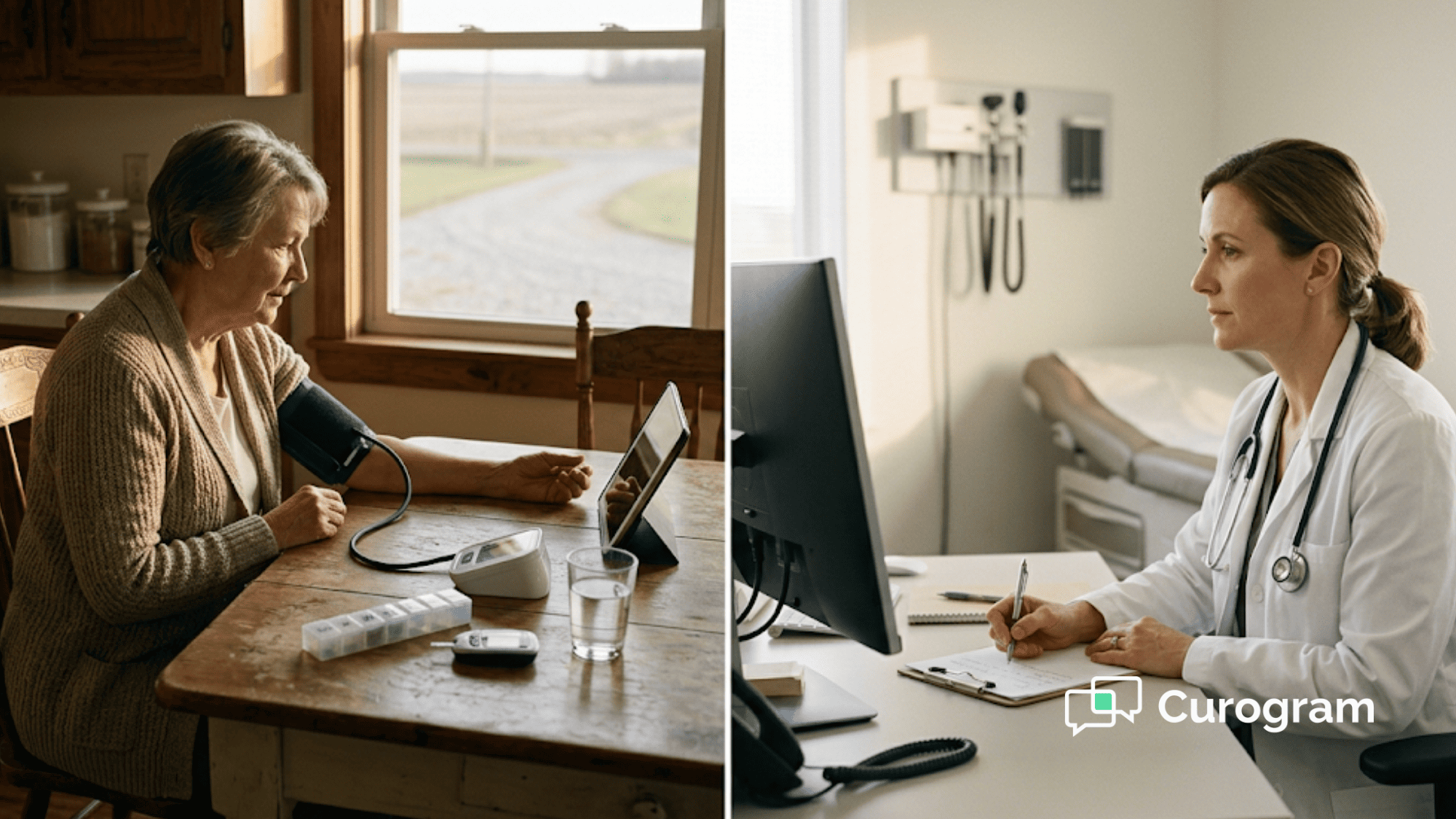
.png?width=2000&height=1125&name=Telemedicine%20in%20Rural%20Areas-inline%20(1).png)
The CDC reports that people in rural areas have worse health outcomes because they can't easily reach basic medical services. Rural residents also tend to be sicker than people who live in cities.
Two barriers cause most of the trouble: distance and a shortage of specialists.
Where a patient lives is a big part of why rural residents face a higher risk of dying early.
Someone who needs urgent care may have to drive a long way to reach the nearest hospital or ER. Rural clinics and hospitals exist, but there aren't enough to care for the millions of Americans who live far from town.
Distance also costs money. One visit can mean:
For a rural family, a routine checkup can carry the cost of a short trip.
Most rural towns have primary care providers. Specialists are much harder to find. A patient with a heart problem, for example, may not be able to see a cardiologist in person at all.
Telehealth closes part of that gap. It uses video, phone, and other digital tools so a provider can care for a patient from a distance. Patients can be diagnosed, treated, and followed from home through virtual consults, follow-up visits, and medication management.
Telehealth Offers Numerous Advantages for Millions of People Living in Rural AreasRemote care reaches rural patients through the internet, video visits, and wearable devices that track health data at home. Its benefits reach three groups: rural patients, the providers who treat them, and critical access hospitals. |
Some rural patients hold back from remote care at first because the technology feels new. Texting lowers that bar. It's something most of them already do every day.
With Curogram's 2-way texting, a patient can book an appointment without calling the clinic. Rescheduling works the same way:
No hold music, no phone tag between their work shift and your office hours.
Remote patient monitoring (RPM) helps patients who live with chronic conditions such as heart disease.
Devices at home track vital signs like heart rate or blood sugar and alert the provider when a reading shifts. If the numbers point to trouble, the provider can tell the patient to go to the hospital.
That steady check-in gives rural patients better preventive care, without a long drive for every reading.
Rural America has too few physicians, and specialists are the hardest to find. The more specialized a provider is, the less likely they are to settle in a rural area. Fewer patients and limited equipment keep many of them in cities.
Telehealth lets those specialists treat rural patients without moving. A cardiologist in a city can see a patient three counties away over video. For your practice, that means a larger patient pool and more visits you can bill for, without adding exam rooms.
It also cuts steps from the visit itself. With telehealth, your patients can:

A virtual visit works as a first check, or triage, before anyone drives to the hospital. The provider makes an initial diagnosis over video. Patients with severe or emergency symptoms get sent in, and the rest are treated at home.
That keeps beds and ER staff free for the patients who need them. Critical access hospitals gain in three other ways:
Telehealth in rural areas also comes with real drawbacks. Knowing them ahead of time helps you plan before you offer remote care to rural patients.
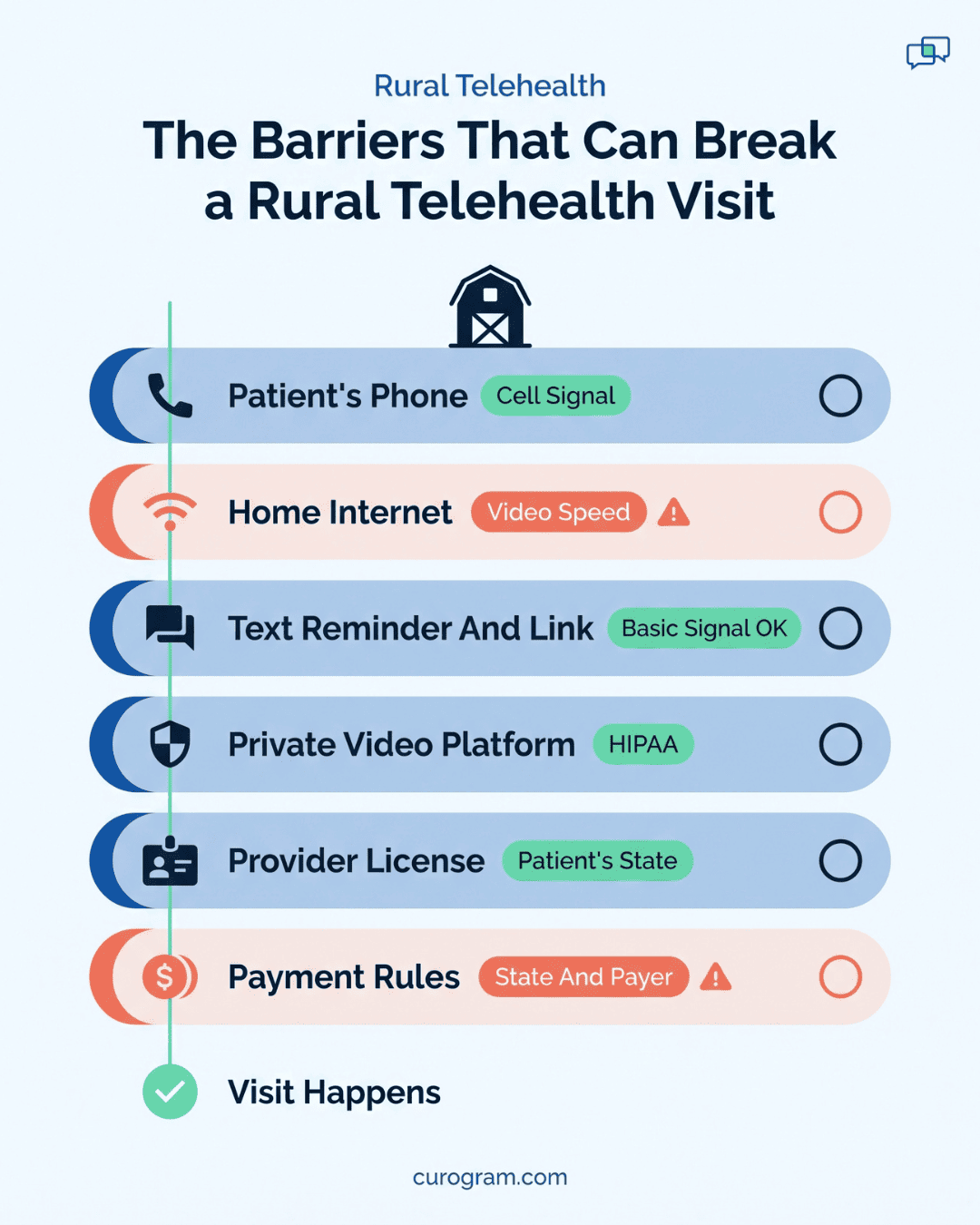
Telehealth makes care easier to reach, but rural programs run into four problems more than any others. Each one has a fix you can plan for before launch.
Payment is the challenge practices raise most often. Each state and each insurance payer sets its own telehealth rules. Common limits include:
These rules shift often, so check your state's current policy before you build a schedule around video visits.
A provider who treats patients in another state usually needs a license in that state too. Getting one means paperwork, fees, and waiting.
The Interstate Medical Licensure Compact (IMLC) shortens that process. Many states belong to it, so physicians licensed in a member state can apply for others through one faster path.
Rural residents in the U.S. tend to be older than people in cities. Some are at ease with video calls. Others have never opened a patient portal and won't want to start.
Curogram meets them with a tool they already use: the text message. A patient confirms, reschedules, or opens a visit link by replying to a text, without downloading an app or making an account.
Video visits need a strong connection on both ends. Some rural homes don't have internet fast enough to hold a steady video call. Text messages still go through on a basic cell signal, so reminders and updates reach those patients even when video won't load.
Privacy and security are a concern too. Patients need to know their health details are safe before they'll share them over a screen. A HIPAA-compliant platform answers that worry from the first message.
None of these problems outweighs what rural patients gain from remote care. They're planning items, and each one has a known fix.
Rural patients do better with steady access to a provider. Your telehealth program needs a platform that's reliable, follows privacy rules, and doesn't need a manual.
Curogram is a 2-way texting platform built for medical practices. It runs in a web browser, so your staff can start on day one without special training.
We built Curogram to feel like the clinic your staff already knows. You can set up several virtual clinics, each with its own waiting room. Patients check in and wait; your staff moves them to the provider when it's time, the same way the front desk does in person.
Intake forms go out by encrypted text or secure web form. Patients fill them out on their phones, and the forms come back to you as PDFs. You'll have the history and insurance details in hand before the video visit starts.
Curogram syncs with hundreds of widely used EHRs. Data moves between the platform and your EHR on its own. Your staff stops typing the same details twice, which also cuts down on entry errors.
You set the wording and timing, and Curogram sends each reminder on its own. That matters most in rural care, where a missed slot is hard to refill.
| Atlas Medical Center | No-show rate |
|---|---|
| Before Curogram | 14.20% |
| After 3 months | 4.91% |
Based on our internal data
Your staff can send patient records and other sensitive files to each other on a fully HIPAA-compliant platform. A nurse can pass a chart to the provider in the same place they message patients, with no switching between apps.
Patients text your office the way they text family. Every message stays HIPAA-compliant. Based on our internal data, practices cut their phone volume by up to 50% once patients can text instead of call.
You can set up a virtual clinic in less than 48 hours and start seeing rural patients online right away.
For a rural patient, the hard part of care often comes before the visit. It's the long drive, the lost day of work, and the call to reschedule that keeps hitting a busy line.
Telehealth removes the drive. In our view, though, rural programs succeed or stall on the messages around the visit: the reminder, the intake form, the quick reply to move an appointment. Those messages need to reach patients on a basic cell signal, on a phone they already use every day.
Text does that. Based on our internal data, Atlas Medical Center cut its no-show rate from 14.20% to 4.91% in three months with automated reminders. For a practice whose patients live an hour out, each kept slot is a patient who got care.
Reimbursement rules and licensing still take planning. Patient trust and weak internet take planning too. You can handle all four once the basic channel to your patients works.
Book a demo to see Curogram with your own workflow. We'll walk your team through a rural patient's visit, from the first reminder text to the video waiting room to the follow-up.
Text messages go through on a basic cell signal, even in homes where the internet can't hold a video call. Reminders, visit updates, and reschedule requests still reach those patients. With Curogram, a patient confirms or moves an appointment by replying to a text. Your schedule stays accurate, and your staff knows about an open slot early enough to fill it.
Start with your state's rules and each payer's policy. Check which provider types can bill, whether the patient's home counts as an "originating site," and which services qualify as telehealth. Medicare's telehealth flexibilities have been extended several times, so confirm the current end date with CMS. A live tracker from the Center for Connected Health Policy helps you keep up between changes.
The provider usually needs a license in the patient's state. The Interstate Medical Licensure Compact (IMLC) speeds this up for physicians. If you're licensed in a member state, you can apply for licenses in other member states through one shared process. Check the IMLC website for the current member list before you start seeing patients across state lines.
Start with the tool they already use. Many older patients text family every day but have never opened a patient portal. Send the reminder and the visit link by text, so joining a video call takes one tap. Before the first visit, have your front desk call once to walk them through it. After that, follow-ups can be booked by text alone.
A virtual visit lets a provider make an initial diagnosis before the patient drives in. Patients with severe or emergency symptoms are sent to the hospital, and the rest are treated at home. ER beds and staff stay free for urgent cases. The patient also skips a long trip for a problem that could be handled over video.
1 min read
💡 Rural behavioral health access is a growing crisis in the United States. According to HRSA, 122 million Americans live in a mental health...

1 min read
💡 Telemedicine CPT codes are the billing codes you use to get paid for care delivered by video or phone. Most virtual visits use the same E/M...
1 min read
Medicare is a federal health insurance program in the United States that facilitates medical care by providing health insurance to people over 65...