

11 min read

Maximizing ROI for ModMed Practices with Telehealth & Virtual Visits

Maximizing ROI for ModMed Practices with Telehealth & Virtual Visits
💡 Specialty practices can unlock powerful ModMed ROI for telehealth by using virtual visits to recover lost revenue. When patients cancel because they can't travel or struggle with technology, your clinic loses money.

Curogram's one-click virtual rooms make it easy for patients to connect with providers. Practices typically see a 53% drop in no-shows and gain 10-20% more provider capacity. This means more billable appointments each day without adding physical space.

Virtual visits work for follow-ups, lab reviews, and consultations. They reduce overhead costs while expanding your reach to patients who live far away. Your practice becomes a profit engine that scales beyond your building's walls.

Every time a specialty patient cancels an appointment, your practice loses money. When a dermatology patient skips a skin check because they can't find parking, that's lost revenue. When an orthopedic patient cancels a post-op review because the drive is too hard, that's a gap in your schedule you can't fill.

These canceled slots add up fast. A single empty hour in your schedule can cost hundreds of dollars in unrealized income. Traditional appointment systems create barriers that turn away paying patients before they even reach your office.

Healthcare remote care ROI starts with understanding this problem. Your physical square footage limits how many patients you can see each day.

Room turnover, travel time, and no-shows all drain your profit margin. But what if you could add virtual exam rooms to your practice for a fraction of the cost of building new space?

Curogram's telehealth integration with ModMed changes how specialty practices think about capacity. You're not limited by four walls anymore. By adding no-app virtual visits to your workflow, you create a scalable profit engine that captures revenue other practices lose.

You increase throughput without increasing overhead. And you turn your ModMed system into a tool for specialty practice revenue growth.

This article shows you how to maximize telehealth profitability. You'll see the real numbers behind virtual visit success. You'll learn how practices boost dermatology practice revenue and drive orthopedic clinic growth. And you'll discover how to reduce virtual visit no-shows while expanding your geographic reach.

The business case is clear. Virtual care isn't just a convenience feature. It's a revenue strategy that protects your specialty income and grows your patient base. Let's look at how it works.

Why Empty Exam Rooms Cost More Than You Think.

The True Cost of Cancellations

When a specialty patient cancels, you can’t replace them with a walk-in. That empty slot is pure loss. For dermatology or orthopedics, a single $200–$250 cancellation can wipe out a meaningful share of daily revenue, and the impact goes far beyond the missed visit.

Staff time was already spent preparing charts, confirming appointments, and planning billing. The exam room sat unused. If the visit was a new consult, you also lost the lifetime value of that patient relationship.

Just three cancellations per day at $250 per visit adds up to $187,500 in lost revenue each year. For many practices, that’s the difference between growth and stagnation.

Travel is the biggest driver of these cancellations. Patients with mobility issues, demanding jobs, long commutes, or post-surgical pain struggle to justify short in-person visits. When travel is the only option, appointments get skipped, care is delayed, and revenue quietly disappears.

Technology Barriers Drain Your Resources

Technology friction makes the problem worse. Many telehealth and telemedicine systems force patients to download apps, create accounts, and troubleshoot technical issues.

A 65-year-old patient with arthritis doesn’t want to manage passwords or navigate a complex interface—they just want to talk to their doctor.

Every minute a $200-per-hour provider spends helping a patient install software is negative ROI. You’re paying specialty rates for tech support instead of delivering care.

The hidden costs multiply across your practice:

  • Front desk staff field endless calls from frustrated patients who can't log into portals
  • IT resources get diverted to password resets and technical troubleshooting
  • Providers start visits 10-15 minutes late due to connection problems
  • Staff morale drops as technology problems create daily frustration
  • Patients abandon virtual care attempts and simply cancel appointments

Each of these incidents seems small in isolation, but they add up to hundreds of lost hours and thousands of dollars in wasted resources every year.

This creates a vicious cycle. Staff spend time troubleshooting logins, providers get frustrated with failed connections, and patients cancel appointments they want to keep. Practices then fall back to in-person–only care, accepting lost revenue as unavoidable.

But the issue isn’t telehealth—it’s friction. Remove the technology barriers, reduce cancellations, and recover revenue that’s already within reach.

How Virtual Visits Expand Your Practice Capacity

Breaking Free from Physical Limitations

Adding virtual exam rooms changes your capacity model because you’re no longer limited by physical space. Routine post-op checks and lab result reviews can move to virtual visits, freeing exam rooms for procedures that require hands-on care.

Improving patient access through telemedicine lets you do this without building more space.

A post-op visit may only take 15 minutes with the provider, but the patient still occupies the room for 30–40 minutes. That room could instead be used for a higher-revenue procedure, so virtual visits directly increase your revenue potential.

Virtual visits also eliminate room turnover time—sanitizing, restocking, and resetting equipment—which can add 80–120 minutes per room each day. That’s enough time for two extra billable appointments.

Your fixed costs don’t change whether you see 20 patients or 25. Increasing throughput through virtual visits spreads those costs across more revenue and improves profit margins. Virtual exam rooms also allow you to scale capacity during peak demand instead of turning patients away.

Expand Your Market Without Opening New Locations

Geographic market expansion becomes possible with telehealth. Your dermatology practice can now attract patients from a 100-mile radius instead of 20 miles, and they don’t need to drive for every appointment. They come in person for biopsies and procedures, then follow up virtually for results and care planning.

Traditional expansion is costly and risky. Opening a satellite office requires hundreds of thousands in buildout, equipment, staffing, and marketing, with no guarantee of volume. Virtual care gives you the same market reach with almost none of the cost or risk.

Your value proposition to distant patients becomes unbeatable. They gain access to specialized care without the travel burden, seeing you in person only when necessary and handling routine care virtually. This hybrid model attracts patients who previously chose a less-qualified local provider for convenience.

The revenue impact is measurable and significant. Curogram’s ModMed integration ensures virtual visits are documented and billed with the same precision as in-person encounters.

Key benefits include:

  • Automated billing prompts that prevent lost charges
  • Digital intake that captures insurance information before visits start
  • Seamless documentation within your existing ModMed workflow

Your practice reclaims hidden revenue that used to slip through workflow gaps. Every virtual visit is properly coded, documented, and billed, so there’s no revenue leakage from incomplete documentation or forgotten charges.

The system handles the administrative burden automatically, ensuring you capture every dollar you’ve earned.

The Competitive Advantage

What many practice owners miss is that virtual care isn’t just about serving current patients better—it’s about competitive positioning. When patients search for specialists, they compare practices based on convenience and access.

The practice offering virtual follow-ups wins patients away from competitors who only offer in-person care.

You also reduce patient churn. Patients who have positive virtual experiences stay with your practice longer and are less likely to switch to a competitor. Loyal patients refer others, creating a growth engine that feeds itself.

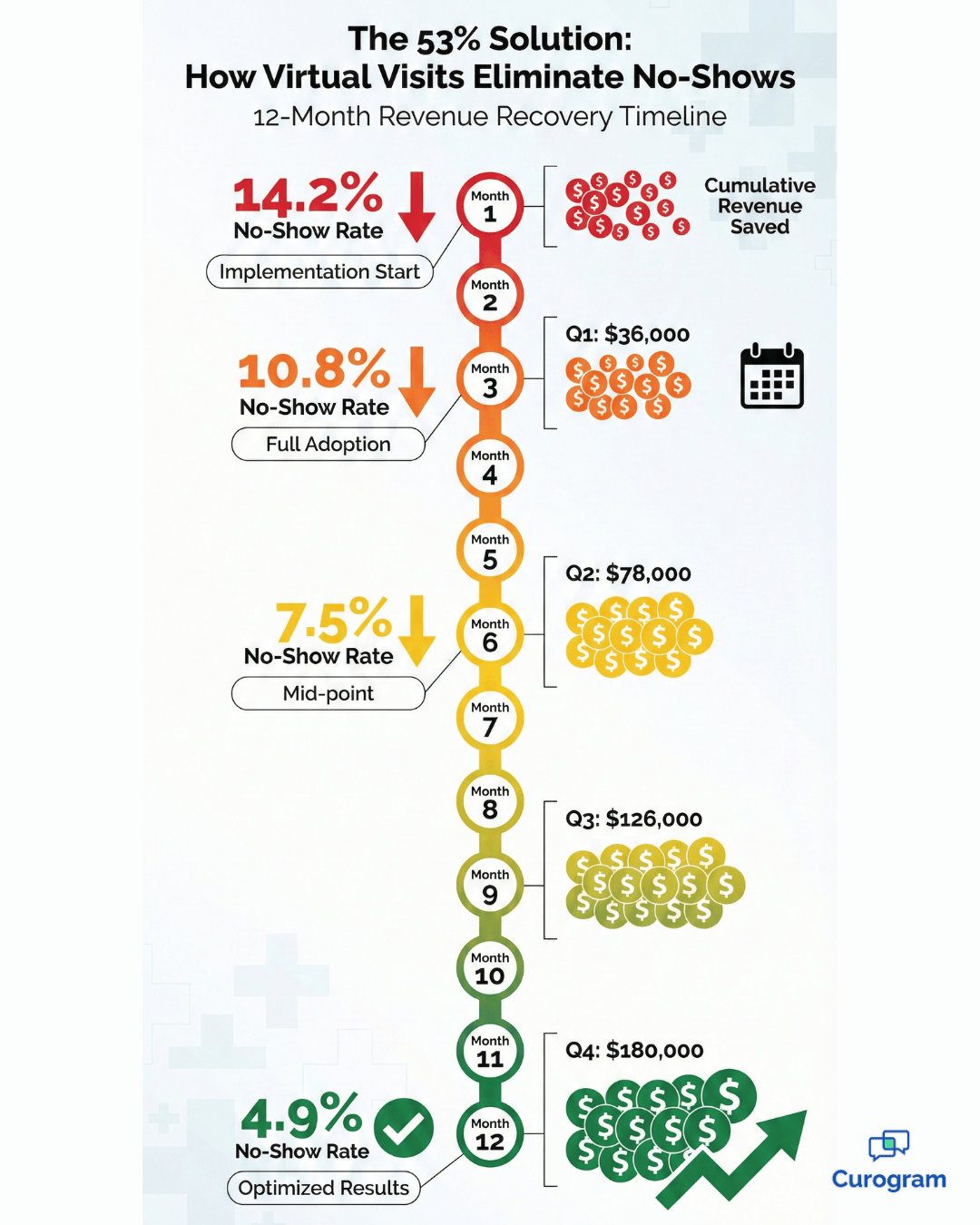
Timeline showing 53% reduction in telehealth no-shows over 12 months with revenue recovery

The Real Numbers Behind Virtual Care Success

Practices using Curogram see a 53% lower no-show rate compared to traditional appointment systems. This isn't a small improvement. It's the difference between losing three patients per day versus losing one.

For a specialty practice with $300 average visit value, that's $600 in saved revenue every single day.

Calculate Your Practice's Revenue Recovery

Let's break down the math. Here's what a typical specialty practice sees when implementing virtual visits:

Monthly Revenue Impact Calculator

Metric Before Virtual Visits After Virtual Visits Improvement
Daily No-Shows 3 patients 1 patient 2 patients saved
Average Visit Value $300 $300
Daily Revenue Recovered $0 $600 +$600
Monthly Revenue Recovered $0 $12,000 +$12,000
Annual Revenue Recovered $0 $144,000 +$144,000


Additional Capacity Gains

Factor Traditional Model With Virtual Visits Net Gain
Room Turnover Time 15 minutes 0 minutes (virtual) 15 min/patient
Extra Patients Per Day 0 2 patients +2 patients
Additional Daily Revenue $0 $600 +$600
Additional Annual Revenue $0 $156,000 +$156,000


Combined Annual Impact: $300,000+

These numbers represent real dollars flowing back into your practice without adding staff, expanding facilities, or increasing overhead costs.

Proven Results from Real Practices

Atlas Medical Center provides a clear benchmark: they reduced their no-show rate from 14.2% to 4.9% after implementing virtual visits, a 65% reduction. The practice saved hundreds of hours of provider time and thousands of dollars in lost revenue.

Virtual visits also lower overhead. You don’t need table paper, gowns, or gloves, and you don’t pay to cool empty rooms.

Your cost-to-serve for follow-up care drops while reimbursement rates remain the same, since many specialties bill virtual visits at the same E/M rates as in-person care.

Fast Return on Investment

The ROI timeline is fast. Most practices see returns within the first month by capturing just two or three saved appointments per week.

Here's why the investment makes sense:

  • No expensive hardware to purchase or maintain
  • No custom app development required
  • Text message links work on any device
  • Integration with existing ModMed systems

The system works through simple text message links that patients can click from any device, making adoption instant and friction-free.


Strategic Implementation for Maximum Impact 

Identifying the Right Visit Types for Virtual Care

Not every appointment should be virtual, and that's actually the key to success. The practices that see the highest ModMed ROI for telehealth understand which visit types benefit most from virtual delivery. This strategic approach maximizes revenue while maintaining quality of care.

Start by analyzing your schedule over the past three months. Look for patterns in cancellations and no-shows. You'll likely find that certain visit types have much higher cancellation rates than others.

These are your prime candidates for virtual conversion:

  • Post-operative follow-ups for wound checks and recovery monitoring
  • Lab result discussions that don't require physical examination
  • Medication management visits and prescription adjustments
  • Routine check-ins for chronic condition monitoring
  • Pre-operative consultations and surgical planning discussions

Post-operative follow-ups, lab result discussions, medication management visits, and routine check-ins typically have cancellation rates of 20–30%. Moving these to virtual visits can reduce cancellations to 5% or less.

From the patient’s perspective, virtual visits remove major barriers. A patient traveling 60 miles for a 10-minute wound check faces huge inconvenience, while a smartphone video visit is simple and convenient. You deliver the same quality assessment without the friction.

The economic calculation is simple: average revenue per visit × current cancellation rate vs. reduced cancellation rate. For most specialty practices, this reveals $100,000 to $300,000 in recoverable annual revenue.

Training Your Team for Success

Implementation success depends on your team understanding why virtual visits benefit the practice, not just how to use the technology. Front desk staff see reduced phone burden, medical assistants see streamlined workflow, and providers gain more control over their schedules.

Start with a clear communication plan that explains the business case and shares revenue recovery numbers. When staff see virtual visits as solving real problems, adoption becomes natural.

Technical training is minimal because Curogram’s no-app system has almost no learning curve. Staff simply send a text link to patients, so the focus is on workflow: which visits are virtual, when to offer them, and how to document them in ModMed.

Create simple protocols for common scenarios.

Here are effective default rules that many practices use:

  • All post-op checks at 7 days and 14 days default to virtual unless patients request in-person
  • Lab result discussions default to virtual unless abnormal findings require physical examination
  • Medication follow-ups for stable chronic conditions default to virtual quarterly
  • Initial consultations remain in-person for comprehensive assessment
  • Any visit requiring procedures or physical therapy stays in-person

These protocols remove decision-making burden from staff and ensure consistent application of your virtual care strategy.

Patient Communication That Drives Adoption

How you introduce virtual visits determines adoption. The message should focus on patient benefits, not practice efficiency. Patients care about saving time, reducing stress, and easier access to their provider.

Frame virtual visits as a premium service that shows your commitment to patient-centered care. “For follow-ups, we can connect virtually so you don’t have to travel to the office.” This makes virtual care feel like an upgrade, not a downgrade.

Address concerns proactively. Some patients worry virtual care is lower quality or less personal. Train your team to explain that virtual visits offer the same thorough care, often feeling more personal because patients are in their own home.

Use automated text reminders to guide patients. Send a reminder 24 hours before the visit with the link and simple instructions. Reassure them: “No app download required. Works on any phone or computer.”

Patient at home connecting with doctor via virtual visit on laptop in comfortable setting

Measuring and Optimizing Your Results

Track key metrics from the start, with no-show rate as your primary indicator. Measure it weekly and compare it to your baseline before virtual visits.

If you don’t see improvement within two weeks, investigate why patients are still canceling—usually it’s a communication issue, not a technology problem.

Monitor patient satisfaction with brief post-visit surveys. Most practices find virtual visit satisfaction equals or exceeds in-person visits. Use this feedback to refine your approach and expand the program confidently.

Calculate revenue recovery monthly by multiplying your average visit value by the number of no-shows prevented. This gives you a concrete ROI figure to share with your team. Celebrating wins builds momentum and reinforces the value of virtual care.

Look for opportunities to expand. Once your team is comfortable with basic virtual follow-ups.

Consider these advanced applications:

  • Virtual triage visits to assess urgency before scheduling in-person care
  • Virtual urgent care slots for same-day minor issues
  • Virtual new patient consultations for appropriate specialties
  • Virtual group visits for patient education sessions
  • Virtual second opinion consultations for patients outside your area

Each expansion multiplies your revenue recovery and strengthens your competitive position in your market.

Pay attention to provider feedback. Some providers embrace virtual care immediately while others need time to adjust. Create opportunities for providers to share tips and best practices.

Often, reluctant providers become the biggest advocates once they experience how virtual visits improve their day by filling schedule gaps and reducing the frustration of no-shows.

Integration with Your ModMed Workflow

The seamless integration between Curogram and ModMed is what makes this strategy work at scale. Virtual visits need to fit into your existing documentation and billing processes without creating extra work. When integration is done right, virtual visits reduce administrative burden rather than adding to it.

Document virtual visits the same way you document in-person visits in ModMed—same templates, same coding, same workflow. The only difference is the delivery method. This consistency ensures billing accuracy and makes adoption easy for providers.

Automated billing prompts prevent revenue leakage by reminding you to code and bill for every virtual visit. This eliminates the common problem of delivering care but forgetting to bill. Every visit generates revenue because the workflow ensures nothing falls through the cracks.

Digital intake before virtual visits captures insurance information, consent forms, and medical history updates. This front-loaded data collection makes the virtual visit more efficient and lets providers focus on care instead of administrative tasks.

Frequently Asked Questions About ModMed Telehealth ROI

Is telehealth as profitable as in-person visits?

Yes. In most specialties, follow-up and evaluation codes for virtual visits are reimbursed at the same rate as in-person visits.

Overhead is much lower because you don’t use physical supplies or room space, which means higher profit margins per visit. For routine follow-ups and lab reviews, virtual care often delivers better returns than in-person appointments.

Will this cannibalize my in-person procedure revenue?

No. Virtual triage actually helps you identify which patients need procedures faster. Instead of waiting weeks for an in-person consultation, patients can connect virtually for an initial assessment. You can quickly determine who needs to come in for hands-on care.

This keeps your physical exam rooms open for high-value surgical tasks and procedures. Your procedure revenue grows because you're using time more efficiently.

How fast is the ROI?

Most practices see a return on investment within the first month. You don't need to build apps or buy expensive equipment. The system integrates with your existing ModMed workflow.

By capturing just two or three appointments per week that would otherwise be canceled, you cover your costs and start generating profit. The math is simple: each saved appointment equals immediate revenue that would have been lost.

Unlock Your Practice's Full Revenue Potential

Your practice doesn’t need more exam rooms to grow revenue—you need to use your existing capacity better. Virtual visits let you see more patients without expanding physical space, turning cancellations into kept appointments and opening your practice to patients who couldn’t reach you before. This shift separates growing practices from stagnant ones.

Traditional healthcare is built on scarcity: limited exam rooms, limited hours, and limited geographic reach. Those constraints force you to turn away patients or accept no-show rates as inevitable. Virtual visits break these limits and unlock capacity you didn’t know you had.

The data proves it works. A 53% reduction in no-shows recaptures thousands of dollars every month, and seeing one or two more patients per day adds up to significant yearly growth. Eliminating travel barriers expands your market reach beyond your immediate area.

Traditional expansion requires massive capital investment—more space, more staff, and higher fixed costs. Virtual visits give you a path to growth without doubling overhead. You can increase revenue while simplifying operations.

Curogram’s integration with ModMed makes this transformation seamless. Patients receive text links to join visits, documentation stays the same, and billing happens automatically through your current setup. Everything works together to maximize your ModMed ROI for telehealth without disrupting your workflow.

This is about more than convenience—it’s about building a scalable profit engine. Virtual exam rooms cost a fraction of physical expansion and deliver immediate returns through saved appointments and increased throughput.

They position your practice for long-term growth in a market that increasingly rewards flexibility and access.

Other practices are still operating under the scarcity model. They’re losing patients to cancellations and turning away distant patients who can’t make the drive. By implementing virtual visits, you gain a competitive advantage and become the convenient choice in your market.

The implementation risk is minimal. Virtual care is validated across specialties, the financial model is straightforward, and patient demand is already there. The only question is whether patients will get virtual care from your practice or from a competitor.

Your next step is a quick demo to calculate your practice’s ROI. You’ll get a personalized analysis of your current no-show rate, estimated revenue recovery, and an implementation timeline. Every week you wait is another week of lost revenue from preventable cancellations.

Ready to transform your practice? Schedule a demo today  and start capturing the revenue you're currently losing to cancellations and no-shows. See the exact numbers for your practice. 


Telehealth for Elation Health: Delivering Frictionless Virtual Care

Telehealth for Elation Health: Delivering Frictionless Virtual Care

💡 Independent practices using Elation Health can improve virtual care with telehealth for Elation Health through Curogram. This system removes the...

Read More
Streamlining the ModMed Telehealth Workflow for Clinical Staff

Streamlining the ModMed Telehealth Workflow for Clinical Staff

💡 Clinical teams can boost their ModMed telehealth workflow efficiency by using Curogram's "No-App" virtual room. This system launches directly...

Read More
How Virtual Visits in StreamlineMD Boost Imaging Workflows

How Virtual Visits in StreamlineMD Boost Imaging Workflows

💡 StreamlineMD practices use telehealth to boost workflow in radiology, vascular, and IR settings. Virtual visits help patients prepare for exams...

Read More