Streamlining the Elation Health Telehealth Workflow for Clinical Staff
💡 Independent clinics can boost Elation Health telehealth workflow efficiency by using an app-free, SMS-based video solution.When you integrate...
10 min read
Jo Galvez
:
January 26, 2026
Running an independent practice means keeping the human touch alive. Your patients chose you because they want real care, not automated forms. But when it comes to virtual visits, most systems work against that bond.
Think about your last video visit. Did your patient struggle to download an app? Did they forget their portal password? Maybe they called your front desk three times just to get into the waiting room. By the time the visit started, both of you felt drained.
Elation Health users face this problem daily. The EHR works great for patient records and clinical workflows. But when you add third-party video tools, things fall apart. Apps need downloads. Portals need logins. Technical issues eat up the first ten minutes of every visit.
Here's what makes this worse for small practices. You don't have an IT team. Your staff already handles scheduling, billing, and patient calls. Now they're also tech support, walking patients through app installs and browser settings.
Telehealth for Elation Health through Curogram solves this with a simple concept: one click via SMS. No apps, no portals, no hassle. Your patient gets a text with a link. They click it. The visit starts. That's it.
This system delivers a 99% success rate for joining visits. It cuts no-shows by 30%. And it does all this while keeping your clinical data where it belongs—inside Elation Health. Visit times, notes, and logs sync automatically with patient charts.
For DPC telehealth and specialty practices, this matters even more. Your whole model depends on strong relationships. Curogram's Elation Health virtual visits protect that bond.
They make video calls feel less like a corporate call and more like a house visit. Patients appreciate the ease. You reclaim time for actual medicine.
Most virtual care systems were built for big hospital networks with full IT staff. When small clinics try to use them, the cracks show fast. These tools assume patients have tech skills and infinite patience. Neither is true.
Every video system wants its own app. Download this. Update that. Create an account. Verify your email. By the time a patient jumps through all these hoops, they've lost ten minutes and, more importantly, their patience.
Older patients struggle the most. They might not know how to find apps in a store. They forget passwords constantly. Some use phones with limited storage and can't install new software. For a quick follow-up that should take five minutes, this creates real barriers.
Portal logins add another layer of friction. Many patients only use their Elation Health portal once or twice a year. When they need it for a video visit, they can't remember their credentials. Password reset emails go to spam. The whole process stalls.
When five patients per day each waste ten minutes on tech issues, that's nearly an hour of lost clinical time. For an independent practice, that hour represents real revenue and real patient care that never happens.
You didn't train for eight years to troubleshoot camera settings. Yet here you are, telling Mrs. Johnson how to allow browser permissions while your next patient waits. This isn't medicine. It's tech support.
Small practices feel this pain acutely. In larger systems, nurses or medical assistants might handle tech triage. In your clinic, it's often you or your front desk staff—people who already have full plates. Every minute spent on "Can you hear me now?" is a minute stolen from care.
Audio and video issues create the worst delays. Patients don't understand microphone access or camera toggles. They call from spotty Wi-Fi. They hold their phone at odd angles. You spend the visit coaching them through settings instead of discussing their health.
Constant tech problems drain morale. Your staff gets frustrated. You feel the schedule slip. Patients sense the stress. None of this helps anyone, and it makes virtual care feel like a chore instead of a tool.
Generic video platforms don't talk to Elation Health. After the visit ends, someone has to document everything manually. When did the visit start? How long did it last? Who attended? All that data should flow into the chart automatically.
This creates extra work for your staff. They log into the video system, check timestamps, and then copy details into Elation Health. It's double entry—the exact inefficiency that EHRs were supposed to eliminate.
Billing gets messy, too. Telehealth reimbursement requires precise documentation. If your video tool doesn't track time properly, you might under-bill or over-bill. Both create problems. The whole system feels disconnected because it is.
Administrative Overhead Grows
Every manual step adds cost. Your staff spends more time on paperwork and less on patients. These hidden costs drain your practice slowly but surely. For HIPAA-compliant video for independent practices, integration isn't optional; it's essential.
Curogram removes every technical obstacle between you and your patient. The system handles video visits through SMS, which means patients need nothing more than a working phone. No apps. No downloads. No logins. Just a text and a link.
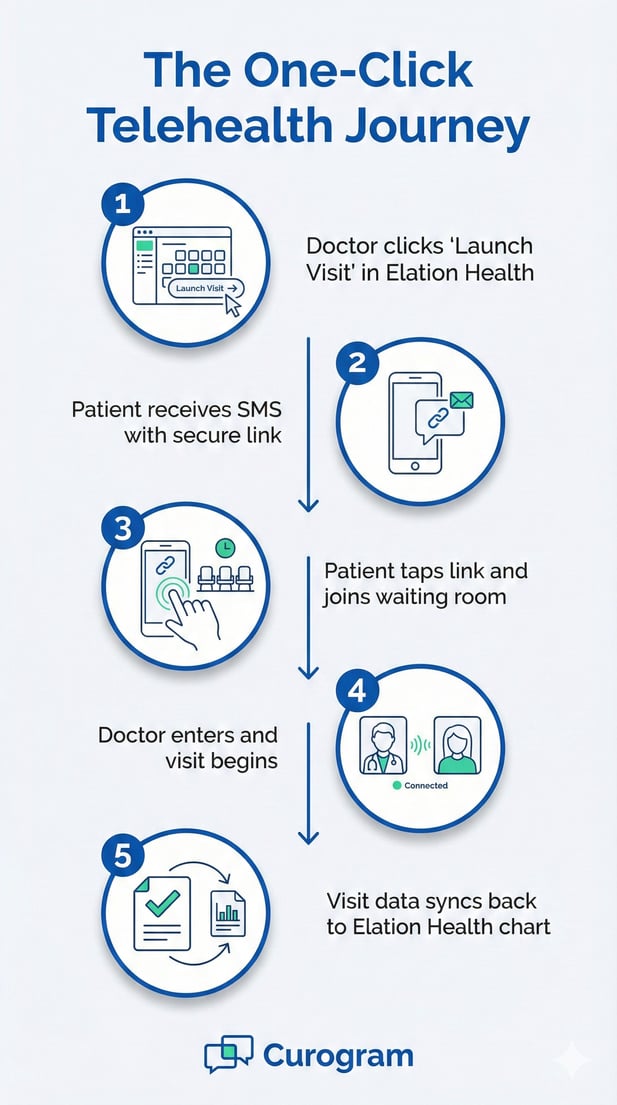
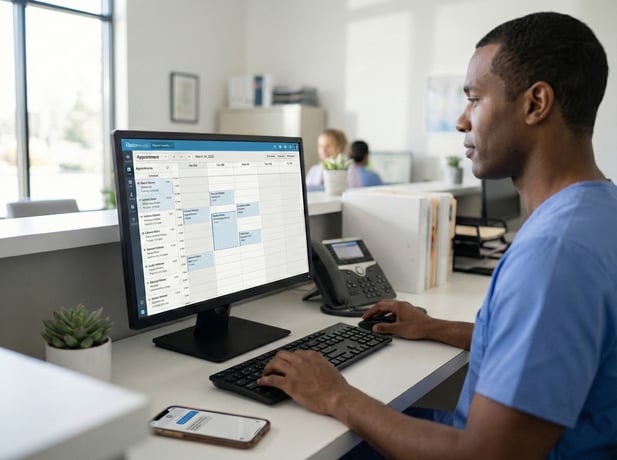
The workflow starts in Elation Health. You open the patient's schedule and launch the virtual room directly from there. Curogram sends an SMS to the patient's phone. They tap the link. Their phone browser opens. They're in the virtual waiting room.
This takes seconds. There's no account creation, no password to remember, no software to install. The patient clicks once and waits for you to join. That simplicity drives the 99% connection rate. When you remove friction, people actually show up.
For your practice, this means predictable starts. Your 2 pm appointment begins at 2 pm, not 2:12 pm, after troubleshooting. You stay on schedule. Patients appreciate the respect for their time. Everyone wins.
SMS as the Great Equalizer
Text messages work on every phone—smartphones, flip phones, old and new devices. Unlike apps that need specific operating systems or updates, SMS reaches everyone. This matters for practices serving diverse age groups or lower-income communities.
Curogram runs entirely in the web browser. For patients, this means instant access. They don't need to clear phone storage or worry about compatibility. If their device has a camera and can open links, it works.
The video quality stays clinical-grade. The platform uses a secure, HIPAA-compliant engine built for healthcare. Audio comes through clearly. Video adjusts to network conditions. Even patients on slower connections get reliable service.
For you as the provider, the interface stays clean and simple. You see the patient, basic controls for audio and video, and nothing else to distract you. The focus stays on the conversation, not the technology.
Being web-based also means faster updates. When Curogram improves the platform, patients don't need to download anything. They just click the link and get the latest version automatically. This keeps security tight and features current.
After each visit, Curogram automatically sends key details back to Elation Health. Start time, end time, duration, participants—all the data you need for documentation and billing flows into the chart without manual entry.
This sync happens in the background. You finish the visit, close the window, and move on. The system handles the rest. No copying timestamps. No logging into separate platforms. Your clinical record stays complete and accurate.
For billing purposes, this precision matters. Telehealth codes require specific time documentation. When your EHR already has the data, claims go out correctly the first time. Fewer denials mean faster payment and less rework.
Manual data entry creates mistakes. Someone transposes a number. Someone forgets to log a visit. Automated sync eliminates these risks. The system captures what happened and records it accurately every time.

Direct primary care and specialty practices share one thing: they thrive on relationships. Patients pay for access to you, not to a system. When virtual care feels clunky or impersonal, it undermines everything you've built. Curogram protects that bond by making video visits feel natural.
In a DPC model, patients expect direct access. They're not navigating phone trees or waiting weeks for appointments. They text you when they need help. They value convenience paired with personal attention.
DPC telehealth through Curogram extends that same philosophy to video. A patient messages you. You send them a visit link via SMS. Within seconds, you're face-to-face on screen. It feels like a digital house call—quick, personal, and focused on them.
This approach reinforces why patients chose DPC in the first place. They want easy access and a real connection. Traditional portals break that flow. They add steps and delays. Curogram removes those barriers and keeps the relationship central.
Specialty practices benefit the same way. Whether you're a dermatologist reviewing photos or a psychiatrist doing follow-ups, the tech should stay invisible. Patients need to focus on their concerns, not on getting the video to work.
Before the visit starts, you can verify that digital intake forms are complete. Curogram works with Elation Health to confirm that consents, medical history updates, and pre-visit questionnaires are in the chart.
This saves time at the start of the visit. You don't need to ask if they filled out the forms. You already know. If something's missing, your staff can reach out before the appointment. When the video call begins, you jump straight into clinical care.
For new patient visits, this matters even more. First impressions count. When intake flows smoothly, patients see your practice as organized and efficient. That builds confidence from day one.
Digital forms sent via SMS have high completion rates. Patients can fill them out on their phones while waiting in line or during a break. The forms sync with Elation Health instantly, keeping your records current and complete.
Some visits need more than two people. A spouse wants to join the discussion. An adult child helps their elderly parent. A caregiver needs to hear discharge instructions. Curogram makes this easy.
You can send multiple join links from the same virtual room. Everyone taps their link and enters the call. No complicated meeting IDs or passcodes. The platform handles multiple participants smoothly.
This capability proves critical for geriatric care and pediatrics—two areas where Elation Health practices often focus. Older patients might need family support during visits. Kids benefit when parents hear instructions directly. Specialty virtual care needs these options.
Including family members also improves outcomes. They hear the same information you share. They can ask questions. They become partners in care. For chronic disease management, this support network makes a real difference in adherence and results.
Good technology should improve your bottom line without creating new headaches. Curogram does both. By removing technical friction, the platform helps you see more patients, reduce wasted time, and lower operational costs.
SMS links act as built-in reminders. When patients receive the join link, they see their appointment time staring back at them. That text message sits in their inbox, ready to tap when it's time.
This immediate call to action reduces no-shows by 30%. Patients don't forget because the reminder is also their entry point. They don't need to write down a separate meeting ID or remember where they put the portal link. Everything they need arrives in one message.
For your schedule, this creates real value. Fewer gaps mean more consistent revenue. You can plan your day with confidence. When patients actually show up, your practice runs more smoothly and earns more.
Filling Last-Minute Slots
When someone cancels, you can quickly offer that spot to another patient via text. They get the join link immediately and can hop on the visit within minutes. This agility helps you maximize your available time every day.
Telehealth lets you serve patients across your state without opening new offices. A patient who moves away can stay in your panel. Someone in a rural area can access your specialty expertise. Your geographic footprint grows without the overhead.
This matters for independent practices competing with larger systems. You can offer convenience that rivals big hospital networks. Patients who value personal care but need flexible access get the best of both worlds.
For specialty practices, telehealth opens new referral channels. Primary care doctors across the state can send you patients for virtual consultations. You build your reputation beyond your local market. Revenue grows while fixed costs stay steady.
Avoiding Satellite Office Costs
Physical expansion requires rent, utilities, equipment, and staff. Virtual expansion requires none of that. You serve more people from the same chair you're sitting in now. The math clearly favors telehealth for growth.
When patients struggle with portal logins or app downloads, they call your office. Your staff becomes an unpaid help desk. Each support call takes time away from scheduling, billing, and clinical tasks.
Curogram eliminates those calls. Patients click the SMS link and join. They don't need help. Your phone stays quiet. Your staff focuses on work that actually matters. Those reclaimed hours add up fast.
Calculate the value: if three staff members each save two hours per week on tech support, that's six hours. At an average hourly rate of $20, you save $120 per week or nearly $6,000 per year. That's before counting the value of reduced stress and higher morale.
Staff Efficiency Gains
Happier staff stick around longer. Lower turnover saves you recruitment and training costs. When your team isn't fighting with technology all day, they perform better and enjoy their jobs more. That's a win for everyone.
Most practices have similar concerns when considering new telehealth systems. Here are clear answers to the most common questions about using Curogram with Elation Health.
Do patients need an Elation portal login?
No. Curogram bypasses the portal entirely. Patients join visits through a secure SMS link. They don't create accounts. They don't log in. They just tap the link in their text message and enter the virtual room.
This approach removes the biggest barrier to virtual care. Portal adoption rates stay low because patients forget passwords and rarely check them. SMS works because everyone already uses text messaging. It's familiar, fast, and reliable.
Each link is unique to that patient and that visit. Once the visit ends, the link expires. This keeps your virtual waiting room secure without forcing patients through complicated authentication.
Is the video quality clinical-grade?
Yes. Curogram uses a high-definition, HIPAA-compliant video engine designed for healthcare. The system adjusts to network conditions automatically. Even patients on slower connections get clear audio and stable video.
The platform prioritizes clinical needs over flashy features. You get clear sight and sound. Controls stay simple. The video quality lets you read facial expressions, assess skin conditions, and hold meaningful conversations. That's what matters in medical video.
Since most patients join from phones, the system is built for mobile networks. It handles varying bandwidth gracefully. Video quality scales up or down as needed to maintain the connection.
Can we use this for chronic care management (CCM)?
Absolutely. The ease of connection makes Curogram perfect for CCM. Patients with diabetes, heart disease, or other chronic conditions need frequent check-ins. When joining a visit takes one click, they're more likely to attend.
Regular touchpoints improve outcomes. You can monitor symptoms, adjust medications, and catch problems early. The low barrier to entry means patients actually use the service instead of skipping appointments because the technology feels too hard.
CCM billing requires accurate time tracking. Curogram automatically logs visit duration and syncs it with Elation Health. You get the documentation you need without extra effort.

Independent practices face constant pressure. Big systems have money and name recognition. You have something better: personal relationships and excellent care. Curogram helps you protect that advantage while meeting modern expectations.
Patients want easy access. They want video visits that work without frustration. They want their doctor, not a system. Telehealth for Elation Health through Curogram delivers all three. You maintain the high-touch care model while offering the convenience that keeps patients loyal.
The platform handles the technical details. You focus on medicine. Your staff reclaims time lost to phone support. Your schedule stays full because no-shows drop. Your reach extends across the state without new office space.
This isn't about replacing in-person care. It's about adding a tool that makes sense for your practice and your patients. Quick follow-ups. Chronic care check-ins. Urgent consultations when someone can't come in. All of it flows through Elation Health seamlessly.
Your patients chose you for a reason. Give them the virtual care experience that matches the in-person care they already love. Make it simple. Make it secure. Make it feel like you.
Schedule a Quick Demo today to see how Curogram’s telehealth for Elation Health can eliminate technical friction and help you provide the high-quality virtual care your patients deserve.
💡 Independent clinics can boost Elation Health telehealth workflow efficiency by using an app-free, SMS-based video solution.When you integrate...
💡 Virtual care workflows for Meditab IMS teams streamline telehealth delivery through automated scheduling, communication, and follow-up processes....
💡 Independent practices can boost Elation Health ROI for telehealth by cutting virtual visit no-shows by 30%. When doctors spend ten minutes per...