
 Michael Hsu
1 min read
Telehealth in Florida — Laws and Regulations | Blog
 Michael Hsu : 5/28/20, 6:07 AM
💡 Telehealth in Florida is governed by Section 456.47 of the Florida Statutes, which took effect in July 2019 and has been amended five times...

Half the telehealth guidance about Hawaii still says you need an in-person visit before you can treat a patient remotely. That requirement is gone.
HRS 453-1.3 now lets you establish a physician-patient relationship through a telehealth interaction, provided you hold a Hawaii license — and practices that haven't updated their intake are building a step the law stopped asking for.
The permission side of Hawaii telemedicine law opened up considerably. What replaced it is a documentation problem, and that's where practices actually lose money.
Consider two claims for the same audio-only therapy session. One gets paid at 80% of the in-person rate. The other gets denied. The difference isn't clinical. It's whether the record shows the patient preferred audio-only, states why, and confirms a qualifying visit fell inside the lookback window. Your therapist did identical work in both cases.
That pattern repeats across Hawaii's rules. Originating-site denials come from administrative rules that still carry limits the statute removed.
Controlled substance prescriptions hinge on where the prescriber is physically sitting, not where the patient is. Compact licensure works for mainland physicians coming in and doesn't work for Hawaii-only physicians going out.
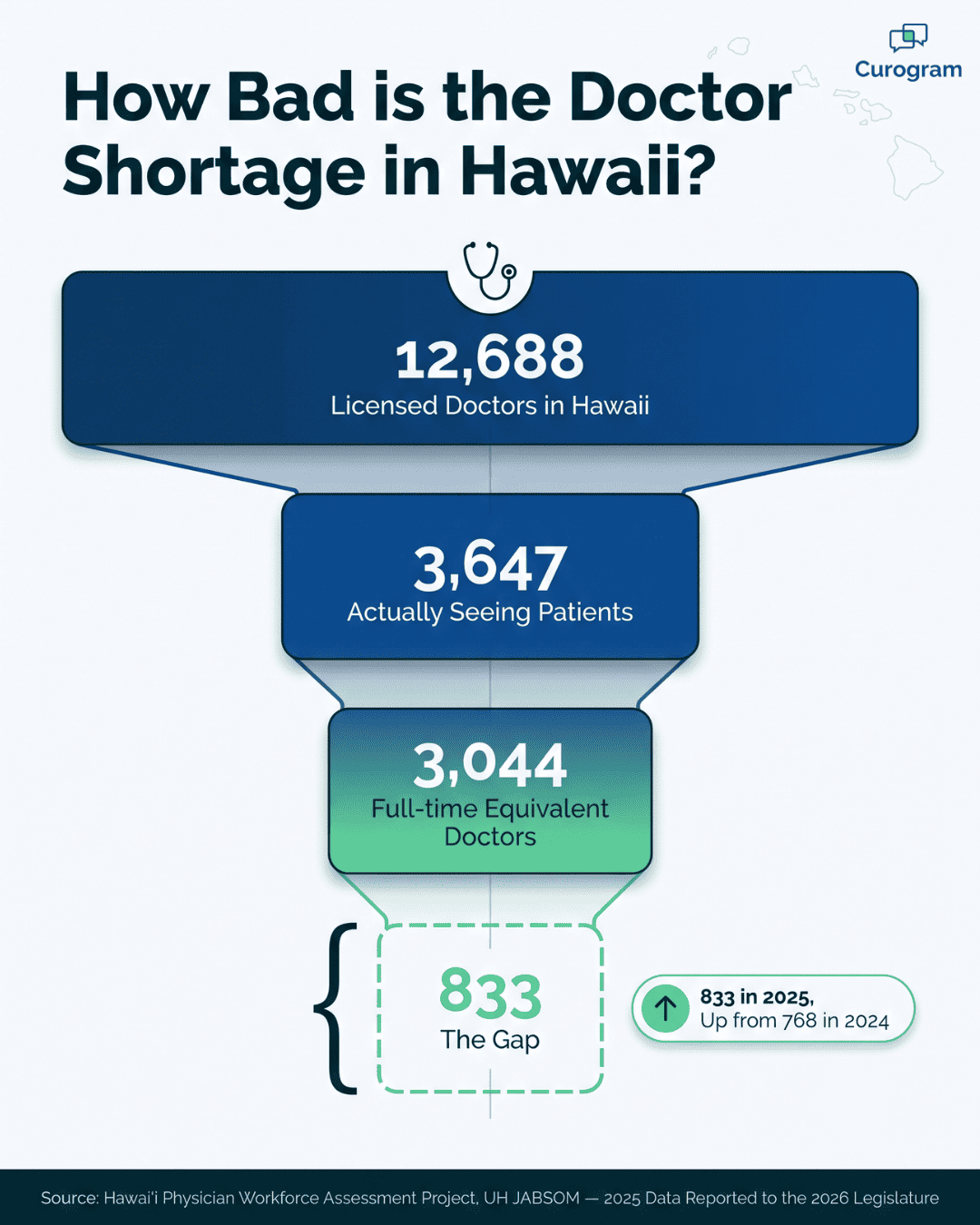
The stakes are higher here than in most states. Hawaii fell short by 833 full-time-equivalent physicians in 2025, up from 768 the year before, with the widest gaps on neighbor islands.
Roughly 3,044 full-time-equivalent doctors serve the entire state. Every visit you can hold remotely is one that doesn't require a patient to board a plane.
This guide covers what Hawaii law currently permits, what it requires you to document, and the three federal and state deadlines that could change both.
Telemedicine is care delivered when the doctor and the patient are in two different places. A visit runs over a secure digital connection instead of in your exam room. Everything else about it stays the same: you take a history, reach a diagnosis, and document the encounter.
The term covers far more than a video call. Diagnosis, follow-up consultations, prescribing, and remote patient monitoring all fall under it.
If you practice in Hawaii, the word that matters legally is telehealth. HRS 453-1.3 is titled "Practice of telehealth," and the statute defines it across four modalities:
| Modality | What It Looks Like in Practice |
|---|---|
| Live consultation | Real-time video between you and the patient |
| Store-and-forward | Sending images, labs, or records for a specialist to review later |
| Remote monitoring | Devices reporting patient data back to your office |
| Mobile health | Care and communication delivered through a phone or tablet |
Four goals sit behind almost every telehealth program:
Hawaii does not have enough doctors, and the gap is widening. The state fell short by 833 full-time-equivalent physicians in 2025, up from 768 the year before, according to the Hawaiʻi Physician Workforce Assessment Project at UH JABSOM. Neighbor islands carry the widest gaps.
Look closer at the supply and the problem sharpens. Hawaii lists 12,688 licensed physicians. Only 3,647 of them actually see patients, and once part-time schedules are counted, that works out to roughly 3,044 full-time equivalents.
For a patient on Molokai or Lanai, that math shows up as a flight to Oahu for a 15-minute follow-up. Some skip the visit instead.
Telehealth changes what "in range" means. A specialist on Oahu can hold a follow-up with a patient in Hilo without either one boarding a plane. Your panel stops being limited by who can physically reach your parking lot.
Think about what a specialist visit costs a patient on Kauai. An interisland flight, a rental car, a full day off work, and a babysitter — for a 15-minute follow-up to review labs that came back normal.
That patient does the math and cancels. Your front desk gets the call two days out, or gets nothing at all.
Telehealth removes the travel from the visit without removing the visit. The same follow-up runs from the patient's kitchen table in the same 15 minutes.
Waiting rooms shrink too. Patients who fill out intake forms on their phones before a visit aren't sitting with a clipboard while the schedule slips.
Based on our internal data, Curogram clients see appointment confirmation rates above 75% when reminders and forms go out by text, which gives your staff a much clearer picture of who is actually coming.
A virtual visit costs your practice less to deliver than an in-person one. No room turnover, no clipboard, no staff time spent walking someone back and forth.
That margin buys you range. Follow-ups, med checks, and results reviews can run remotely, which frees your exam rooms for the visits that genuinely need hands on a patient. You also get to triage sooner: a five-minute video check tells you whether someone needs to make the drive at all.
Hawaii's statute names four modalities that count as telehealth. Knowing which bucket a service falls into matters, because coverage rules differ by modality.
| Modality | What It Means | Example in Practice |
|---|---|---|
| Live Consultation | Real-time video between provider and patient | A dermatology follow-up held over two-way video |
| Store-and-Forward | Sending recorded images and records for later review | Forwarding a scan, lab result, or skin photo to a specialist to read |
| Remote Monitoring | A device sends patient data to you from another location | A Bluetooth cuff reporting daily blood pressure readings |
| Mobile Health | Care delivered through a phone or tablet | Secure two-way texting for medication check-ins |
One caution on that last row. Under Hawaii law, a standard phone call, a fax, or plain email text does not count as telehealth on its own. Those channels have to run through an interactive telecommunications system to qualify.
Most people use the two words interchangeably. Hawaii's statute does not. HRS 453-1.3 is titled "Practice of telehealth," and telehealth is the term that carries legal weight across Hawaii's code.
The statute defines telehealth as telecommunications covering four modalities: store-and-forward, remote monitoring, live consultation, and mobile health.
That includes real-time video, secure web-based tools (both interactive and not), and secure asynchronous exchange of patient data — sending records and images for review at a later time.
The 2023 rewrite widened what telehealth can be used for. It now covers four purposes:
Purpose two is the one that changed practice. You no longer need an in-person visit first to establish the relationship.
What doesn't count: A standard phone call, a fax, or plain email text — alone or combined — is not telehealth under Hawaii law.
That exclusion has one exception, and it matters if you treat mental health. Audio-only visits are reimbursable for diagnosis, evaluation, or treatment of a mental health disorder when the patient is at home, paid at 80% of the in-person rate.
A qualifying visit has to come first: in person or by audio-video telehealth, within 6 months before the initial audio-only visit, or within 12 months before any later one. That prior visit can't itself be audio-only. These provisions sunset December 31, 2027.
Hawaii built one of the country's more permissive telehealth frameworks, and it did so under pressure. The state does not have enough doctors, and the shortage is getting worse.
The Hawaiʻi Physician Workforce Assessment Project at UH JABSOM tracks the gap each year. Its 2025 findings, reported to the 2026 Legislature:
| Measure | 2025 |
|---|---|
| Licensed physicians in Hawaii | 12,688 |
| Physicians providing patient care | 3,647 |
| Full-time equivalents | ~3,044 |
| FTE shortfall | 833 (up from 768 in 2024) |
Geography multiplies the problem. Hawaii is largely rural, spread across islands, and a patient on a neighbor island can't drive to a specialist. The report notes the widest gaps sit outside Oahu.
Two more numbers from that report frame the trend. In 2025, more than 88 physicians moved away and at least 81 retired. About 25% of the state's physicians are already 65 or older.
Hawaii passed telehealth payment parity in 2016 and has amended it since. Act 217 (SB 1281, 2025) extended the current parity provisions and set them to sunset December 31, 2027.
Three changes matter most for day-to-day practice:
Hawaii Medicaid no longer works from a fixed list of approved telehealth services. Med-QUEST applies a four-part test instead. A service qualifies when it is:
A few specifics sit outside that general test. Teledentistry has its own codes (D9995 for synchronous, D9996 for asynchronous).
Applied behavior analysis can be delivered by telehealth. And one hard limit applies regardless of service: if you're prescribing controlled substances, you must be physically located in Hawaii.
Hawaii's approach is simple to state. A telehealth visit is held to the same standard as an office visit. The channel changes; the obligations don't.
That principle sits directly in HRS 453-1.3. Treatment recommendations made by telehealth, including prescriptions issued electronically, are judged by the same standards that apply in traditional physician-patient settings.
The statute draws one hard line. Writing a prescription based only on an online questionnaire is not treatment, and it does not meet an acceptable standard of care.
Every telehealth visit still requires a documented patient evaluation. That means a history and a discussion of physical symptoms detailed enough to support a diagnosis and to catch any underlying condition or contraindication before you recommend treatment.
Records follow the same rule. All medical reports produced by telehealth become part of the patient's health record, must be made available to the patient, and have to be kept in line with state and federal requirements, privacy rules included.
Hawaii does not limit telehealth to certain specialties or provider types. The gate is licensure, not discipline.
To treat a patient located in Hawaii, you need a Hawaii license. Where you sit while you do it matters less than you'd expect.
Distant sites anywhere in the United States or its territories are eligible, with one exception: if you're prescribing controlled substances, you must be physically located in Hawaii.
The rule runs the other way too. A Hawaii physician treating a patient who is located in California needs a California license. Licensure follows the patient's location, not yours.
Hawaii joined the Interstate Medical Licensure Compact in 2023, and compact licenses have been issued since January 1, 2025. That's a meaningful shortcut — but it only runs one direction.
| If you hold... | Then... |
|---|---|
| A license in a mainland compact state | You can obtain a Hawaii license through the IMLC |
| Only a Hawaii license | You cannot enter the compact through Hawaii |
Hawaii isn't a State of Principal Licensure. A physician whose only license is in Hawaii has to establish another state as their SPL before using the compact at all.
Two carve-outs exist for out-of-state providers. A licensed out-of-state physician may use telehealth to consult with a Hawaii-licensed physician, provided they don't open an office in Hawaii or meet patients there, and the Hawaii provider keeps control of the patient.
Separately, medical officers and psychologists employed by the Department of Defense and credentialed by Tripler Army Medical Center are exempt from licensing when serving neighbor island beneficiaries inside a Hawaii National Guard armory.
This rule changed, and the old version still circulates. You no longer need to see a patient in person before treating them by telehealth.
HRS 453-1.3 allows a physician-patient relationship to be established through a telehealth interaction, as long as you hold a Hawaii license. A referral from a colleague who saw the patient in person still works, but it's no longer the only way in.
Once the relationship exists, telehealth is open for any authorized purpose. That includes bringing in a consultant licensed in another state.
Your clinical judgment still gates the visit. You have to evaluate the patient and decide whether telehealth suits their condition at all. Nothing in the statute obligates you to treat remotely if the case calls for hands on the patient.
Hawaii does not require informed consent as a precondition for starting telehealth treatment.
Two categories keep the old rule, and both involve prescribing.
| Purpose | Requirement |
|---|---|
| Opiates | In-person consultation first, with one exception below |
| Medical cannabis certification | Statutes conflict. See note. |
HB 951 (2025) created the opiate exception. A patient seen in person by a health care provider in the same medical group as the prescribing provider may receive an opiate prescription for a 3-day supply or less by telehealth.
Cannabis is the messier one. HB 302 (2025) amended HRS 329-126 so a bona fide physician-patient relationship may be established by telehealth for medical cannabis certification, and it states that nothing in that part requires an initial in-person consultation.
HRS 453-1.3 still carries the older in-person language. The two read in tension, so check with your counsel before building a telehealth certification workflow.
You decide whether telehealth fits the case. Nothing in Hawaii law obligates you to treat remotely when the condition calls for an exam room.
The statute sets a floor for every telehealth encounter.
Each visit needs a documented patient evaluation, and that evaluation has to include a history and a discussion of physical symptoms detailed enough to do two things: establish a diagnosis, and surface any underlying condition or contraindication to what you're about to recommend.
That's the same bar as an office visit, which is the point. Hawaii holds telehealth treatment recommendations, prescriptions included, to the standards that apply in traditional settings.
Continuity of care is where remote visits get thin. A patient on Lanai who deteriorates mid-visit needs somewhere to go, and you should know where that is before the call starts. Work out in advance which facility takes the transfer, and tell patients what to do if things escalate between visits.
Med-QUEST adds a requirement that catches telehealth-only practices off guard. If you can't provide in-person services, then at each appointment you have to tell the patient three things and document that you did:

Prescribing by telehealth follows the same rules as prescribing in your office. HRS 453-1.3 holds telehealth treatment recommendations, including electronic prescriptions, to the standards that apply in traditional physician-patient settings.
A video visit is enough to support a prescription. A questionnaire is not. The statute is blunt about this: issuing a prescription based solely on an online questionnaire is not treatment, and it does not meet an acceptable standard of care. Text messages don't clear the bar either.
Two rules apply here, one state and one federal, and they operate independently.
| Layer | Rule | Watch date |
|---|---|---|
| Hawaii | If you prescribe controlled substances, you must be physically located in Hawaii | Ongoing |
| Federal (DEA) | You may prescribe Schedule II–V by telemedicine without a prior in-person evaluation | Expires Dec 31, 2026 |
The DEA date deserves a calendar reminder. The current allowance comes from a fourth temporary extension effective January 1, 2026. The agency has a permanent rule in progress, so the terms could change before the year ends.
Both categories once required an in-person visit with no exceptions. Both changed in 2025.
Opiates now have a narrow path. A patient seen in person by a health care provider in the same medical group as the prescribing provider may be given an opiate prescription for a 3-day supply or less by telehealth. Anything beyond that still needs the in-person consultation.
Cannabis is unsettled. HB 302 (2025) amended HRS 329-126 to allow a bona fide relationship for medical cannabis certification to be established by telehealth, and it states nothing in that part requires an initial in-person consultation.
HRS 453-1.3 still carries the older in-person language. Run any telehealth certification workflow past your counsel before you build it.
Hawaii treats a telehealth encounter as a full clinical event in the chart. Every medical report that comes out of a telehealth visit becomes part of the patient's health record, and it has to be made available to the patient.
Retention and privacy rules don't change either. Records from remote visits must be maintained in line with all applicable state and federal requirements, HIPAA included.
The operational problem shows up in how those records get created. A video visit that lives in one system and a chart that lives in another means someone on your staff retypes the encounter by hand. That's how details get dropped and how the same visit ends up entered twice.
Whatever platform you run should write back to your EHR directly. Curogram integrates with most EMRs, so intake responses, appointment history, and message threads land in the chart without a second round of data entry.
Hawaii law tracks two locations in every telehealth visit, and they carry different rules.
| Term | Who's there | Rule |
|---|---|---|
| Originating site | The patient | Anywhere, including home |
| Distant site | You | Anywhere in the US or its territories |
The distant-site rule has one exception, and it's absolute. If you're prescribing controlled substances, you must be physically located in Hawaii.
HRS 346-59.1 lists the qualifying originating sites, and the list is broad:
The patient's home
A provider's office
A hospital
A critical access hospital
A rural health clinic
An FQHC
A school-based or university-based health center
The patient's workplace
One practical caveat comes from the federal side. The HHS Office for Civil Rights expects patients not to take telehealth visits in public or semi-public settings without consent or an urgent reason. A patient dialing in from a parking lot is a conversation worth having before the visit starts, not after.
Here's the trap. Hawaii's statute bars Medicaid from restricting originating sites, and the approved state plan amendment (HI 16-0004) authorizes removing the geographic limits. But the old restrictive language is still sitting in the administrative rules.
HAR 17-1737-51.1 still lists a narrow set of eligible originating sites and still references rural shortage areas and non-metropolitan counties. Those limits are superseded, not deleted.
If a claim gets denied on originating-site grounds, that stale rule text is the likely reason. Point your billing team to the statute and the state plan amendment when they appeal.
Hawaii writes the privacy requirement straight into the telehealth statute. Services must be delivered consistent with all federal and state privacy, security, and confidentiality laws, and records from those visits have to be maintained the same way.
HIPAA does the heavy lifting underneath that. Nothing about a remote visit lowers the bar.
Three things decide whether a tool is safe to run patient conversations through:
Consumer messaging apps and standard SMS fail at least one of these. That's the practical reason a HIPAA-compliant texting platform exists as a separate category.
The HHS Office for Civil Rights expects providers to apply HIPAA safeguards and hold telehealth visits in private settings — a clinician in a closed office, not a shared workspace.
The same expectation runs toward the patient: they shouldn't take a visit in a public or semi-public place without consent or an urgent reason.
Sharing records with a specialist for a consult is permitted under HIPAA's treatment provisions. Use a secure channel to send it, and log the disclosure.
Hawaii has both kinds of parity, and the distinction matters when a claim gets denied.
Service parity means a plan can't require an in-person visit as a condition of paying for something you appropriately delivered by telehealth.
Payment parity means the rate has to match. Reimbursement for telehealth through an interactive telecommunications system must be equivalent to the rate for that same service in person.
Both apply to private payers and to Medicaid. Neither is permanent — Act 217 (SB 1281, 2025) extended the current provisions and set them to sunset December 31, 2027.
Hawaii Medicaid reimburses live video, store-and-forward, and remote patient monitoring. Audio-only sits in a separate bucket with its own rules.
| Modality | Rate |
|---|---|
| Audio-video telehealth | 100% of the in-person rate |
| Audio-only, mental health, patient at home | 80% of the in-person rate |
This is where claims fail. Four conditions have to be met, and three of them are documentation:
That prior visit can't itself be audio-only. After the initial 6-month in-person visit, at least one medically necessary in-person service has to happen within 12 months, and every 12 months after that.
Bill audio-only services with modifier FQ. For store-and-forward, use modifier 95, GQ, or GT.
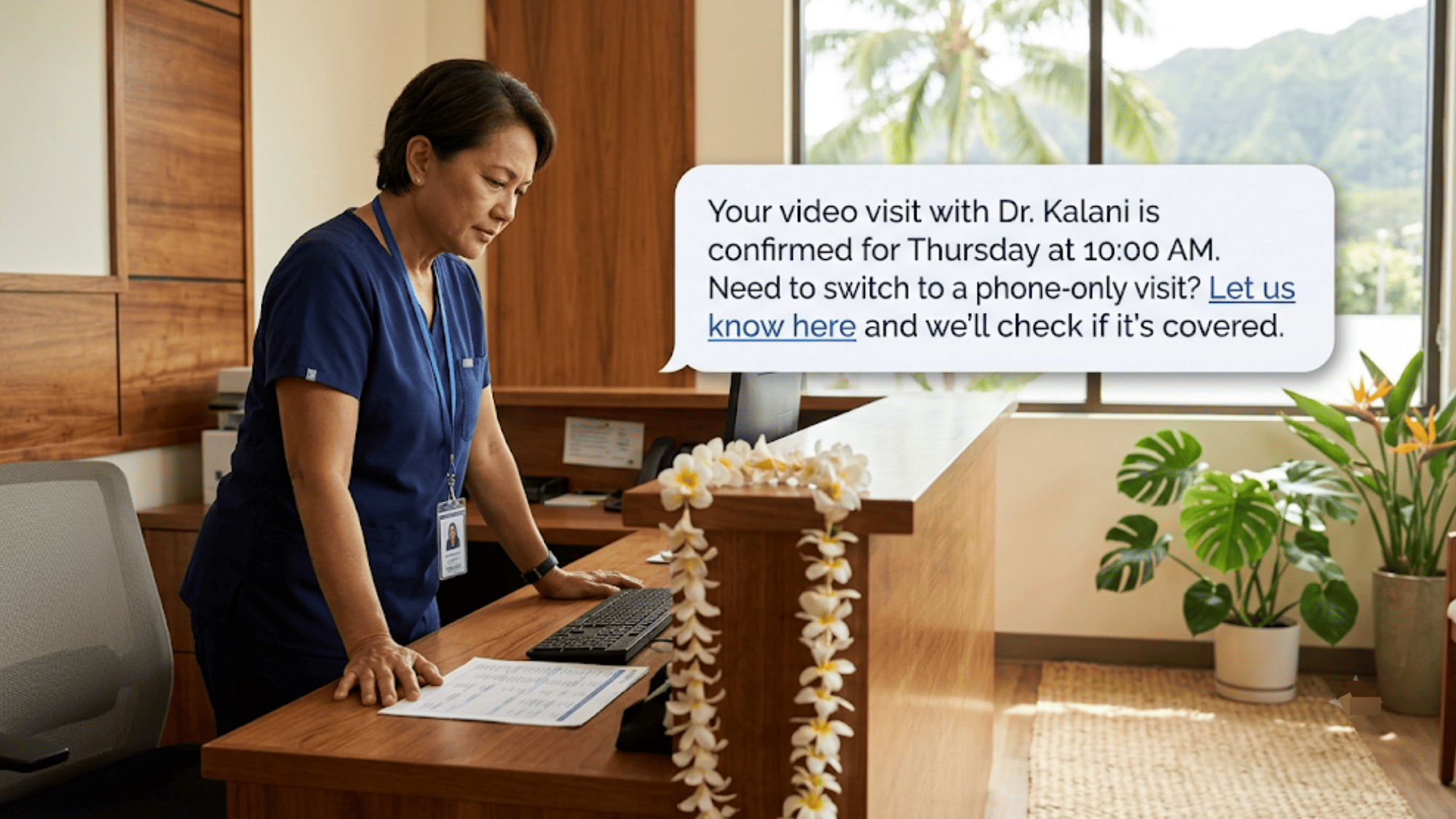
Hawaii's telehealth law is more permissive than most states'. The friction sits elsewhere — in connectivity, in continuity, and in a few compliance traps that are easy to walk into.
Broadband quality varies sharply across the islands, and a dropped video call mid-visit is a real operating condition, not an edge case.
Med-QUEST implicitly acknowledges this: unsatisfactory broadband access is listed as an acceptable documented reason a patient prefers an audio-only visit.
Build a fallback into your workflow. Decide in advance what your staff does when video fails 4 minutes into a 15-minute slot, and make sure the chart reflects what actually happened.
A patient on Lanai who needs admission can't be walked down the hall. Emergency escalation from a remote island takes coordination you have to arrange before the visit, not during it.
The Maui wildfires made this concrete. Hawaii declared a public health emergency in August 2023, and Med-QUEST enacted waivers in response.
The 2025 workforce report notes the fires eliminated facilities that haven't been rebuilt, with providers and patients relocating or leaving the state entirely.
| Trap | What goes wrong |
|---|---|
| Controlled-substance location rule | A mainland prescriber can serve Hawaii patients for most things, but not controlled substances. You must be physically in Hawaii. |
| Stale administrative rules | HAR 17-1737-51.1 still lists originating-site and geographic limits the statute removed. Denials cite rules that no longer control. |
| Audio-only documentation | The 80% rate requires the patient's stated preference, a documented reason, and a qualifying prior visit. Miss any one and the claim fails. |
None of these is a reason to skip telehealth in Hawaii. They're the reasons to write your workflows down before the first visit rather than after the first denial.
Most of what trips up a Hawaii telehealth practice is procedural, not clinical. These are the things worth settling before your first virtual visit.
Your public page should answer four questions without a phone call: which services you deliver remotely, what they cost including any add-on fees, the credentials of every provider on staff, and how a patient exercises their rights if something goes wrong.
The credentials line carries extra weight in Hawaii. Licensure follows the patient's location, so a patient checking whether you're licensed here is asking a legitimate question. Answer it on the page.
The 80% audio-only rate for mental health visits depends on documentation your front desk creates, not your clinical note. Three things have to be captured:
That the patient preferred audio-only
Why they preferred it
That a qualifying visit happened inside the lookback window
Give your staff the exact wording to use and the exact field to record it in. "Patient reports broadband unreliable at home" is a payable reason. A blank field is a denial.
Telehealth no-shows are quieter than office no-shows — nobody sees an empty chair, the slot just evaporates. Text confirmations close that gap.
Based on our internal data, Curogram clients average confirmation rates above 75%, which gives your schedule a real read on who's actually showing up.
Video alone isn't enough. Your platform should allow for advanced two-way communication through video calls, texting, and chat because a single patient encounter usually spans all three: a reminder by text, an intake form by link, then the visit itself.
Two hard requirements before you sign anything:
The vendor must sign a business associate agreement
Traffic must be encrypted in transit and at rest
A vendor that won't sign the BAA cannot touch PHI, full stop.
If your telehealth tool doesn't feed your EHR, someone retypes every encounter by hand. That's where duplicate entries and dropped details come from.
Curogram integrates with most EMRs, so intake responses and message history land in the chart without a second pass.
Your medical assistant should be able to room a patient before you join — verify identity, confirm the pharmacy, take vitals the patient measured at home.
You start the video when the patient is actually ready, which keeps the schedule from sliding when one visit runs long.
Don’t see your state? We just haven’t written about it yet! Stay tuned on our blog or check out our article on telemedicine reimbursement by state.
|
Nebraska |
|||
|
Alaska |
Iowa |
Nevada |
South Dakota |
|
Kansas |
New Hampshire |
||
|
Kentucky |
|||
|
New Mexico |
Utah |
||
|
Maine |
Vermont |
||
|
Connecticut |
|||
|
Delaware |
North Dakota |
||
|
West Virginia |
|||
|
Oklahoma |
|||
|
Hawaii |
Mississippi |
Wyoming |
|
|
Montana |
Rhode Island |
Book a demo and we'll walk your team through the workflows specific to Hawaii's rules. Bring your billing lead — the audio-only documentation piece is worth 20 minutes of their time.

1 min read
Michael Hsu : 5/28/20, 6:07 AM
💡 Telehealth in Florida is governed by Section 456.47 of the Florida Statutes, which took effect in July 2019 and has been amended five times...
1 min read
Michael Hsu : 6/3/20, 7:59 AM
💡 Michigan covers telemedicine, and its rules are broader than most published guides suggest. Private insurers must give a telemedicine service...

1 min read
Michael Hsu : 5/30/20, 7:07 AM
💡 Telehealth reimbursement depends on 3 things: the state where the patient is during the visit, the patient's payer, and the service provided....