
 Michael Hsu
1 min read
Telemedicine Colorado: Laws and Policies | Blog
 Michael Hsu : 6/9/20, 8:47 AM
💡 Telemedicine in Colorado runs under a full parity law. Private health plans and Health First Colorado must cover virtual visits and pay the...
When a patient books a video visit, your front desk fields the real question first: will insurance pay the same as an office visit? A year ago, the honest answer was uncertain, and the rule was about to expire. Now the answer is a good deal steadier.
New Jersey has treated telemedicine as real care since 2017. The state passed a parity law, then kept extending its payment rules year by year. For a clinic trying to budget, that uncertainty carried a real cost. Each near-deadline sent practices scrambling to guess what came next and how to bill for it.
The rules changed again in 2026, mostly in your favor. Payment parity now runs through the end of 2027. New Jersey joined the Interstate Medical Licensure Compact. A July 2026 law reshaped how you prescribe some controlled drugs by video.
The core idea for this guide is simple. New Jersey supports virtual care, but it attaches real conditions, and those conditions shifted this year. Get them right, and you bill with confidence. Get them wrong, and you risk denied claims, unpaid visits, or a compliance letter.
We work with practices that run virtual visits every day. We see where the friction lives: the intake form nobody sent, the prescription that needed an exam no one booked, the claim that bounced over an audio-only visit. None of that is hard to avoid once you know the rules. We also see how one small workflow fix removes each of these.
This article covers what New Jersey requires right now. We walk through parity, provider eligibility, the standard of care, new patient relationships, prescribing limits, licensing, records, and Medicaid. Read it once, fix your workflow, and get back to patients. The rules reward practices that get the details right.
The parity law is the foundation for everything else. It says virtual care counts, and it says payers must treat it fairly. The specifics changed in 2026, so start here.
Parity is about money. It ties what you get paid for a video visit to what you would get paid in person.
If a health plan covers a service in the office, it must cover that same service by telehealth, at the same rate. The plan cannot charge the patient a higher copay for going virtual. This holds for private carriers, State Health Benefits plans, and School Employees' plans. Medicare sits outside this rule.
For years, parity lived on short extensions. The latest law, signed in June 2026, pushed the deadline to December 31, 2027. That gives your practice real planning room after years of near-annual rebuilds. Mark the date and watch for the next extension.
New Jersey uses two terms, and the difference affects billing. One covers diagnosis and treatment. The other is broader.
Telemedicine means delivering a medical service through live electronic communication, like diagnosis or prescribing over video. Telehealth is wider. It covers clinical support, provider consultations, patient education, and remote monitoring. State law now folds telephones and other tools into the telehealth definition.
This is where practices trip. For physical health services, a phone-only visit with no video does not get parity pay. Behavioral health is the exception, since a phone session for mental health care is paid at the in-person rate. So a therapist can bill an audio-only client; a dermatologist usually cannot.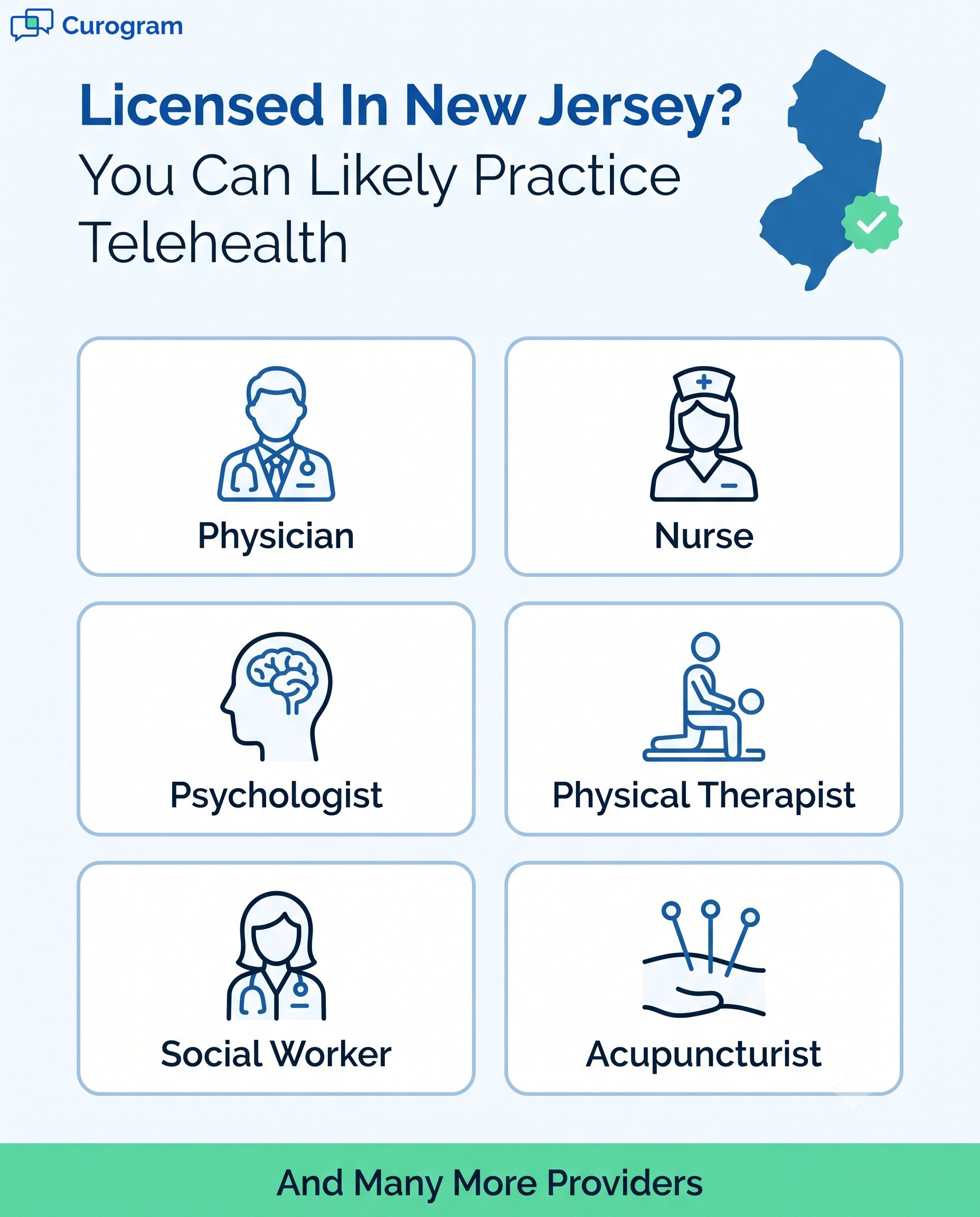
New Jersey keeps the door wide. If you are licensed here to provide a service, you can almost certainly provide it remotely.
The parity law does not hand you a short list of approved roles. State board rules fill that gap.
Physicians, nurses, and psychologists all qualify. So do physical therapists, social workers, midwives, and licensed acupuncturists. Podiatrists, genetic counselors, and hearing specialists are in too. The common thread is simple: hold a valid New Jersey license or certification, and stay inside your scope.
Care does not stop when you are out. A cross-coverage provider can treat your patient at your request. An on-call provider can handle urgent needs and follow-ups you assign. Both roles let a patient keep getting care during gaps, without starting fresh each time.
Going virtual does not lower the bar. The care you give by video must match office care.
Evaluation, diagnosis, treatment, and prescribing all carry the same duties online. You still weigh risks and benefits with the patient. You still document each visit. A video screen changes the setting, not the standard you are held to.
Sometimes video cannot do the job. A rash may need a hands-on look, or a worrying symptom may need labs. If you cannot meet the standard of care remotely, the law says stop and send the patient in. That call sits with you, every visit.
You can meet a patient for the first time on a screen and still form a valid relationship. New Jersey allows it, with a few steps.
No prior office visit is required. But you do have to confirm who you are treating and what you are working with.
Before the visit, get the basics: name, address, date of birth, and phone number. You can ask for more, like a photo or insurance ID. You also tell the patient who you are, your license, and your specialty. A digital intake form sent a few days early handles most of this.
For a first visit, review the patient's history and any records you can get. For later visits, you can review during or before the encounter. If the patient has no regular provider, point them toward one. Where you can, help them find in-person care nearby.
The visit itself needs no special consent form. Other moments do.
New Jersey does not require formal consent just to hold a telehealth visit. You do need consent to send records to another provider. You also need it before referring a patient out for in-person care. That consent can be spoken, written, or digital, as long as it fits the standard of care.
A few situations skip the full-relationship rule. Informal, free curbside consults count, as does periodic advice from an out-of-state specialist to a New Jersey provider. Free care during an emergency or disaster also qualifies. So does coverage by an on-call peer in your specialty.
This is the area that changed most in 2026, and the one that trips practices up. Regular prescriptions by video are fine once you form a valid relationship. Schedule II drugs carry extra rules.
Schedule II covers drugs like oxycodone and many stimulants. New Jersey guards these closely.
By default, the rule is firm. You need an in-person exam before prescribing a Schedule II drug by telehealth, then a follow-up in-person visit every three months. COVID-era waivers that loosened this ended in February 2026. So the in-person rule is back for most cases.
A law signed July 8, 2026 carved out real exceptions. Patients in cancer treatment, hospice, or palliative care are exempt from the in-person rule, as are long-term care residents and the terminally ill. Drugs used to treat substance use disorder are also exempt. Document why a patient qualifies.
Adult stimulant prescriptions, like ADHD medication, now follow a separate track. Kids follow an older one.
You can now start an adult on a Schedule II stimulant after a telehealth exam. But an in-person visit must follow within 30 days. After that, you check in every three months, by video or in person. At least one visit each year has to be in person.
The rule for minors held steady. You can prescribe a stimulant to a patient under 18 by video, skipping the in-person exam, if you use live two-way audio and video. You must also get written consent from the parent or guardian first. Every Schedule II telehealth visit needs real-time audio and video.
Two back-office duties round out compliance: where you are licensed, and how you keep records. Both got easier or clearer recently.
You still need a New Jersey license to treat a patient located in New Jersey. Getting one across states is now faster.
The old rule stands: the patient's location decides which license you need. What changed is speed. New Jersey joined the Interstate Medical Licensure Compact in 2022, and the compact now accepts New Jersey applications. Qualified physicians can get licensed in member states through one faster pathway.
The Compact speeds licensing, but it does not rewrite the rules. You still answer to the medical board where your patient sits. You still follow New Jersey's practice standards when treating New Jersey patients. So the Compact helps you get licensed faster, while state rules still govern the visit.
Virtual visits carry the same recordkeeping duties as office visits, plus one registration step many practices miss.
Chart every telehealth encounter the way you would an in-person one. Follow state and federal rules for records, privacy, and disclosure. Store and share everything in a HIPAA-compliant way. After each visit, make the record available to the patient on request, and forward it to their provider if they ask.
Many practices forget this step. A telehealth organization must register with the New Jersey Department of Health each year, and file an annual report on its virtual activity. The rule clearly covers practices built mainly around remote care. If virtual visits are only a side offering, check with the Department about your duties.
Public coverage tracks close to private coverage now. Medicaid and NJ FamilyCare both pay for virtual care, with a few checks.
New Jersey Medicaid has expanded well past its early telepsychiatry focus. Coverage is broad today.
New Jersey Medicaid pays for live video visits. It also covers remote patient monitoring, store-and-forward, and audio-only in defined cases. The 2026 parity extension applies to Medicaid and NJ FamilyCare too. So covered virtual services get paid at in-person rates through 2027.
Coverage is broad, but not unlimited. A program can still limit which telehealth services it reimburses. Before you treat a Medicaid or NJ FamilyCare member remotely, confirm the specific service is covered. One phone call up front beats a denied claim later.
New Jersey's telehealth rules move fast. Two habits keep you ahead.
Parity runs through December 31, 2027, not forever. Lawmakers have extended it many times, but never permanently. Put the date on your calendar. Watch for the next bill so a lapse never catches your billing off guard.
Federal telehealth flexibilities for controlled drugs run through the end of 2026. That does not override New Jersey. When state law is tougher, state law wins. Build your prescribing workflow around New Jersey's rules, then layer federal rules on top.
New Jersey rewards practices that offer virtual care and follow the rules. Those rules are clear, current, and mostly in your favor through 2027. The hard part is not the law. It is building a workflow that meets every step without adding busywork.
That is where the right platform helps. Curogram is a HIPAA-compliant patient communication and telemedicine tool that connects with your EHR. It sends digital intake forms a few days early, so you verify identity and history before the visit starts. It hosts video visits, updates records after each one, and keeps sharing secure.
Practices using our tools see appointment confirmation rates above 75%, based on our internal data. Fewer missed visits means steadier revenue and fewer gaps to chase.
Want to know how this fits your New Jersey practice? Book a short demo, and we will walk through it with your setup in mind.
1 min read
Michael Hsu : 6/9/20, 8:47 AM
💡 Telemedicine in Colorado runs under a full parity law. Private health plans and Health First Colorado must cover virtual visits and pay the...

1 min read
Michael Hsu : 6/22/20, 11:03 AM
💡 Illinois law requires private health plans to cover telehealth the same way they cover office visits. Plans must also pay in-network providers...
1 min read
Michael Hsu : 6/20/20, 10:49 AM
💡 Telemedicine in Maryland runs on three sets of rules: state insurance law, Medicaid policy, and licensing board rules. The Preserve Telehealth...