22 min read
Running a Modern Substance Use Disorder Treatment Practice
Mira Gwehn Revilla
:
April 25, 2026
The goal is simple: cut dropout, pass audits, and scale safely without burning out staff. This guide walks through what makes SUD operations unique, the six pillars of a modern program, common failure points, the tech stack that matters, and the outcome metrics that prove your clinic works. Whether you run an OTP, an MAT clinic, or a CCBHC with an SUD track, these fundamentals apply.
Demand for substance use disorder care has never been higher. Overdose deaths remain a national crisis, and more people seek help than ever before.
Yet many programs still run on phone tag, paper forms, and fax machines. That mix of rising need and outdated workflows is why clinics struggle to keep people in treatment.
Running a modern program takes more than skilled clinicians. Substance use disorder treatment practice management sits at the crossroads of strict rules, tight budgets, and rising patient need.
Programs that succeed pair a solid clinical model with SUD-aware tools like Curogram's Opus EHR integration and secure patient messaging. Policy keeps shifting, staff turnover is high, and every missed visit carries real clinical risk.
The good news? Operations can be fixed. Better tools, cleaner workflows, and the right metrics change outcomes fast.
That is why leading teams now treat SUD practice operations with the same weight as clinical quality. The two drive each other, and neither works alone.
This guide is for administrators, clinical directors, and executives running an SUD treatment clinic or scaling one. We walk through what makes this work different from general mental health care.
We break down the six pillars every modern substance use treatment practice needs to hit. You will see where programs fail most often, which tools pay for themselves, and which numbers matter most to track.
We pull in lessons from Curogram client data from clinical settings. Some examples come from general medical practices and work as illustrations, not direct SUD data. For more on fit, see how Curogram serves behavioral health clinics.
Let us start with the rules that set this work apart.
What Makes SUD Practice Management Different from General Behavioral Health?
Running an SUD program is not the same as running a general therapy clinic. The rules are stricter. The medications are controlled.
Patients cycle through more levels of care. Dropout risk is higher, especially in the first month. These differences shape every workflow, from intake to billing. Here is how three key areas set this work apart.
Here is a quick comparison between SUD practice vs. general mental health practice:
|
Operational Area |
General Mental Health Practice |
SUD Treatment Practice |
|
Primary federal rules |
HIPAA |
HIPAA + 42 CFR Part 2 |
|
Consent structure |
Standard release |
Granular consent per disclosure |
|
Medication workflows |
Standard e-prescribing |
MAT with DEA oversight |
|
Care duration |
Often episodic |
Long-term continuum of care |
|
Highest dropout risk |
Varies |
First 30 days |
|
Core staff model |
Therapists, psychiatrists |
Prescribers, counselors, case managers, peers |
|
Typical levels of care |
Outpatient focus |
Detox → residential → IOP → OP → recovery support |
|
Audit focus |
HIPAA basics |
42 CFR Part 2 + DEA + state licensing |
Legal Framework (HIPAA Plus 42 CFR Part 2)
Every medical practice follows HIPAA. SUD programs follow HIPAA plus 42 CFR Part 2. Part 2 is a federal rule that protects records from SUD treatment. It is much stricter than HIPAA.
Under Part 2, you cannot share SUD records with primary care, family, insurance, or another clinic without specific written consent. The consent must name the recipient, the purpose, and the expiration date. Even confirming that a person is a patient can trigger a violation.
This shapes daily work in three ways:
- Intake staff cannot disclose patient status to callers without proof of consent.
- Billing teams must use careful coding and share only what the consent allows.
- Any patient communication tool, like SMS or portal messages, must lock down SUD-specific records.
42 CFR Part 2 was updated in 2024 to align more closely with HIPAA for treatment, payment, and operations. Some disclosures are easier now. But patient consent rules are still tighter than general behavioral health. SAMHSA maintains the current guidance and should be your source of truth.
Practical example: a patient in your methadone program is hospitalized. The ER calls your clinic asking about their medication.
Without a signed Part 2 consent naming that hospital, you cannot confirm they are even your patient. A modern substance use treatment practice solves this with digital consent forms that flow through the EHR at intake.
Treatment Modalities That Shape Workflow
General mental health clinics mostly offer talk therapy and psychiatric meds. An SUD program runs many treatment types at once, often for the same patient.
Common modalities include:
- Medication-assisted treatment with buprenorphine, methadone, or naltrexone.
- Individual and group counseling.
- Contingency management for stimulant use disorder.
- Peer recovery support services.
- Harm reduction workflows such as safer use education and naloxone distribution.
Each type needs its own workflow. MAT patients need DEA-compliant prescribing, drug screening, and regular check-ins. Group therapy needs room scheduling, attendance tracking, and billing that accounts for group size. Peer support needs notes that meet state rules without crossing into clinical documentation.
This mix is why SUD practice operations get complex fast. A single patient may see a prescriber, a counselor, a peer specialist, and a case manager in one week. Your schedule, consents, and records must all sync.
Harm reduction workflows add another layer. Some programs now offer fentanyl test strips, naloxone distribution, or overdose response training. These services often fall outside standard billing codes. Your documentation must prove compliance without forcing staff into clunky workarounds.
The takeaway: an SUD clinic is less like a therapy practice and more like a small specialty hospital with mixed care. The right EHR and communication stack must support every flow. A one-size platform will leave staff filling gaps by hand.
Continuum-of-Care Demands
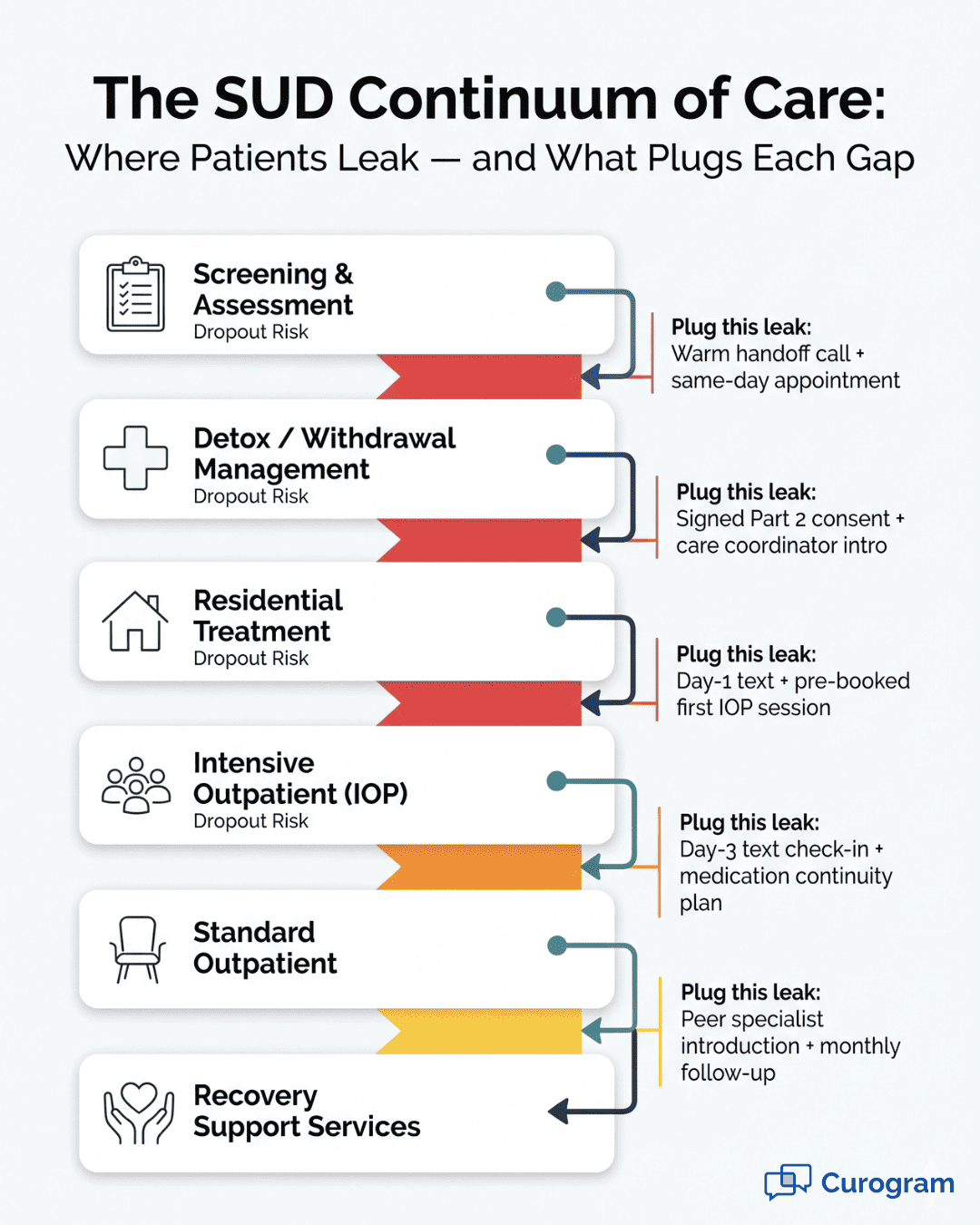
Recovery is rarely linear. Most patients move through several levels of care over months or years. A solid continuum of care plan is the core of addiction treatment practice management.
The typical SUD continuum includes:
- Screening and assessment
- Detox or withdrawal management
- Residential treatment (for some)
- Intensive outpatient (IOP) or partial hospitalization (PHP)
- Standard outpatient
- Long-term recovery support services
Patients often step down from one level to the next, and sometimes step back up. A relapse may send someone from outpatient back to detox. The handoff between levels is a high-risk moment. Miss it, and the patient drops out.
General mental health clinics rarely coordinate across this many levels. They refer out and lose track. SUD programs must own the handoff or risk losing the patient. This is why warm transfers, shared records, and tight communication between levels matter so much.
Some programs, such as CCBHCs, must offer or coordinate the full continuum by design. CCBHC operations require partnerships with hospitals, jails, social services, and housing groups. Your practice must prove that patients moved smoothly between settings, not just that you offered care.
A practical fix: keep one care coordinator tied to each patient across levels. Use secure messaging to check in during transitions. Based on our internal data, timely, personal touchpoints lift retention during these high-risk windows.

The 6 Operational Pillars of a Modern SUD Practice
A modern SUD treatment practice runs on six linked pillars. Each one supports the others. Weaken one pillar, and the whole program wobbles. These pillars are not new, but the tools and expectations around them have changed fast.
The clinics pulling ahead in 2026 treat each pillar as a system with clear owners, clear metrics, and clear tech. Here is what each pillar looks like in practice, with moves you can make this quarter.
1. Compliance and Confidentiality-by-Design
Compliance is not a department. It is a design principle that shapes every workflow. "By design" means you build Part 2, HIPAA, and DEA rules into the system, not bolt them on later.
Key features of compliance-by-design:
- Granular consent forms that track which clinic, which record, and which time frame.
- Audit logs on every record view, disclosure, and message.
- Role-based access so counselors see therapy notes, billing sees codes, and intake sees demographics only.
- Secure messaging that flags SUD-specific records before any external share.
Most audit failures come from the same three places: missing or expired consents, sloppy staff-to-patient texts outside the secure platform, and mismatched records when patients move between levels. A simple way to catch these is a monthly internal audit on 10 to 20 random charts.
|
Consider a real example: A counselor texts a patient from their personal phone to confirm an appointment. That single text, outside the platform, can count as an unsecured disclosure under 42 CFR Part 2. The fix is simple: make secure two-way texting the only channel staff can use. Based on our internal data, practices using this approach cut phone call volume by up to 50%, which also removes the temptation to use personal texts. |
The goal is to make the compliant path the easy path. If staff must work around the rules to do their jobs, the rules will break. Design the system so compliance happens by default, not by effort.
2. Patient Engagement and Retention
SUD dropout is steep. SAMHSA data shows many patients leave treatment within the first 30 days. The cost is clinical and financial. Every drop-off is a relapse risk and a lost revenue slot.
Retention depends on three things: how easy it is to stay in touch, how personal the outreach feels, and how fast you respond when someone slips. Modern engagement looks like this:
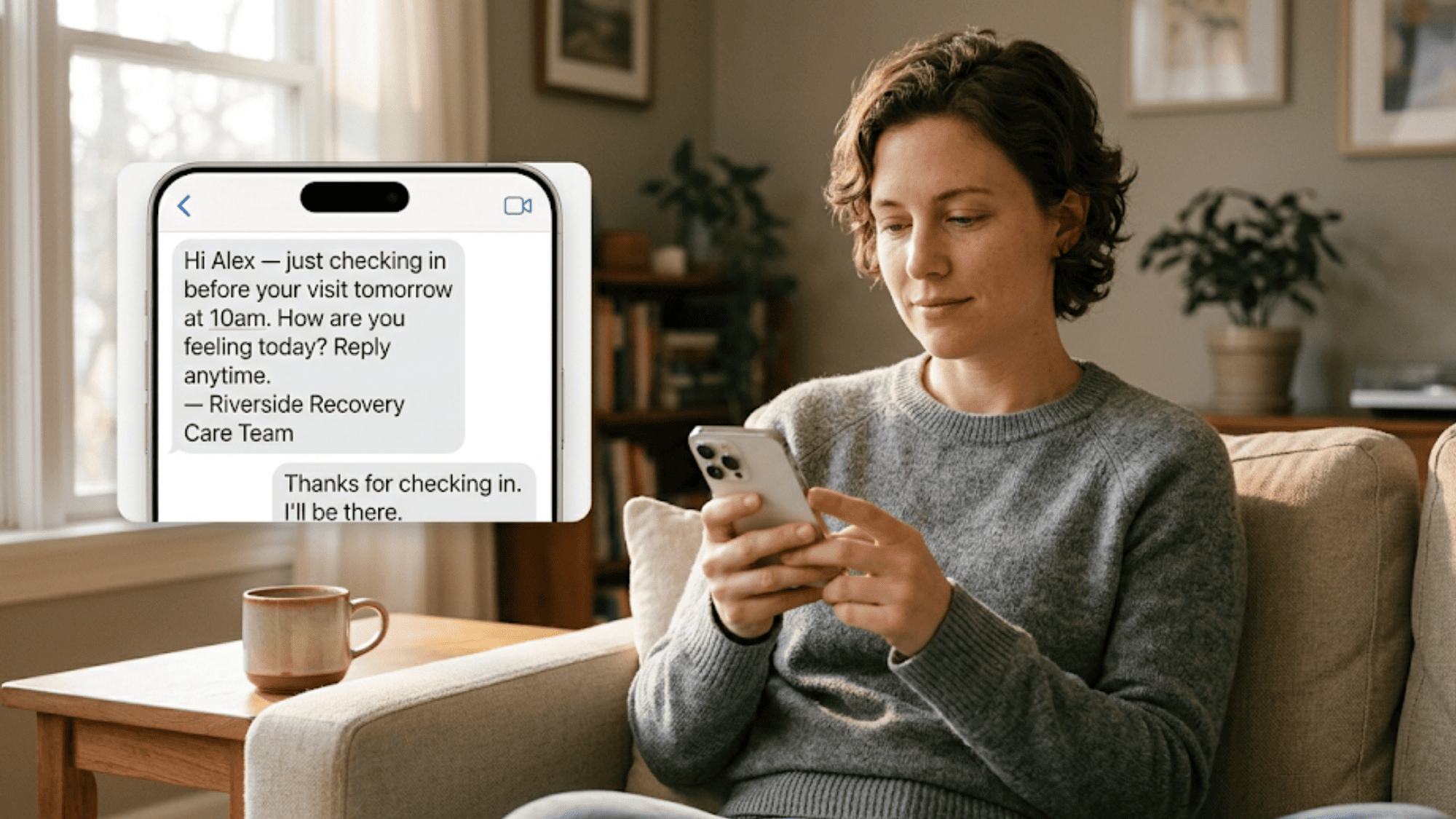
- Two-way secure texting for confirmations, nudges, and quick check-ins.
- SMS recall campaigns that bring overdue patients back without staff phone marathons.
- Pre-visit forms the patient can fill out on their phone, not in the waiting room.
- Automated reminders that cut no-show risk.
Numbers from Curogram tell the story. Based on our internal data, SMS recall campaigns drove a 35% reconversion rate, meaning one in three overdue patients booked a new visit within a month.
The platform average for no-show rates runs 53% below the industry average. While this data comes from mixed medical settings, the engagement logic applies to any substance use treatment practice.
A practical example: a clinic with 400 active MAT patients sends weekly check-in texts. If 5% respond with a concern, that is 20 early warnings per week counselors can act on. Without texting, most of those patients simply miss their next visit. You find out when it is too late. Engagement is not a nice-to-have. It is a retention engine.
3. Medication Management (MAT Workflows)
Medication-assisted treatment is the clinical backbone for opioid use disorder. The three main drugs are buprenorphine, methadone, and naltrexone. Each has its own rules and its own workflow demands.
The core MAT workflow includes:
- DEA-compliant prescribing (the X-waiver is no longer required for buprenorphine, but DEA registration still is).
- Regular drug screening and result review.
- Scheduled med checks, often weekly or biweekly early in care.
- Careful documentation tied to dispensing records.
Methadone adds a layer. OTP programs must follow SAMHSA accreditation rules and state methadone regulations. Dosing happens on-site for most patients, at least early in treatment. Take-home privileges depend on patient progress and tight records.
Naltrexone, especially the long-acting injectable form, is easier to manage but still requires careful screening to avoid precipitated withdrawal.
Your practice management platform needs to handle all three. The EHR should flag prescribing gaps, missed screenings, and overdue med checks. Curogram's Welligent integration is built for large multi-location agencies that run mixed MAT, methadone, and residential care under one roof.
A practical note: do not mix MAT notes with general therapy notes in the same record view. Part 2 rules treat them differently. Your EHR setup should separate the data paths so staff see only what their role allows, and sharing follows consent rules automatically.
4. Telehealth-Enabled Access
Telehealth changed SUD care. DEA and HHS have extended telehealth flexibilities for controlled substances through December 31, 2026. A final buprenorphine rule also makes buprenorphine prescribing via telemedicine permanent under defined conditions.
This matters because telehealth closes care gaps for the hardest-to-reach patients:
- Rural patients who live hours from the nearest MAT provider.
- Working adults who cannot take three hours off for a 30-minute visit.
- Patients with transportation, childcare, or mobility barriers.
- Pregnant patients who need more frequent check-ins.
A practical telehealth workflow for SUD looks like this:
- Patient books through secure texting or an online portal.
- Intake forms and consents go out by SMS link, signed on the phone.
- Patient joins a video visit, with audio-only as a backup where rules allow.
- Prescription and drug screen orders flow straight into the EHR.
- Follow-up reminders go by text, not phone.
Audio-only telehealth remains allowed for buprenorphine under the DEA extension. This is a lifeline for patients without reliable internet or smartphones. Verify current rules with SAMHSA and your state board before you lean on audio-only as a default.
The operational gain is real. A clinic that runs half of its med checks by telehealth can serve more patients per clinician hour. Staff spend less time on no-show follow-up. Patients show up more. Build telehealth into your scheduling templates so it becomes the default for routine check-ins, not the exception.
5. Warm Handoffs and Care Coordination
Handoffs are where SUD programs win or lose. A warm handoff means a patient is personally connected to the next provider, not just handed a phone number. A cold handoff, by contrast, is a referral slip and a hope.
High-risk handoff moments include:
- ED to outpatient after an overdose.
- Detox to residential.
- Residential to IOP.
- Jail or prison release to community care.
- Pregnancy discharge to postpartum follow-up.
Each of these is a drop-off point where people vanish from care. The fix is direct, real-time contact between sending and receiving providers, with the patient in the loop.
A good warm handoff workflow:
- Secure messaging between sending and receiving staff before the patient leaves.
- A confirmed first appointment booked while the patient is still on-site.
- A same-day text reminder to the patient with the next step.
- A check-in text 24 to 48 hours after handoff to catch issues early.
CCBHC operations require this level of coordination as a core standard. Even non-CCBHC programs benefit from the same discipline. The cost of building a warm handoff workflow is hours of staff training and a few tech integrations. The cost of skipping it is measured in relapse rates and revenue loss.
Based on our internal data, clinics using secure two-way texting for patient follow-up see stronger retention during these transitions. Your goal should be zero patients lost between levels.
6. Data, Documentation, and Measurement-Based Care
You cannot improve what you do not measure. The best SUD programs track clinical, operational, and financial data in a tight loop. Measurement-based care means using that data at the patient level to guide treatment choices.
Core data categories to track:
- Clinical: PHQ-9, GAD-7, and SUD-specific screeners like ASI or DAST scores over time.
- Retention: 30-day, 90-day, 6-month, and 12-month retention rates.
- Attendance: no-show and cancellation rates by provider, day, and program.
- Outcomes: negative drug screens, housing stability, employment, return-to-use events.
- Financial: no-show cost, billable hours per clinician, average revenue per patient.
Documentation must support all of this. Notes should lock down quickly, capture the data points payers need, and keep Part 2 records segregated. Many programs lose money at audit simply because their notes do not match the service codes billed.
A concrete example: a clinic finds its 30-day retention is 58%. When broken down by clinician, one clinician hits 90%.
The operations team looks at that clinician's schedule, reminder patterns, and outreach habits. Then they roll those habits out program-wide. Retention climbs to 70% within two quarters. That is measurement-based care applied to operations.
Pick three metrics to watch weekly. Share them with clinical leadership. Over time, the numbers become a shared language. Staff stop guessing what good looks like. They see it on a dashboard and work toward it.
Common Operational Failure Points — and How to Avoid Them
Even well-run SUD clinics hit the same few operational walls. These failure points show up in audits, staff burnout surveys, and dropout data. The good news is they are predictable. Predictable problems have repeatable fixes.
Here are four failure points that sink programs most often, along with practical ways to get ahead of each one:
High Dropout After the First 30 Days
The first 30 days are the make-or-break window. SAMHSA research shows most SUD dropouts happen in this stretch. If a patient is still engaged at day 30, they are far more likely to reach 90 days and beyond.
Why the cliff? A few reasons:
- Early ambivalence about treatment.
- Logistical friction with scheduling, transport, or costs.
- Withdrawal symptoms or medication side effects.
- Lack of early wins to build momentum.
How to avoid it:
- Front-load contact. Plan 3 to 5 touchpoints in the first 2 weeks, not just 1 weekly visit.
- Use SMS check-ins between visits. A short "how are you doing today?" text catches struggle early.
- Remove friction. Offer telehealth, same-day appointments, and mobile intake.
- Flag high-risk patients for extra support, such as pregnant patients, post-overdose patients, and those with housing instability.
A practical example: a 90-bed outpatient program adds day-3, day-7, and day-14 check-in texts to every new patient. The protocol is simple, short, and automated. Their 30-day retention moves from 52% to 68% over two quarters. No new hires. No new software. Just a protocol built on secure texting and a clear trigger list.
The cost of a dropout is high. Clinically, it raises overdose risk. Financially, you have eaten intake time and setup cost without billing a full course of care. Front-loaded engagement pays back fast.
Phone-Heavy Intake That Overwhelms Staff
Intake is the first impression and the first bottleneck. A phone-heavy model pins staff to headsets all day. Calls pile up, voicemails go unreturned, and patients who need help now give up.
Common symptoms:
- Multiple phone calls needed to schedule a single intake.
- Long hold times during peak hours.
- Forms mailed or faxed, then re-entered by staff.
- Staff burnout from repetitive call volume.
The fix is a hybrid intake built around secure texting and mobile forms. A typical flow:
- Patient reaches out via web form, text, or call.
- System replies by text with a secure intake link.
- Patient completes consents, demographics, and screeners on their phone.
- Staff review a completed chart before the first visit, not during.
Based on our internal data, practices using 2-way texting cut phone volume by up to 50%. That is the single biggest hour-saver staff can get. Freed-up time goes back to patients who need a live person.
A worked example: a 10-person intake team handles 80 calls a day. With texting, half of those calls become texts. The team can now handle 120 inquiries in the same shift.
Intake wait times drop from 10 days to 3. That shorter wait is a retention driver on its own. People who reach out during a crisis cannot wait 10 days for a callback. They will find another program or give up.
Fragmented Communication Between Levels of Care
SUD care lives across settings. Detox, IOP, outpatient, residential, and community partners each hold a piece of the record. If they do not talk, patients fall through the cracks.
Signs of fragmentation:
- The same patient gives the same history five times.
- Prescribers do not know what the counselor tried last month.
- Case managers chase records by fax for days.
- Warm handoffs break down at transition points.
Why this is hard in SUD: 42 CFR Part 2 limits what you can share and with whom. A shared EHR is not enough. You need consents that cover each partner, plus secure messaging that flags SUD records before sharing.
Practical fixes:
- Build a standard multi-party consent form used at intake.
- Use one secure messaging platform across sending and receiving staff.
- Assign one care coordinator per patient for the full episode of care.
- Run monthly case reviews where each level reports on shared patients.
For large multi-site SUD agencies, Curogram's Welligent integration supports communication and record flow across many locations under one system. If you are weighing messaging platform alternatives, compare options allows you to see how Part 2–aware workflows differ from standard behavioral health tools.
The goal is one record, one consent path, one care story per patient. The patient should never feel like they are starting over when they move between levels.
Compliance Gaps That Surface During Audits
Audits are a fact of life. SAMHSA, DEA, state licensing boards, and payers all audit SUD programs. The gap between "we have policies" and "we can prove we followed them" is where programs get cited.
Common gaps:
- Expired or missing Part 2 consents on disclosures.
- Undocumented or missing drug screens for MAT patients.
- Staff-to-patient texting outside the secure platform.
- Notes that do not match the billed codes.
- No audit trail on who viewed which record.
How to stay audit-ready:
- Run internal audits monthly on a random sample of 10 to 20 charts.
- Keep a shared consent registry that flags expirations 30 days out.
- Block any outbound SUD record sharing that does not match an active consent.
- Use role-based access so staff cannot see records outside their role.
- Train new hires on Part 2 within their first two weeks, not just HIPAA.
An example: a 150-patient OTP fails a state audit because 14% of charts have expired Part 2 consents. The fix is a consent registry with auto-alerts. Six months later, their second audit finds zero expired consents. The cost was a workflow change, not new software.
Audits are not the enemy. They are a mirror. Every citation tells you where your daily workflow breaks down. Treat them as operational data, not just legal risk. Your next audit should be cleaner than your last.
Technology Stack Essentials for SUD Practices
Your tech stack is the spine of your operations. Pick the wrong tools, and your staff spends half their day on workarounds. Pick the right ones, and compliance, retention, and care coordination start to run themselves. The SUD stack has four essential layers. Each must play well with the others.
Here is what to look for in each, and why generic behavioral health tools often fall short for this work:
EHR with SUD-Aware Consent Management
A general behavioral health EHR is not enough for SUD. You need an EHR that understands 42 CFR Part 2 at the data layer, not just as a paper form. That means:
- Flags on every SUD-specific record.
- Consent tracking built into the chart, not stored in a side folder.
- Automatic filtering when records are shared, exported, or printed.
- Role-based access that separates SUD data from general BH data by default.
Opus EHR is a behavioral-health-native platform built for SUD and OUD programs. It handles MAT prescribing, methadone dispensing records, and Part 2 consent tracking in one system.
Curogram's Opus EHR integration connects secure messaging and patient engagement tools so your clinical and operational workflows run on one data layer. This matters because the weakest link in any SUD stack is usually the handoff between EHR and patient communication.
What to ask an EHR vendor:
- Does your system tag SUD records distinctly from non-SUD records?
- Does it enforce Part 2 consents automatically on external shares?
- Does it support MAT, methadone, and residential workflows?
- Does it log every view and disclosure for audit?
If the vendor cannot show you these features in a live demo, keep looking. SUD-aware EHRs are a narrower category than general BH EHRs, and the difference shows up in audits.
HIPAA + 42 CFR Part 2–Compliant Patient Communication
Secure messaging is not optional. It is the core channel for reminders, check-ins, recall campaigns, and Part 2–aware disclosures. A compliant messaging tool must do three things:
- Sign a BAA and support HIPAA plus Part 2 requirements.
- Keep SUD-specific records segregated within the messaging system.
- Provide full audit logs on every message sent, received, and read.
Not every "secure texting" product meets this bar. Many tools handle HIPAA fine but treat all records the same. For SUD, that gap can cost you an audit finding.
Features to look for in HIPAA-compliant texting:
- Two-way SMS the patient can use without installing an app.
- Automated reminders, recall, and post-visit follow-ups.
- Broadcast messaging for program updates and weather closures.
- Team inbox so front desk, clinical, and billing can all route messages.
Curogram's platform is built on HIPAA-compliant 2-way texting and handles these workflows at scale. Based on our internal data, practices cut phone call volume by up to 50% with 2-way SMS, and no-show rates run 53% below the industry average. While these numbers come from mixed medical settings, the workflow logic transfers directly to any substance use treatment practice.
A quick check: ask your vendor what happens when a patient texts a question about their methadone dose. If the answer is "it goes to the shared inbox and anyone can see it," that is a Part 2 problem waiting to happen. The right tool routes it by role.
Telehealth for Induction and Maintenance Visits
Telehealth is now core infrastructure for SUD care. DEA flexibilities through December 31, 2026 plus the final buprenorphine rule allow buprenorphine induction and maintenance by video, and audio-only where applicable.
Your telehealth software must handle more than a simple video call:
- HIPAA-compliant video with no third-party recording by default.
- Audio-only fallback for patients without reliable internet.
- Integrated scheduling that syncs with the EHR.
- Pre-visit intake links so patients arrive ready.
- Post-visit follow-up via secure text.
Choose a telehealth platform that plugs directly into your EHR and patient communication tool. A standalone video link forces staff to copy info across three systems. That is a recipe for missed details and documentation gaps.
Practical tips for SUD telehealth:
- Use telehealth for routine med checks, counseling follow-ups, and check-ins between in-person visits.
- Keep in-person visits for initial assessments, drug screening, and complex clinical needs.
- Send a prep text 24 hours before the visit with the link and any intake form.
- Have a staff member start the call, verify ID, then hand off to the clinician.
Telehealth is also a retention tool. A patient who cannot drive 40 minutes to an in-person visit may still join a video call. Verify DEA, state, and payer rules before launching any telehealth-first MAT workflow. Rules shift often, and SAMHSA updates guidance as policy evolves.
Secure Digital Intake and Screening
Paper intake is a retention killer. A patient shows up, spends 30 minutes on a clipboard, and then waits. Some leave before they see a clinician. Digital intake removes that friction.
A strong digital workflow using online patient forms:
- Send an intake link by secure text once the patient books.
- Let the patient complete consents, demographics, and screeners on a phone.
- Include SUD-specific screeners like DAST-10, AUDIT, or ASI-Lite.
- Pull completed forms straight into the EHR, not into PDFs that staff re-key.
- Flag urgent responses (suicidal ideation, overdose history) for same-day clinical review.
Screening is more than paperwork. It is an early-warning system. A patient who scores high on a depression screener and reports recent overdose history should not wait 7 days for a standard intake. Your digital intake tool must flag these cases in real time.
Practical example: a MAT clinic switches from paper to mobile intake. Before the switch, 20% of patients arrived with incomplete forms and required follow-up calls.
After the switch, 95% of patients arrive with a complete chart ready for the clinician. Intake time per patient drops from 45 to 25 minutes. The clinic can now see more patients per day with the same staff.
Digital intake also protects consent tracking. Every signed form is timestamped and tied to a record, not a paper file in a cabinet. At audit time, pulling the consent history is a search, not a scavenger hunt.

Measuring What Matters in SUD Operations
Metrics tell you what your program actually does, not what you hope it does. Good substance use disorder treatment practice management rests on three metric families: retention and engagement, clinical outcomes, and financial sustainability.
Each tells a different part of the story. Track them weekly if you can, monthly at minimum. Share them across clinical and operations leadership. The goal is a shared view of performance that drives decisions, not just reports.
Retention, Attendance, and Engagement Metrics
Retention is the single most important metric in SUD care. If patients do not stay, nothing else matters. Track retention at 30 days, 90 days, 6 months, and 12 months. Break it down by clinician, program, and referral source.
Attendance metrics to watch:
- No-show rate (overall and by clinician).
- Cancellation rate.
- Same-day fill rate for canceled slots.
- First-visit completion rate (intake to first clinical visit).
- Wait time from inquiry to first appointment.
Engagement metrics are newer but matter just as much:
- Response rate to automated reminders.
- Response rate to SMS recall campaigns.
- Portal or app login frequency for enrolled patients.
Why these matter: a patient who responds to texts is more likely to show up. A clinician with high no-shows may have scheduling, rapport, or communication issues the dashboard can surface.
Based on our internal data, clinics using automated reminders and 2-way texting see no-show rates 53% below industry average, and SMS recall campaigns drive 35% reconversion.
While these come from general medical settings, the mechanics apply to SUD. A no-show in an SUD program is higher clinical risk than in most specialties because the missed patient may be in active use or withdrawal.
Set a weekly dashboard for no-show rate, 30-day retention, and recall response. Review it in team huddles. Trends show up fast when the numbers are always in front of staff.
Clinical Outcome Indicators
Clinical outcomes prove your program works. Payers, grant funders, and accreditors all want to see them. More importantly, they tell you whether patients are getting better.
Core SUD clinical indicators:
- Negative drug screens over time (at 30, 60, 90 days).
- PHQ-9 and GAD-7 trends (many SUD patients have co-occurring conditions).
- Housing and employment status.
- Return-to-use events (with context, not punishment).
- Overdose events in the patient population.
- Medication adherence for MAT patients.
Measurement-based care means using these indicators at the patient level, not just in aggregate reports. A counselor should see the patient's last PHQ-9 before each session. A prescriber should see drug screen history at each med check. The data guides the visit, not just a year-end report.
Example from practice: a CCBHC tracks 6-month retention and negative drug screens together. They find patients who attend a weekly peer recovery group have double the 6-month retention of those who only see a prescriber. The program adds peer support as a default, not an add-on. Six months later, overall retention climbs 15 points.
Recovery support services like peer specialists, housing navigation, and employment help are hard to measure in billing codes but show up clearly in outcome data. If you can link peer support to retention or to negative screens, you have a case for funding.
The point of outcome data is not to judge. It is to learn what works and do more of it.
Financial Sustainability Benchmarks
A program that cannot pay its bills cannot help patients. Financial metrics are not optional for behavioral health operations for SUD.
Key financial benchmarks:
- Revenue per active patient per month.
- Billable hours per clinician per week.
- No-show cost (lost revenue from missed slots).
- Collections rate.
- Days in accounts receivable.
- Cost per acquired patient (marketing and intake spend).
No-show cost is often the biggest preventable loss. If a 60-minute MAT med check visit bills $200 and your no-show rate is 15%, every clinician loses thousands per month in unbilled time. Cutting that rate is the fastest revenue win available to most SUD programs.
Based on our internal data, automated reminders and 2-way texting tie to a 10–20% increase in revenue through recovered appointments in general medical settings. In an SUD context, a similar recovery lift plus higher retention means more patients staying longer, which directly drives revenue stability.
Grant funding (SAMHSA block grants, CCBHC funding, state opioid response dollars) adds revenue but often comes with heavy reporting. Track your grant reporting burden separately. It takes staff time that is not billable.
Benchmark example: a 200-patient MAT clinic with a $180 average med check and 10% no-show rate loses about $4,300 per month to no-shows. Cutting that rate to 5% saves $2,150 per month, or around $26,000 per year. That pays for two scheduling coordinators or a full patient engagement platform.
Sustainability is not about squeezing every dollar. It is about protecting the revenue that keeps the doors open.
How SUD Programs Fit into Integrated Behavioral Health
SUD treatment rarely happens in a silo anymore. Most patients have co-occurring conditions: depression, anxiety, trauma, chronic pain, or housing instability.
The trend in modern care is integration. That means pulling SUD care into the wider behavioral health and primary care ecosystem, not running it as a separate track.
Integration can look several ways:
- Co-located SUD and mental health services in the same clinic.
- CCBHCs that offer the full continuum under one roof.
- Primary care clinics that add MAT with bridge support from SUD specialists.
- Hospital-to-community warm handoffs for ED overdose patients.
Each model has trade-offs. Co-location is powerful but requires careful consent design so mental health and SUD records stay separate where Part 2 demands.
CCBHC operations offer the broadest integration but carry heavy federal and state reporting. Primary care MAT expands access but needs specialist backup for complex cases.
The operational lift for integration is real. You must sync schedules across teams, share records within consent limits, and coordinate billing across program types. Your EHR and messaging tools must keep Part 2 records distinct while still supporting team-based care. The compliance standards your tech stack meets will shape how much of this lift falls on staff versus the platform.
For a broader view of how behavioral health teams manage engagement across conditions, our cluster on patient engagement in behavioral health covers practices that apply to both mental health and SUD programs. Clinician burnout is another shared challenge across integrated teams, which we explore in depth in our piece on behavioral health clinician burnout.
The biggest benefit of integration is the patient experience. One intake, one care team, one record path. For many people with co-occurring conditions, the fragmented system is itself a barrier to care. Well-run integrated programs remove that barrier. Running an SUD treatment clinic inside an integrated setting takes more setup but pays back in retention and outcomes.
Conclusion
Running a substance use treatment practice in 2026 is a balancing act. Compliance, retention, and care coordination must run together every day, for every patient. No single fix makes a program great. The work is the discipline of doing many things well at once.
Programs pulling ahead share a pattern. They treat operations as a clinical tool, not a back-office chore. They measure what matters and act on it weekly. They build compliance into every workflow so staff do not have to think about it.
Start where the return is clearest. Cut no-show rates with automated reminders and secure two-way texting. Front-load engagement in the first 30 days when dropout risk is highest. This is the single highest-leverage change most SUD programs can make.
Build digital intake to remove friction for new patients. Tighten your Part 2 consent workflow before your next audit. Each of these moves pays back fast in retention, revenue, and peace of mind for staff.
Rules will keep shifting. Telehealth flexibilities, CCBHC funding, and 42 CFR Part 2 updates will change again in the next few years. Your platform choices should help you adapt, not lock you in. Pick tools your team will actually use and that link across EHR, messaging, and telehealth.
Curogram helps SUD programs, CCBHCs, MAT clinics, and integrated behavioral health teams run more efficiently. Our platform works with SUD-aware EHRs like Opus and Welligent. Our secure messaging handles the HIPAA plus Part 2 layer that general tools miss.
Drowning in inbound calls your front desk can't keep up with? Book a demo to see how Curogram cuts phone volume by up to 50% with HIPAA-compliant two-way texting.
Frequently Asked Questions
CCBHCs must offer or coordinate the full continuum, including 24/7 crisis services, MAT, recovery support services, and integrated primary care screening. This means tighter coordination, broader partnerships, and stricter reporting than a standard outpatient SUD clinic.
Most dropouts happen within the first month, when ambivalence, side effects, and logistical friction peak. Patients who stay through day 30 are far more likely to reach 90 days, which is tied to stronger long-term outcomes and revenue stability.
Under current DEA and HHS rules (flexibilities extended through December 31, 2026, plus a final buprenorphine telemedicine rule), providers can start buprenorphine by video without a prior in-person visit. Always verify current DEA and state requirements before launching.