Skip to the main content.

17 min read

Telehealth for Substance Use Disorder: Rules, Tools, and Outcomes

Telehealth for Substance Use Disorder: Rules, Tools, and Outcomes
 💡 Telehealth for substance use disorder care now spans the full treatment journey, from intake and MAT induction to counseling and long-term maintenance. The DEA's Fourth Temporary Extension keeps controlled substance prescribing flexibilities active through December 31, 2026.

This means clinicians can start buprenorphine for new patients through audio-video visits, and in some cases through audio-only calls. The 2026 model rewards programs that mix virtual access with smart in-person checkpoints.

This guide breaks down what works on screen, what still needs an office visit, and how to build a hybrid program your patients will stick with. It is written for SUD program directors, telehealth coordinators, and clinical operations leaders who need a clear-eyed playbook, not a hype piece.

Telehealth for substance use disorder is no longer a stopgap. It is now a core part of how strong SUD programs reach people, keep them in care, and reduce the friction that pulls them away. In 2026, the question is not whether to offer virtual care. The question is how to design it well.

Since 2020, telehealth has rebuilt SUD telehealth access in big ways. Audio-only visits opened doors for patients without broadband, and remote intake cut wait times from weeks to days.

At-home buprenorphine induction gave many people their first real shot at recovery. Federal rules kept pace, with the DEA's fourth extension of controlled substances telehealth flexibilities holding through December 31, 2026.

Yet the picture is not simple. Some services thrive online, while others still need an in-person touch. Compliance, identity checks, and Part 2 consent all add real layers your team must plan for. Workflow gaps can also chip away at retention if your tech stack is patched together poorly.

This guide is built for SUD program directors, telehealth coordinators, and clinical operations leaders running real programs. We will walk through what telehealth for SUD looks like in 2026, the rules that shape it, and the patient groups it serves best. You will see what works, what still needs an office visit, and how to design a hybrid program that holds up over time.

We will also cover the tech choices, safety protocols, and outcomes data you need to make the case to your team. The goal is not to replace clinical judgment with a screen. It is to use virtual care as an access lever, so your program can reach more people and treat them better.

What Telehealth for SUD Looks Like Today

Today, telehealth for SUD treatment covers far more than a video check-in. It now spans intake, medication-assisted treatment (MAT) induction, counseling, and long-term maintenance, often without an office visit.

The model that works best in 2026 is hybrid. It blends virtual access with thoughtful in-person checkpoints. Knowing which services belong where is how strong programs are built — and how patients get the right care at the right moment.

Services That Work Well Virtually

A surprising share of SUD care translates cleanly to a screen. Initial intake and screening, including standardized tools like AUDIT or DAST, work well over video. Patients can answer at their own pace from a place where they feel safe.

Telehealth MAT maintenance is now routine. After a patient is stable, refill visits, side-effect checks, and dose adjustments rarely need an office. Telehealth buprenorphine refills are the clearest example, with steady use across most state programs.

Counseling is the other big win. Individual therapy, motivational interviewing, and group sessions all hold up well online. Many patients say they open up more on video than in a clinic waiting room. Peer support and recovery coaching also fit naturally into a virtual format.

Other services that work well virtually include:

  • Care coordination and case management calls
  • Family education sessions
  • Brief check-ins between formal visits
  • Recovery housing referrals and social work touchpoints
  • Routine medication reviews

Audio-only telehealth has been a real lifeline here. It reaches patients who lack reliable internet, a smartphone, or a private space to use video. For SUD patients in rural counties or older adults, the phone is sometimes the only way in.

The common thread: when a service is conversation-driven, not procedure-driven, it usually works on screen. That covers most of the day-to-day visits in a SUD program.

Services That Still Need In-Person Elements

Some parts of SUD care simply do not move online cleanly. The most obvious is observed dosing for methadone, which is still required at certified Opioid Treatment Programs (OTPs). A virtual visit cannot replace the dosing window, even if some intake steps can be done over video.

Long-acting injectables also need an office. Sublocade, Vivitrol, and similar medications must be given by a trained clinician. Some clinics use a hybrid setup: video for the consult, then a brief in-person visit just for the shot.

Other services that still need an in-person element include:

  • Urine drug screens for clinical or legal monitoring
  • Severe withdrawal management for alcohol, benzodiazepines, or high-tolerance opioid use
  • Initial physical exams when comorbidities are suspected
  • Vital signs checks for medically complex patients
  • Detox admissions that need real-time observation

The 2026 reality is that most programs use hybrid treatment models, not pure-virtual ones. The table below shows where most SUD services land.

Service

Telehealth-appropriate

In-person required

Intake and screening

Buprenorphine maintenance

Counseling and groups

Care coordination

Buprenorphine induction (new patient)

✅ (with conditions)

Methadone dosing (OTP)

Long-acting injectables

Urine drug screens

Severe withdrawal

Initial physical exam

Sometimes

Often


Healthcare operations coordinator designing a telehealth SUD program workflow

The 2026 Regulatory Landscape for SUD Telehealth

The rules around virtual SUD care shifted again at the end of 2025. The DEA telehealth rule extension keeps prescribing flexibilities in place through December 31, 2026. State and payer rules vary, so program leaders need a quick map of what changed and what to watch.

This section breaks down the three layers that matter most: federal controlled substance rules, state licensure, and reimbursement. Verify all rule details at the time of action — these are moving targets.

Controlled Substances and DEA Rules

On December 30, 2025, the DEA and HHS issued a Fourth Temporary Extension of telemedicine flexibilities. The rule is effective January 1, 2026 through December 31, 2026. Practitioners can still prescribe Schedule II–V controlled substances via audio-video telehealth without a prior in-person visit.

For SUD specifically, this matters in two big ways. First, audio-only telehealth is still permitted for FDA-approved Schedule III–V medications used in opioid use disorder treatment, such as buprenorphine. Second, the buprenorphine-specific final rule that took effect December 31, 2025 created a permanent pathway for telehealth buprenorphine prescribing under set conditions.

A few key points to keep in mind:

  • The temporary extension applies to new patient relationships. No prior in-person visit is needed before a telehealth prescription.
  • The buprenorphine final rule allows a defined window for virtual prescribing to a new patient before an in-person visit becomes required.
  • Clinicians must still check state Prescription Drug Monitoring Program (PDMP) databases.
  • Permanent DEA rules are expected before the 2026 deadline. Do not assume the current rules will survive unchanged.

The bottom line for operations leaders: build your remote MAT induction workflow on the assumption that the rules will tighten again. Document every telehealth visit cleanly, log identity checks, and keep your PDMP step in the workflow. That way, when permanent rules land, your program is ready instead of scrambling.

State Licensure and Cross-State Care

Federal rules are only half the story. State licensure is where many programs trip up. A clinician must usually be licensed in the state where the patient is located at the time of the visit, not the state where the clinician sits.

That means a patient who travels for work, visits family, or moves states can suddenly fall outside your provider's license. For SUD patients, who often relocate during early recovery, this is a daily issue. Programs near state borders feel it most.

A few practical patterns help:

  • Multi-state licensing pools for at least one prescriber per program
  • Interstate compacts like IMLC for physicians and PSYPACT for psychologists
  • A check at scheduling to confirm the patient's location for the visit
  • Clear policies on what to do if a patient is out of state

Cross-state care still works in 2026, but only with planning. Some states have telehealth registration pathways for out-of-state providers; others do not. Your team should keep a current matrix of every state your patients live in or travel to.

For SUD care, the stakes are high. A missed visit because of a license gap can mean a missed dose, a missed lab, or a missed therapy session. Each gap is a chance for a patient to fall out of care. Treat licensure as a clinical safety issue, not just a paperwork one.

Commercial and Medicaid Reimbursement Status

Virtual substance use treatment is now widely reimbursed, but the details matter. Medicare permanently authorizes behavioral health telehealth from the patient's home, including audio-only visits for mental health and SUD. It also recognizes Marriage and Family Therapists and Mental Health Counselors as distant-site providers.

Medicaid coverage varies by state but has expanded in nearly every program since 2020. Most states now reimburse audio-only SUD telehealth at parity, at least for established patients. Commercial payers generally follow Medicare's lead but may carve out specific limits.

A few practical reimbursement notes:

  • Modifiers matter - Use the correct place-of-service code and audio-only modifiers, or claims will deny.
  • Document time and modality - Most payers require notes that show whether the visit was audio-video or audio-only.
  • Track payer changes - Reimbursement rules shift each plan year, especially for SUD-specific codes.
  • Watch for Medicare's six-month in-person visit requirement - This requirement is suspended for now, but expected to return after December 2027 for behavioral health telehealth.

The Medicare deadline matters even if it feels distant. Programs that build compliance tracking now will avoid a scramble in late 2027. Add a content review date for Q4 2027 to your operational calendar.

Who Telehealth SUD Treatment Serves Best

Telehealth is not a perfect fit for every patient. But for a few specific groups, it is the difference between getting care and getting none at all. Knowing your highest-leverage groups helps you focus your virtual program where it pays off most.

The three groups below benefit the most from a strong virtual track. Most SUD programs find that 60–80% of their active caseload fits into at least one of these buckets.

Rural and Underserved Patients

Rural patients face a real shortage of SUD providers. Many counties have zero waivered prescribers for buprenorphine. The closest clinic may be a 90-minute drive, in a state where public transit barely exists. For these patients, telehealth is not a convenience — it is the only viable option.

A virtual MAT visit eliminates the travel barrier. It also reduces the social cost of being seen entering a clinic, which still carries stigma in small towns. Audio-only telehealth is especially important here because broadband is often spotty or absent.

Underserved urban patients face similar barriers in different forms:

  • Multiple jobs that block weekday clinic hours
  • Childcare gaps that make in-office visits impossible
  • Limited transportation in transit deserts
  • Distrust of clinical settings tied to past experiences

Telehealth flips the equation. A patient can take a 20-minute lunch break for a counseling session, instead of losing half a workday. They can attend a group from a parked car if home is not private.

For programs serving Federally Qualified Health Centers and Rural Health Clinics, the 2026 rules now permanently authorize FQHCs and RHCs as distant-site providers for behavioral health telehealth.

This matters financially: it lets these clinics bill at parity for virtual SUD visits and keeps a critical safety net intact. If your clinic serves rural or underserved patients, telehealth is no longer optional. It is the front door.

Working Adults with Schedule Constraints

A surprising share of SUD patients are working adults holding down full-time jobs. They are nurses, drivers, line cooks, IT workers, and parents juggling multiple shifts. The biggest barrier to staying in care is not motivation — it is time.

Traditional in-person SUD programs assume the patient can take half a day off. For an hourly worker, that means lost wages and risked employment. For a salaried worker with no PTO left, it means choosing between care and a paycheck. Telehealth removes that trade-off.

A virtual visit can fit into a 30-minute lunch break. Group therapy at 7 p.m. is much easier to attend from home than from a clinic across town. Refill visits drop to 15 minutes, instead of an hour of waiting room and travel.

A few patterns that work for this group:

  • Early morning or evening slots that match shift schedules
  • Quick refill visits with a brief check-in template
  • Asynchronous tools like secure SMS for non-urgent questions
  • Calendar reminders by text to prevent missed visits

Internal Curogram client data from clinical settings shows that practices using automated text reminders saw psychiatry no-show rates drop to about 11% — versus a 23% industry average.

For a working-adult panel, that is the difference between a program that retains patients and one that loses them. The takeaway is simple: meet patients where their week is, not where your clinic schedule is.

Patients in Early Recovery Who Need Frequent Contact

Early recovery is the highest-risk window in SUD care. Relapse rates peak in the first 90 days. Patients in this phase need more contact, not less — but the kind of contact that is brief, frequent, and easy to access.

Telehealth fits this pattern almost perfectly. A 15-minute video check-in twice a week is unworkable in person. Done virtually, it is easy. The same is true for brief peer support calls, daily SMS check-ins, and short "are you okay" outreach from a recovery coach.

A high-touch virtual model in early recovery often looks like this:

  • Two short clinical visits per week
  • One peer support or recovery coach call
  • A daily mood-and-craving text check-in
  • A weekly group session
  • 24/7 access to an on-call clinician via video or phone

This level of contact would be impossible to deliver in person without massive staffing. Telehealth makes it feasible, and the evidence suggests it works.

Operations teams should design intake to flag early-recovery patients automatically and route them to a high-touch virtual track. After 90 days, patients can step down to a lower-touch maintenance schedule.

This kind of tiered hybrid treatment model is what separates a program with stable retention from one that loses patients early. In SUD, contact frequency often beats contact length.

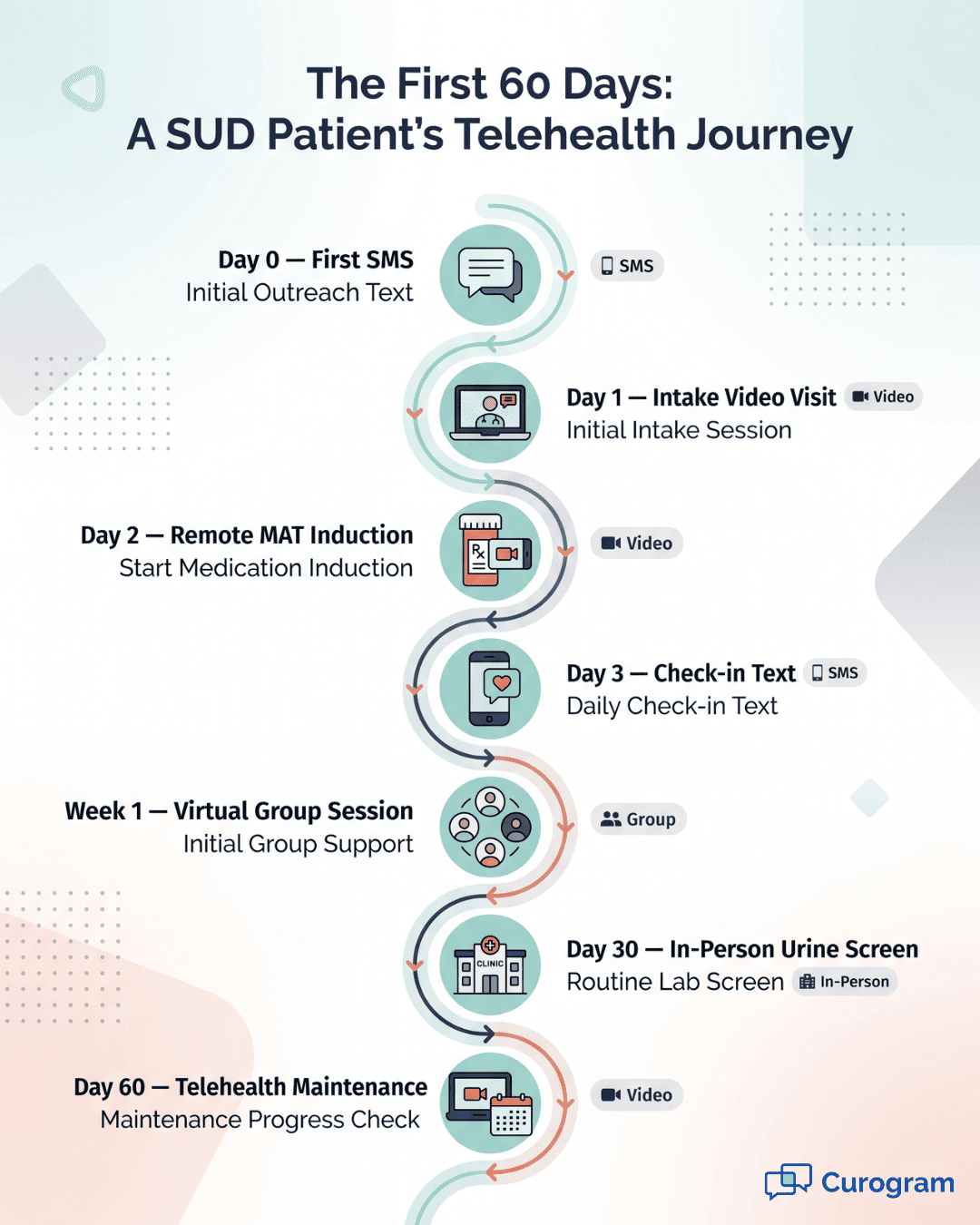
Timeline of telehealth touchpoints in a hybrid substance use disorder program

Designing a Telehealth-Enabled SUD Program

A telehealth-enabled SUD program is not a clinic with a video tool bolted on. It is a workflow design problem. Every step — from first contact to long-term maintenance — needs to be mapped to the right modality, with the right tech, and the right safety checks.

This section walks through the four core design decisions: hybrid intake, technology stack, clinical safety, and consent. Get these right and the rest of your program runs smoother.

Hybrid Intake and Induction Workflows

Intake is where most programs win or lose new patients. A clunky intake — too many forms, a long wait, a confusing portal — drives people away in the highest-risk window. A clean hybrid intake keeps them.

A strong workflow looks like this:

  1. First contact via SMS or web form - The patient texts a number or fills a short form. A staff member responds within minutes, not days.
  2. Same-day or next-day virtual screening - A 20-minute video call covers history, urgency, and basic eligibility.
  3. Async forms by secure link - Insurance, consent, and Part 2 release forms are sent by text and signed on a phone.
  4. Remote MAT induction for eligible patients, scheduled within 48 hours.
  5. An in-person visit if labs, a physical, or observed dosing is needed.

Speed is the key. The gap between "I want help" and "I am in care" should be hours, not weeks. Internal Curogram client data from clinical settings shows that practices that recall lapsed patients via SMS saw 35% of those patients schedule a visit within a month. The same texting-first approach works for new intakes.

For remote MAT induction, a strong workflow includes a clear pre-visit checklist (symptom check, last use, home environment), a clinician-led video session, and a follow-up call within 48 hours. The first 72 hours of induction set the tone for the whole episode of care.

Technology Stack — Video, SMS, Secure Forms

Your tech stack does not need to be expensive. It needs to be tight. The biggest mistake programs make is buying separate tools for video, texting, and forms, then leaving staff to copy data between them.

A working SUD telehealth stack includes:

  • HIPAA-compliant video with a low-friction patient join (no app downloads where possible)
  • Two-way HIPAA-compliant texting for reminders, check-ins, and quick questions
  • Secure forms for intake, consent, and Part 2 releases, signed on a phone
  • A scheduling layer that lets patients self-book or rebook
  • An EHR integration so notes, scripts, and labs flow into one chart

Two-way texting is the unsung hero here. Most SUD patients respond to a text far faster than to an email or a phone call. A reminder text the night before a visit cuts no-shows. A "checking in" text two days after induction can catch a patient who is wavering.

Internal Curogram client data from clinical settings shows that automated reminder texting brought one specialty practice's no-show rate from 14.20% down to 4.91% in three months — about 3X better than the industry average. For a SUD program, every kept visit is a chance to reinforce recovery and adjust care.

The integration layer is the second hidden lever. When your video tool, texting tool, and EHR all talk to each other, staff stop wasting time on data entry. They get more time with patients, and patients feel a coherent program instead of a patchwork.

Clinical Safety Protocols

Virtual care does not lower the safety bar. It changes how you meet it. Every telehealth SUD program needs written protocols for the moments when a screen is not enough.

Core protocols should cover:

  • Emergency escalation - If a patient appears intoxicated, suicidal, or in withdrawal during a visit, what happens next? Staff need a script.
  • Address verification at the start of each visit - Patients can travel. Knowing where they are now is a license issue and a safety issue.
  • Buddy or contact identification - A trusted contact for emergencies, with consent on file.
  • Naloxone education and distribution for every OUD patient, regardless of treatment modality.
  • Overdose-risk screening at every visit, not just intake.

Identity verification is its own line item. Most programs use a combination of photo ID at first visit, voice and face recognition on later visits, and a verified phone number on file.

Document each visit with the same rigor as an in-person session. Note the modality (audio-video vs. audio-only), the patient's location, and any deviation from protocol. Audit your charts quarterly. The point is not to create paperwork — it is to make sure your team is doing what they think they are doing.

Programs that take safety seriously also build a clinical-on-call model. A clinician is reachable for urgent questions outside scheduled visits. For early-recovery patients, this is a critical link. A virtual program without a clear safety net is not a program — it is a risk.

Consent and Part 2 Considerations for Virtual Care

42 CFR Part 2 governs the confidentiality of SUD treatment records. It is stricter than HIPAA in important ways. Programs cannot disclose that a patient has SUD, much less their record contents, without specific written consent.

In a virtual setting, Part 2 raises practical questions:

  • Who else might be in the patient's home during the visit?
  • How do you confirm a private setting before discussing diagnosis?
  • How do recordings, if any, comply with Part 2?
  • How do consent forms reach and return from the patient?

A few practices help:

  1. Open every visit with a privacy check - Ask the patient if they are alone and able to talk freely. Document the answer.
  2. Use short, plain-language consent forms - Long legalese is a barrier. A two-page form patients can sign on a phone is far more useful.
  3. Keep Part 2 release forms separate from general HIPAA authorizations. They are not interchangeable.
  4. Train staff on how to handle accidental disclosures, like a family member walking into the room mid-visit.

For audio-only telehealth visits, the same Part 2 rules apply. The lack of video does not lower the privacy bar. Your team should always know who could be on the other end of the line.

When in doubt, get consent again. Re-consenting takes a minute and protects the patient. In SUD care, the trust the patient places in you is the foundation of every other outcome.

What the Evidence Says About Telehealth SUD Outcomes

The evidence base for telehealth SUD treatment has matured rapidly since 2020. Early studies asked, Does it work at all? Newer studies ask, For whom does it work best, and under what conditions?

The short answer in 2026: telehealth produces SUD outcomes comparable to in-person care for most patients, with notable advantages in retention and access. Here's a breakdown of the data that operations leaders should know:

Retention and Attendance Data

Retention is the single most important metric in SUD care. A patient who stays in treatment for 90 days is far more likely to reach lasting recovery. SAMHSA and HHS reporting since 2020 has consistently shown that telehealth-enabled SUD programs hold patients longer than in-person-only programs.

The retention gain comes from a few simple mechanisms:

  • Fewer missed visits because travel is removed
  • More frequent contact in early recovery because short visits are feasible
  • Faster intake that closes the "I want help now" window
  • Easier rescheduling when life gets in the way

Internal Curogram client data from clinical settings supports this pattern across a wider set of practices. Across specialties, no-show rates for clinics using automated reminders and two-way texting averaged about 53% lower than the industry average. For psychiatry specifically — the closest proxy in our data set — Curogram clients averaged 11.03%, versus a 23% industry average.

Lower no-shows translate directly into more therapeutic contact. For a 100-patient SUD panel, the difference between a 20% no-show rate and a 10% no-show rate is roughly 200 extra visits per year. That is a meaningful gain in clinical exposure for any program.

The takeaway for operations leaders: telehealth alone does not guarantee better retention. Telehealth plus a strong reminder and check-in system does. The combination is what moves the needle on the metric that matters most.

Clinical Outcomes Research

On clinical outcomes, the published evidence is consistent. Studies of telehealth-delivered MAT for opioid use disorder show comparable rates of treatment retention, abstinence, and patient-reported recovery compared with traditional in-person care.

Some specific findings to be aware of:

  • Telehealth buprenorphine induction shows non-inferior 30-day and 90-day retention compared with in-person induction in published studies.
  • Patients receiving counseling via video report similar therapeutic alliance scores as those in person.
  • Audio-only visits, while less studied, do not appear to harm outcomes for established patients on stable doses.
  • Outcomes tend to be better for patients in rural or underserved settings, where the alternative was no care.

A few caveats are worth flagging. The strongest outcomes come from programs that use telehealth as part of a hybrid treatment model, not as a complete replacement. Patients with severe co-occurring mental illness or unstable housing often need more in-person contact, regardless of preference.

The evidence also shows a pattern programs sometimes miss: the first three months matter most. Telehealth's biggest outcome advantage is in keeping patients engaged through that high-risk early-recovery window. After stabilization, the gap narrows.

For program leaders making the case to a board, the evidence supports a clear message. Telehealth for SUD is not a workaround. It is a clinically equivalent option for most patients and a clinically superior option for groups with access barriers. The data backs the business case.


5 Operational Tips for a Telehealth SUD Program That Actually Works

The difference between a telehealth SUD program that works and one that limps is rarely the technology. It is the operational design around it. Below are five tips drawn from programs that consistently retain patients and stay compliant.

1. Build Your Intake for Speed, Not Paperwork

The window between "I want help" and "I am scheduled" should be hours, not days. Use SMS as the first contact channel. Cut your intake form to the minimum legally required. Send everything else after the first visit, when the patient is already engaged.

2. Use Texting as the Connective Tissue

Two-way HIPAA-compliant texting is the single highest-ROI tool in a telehealth SUD program. Reminders cut no-shows. Quick check-ins catch patients who are wavering. Async questions keep small issues from becoming dropped visits. Internal Curogram client data from clinical settings shows automated reminders alone can drop no-show rates by more than 60% within three months.

3. Tier Your Panel by Recovery Stage

Early-recovery patients need high-touch, brief, and frequent visits. Maintenance patients need predictable, lower-frequency check-ins. Build two distinct visit templates and route patients automatically based on time in treatment. One template for everyone is one template too many.

4. Track Location at Every Visit

Document the patient's exact location at the start of every telehealth SUD visit. This handles three problems at once: state licensure, Part 2 privacy, and clinical safety. Make the field mandatory in your EHR template so staff cannot skip it.

5. Treat Compliance as a Workflow, Not an Afterthought

DEA rules, Medicare deadlines, Part 2 consents, and PDMP checks all need to be baked into the visit flow. If your clinician has to remember a step, your clinician will eventually forget it. Use checklists, smart phrases, and EHR forcing functions. Compliance that depends on memory is compliance that fails.

Conclusion

Telehealth for substance use disorder treatment in 2026 is no longer the exception. It is the rule for most touchpoints in a strong program. The DEA's fourth extension keeps the door open through year-end. The evidence supports it. Patients clearly prefer it for most of their care.

But a successful program is not built by adding a video link to a clinic. It is built by designing each step of the patient journey for the right modality. Intake, induction, counseling, and maintenance each need their own playbook. Compliance, identity checks, and Part 2 consent need to be in the workflow, not in someone's memory.

The strongest programs treat telehealth as an access lever. They use it to reach patients who would otherwise never start care. They use it to keep early-recovery patients in frequent contact during the highest-risk window. And they pair it with smart in-person checkpoints, so clinical judgment is never sacrificed for convenience.

Three things will separate the programs that thrive from those that stall over the next 18 months:

  • The ones that thrive will have built compliance into their workflow before the December 2027 Medicare in-person visit requirement returns.

  • They will have integrated their video, texting, and EHR systems so staff can spend time on patients, not on data entry.

  • They will keep adapting as the DEA finalizes permanent rules.

If your program is still patching together separate tools, now is the time to consolidate. If you are still treating texting as a "nice-to-have," it is time to make it core. And if you are still building your panel without a recovery-stage tier, it is time to redesign the workflow.

Give your staff back hours every week by replacing your patchwork of video, texting, and intake tools with one unified platform. Schedule a demo to see how a connected SUD telehealth stack actually runs.


Frequently Asked Questions

How does buprenorphine telehealth induction work in 2026?
A clinician can start buprenorphine via video, or in some cases audio-only, without a prior in-person visit. The DEA's Fourth Temporary Extension keeps this in place through December 31, 2026, alongside a permanent buprenorphine-specific rule with set conditions.
Why does a patient's location matter for a telehealth SUD visit?
Most states require the clinician to be licensed where the patient is physically located during the visit. A patient who travels can move outside your provider's license, breaking compliance. Confirm and document location at the start of every visit.
When can clinics use audio-only telehealth for SUD care?

Audio-only telehealth is permitted in 2026 for FDA-approved Schedule III–V medications used in opioid use disorder treatment, including buprenorphine. It is also widely allowed for behavioral health visits under permanent Medicare provisions, with reimbursement parity in most states.

How do clinics verify patient identity in telehealth SUD care?

Most programs combine three checks: a photo ID matched at the first visit, a verified phone number on file, and visual or voice recognition at later visits. Documenting each check in the chart protects against diversion and supports DEA compliance.

How does telehealth compare to in-person care for OUD treatment retention?

Published research and SAMHSA reporting both show telehealth-delivered MAT produces comparable retention and clinical outcomes to in-person care. Telehealth often outperforms in-person care for rural, underserved, and working patients, mainly by removing access barriers that drive early dropout.