


10 min read
Expanding Rural Behavioral Health Access with Texting and Telehealth
Jo Galvez
:
April 26, 2026
Telehealth has helped narrow the gap, but it does not reach patients without reliable internet. Text messaging fills that gap — it works on any mobile phone, requires no app, and keeps patients connected between visits. This article covers what is driving the access crisis, what telehealth got right and where it fell short, and how clinics use SMS to support underserved communities.
Rural behavioral health access in the US is in critical short supply. According to HRSA, 122 million Americans live in a mental health professional shortage area and only 26.4% of behavioral health care needs are being met. Telehealth and text-based messaging are two of the most practical tools rural clinics have to close that gap.
The consequences of limited access are not abstract. The CDC and SAMHSA report that rural counties see higher rates of suicide and drug-overdose deaths compared to urban areas.
People in these communities often wait months for an appointment, travel hours to reach care, or go without it entirely. Better tools for reaching and keeping patients engaged will not fix everything, but they are a vital part of the answer.
This article walks through the state of rural behavioral health in the US, what telehealth has achieved and where it still falls short, and how texting is filling gaps that other tools cannot reach.
The State of Rural Behavioral Health Access in the US
Understanding the problem starts with knowing its scale. Millions of Americans live in places where mental health care is simply not within reach — not because of cost alone, but because providers are not there. Below, we break down how shortage areas are defined and who feels their impact most.
How HPSAs and Mental Health Deserts Are Defined
A Health Professional Shortage Area (HPSA) is a federal designation from HRSA that marks a region, population group, or facility as having too few mental health providers to meet local demand.
To qualify, an area typically needs at least 30,000 residents per psychiatrist — or 20,000 in high-need communities. There are currently more than 6,700 designated mental health HPSAs across the US. These regions are often called
These regions are often called "mental health deserts" — a shorthand for places where getting behavioral health care means overcoming serious barriers of distance, cost, or both. The term captures something important: in these areas, going without care is not a choice. It is often the only option.
Who Is Most Underserved
Rural populations, low-income communities, and communities of color are most likely to live in behavioral health shortage areas. SAMHSA data shows that rural counties have higher rates of untreated serious mental illness compared to urban counties.
Many residents in these areas also lack private insurance or live in states without Medicaid expansion, putting out-of-pocket care out of reach. Underserved behavioral health populations face layered barriers — geographic, financial, and social — that compound the access problem.
Why Rural Patients Are Harder to Engage — and Retain
Getting patients through the door is only part of the challenge. Keeping them in care over time is where many rural practices struggle most. Four distinct factors make engagement and retention uniquely difficult in rural settings.
Distance and Transportation
In many rural counties, the nearest behavioral health provider is 30 to 60 miles away — or further. Most rural residents don't have access to public transit, and many depend on others for rides.
Missing a single appointment often means waiting weeks for the next available slot. For patients managing depression, anxiety, or a substance use disorder, that gap in care can have serious consequences.
Broadband and Digital Access
Telehealth offers real relief from distance, but only for patients with a stable internet connection. The FCC estimates that more than 21 million Americans lack broadband access, with rural areas making up a large share.
A patient without a reliable connection cannot complete a video session. This is a key reason why telehealth for rural mental health, on its own, cannot serve every patient in a shortage area.
Stigma in Tight-Knit Communities
In small towns, privacy is hard to come by. Being seen entering a mental health clinic — or having a neighbor notice a behavioral health provider's name on a piece of mail — can deter people from seeking care at all.
Stigma is a well-documented barrier to care in rural communities. Text-based communication offers a level of privacy that in-person or phone-based contact cannot always match.
Workforce Shortages
Even in areas with clinics, staffing is a persistent problem. Rural areas face a long-standing shortage of psychiatrists, licensed counselors, and social workers.
Many providers prefer urban or suburban settings, leaving rural programs stretched thin. Technology can help existing staff reach more patients — but it cannot replace the people needed to deliver care.
How Telehealth Expanded Rural Behavioral Health — and Where It Fell Short
Telehealth changed what was possible for rural behavioral health. It allowed patients to access care without traveling and gave providers a way to serve a broader geographic area. But like any tool, it has limits, and understanding them is key to building a stronger strategy.
What the Post-2020 Telehealth Expansion Did Well
The COVID-19 pandemic pushed telehealth from a niche option into a mainstream one, faster than years of policy work had managed. Emergency federal waivers allowed providers to bill for audio-only and video visits, giving many rural patients their first real access to teletherapy.
Both NIMH and SAMHSA reported improvements in treatment retention during periods of expanded telehealth access. For rural patients who had previously driven hours to see a counselor, this was a significant shift.
The Gaps That Remain
Telehealth works best when patients have broadband, a private space, and a device that supports video. Many rural patients do not have all three. Store-and-forward behavioral health — where a provider reviews recorded data or clinical notes asynchronously — offers some flexibility, but it is not yet widely available in community-based settings.
When patients stop showing up, most telehealth platforms have no built-in way to follow up — which is exactly when people fall through the cracks.
Where Texting Fits into Rural Behavioral Health Access
SMS messaging is not a new technology. But for rural clinics, it may be one of the most underused tools available. Here is why it works — and where it makes the most difference.
Telehealth vs. SMS Texting for Rural Behavioral Health
|
Factor |
Telehealth |
SMS Texting |
|
Requires broadband |
Yes |
No |
|
Works on basic phones |
Limited |
Yes — any mobile phone |
|
Best use case |
Live sessions, evaluation |
Reminders, recall, check-ins |
|
Low-literacy friendly |
Moderate |
Yes — short, plain-language messages |
|
Multilingual support |
Provider-dependent |
Capable with the right platform |
|
Reimbursable |
Yes — with appropriate codes |
As part of care coordination |
SMS Works on Every Phone, Even Without Broadband
Unlike video platforms that require a smartphone, tablet, and a strong internet signal, SMS works on any mobile phone, including older, basic models. It does not need Wi-Fi or a data plan beyond basic messaging.
This makes it one of the most accessible tools available for reaching patients in rural areas with limited connectivity. A simple text can confirm an appointment, prompt a rebook, or send a wellness check, all without requiring any app download.
Multilingual and Low-Literacy-Friendly Communication
Rural communities often include patients whose first language is not English — seasonal workers, immigrant families, and others for whom language is a real barrier. Many patients also have lower health literacy, making patient portals or long-form online forms difficult to use.
Short, direct text messages can be written in plain language and sent in multiple languages. That makes texting one of the most inclusive patient communication options available.
Keeping Patients Engaged Between Visits
One of the hardest problems in behavioral health is what happens between appointments. Patients may disengage, miss doses, or face a crisis — all without anyone on the care team knowing until they stop showing up. Regular text check-ins, reminders, and follow-up messages help keep that connection alive.
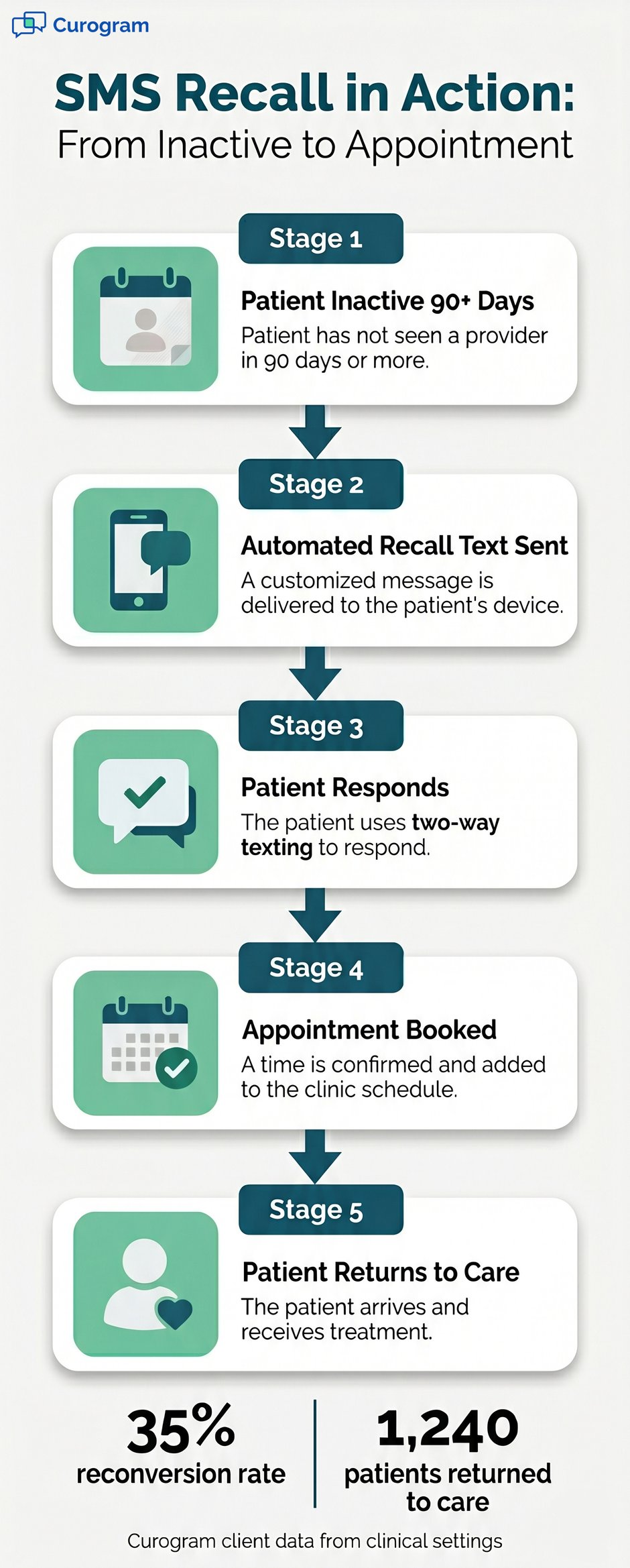
Curogram client data from clinical settings shows that SMS-based recall campaigns brought back 1,240 patients, with 35% of those who received a recall text scheduling an appointment within the month.
5 Practical Moves for Rural Behavioral Health Practices
These five strategies are grounded in what actually works for rural and community-based clinics. None requires a full system overhaul — just deliberate use of tools many practices already have or can access at a reasonable cost.
1. Blend Telehealth with SMS Touchpoints
Telehealth and texting work best as a team, not as alternatives. Use your telehealth platform for the actual visit and SMS for everything around it: scheduling links, pre-visit reminders, post-visit instructions, and follow-up check-ins.
Patients who lose broadband mid-week can still receive a text. This hybrid model extends the reach of your rural mental health care access program without adding meaningful cost or staff burden.
2. Make Self-Scheduling Available 24/7
Many rural patients work non-standard hours — early shifts, evenings, or weekend jobs — making it hard to call during clinic hours. A self-scheduling link sent by text, available any time of day, removes that barrier entirely.
Patients who can book on their own schedule are more likely to follow through. This is one of the simplest ways to reduce no-shows and improve first-appointment rates.
3. Run SMS-Based Recall Campaigns
Patients who have not been seen in 90 days or more are at risk of falling out of care entirely. A targeted recall campaign — a brief, friendly text asking them to come back — can reverse that trend.
Curogram client data from clinical settings shows a 35% appointment reconversion rate from SMS recall campaigns, with 1,240 patients returning to care from recall messages alone.
For a resource-limited rural clinic, that is a meaningful result from a low-effort intervention.
4. Coordinate with Local Primary Care via Shared Messaging
In rural communities, primary care is often the only regular healthcare touchpoint a patient has. Building a referral relationship with local primary care offices — supported by shared or coordinated messaging — can bring patients into behavioral health care who might never call a clinic on their own.
Curogram's integration support tools make this kind of cross-practice coordination easier for rural teams that are already stretched thin. And for FQHC behavioral health programs on athenahealth, Curogram's Athenahealth integration allows this coordination without disrupting existing workflows.
5. Use Texting for Crisis Follow-Up Workflows
The 24 to 72 hours after a crisis event or hospital discharge are among the highest-risk periods for a behavioral health patient. A brief check-in text — sent within a day of discharge — signals that the care team is still present and paying attention.
It will not replace a clinical call, but it opens a line of communication at a time when patients often feel most isolated. Pair it with a clear escalation protocol so staff know how to respond when a patient replies in distress.
How CCBHCs and FQHCs Are Leading the Way
CCBHCs (Certified Community Behavioral Health Clinics) and FQHCs are federally funded models built to serve underserved behavioral health populations — including uninsured patients, rural residents, and people who have struggled to access care through traditional systems.
Their structure allows them to offer behavioral health services on a sliding-fee scale, which makes care more accessible to patients who would otherwise go without. Many are also eligible for enhanced federal reimbursement for telehealth and care coordination, which makes adding SMS tools financially feasible — not just clinically useful.
River Valley FQHC, a multi-location center operating across three rural sites in Colorado, is a clear example of what is possible. The clinic runs a dual-EMR setup — a common challenge in FQHC environments — and used Curogram to transform its patient communication.
Over 22 months, Google reviews grew from 101 to 479, and the average star rating rose from 1.67 to 5.0. Phone call volume dropped by 24%, freeing staff to focus on patient care rather than call management (Curogram client data from clinical settings).
These results reflect a clinic that rebuilt community trust through better communication — not just better marketing. For patients in rural communities who had previously felt overlooked, consistent and respectful outreach made a real difference.
For larger rural agencies and programs serving IDD or foster care populations, Curogram's Welligent integration offers a similar path to streamlined communication. For FQHCs comparing platforms, it is worth knowing that Curogram is often a better fit for community health budgets than enterprise-tier tools — see how it compares. Strong patient engagement in behavioral health does not happen by accident — it is built through consistent, accessible, and respectful communication.

Conclusion
Technology can do a lot. It can help a patient in a remote county schedule a visit without calling during business hours. It can send a check-in message 48 hours after a crisis discharge. It can bring a patient who quietly drifted away back to care with a well-timed text.
But it cannot hire the providers rural communities need. It cannot replace the clinical relationships built over months of consistent care. And it cannot stand in for the long-term funding that sustains rural behavioral health programs.
What it can do is help the providers who are already there reach further, respond faster, and keep more patients engaged. If your clinic is working to strengthen rural behavioral health access, learn how Curogram serves behavioral health clinics — and explore what a patient communication platform built for your setting can look like.
Schedule a demo to see how Curogram can help you reach your rural patients better.
Frequently Asked Questions
A mental health desert is an informal term for a region where behavioral health providers are so scarce that access to care is effectively out of reach for most residents. It often overlaps with HRSA's HPSA designation, which identifies areas with fewer than one psychiatrist per 30,000 residents. Not every HPSA qualifies as a mental health desert — the term is generally used for the most severely underserved communities. It is a useful shorthand for describing the depth of the access gap in rural and low-resource areas.
Text messages are direct and require no action beyond reading, which makes them far less burdensome than a phone call or a patient portal login. Research consistently shows that text-based outreach achieves higher open rates than email and lower no-show rates than reminder calls alone.
For rural patients already juggling transportation, work, and other access barriers, a simple text lowers the effort required to stay in care. Curogram client data from clinical settings shows a 35% appointment reconversion rate from SMS recall campaigns, with 1,240 patients returning from recall messages alone.
Telehealth reimbursement for behavioral health has improved significantly since 2020, with many pandemic-era flexibilities extended or made permanent for rural providers. Medicare and Medicaid now reimburse a range of audio-only and video-based behavioral health services in designated rural shortage areas.
CCBHCs and FQHCs can also access enhanced federal payment rates for care coordination that includes text-based outreach. Always check current CMS guidelines and your state Medicaid plan, as reimbursement rules vary by state and provider type.
Start with tools that solve more than one problem at once — patient communication platforms that handle appointment reminders, two-way texting, self-scheduling, and recall campaigns cover a lot of ground with a single subscription. Prioritize platforms with simple onboarding, since rural clinics often have small admin teams and limited training time.
For FQHCs and CCBHCs, look for vendors with experience in community health settings and pricing built for community budgets. Comparing platforms like Curogram against higher-cost alternatives often reveals significant differences in both price and fit.
Texting excels at low-friction touchpoints: appointment reminders, scheduling links, wellness check-ins, and recall messages all work well via SMS. It helps clinics stay present in a patient's life without requiring a call or an in-person visit. Where it falls short is in complex clinical interactions.
A text cannot assess a patient's mental state in any meaningful way, and it is not appropriate as a primary crisis support tool. The strongest approach pairs texting with telehealth for sessions and in-person care for the moments that truly require it.