
Why No-Show Rates Are Higher in Mental Health — and How to Fix Them
 Jo Galvez : 4/25/26, 11:00 AM
Mental health no-show rates often exceed 30%. Learn the root causes of missed therapy appointments and proven ways to bring attendance back up.

Patient engagement in behavioral health means more than keeping a full schedule. It means helping patients stay connected to their care — even when fear, stigma, or their own symptoms push them away.
This guide explains why engagement looks different in mental health settings, what gets in the way, and what your practice can do about it.
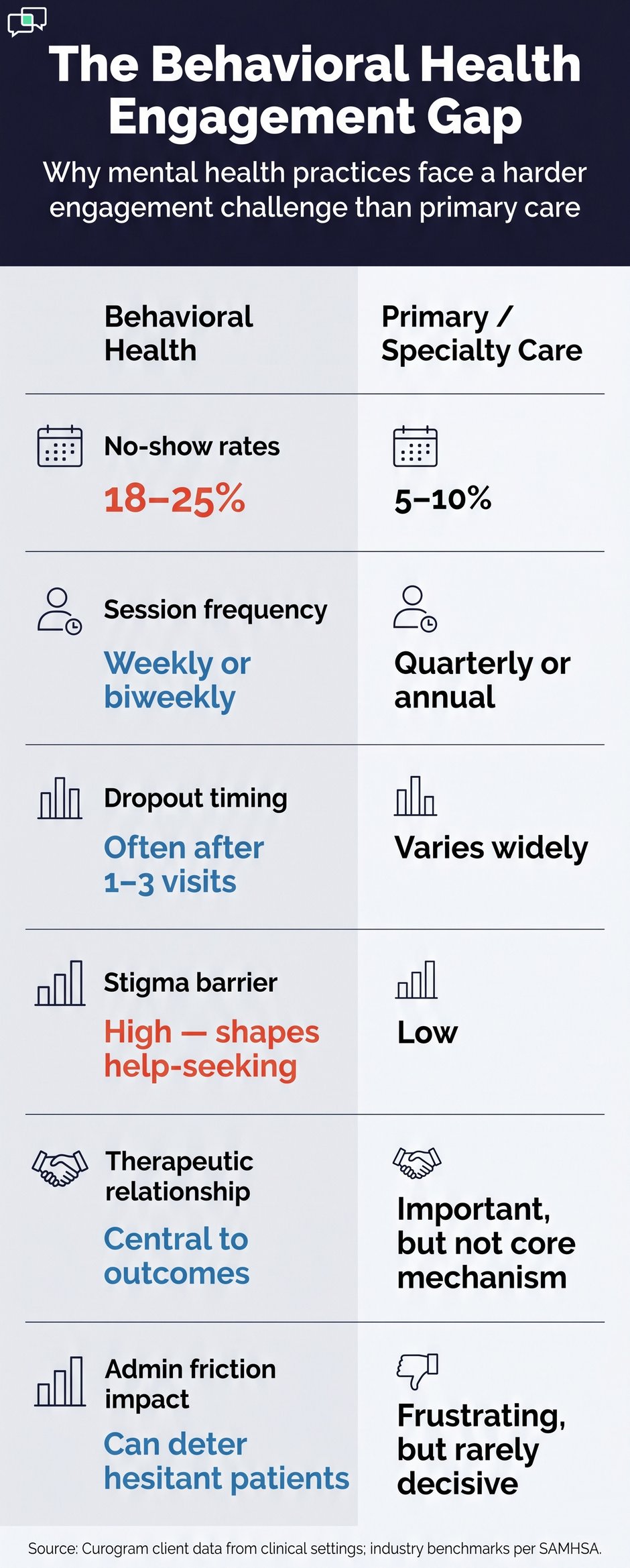
Behavioral health practices lose more patients between visits than nearly any other specialty. Research shows no-show rates of 18–25% are common in outpatient mental health settings — roughly double the rate seen in primary care.
For a practice running 200 appointments a week, that can mean 40 or more empty slots, lost revenue, and patients who quietly fall through the cracks.
The good news is that most of this is fixable. Many patients don't disengage because they want to stop treatment.
They disengage because the process of staying in care feels too hard. Reducing that friction — through smarter communication, simpler admin, and the right tools — can make a real difference.
If you're exploring how Curogram serves behavioral health clinics, this guide connects directly to the tools and workflows your practice can implement starting this week.
Patient engagement in behavioral health covers a wide range of behaviors: scheduling appointments, responding to reminders, showing up consistently, participating actively in sessions, and following through between visits.
It's also about whether patients feel safe enough to reach out when they're struggling. Engagement isn't a single action — it's an ongoing relationship between the patient and your practice.
In primary care, engagement usually means annual check-ups and medication refills. In behavioral health, it means weekly or biweekly contact, often over months or years. The relationship itself is part of the treatment — and that changes everything about how engagement needs to be managed.
The table below shows key differences that affect how your practice should think about engagement strategy.
|
Engagement Factor |
Behavioral Health |
Primary / Specialty Care |
|
No-show rates |
18–25% (industry average) |
5–10% (typical range) |
|
Session frequency |
Weekly or biweekly |
Quarterly or annual |
|
Dropout timing |
Often after 1–3 visits |
Varies widely |
|
Stigma barrier |
High — shapes help-seeking |
Low — most feel safe seeking care |
|
Therapeutic relationship |
Central to outcomes |
Important, but not core mechanism |
|
Admin friction impact |
Can deter already-hesitant patients |
Frustrating, but rarely decisive |
Behavioral health patients often come in ambivalent about treatment. Many are starting care under pressure — from family, an employer, or the legal system. That ambivalence makes the first few visits especially fragile. If the admin experience adds any friction, some patients simply won't come back.
The therapeutic alliance — the bond between a patient and their clinician — is one of the strongest predictors of outcomes in mental health care.
Patients who feel heard and respected are more likely to engage with treatment adherence. They're also more likely to reschedule when they miss an appointment, rather than quietly disappearing.
Communication between sessions plays a real role in building that alliance. A well-timed reminder that sounds human, a fast response to a question about a form, or a simple check-in text after a hard session — these small touchpoints reinforce that the practice cares. Mental health patient communication isn't just logistics. It's part of the care itself.
In most medical specialties, a missed appointment is an inconvenience. In behavioral health, it can be a turning point.
Patients who miss sessions are far less likely to return. Practices that don't have systems to re-engage those patients can lose them entirely, sometimes when they need care most.
Engagement and outcomes are tightly linked in mental health care. Patients who attend consistently make more progress. They're more likely to complete treatment and less likely to experience a crisis or relapse. From an operations standpoint, retention also matters for measurement-based care — the practice of tracking outcomes over time using tools like the PHQ-9 or GAD-7. You can't measure progress if patients aren't showing up.
Patient activation in mental health — the degree to which a patient is informed, motivated, and involved in their own care — directly affects how well treatment works. Practices that actively support activation through outreach, education, and easy communication get better clinical and financial results.
Topics like these are a central focus at conferences such as NatCon, the National Council for Mental Wellbeing's annual gathering, where practice leaders discuss what it takes to move engagement from a clinical aspiration to an operational reality.
The financial impact of disengagement is significant. A practice running at an 18% no-show rate is effectively giving away nearly one in five scheduled slots.
Based on Curogram client data from clinical settings, practices that address no-shows through automated reminders and two-way texting see a 10–20% increase in revenue from recovered appointments alone.
The Atlas Medical Center case is a useful benchmark. Their no-show rate fell from 14.20% to 4.91% in just 90 days after implementing Curogram's reminder system. That's a 65% reduction in missed visits, achieved without adding staff.
Disengagement also creates downstream costs: staff time spent on manual follow-up calls, revenue cycle disruption, and the real cost of not treating patients who need care.
Behavioral health practice management that ignores engagement ends up paying for it in multiple ways.
Understanding why patients disengage is the first step to fixing it. The barriers in behavioral health are different from those in other specialties — and they often stack on top of each other.
A patient dealing with depression, no transportation, and a confusing intake process has three separate reasons to give up before they even walk in the door.
Mental health stigma is still a powerful force. Many patients delay seeking care for years because they fear judgment from family, employers, or even themselves.
When they do finally schedule an appointment, the decision is often fragile. A scheduling hiccup or a cold reminder message can be enough to tip them toward canceling.
Ambivalence is closely related. Patients in early recovery or early treatment often have mixed feelings about getting help.
Their symptoms — depression, anxiety, trauma responses — can actively undermine the motivation to show up. Engaging behavioral health patients means working with these realities, not around them.
Symptom-driven disengagement is one of the trickiest patterns to address. A patient with severe depression may feel too exhausted to attend on their worst days.
A patient managing anxiety may avoid anything that feels overwhelming, including a phone call to reschedule. The goal is to make re-engagement as easy as possible when that happens.
Practical barriers are just as important as psychological ones. In outpatient behavioral health, many patients face insurance gaps, high copays, or networks that limit their provider options.
Transportation is a real issue for patients without reliable vehicles or those who live in rural areas. These aren't reasons to give up on engagement — they're arguments for making every other part of the experience as smooth as possible.
Telehealth has changed this significantly. When a patient can attend a session from their phone, transportation stops being a barrier.
Practices that offer telehealth as a genuine option — not just a fallback — tend to see better attendance among patients who would otherwise cancel due to logistics.
The intake process is where many behavioral health practices lose patients before treatment even begins. Long paper forms, confusing portals, and phone-tag scheduling create friction that can feel insurmountable to someone who is already struggling.
For a patient with anxiety or depression, filling out a 10-page paper form in a waiting room is not a neutral experience.
Administrative friction also shows up in how practices communicate. If the only way to reschedule is a phone call during business hours, patients who work full-time or have phone anxiety will often skip that step and not come back.
Reducing friction at every administrative touchpoint is a direct patient engagement strategy, not just an efficiency improvement.
No single tool fixes engagement on its own. But the right combination of communication tools, digital workflows, and follow-up systems can meaningfully reduce dropout and no-shows.
The strategies below are listed in order of impact, starting with the changes that tend to deliver results fastest.
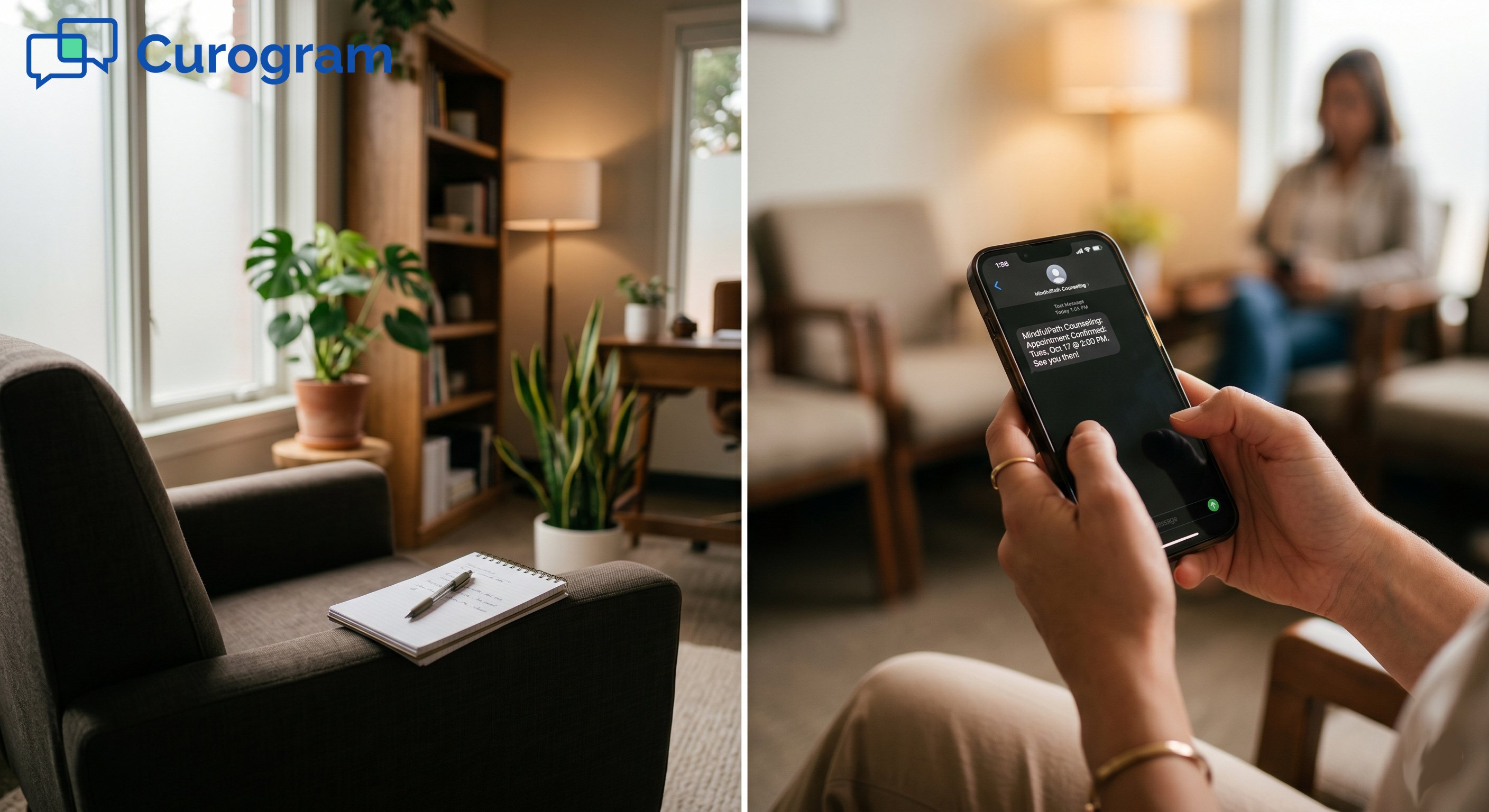
Two-way texting lets patients respond to messages in real time — confirming appointments, asking questions, or flagging concerns — without picking up the phone.
For behavioral health patients, this is often the preferred channel. Texting feels lower-pressure than a voice call, and it creates a natural written record of the exchange.
The operational impact is clear. Practices using two-way texting through Curogram report reducing phone call volume by up to 50%, according to Curogram client data from clinical settings.
That means fewer hours spent on hold, fewer missed calls, and more capacity for staff to focus on patients who are in front of them.
For SUD treatment practices, this kind of communication channel is especially important. Curogram's Opus EHR integration brings two-way texting directly into SUD treatment workflows, keeping communication consistent across the patient journey.
Generic appointment reminders don't account for the specific patterns in behavioral health. A patient seeing a therapist weekly needs a different reminder strategy than someone seeing a cardiologist twice a year.
Mental health treatment adherence improves when reminders are timed correctly — not too early, not too late, and not so frequent that they feel intrusive.
Smart reminders also need to include an easy opt-out for rescheduling. If a patient knows they can't make an appointment, the reminder should make it effortless to reschedule in that same message, rather than forcing them to call. Curogram's text patient reminders feature is built around this logic.
For psychiatry-focused practices, including those using ketamine or TMS treatment protocols, Curogram's Osmind integration connects appointment reminders directly to those specialized workflows.
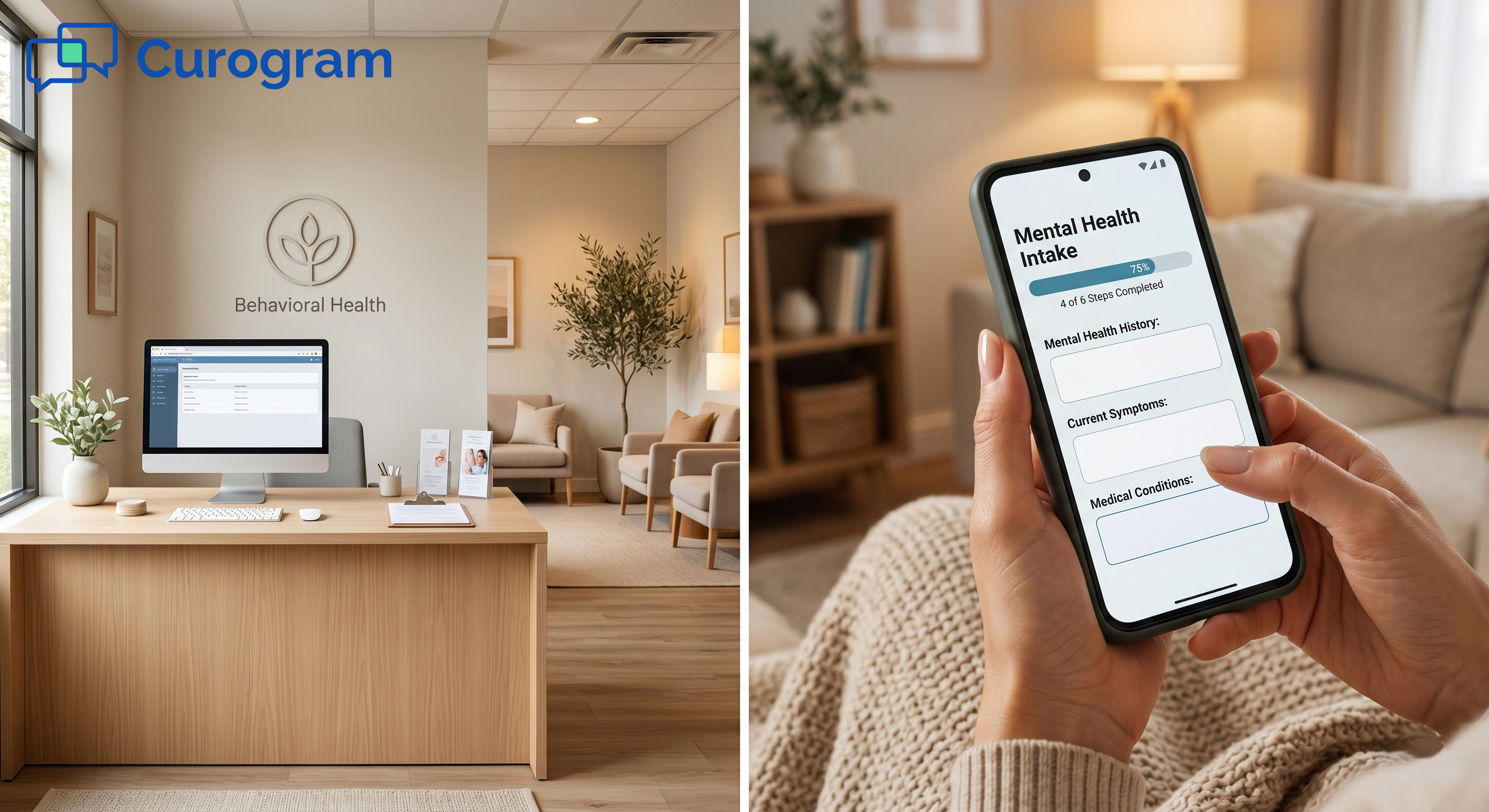
The first visit experience shapes how patients feel about your practice — and whether they come back. Sending intake and consent forms before the appointment removes a major source of waiting-room stress. Patients can complete forms at home, at their own pace, and on any device.
Digital intake forms also give your staff a head start. When paperwork is complete before the patient arrives, the clinical team can prepare more thoroughly for the first session.
That helps the provider focus on building rapport — which matters enormously in behavioral health — rather than spending the first 15 minutes on logistics. Curogram's online patient form tools are built for exactly this workflow.
For practices comparing intake solutions, there's a useful comparison of how Curogram approaches intake and SDOH data differently from Phreesia — worth reviewing if you're evaluating your current process.
Between-session communication is an underused engagement tool in behavioral health. Patients often have questions, concerns, or updates between appointments — and if there's no easy way to share them, those thoughts can build into reasons to drop out.
A simple, HIPAA-compliant messaging channel gives patients a way to stay connected without requiring a full session.
This doesn't mean therapists need to be available around the clock. Clear guidelines about response times and appropriate use of messaging set expectations.
The goal is to give patients a low-pressure way to maintain the connection between visits, which directly supports the therapeutic alliance and mental health patient communication goals.
When patients can schedule their own appointments, they're more likely to do it. Self-scheduling tools remove the "I'll call next week" delay that often turns a missed appointment into a dropout.
Patient-initiated rebooking is especially valuable for behavioral health. A patient who knows they can't make their Thursday appointment but can reschedule instantly via text is far more likely to stay in care than one who has to navigate a phone queue. Self-scheduling is one of those features that feels like a convenience but functions as a retention tool.
For multi-location behavioral health agencies, Curogram's Welligent integration brings self-scheduling into a unified platform, making it easier to manage patient flows across sites.
Telehealth in behavioral health isn't just for emergencies or coverage gaps. When positioned correctly, it's a way to maintain continuity for patients who face barriers to in-person attendance.
A patient who can't get childcare, is traveling, or lives 45 minutes away can still attend their session via video. That's far better than canceling.
The keyword is integrate. Telehealth works best as part of a seamless patient engagement workflow — not a separate system patients have to figure out on their own.
Curogram's telehealth software connects scheduling, reminders, and video visits so the experience feels consistent for patients and staff.
Practices that treat telehealth as a core part of their patient engagement in mental health care strategy — rather than a Plan B — tend to see higher overall attendance rates and fewer long gaps between sessions.
Patient-reported outcomes and satisfaction surveys do two things at once. They give your practice data to track engagement and quality over time. And they signal to patients that their experience matters — which reinforces the relationship.
Automated post-visit surveys also drive online reputation, which matters more than many practices realize. River Valley FQHC, a community health center using Curogram, grew its Google reviews from 101 to 479 and improved its rating from 1.67 to 5.0 stars.
At the same time, the practice saw a 24% reduction in phone calls as more patients engaged through digital channels.
Online reputation is a patient engagement tool in its own right. Most new patients check Google reviews before booking. A strong profile brings in engaged, ready-to-commit patients who are more likely to stay in treatment.
This applies equally to smaller therapy practices using platforms like TherapyNotes — Curogram's TherapyNotes integration keeps the review process automatic and consistent.
You can't improve what you don't track. Most behavioral health practices already collect some of this data. They just haven't connected it to an engagement strategy.
The goal is to move from reactive reporting ("our no-shows were high this month") to proactive monitoring ("we're losing patients after visit two — let's fix that").
The table below shows the core metrics that reflect engagement health in outpatient behavioral health settings. Track these monthly, and look for patterns by provider, day of week, or visit number.
|
Metric |
What It Measures |
Why It Matters |
|
No-show rate |
% of scheduled visits not attended |
Direct indicator of engagement and revenue loss |
|
Retention at 3 visits |
% of patients who return after intake |
Early dropout is the biggest attrition point |
|
Message response rate |
% of texts or messages replied to |
Signals active engagement with your practice |
|
Recall reconversion rate |
% of lapsed patients who rebook |
Measures recovery of lost revenue and care continuity |
|
Patient satisfaction score |
Survey-based rating post-visit |
Leading indicator of retention and referrals |
Curogram client data from clinical settings shows that the platform-wide no-show rate for Curogram practices is around 11% — compared to an industry average of approximately 23%. That's 53% lower than the industry benchmark, and it's driven primarily by automated reminders and two-way texting, not by adding headcount.
Standardized tools like the PHQ-9, GAD-7, or AUDIT-C give your clinical team outcome data. But for the operations team, satisfaction scores and post-visit survey responses are the more actionable signals.
They show which patients are at risk of dropping out before the clinical data catches up.
A patient who rates their experience 3 out of 5 after a second visit is a warning sign. A patient who doesn't respond to a post-visit survey at all may have already mentally disengaged.
Setting up automated follow-up workflows for low scores or non-responses is a practical way to use patient engagement data in mental health care — not just collect it.
For Valant-integrated practices — typically mid-to-large psychiatry and therapy groups — Curogram's Valant integration keeps outcome data and engagement workflows connected in one system.

There's a valid concern in behavioral health that too much technology can feel cold or impersonal. That concern is worth taking seriously.
The therapeutic alliance is built on trust, attunement, and genuine human connection — none of which a text message can replicate.
But the right technology doesn't compete with that relationship. It protects the conditions for it. When a patient gets a warm, well-timed reminder instead of a robocall, they arrive at the session less stressed.
When the intake form is done before they walk in, the provider can spend the first minutes building rapport rather than reviewing paperwork.
Think of communication tools as the operational layer that makes the clinical relationship possible. The therapist's job is to be present in the room.
The practice's job is to make sure the patient gets to the room in the first place — and comes back. That's where behavioral health practice management meets patient care.
Technology in behavioral health works best when it reduces friction without adding noise. The goal is to make patients feel seen and cared for — not tracked or processed.
HIPAA compliance is non-negotiable in this context. Every communication tool your practice uses needs to meet the standards set out in HIPAA-compliant texting guidelines.
Using tools that aren't HIPAA-compliant isn't just a legal risk — it erodes patient trust, which is the one thing behavioral health engagement cannot afford to lose.
A patient engagement plan doesn't have to be built all at once. Trying to implement seven new systems in a week is a recipe for staff burnout and low adoption. The most effective approach is a phased rollout that builds momentum with early wins.
The framework below is based on how Curogram practices typically implement engagement tools. It's designed for outpatient behavioral health settings with 1–5 providers, but scales to larger multi-location organizations as well.
|
Phase |
Focus |
Key Actions |
|
Days 1–30 |
Foundation |
Set up two-way texting, digital intake forms, and automated reminders |
|
Days 31–60 |
Activation |
Launch recall campaigns, enable self-scheduling, and run the first post-visit survey batch |
|
Days 61–90 |
Optimization |
Review metrics, adjust reminder cadence, and identify dropout patterns by visit count |
SMS recall campaigns deserve special attention in the 31–60 day window. Based on Curogram client data from clinical settings, 35% of lapsed patients who received an SMS recall scheduled an appointment within one month.
One multi-location practice brought back 1,240 patients through recall messages alone. That's not a small number — it's a meaningful recovery of both clinical continuity and practice revenue.
For practices looking at enterprise-scale engagement solutions or FQHC-specific pricing, it's worth comparing how different platforms handle these workflows — including how Curogram compares to Luma Health on features like recall campaigns and multi-location management.
Patient engagement strategies for mental health clinics work best when they're treated as an ongoing discipline, not a one-time project.
Revisit your metrics each quarter, update reminder messaging based on what's working, and keep asking: what's still getting in the way of patients coming back?

Patient engagement in behavioral health is both a clinical priority and an operational one. The seven strategies in this guide — from two-way texting and smart reminders to telehealth integration and recall campaigns — address the real reasons patients disengage: stigma, friction, and a lack of easy ways to stay connected.
Practices that build engagement into their daily workflows see measurable results: fewer no-shows, better retention, and stronger patient relationships. The tools to do this exist, and they're not complicated to implement.
You can explore how two-way texting, automated reminders, digital intake, and recall campaigns work together in a real behavioral health setting.
If you're ready to see what this looks like in practice, schedule a free demo.
Frequently Asked Questions
 Jo Galvez : 4/25/26, 11:00 AM
Mental health no-show rates often exceed 30%. Learn the root causes of missed therapy appointments and proven ways to bring attendance back up.
 Jo Galvez : 4/26/26, 1:00 PM
Mental health intake forms balance clinical depth, legal needs, and patient comfort. Learn what to include and how to move from paper to digital.
 Jo Galvez : 5/2/26, 9:00 AM
Up to half of behavioral health patients drop out of treatment early. Learn what drives dropout and how better engagement keeps patients in care.