
Primary Care and Behavioral Health Integration: A Practical Guide
 Jo Galvez : 5/2/26, 1:00 PM
Integrated behavioral health helps primary care practices close mental health access gaps. Learn the four main models, benefits, and tech that...

Mental health intake forms collect clinical history, current symptoms, consent documents, and treatment goals before a patient's first session.
Unlike general medical intake, they ask for deeper personal history and must handle sensitive topics with care — while still meeting HIPAA and other legal requirements.
Intake is not just a formality. It is the first moment a patient engages with your practice, and how that experience feels sets the tone for the entire therapeutic relationship.
A well-designed intake process signals that your practice is safe, organized, and respectful. A clumsy one does the opposite.
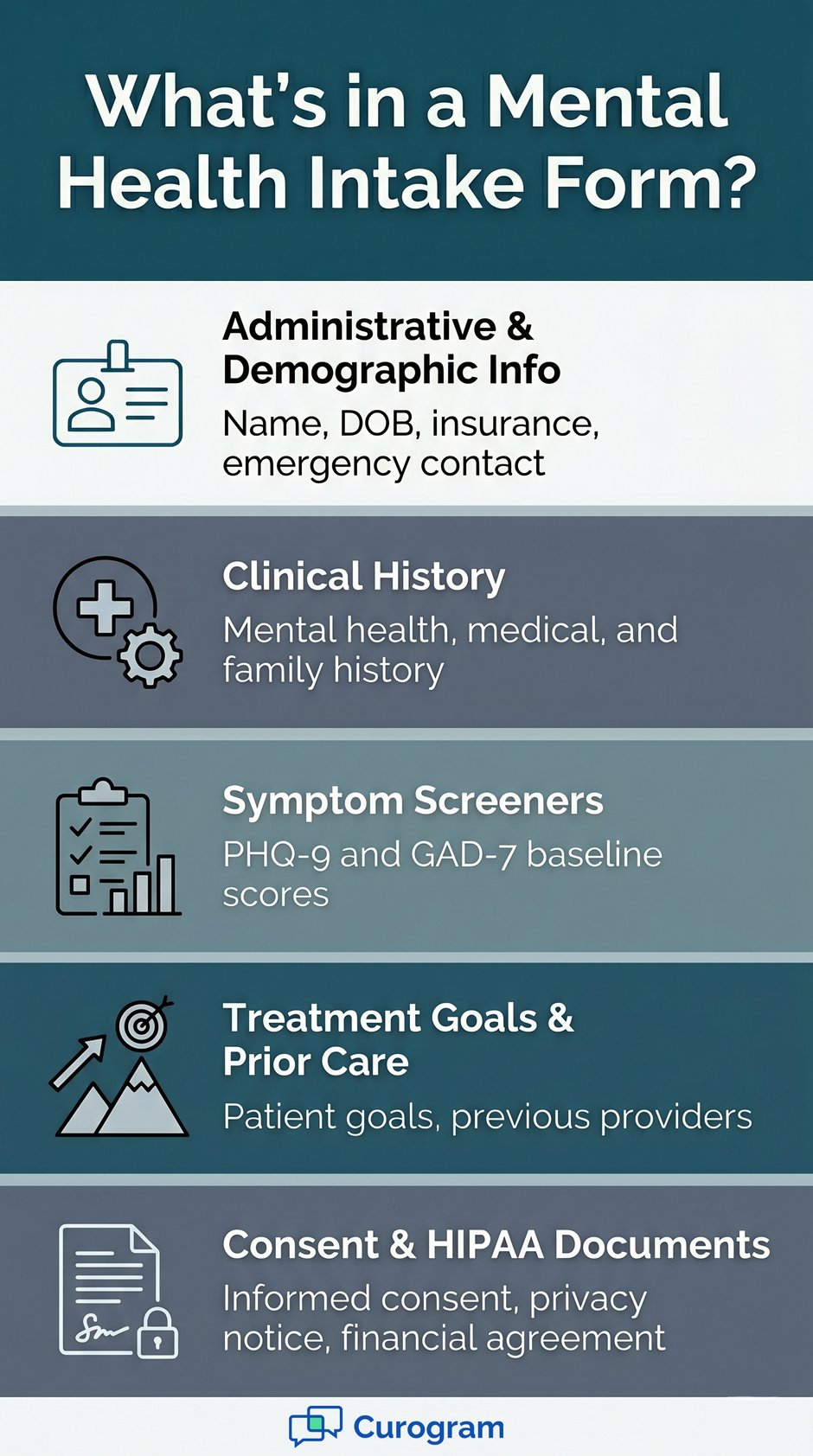
Most mental health intake forms follow a similar structure, but the depth of each section goes far beyond what you would find on a routine medical form. Here is a breakdown of what a complete intake packet for an outpatient behavioral health practice should cover.
This section covers the basics: full name, date of birth, address, emergency contact, and insurance details. It also collects preferred name and pronouns, which matter for building trust from the start. Primary care provider details and referral source are useful here for care coordination across providers.
This is where behavioral health intake forms begin to diverge from standard medical forms. Patients are asked about prior mental health diagnoses, past treatment episodes, and any hospitalizations.
Medical history is included because physical health conditions often intersect with mental health. Family psychiatric history is documented as well, since it provides important context for clinical assessment.
Many outpatient practices include standardized screening tools as part of their intake workflow. The PHQ-9 (Patient Health Questionnaire-9) is widely used to screen for depression, and the GAD-7 (Generalized Anxiety Disorder scale) screens for anxiety.
Both tools are brief, validated, and widely accepted by payers and clinical bodies. Documenting baseline scores at intake supports ongoing measurement-based care and strengthens clinical documentation for billing purposes.
Asking patients what they hope to gain from therapy — in their own words — gives clinicians a starting point and signals that the patient's perspective matters. Prior care history, including previous therapists, medications tried, and what did or did not help, allows the treating clinician to build on what came before rather than repeat it.
This information forms a core part of the biopsychosocial assessment most outpatient practices complete at intake.
Every intake packet must include informed consent for treatment, a HIPAA notice of privacy practices, and — where applicable — an authorization for release of information. Patients must sign and date these documents before services begin.
Financial consent, covering fees, billing practices, and payment policies, is often included here as well. These sections are not optional, and they should be written in plain language that a patient without a clinical background can understand.
On the surface, general medical and mental health intake forms share a lot of the same fields. The differences, though, go well beyond structure. The depth of history, the sensitivity of the questions, and the legal requirements that apply to behavioral health intake forms set them apart in ways that matter both clinically and legally.
A general medical intake asks about current medications and past surgeries. A mental health intake goes much further — asking about childhood experiences, trauma exposure, relationship history, substance use patterns, and social support systems.
This level of detail is what supports the biopsychosocial assessment that behavioral health clinicians rely on to understand the whole person. Without it, the first session starts with too many unknowns.
Psychotherapy intake forms regularly ask about topics that carry stigma or require careful framing — including suicidal ideation, self-harm, trauma history, and substance use. The language used in these sections matters. Trauma-informed wording avoids re-traumatizing patients before they have even met their clinician. Forms that are blunt or poorly worded in this area can drive patients away before care begins.
Practices that provide substance use disorder (SUD) treatment face an added layer of federal regulation under 42 CFR Part 2. This law restricts the disclosure of SUD treatment records more strictly than standard HIPAA rules.
If your practice sees patients with co-occurring disorders, your intake paperwork must include a 42 CFR Part 2-compliant consent form that is separate from your general HIPAA authorization. Missing this is a compliance risk that many practices discover only after a problem arises.
Many outpatient practices still rely on paper-based therapy intake paperwork. It is a familiar system, and changing it takes effort. But the costs of staying with paper go well beyond printer supplies and filing cabinets.
One practice described their intake process this way: "We have 19 pages of paper forms per patient, and staff have to manually download and re-upload them." That is not unusual. Front desk staff at behavioral health clinics routinely spend time scanning, filing, and manually entering data from paper forms into their EHR.
Curogram client data from clinical settings shows that practices can reduce phone call volume by up to 50% and increase staff productivity by more than 30% when they modernize their intake workflows — time that staff can redirect toward patient care.
Paper forms get misplaced, smudged, or only partially filled out. Handwriting errors create data entry mistakes that affect clinical records and billing. A missing field on a consent form is more than a nuisance, it can create a compliance gap.
Digital intake for mental health removes most of these risks by validating required fields before submission and storing data in a structured, searchable format.
A new patient who arrives and is handed a clipboard with 19 pages of forms is not getting a warm welcome. They are getting a chore. That first friction point colors how they feel about your practice before they have ever met their clinician.
Practices that modernize their intake workflow send a very different message: that they respect patient time and that the care they provide will be equally thoughtful.
Switching from paper to digital intake is not just about scanning your existing forms. A well-designed digital intake workflow changes what the experience feels like — for patients and staff alike. Here is what that looks like in practice.
When patients receive a secure text link to their intake forms before the appointment, they can complete their therapy intake paperwork at home, at their own pace. They are not rushed, not in a waiting room, and can review their answers before submitting.
Curogram client data from clinical settings shows that patients who receive mobile-optimized forms ahead of the visit complete them at high rates — reducing lobby wait times and letting staff review the record before the patient walks in. You can see how this works on Curogram's online patient form page.
One of the biggest advantages of digital intake is the ability to show or hide questions based on prior answers. A patient who reports no history of substance use should not see a full SUD screening battery.
Conditional logic reduces time burden and makes the intake experience feel more relevant. This is a feature that paper simply cannot replicate.
Digital intake platforms can allow patients to upload a photo of their insurance card or government-issued ID directly from their phone. This removes a common check-in bottleneck and reduces transcription errors. For HIPAA compliance, these uploads must be transmitted and stored securely — which means the platform you choose matters as much as the form design itself.
The most significant efficiency gain from digital intake is EHR integration. When form data flows directly into the patient's chart without manual re-entry, staff hours drop, and data accuracy improves.
Practices using Curogram benefit from this kind of direct data flow, eliminating the double entry that consumes meaningful staff time across every new patient visit.
Learn more about how this works through integrations like Curogram's Opus EHR integration for SUD admissions or Curogram's Athenahealth integration for FQHC and Medicaid settings.
Paper Intake Vs. Digital Intake: What Actually Changes
|
Area |
Paper Intake |
Digital Intake |
|
Completion timing |
At the front desk, before the visit |
Before the visit, on the patient's phone |
|
Data entry |
Manual entry by staff into EHR |
Automatic via EHR integration |
|
Legibility / accuracy |
Depends on handwriting quality |
Validated fields; no transcription errors |
|
Missing fields |
Caught during manual review (if at all) |
Required fields enforced before submission |
|
File storage |
Physical folders or scanned PDFs |
Structured digital records |
|
HIPAA compliance |
Signed paper stored in-office |
Encrypted digital storage and transmission |
|
Patient experience |
Clipboard in waiting room |
Mobile-friendly, completed on their schedule |
Having the right sections in your intake forms is necessary, but not enough. Patients have to fill out those forms and complete them accurately. These six principles make a real difference in completion rates and data quality.
Aim for a first-session intake that takes no more than 10 minutes to complete. You can gather additional history over the first few sessions as part of the ongoing clinical assessment.
If your current intake workflow runs much longer, look closely at whether every item on page one is truly essential before the first visit. Shorter forms get done. Long ones get abandoned halfway through.
Trauma-informed language means asking about sensitive history in a way that is clear, neutral, and non-leading. Avoid phrasing that implies judgment or assumes a negative experience.
For example, "Did you have any difficult experiences growing up?" is gentler than a direct, blunt alternative. The goal is to invite honest disclosure without causing harm in the asking itself.
Some patients will start their intake forms and need to stop because a question brings up something they need to sit with, or simply because life interrupts. Digital platforms that allow patients to save their progress and return later see higher completion rates. Patients who cannot save often close the form and show up without completing it, which pushes the burden back onto staff.
A short line of context before each major section reduces patient anxiety. Something like: "The next few questions help your clinician understand your history and provide the best care for you."
Patients who understand why they are being asked a question are more willing to answer honestly, especially for sensitive sections around substance use, trauma, or family psychiatric history.
If your practice serves patients whose first language is not English, your intake forms should be available in the languages your patients actually speak.
For many practices serving Medicaid patients, translation may be a legal requirement under Title VI of the Civil Rights Act. Untranslated forms lead to incomplete data, missed consent, and a poor patient experience before care even begins.
The best way to know if your intake forms work is to watch someone complete them. Ask a new staff member or a willing patient to go through the full intake process and note where they hesitate, get confused, or skip a field. Even one round of real-world testing surfaces issues that a clinical review team working in a conference room will miss every time. Fix what you find, then test again.

Intake is the first experience a patient has with your practice. It sets expectations, builds or erodes trust, and shapes how ready a clinician is to deliver care from session one.
Getting mental health intake forms right is not a back-office concern — it is a clinical and operational priority. The move from paper to digital brings real gains: less staff burden, better data, and a first impression that reflects the quality of care your practice provides.
You can see how Curogram serves behavioral health clinics to find out how it fits your workflow.
If your practice is ready to modernize the intake workflow, schedule a demo today.
Frequently Asked Questions
 Jo Galvez : 5/2/26, 1:00 PM
Integrated behavioral health helps primary care practices close mental health access gaps. Learn the four main models, benefits, and tech that...
 Jo Galvez : 5/9/26, 1:00 PM
Practical strategies for texting elderly patients, how to write clear messages, overcome technology barriers, and keep your practice HIPAA-compliant.
 Jo Galvez : 5/9/26, 11:00 AM
Best practices for patient text messaging that save time for your front desk and keep your practice HIPAA compliant. Practical guide for medical...