



10 min read
Reducing Patient Dropout in Behavioral Health Treatment (2026 Guide)
Jo Galvez
:
May 2, 2026
Effective strategies include pre-treatment communication, between-session outreach, easy rescheduling, and structured recall campaigns for patients who stop showing up. This guide breaks down what dropout looks like across therapy, psychiatry, and SUD settings — why it happens, what it costs, and which retention strategies make the biggest difference.
Between 20% and 50% of behavioral health patients leave treatment before they've reached their goals. Some drop out after the first session. Others slowly drift away over weeks or months.
Dropout hurts outcomes. It cuts revenue. And it often happens quietly — one missed session at a time. Practices that want to improve patient retention in behavioral health need to understand why patients leave, not just when.
This guide is written for clinical directors, program managers, and operations leads. It covers dropout definitions, rates, causes, costs, and seven retention strategies you can act on right away. We also look at how to measure retention so you know if your efforts are working.
What Counts As Dropout In Behavioral Health Treatment?
The word "dropout" gets used a lot in behavioral health, but it means different things in different settings. Pinning down a clear definition matters before you can measure or fix it.
Common Definitions Across Therapy, Psychiatry, And SUD
There is no single definition of dropout from psychotherapy or behavioral health care. Most researchers define it as a patient ending treatment before reaching agreed-upon goals — and without telling the clinician. In outpatient therapy, this often means missing two or more sessions without contact.
In SUD programs, dropout may mean leaving a structured program before completing the required level of care. A common research benchmark: leaving before session 8 in a typical outpatient course of treatment is generally considered premature termination.
When Is It Dropout Vs. Natural Treatment Completion?
Not every early exit is a dropout. Some patients genuinely reach their goals ahead of schedule. Others step down to a lower level of care. The key question is: did the patient and clinician agree to end, or did the patient just stop showing up?
Premature termination — the clinical term for dropout — is defined by a lack of mutual agreement between the clinician and patient. If a patient cancels their last session and never reschedules, that is dropout. If a patient and clinician close the case together, that is completion — even if it happens sooner than expected.
How Common Is Behavioral Health Dropout?
Dropout is far more common than most clinics realize. Understanding the benchmarks can help you see where your practice stands — and where improvement is most possible.
Benchmarks For Therapy, Psychiatry, And SUD Programs
Research suggests that roughly 20% of patients leave therapy after a single session (Olfson et al.). When you look across a full course of outpatient therapy, the early exit rate rises to between 30% and 50%. That means nearly half of all patients do not finish treatment.
The numbers are similar — or worse — in SUD programs, where behavioral health treatment dropout rates can exceed 50% within the first few weeks of care. Psychiatry settings tend to see lower short-term dropout, but patients often stop attending follow-up visits or taking medication without notice.
For context: a passive outreach baseline — doing nothing after a patient misses a session — tends to see a return rate of just 5–10%. That gap is where structured outreach makes its case.
|
Setting |
Estimated Dropout Rate |
Key Dropout Window |
|
Outpatient therapy |
30–50% |
Sessions 1–8 |
|
SUD programs |
40–60%+ |
First 2–4 weeks |
|
Psychiatry |
20–40% |
First follow-up visit |
|
Group therapy |
25–45% |
Within 12 weeks |
Source: Olfson et al. and published literature on premature termination.
The Top Reasons Behavioral Health Patients Stop Coming
Dropout rarely happens for just one reason. Understanding what is driving it at your clinic is the first step to reducing it.
Early Expectations That Don't Match Reality
Many patients start therapy expecting to feel better quickly. When progress feels slow — or when the process is harder than they imagined — they begin to question whether it is worth continuing. This gap between expectation and experience is one of the leading causes of dropout from psychotherapy.
Pre-treatment communication can close this gap. When patients know what to expect before their first session, they are better prepared for the work ahead. A single welcome message or pre-session FAQ can shift their mindset enough to keep them engaged through the early difficult stages.
Symptoms Improving (Or Feeling Worse)
When symptoms ease up, some patients decide they no longer need treatment. This is sometimes called a "flight into health" — it feels like progress, but it often means the patient has not yet built the skills to stay well on their own.
On the other end, patients who feel worse in early sessions may also exit. The early phase of therapy can surface difficult emotions. Without support between sessions, patients may read this as a sign that treatment is not working, rather than a sign that it is.
Therapeutic Alliance Problems
The quality of the bond between a patient and their clinician is one of the strongest predictors of whether a patient stays in care. A weak therapeutic alliance — where the patient does not feel heard or respected — is a major driver of early exit.
Checking in on the relationship directly matters. Even a short "how are we working together?" exchange can catch problems before they lead to dropout. Routine feedback tools can make this feasible at scale, even in busy clinics.
Life Barriers: Cost, Time, Logistics
Cost is a real barrier for many behavioral health patients. Copays, deductibles, and gaps in coverage push people to delay or stop care. Transportation and work schedules add to the burden, especially in SUD programs where patients may also be managing housing instability.
Clinics cannot always solve these problems directly. But they can reduce friction in what they do control — easy rescheduling, flexible session times, and telehealth options all lower the effort required to keep up with session attendance.
Forgetting And Drift (The One You Can Fix)
One of the most overlooked causes of dropout is also the most fixable: patients simply forget to come back. Life gets busy. The urgency of the first session fades. Appointments become easier to skip than to keep.
This is where consistent therapy attendance depends on outreach, not willpower. A timely text reminder sent at the right moment can be the difference between a patient who re-engages and one who drifts away for good. This kind of between-session touchpoint is low-cost, low-effort, and highly actionable.
The Real Cost Of Dropout
Dropout has consequences that go beyond any single missed appointment. Clinics that understand what dropout actually costs are better positioned to justify investment in retention programs.
Clinical Outcomes And Relapse Risk
Patients who leave behavioral health treatment early are less likely to hold on to the progress they made. In SUD treatment, early dropout is a strong predictor of relapse. In therapy, patients who leave before completing care are more likely to return to crisis-level symptoms, often without the tools to manage them.
Treatment adherence — the degree to which a patient follows through on their care plan — is closely tied to long-term outcomes. Incomplete treatment does not just hurt the patient; it places more demand on emergency services and inpatient care over time.
Revenue And Clinic Sustainability
Every session a patient skips represents lost revenue. For a clinic operating on thin margins, a high dropout rate can quickly become a sustainability problem. It also costs significantly more to acquire a new patient than to retain an existing one.
According to Curogram client data from clinical settings, a structured recall campaign at a multi-location practice achieved a 35% reconversion rate within 30 days — with 1,240 patients returning to care from recall messages alone.
At an illustrative visit value of $200, that represents roughly $248,000 in recovered revenue from a single campaign cycle. The cost to reactivate each returning patient: approximately $12 — compared to $250–$350 to acquire a new one.
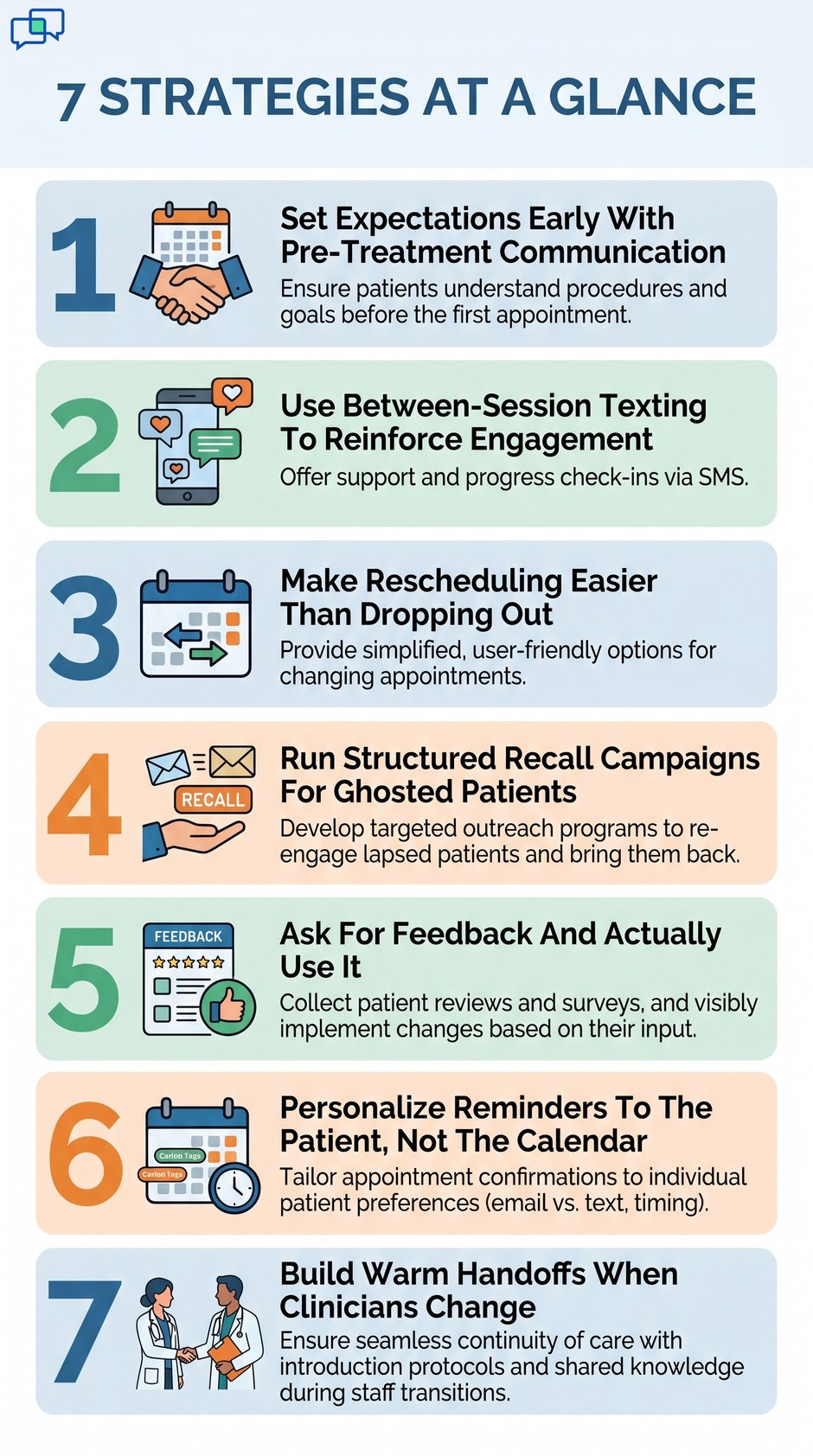
7 Retention Strategies That Actually Move The Needle
Not every retention strategy delivers equal results. Some take months to show impact. Others change behavior within a single session cycle. The seven below are grounded in both research and real-world clinical operations.
1. Set Expectations Early With Pre-Treatment Communication
Patients who know what to expect from therapy are less likely to leave because of surprise. A brief pre-treatment message — via text or email — can cover what a typical course of care looks like, how long progress usually takes, and what to do when they feel uncertain or discouraged.
This one step can meaningfully reduce session-one dropout, which is often the most preventable kind. It signals to the patient that the practice cares about their experience before they even walk in the door.
2. Use Between-Session Texting To Reinforce Engagement
Texting between sessions is not just a reminder tool — it is a way to keep patients connected to their care. A short check-in after a difficult session, or a prompt before an upcoming appointment, can bridge the gap that often turns into dropout.
Curogram's text patient reminders feature supports this kind of consistent, between-session outreach without adding to staff workload. The goal is to keep the practice present in the patient's life between visits.
3. Make Rescheduling Easier Than Dropping Out
If a patient has to call during business hours, wait on hold, and explain their situation to reschedule, many will simply not bother. Making rescheduling frictionless keeps more patients in the pipeline. Two-way texting, self-serve portals, and after-hours booking all reduce the effort required to stay in care.
The easier you make it to say "I'll come next week instead," the less often patients will say nothing at all and quietly exit.
4. Run Structured Recall Campaigns For Ghosted Patients
When a patient goes quiet, waiting and hoping they come back rarely works. A structured recall campaign — an automated sequence of messages sent to patients who have missed sessions or passed their recommended follow-up window — can bring a meaningful portion of them back.
Curogram client data from clinical settings shows that 35% of patients who received an SMS recall message were scheduled within 30 days. For a multi-location practice, that single campaign cycle resulted in 1,240 patients returning to care, illustrating what is possible compared to the 5–10% passive baseline.
Curogram's mass text messaging feature makes this kind of campaign scalable without adding staff time. For psychiatric practices on Osmind, Curogram's Osmind integration enables EMR-linked recall tied directly to care gaps in the patient record.
Practices on Welligent can do the same through Curogram's Welligent integration, which supports IDD and foster care program recall. And for clinics looking to go beyond what is built into Valant, Curogram's Valant integration adds automated recall on top of the existing system.
5. Ask For Feedback And Actually Use It
Routine feedback collection — a short survey after each session or block of sessions — gives clinicians early warning signs of a disengaged patient. But collecting it is not enough. Practices that act on what they hear tend to have better mental health patient re-engagement outcomes than those that treat surveys as a checkbox.
Even a brief "Was today's session useful?" message can surface dissatisfaction before it becomes dropout. The key is closing the loop — letting patients know their feedback was heard.
6. Personalize Reminders To The Patient, Not The Calendar
A generic appointment reminder does not build a connection. A reminder that includes the patient's name, their provider, and their session time — sent when it actually reaches them — feels different. Personalized reminders are one of the most accessible tools for keeping patients in therapy without requiring clinical staff to make individual calls.
Timing matters too. A reminder sent 24 hours before an appointment consistently outperforms one sent the morning of. Small details like these can have a measurable effect on session attendance.
7. Build Warm Handoffs When Clinicians Change
Clinician turnover is one of the most overlooked causes of dropout in behavioral health. When a patient's provider leaves — without a proper transition plan — many patients quietly exit the practice along with them.
A warm handoff, where the outgoing clinician introduces the incoming one in writing or in a final session, preserves enough of the therapeutic relationship for the patient to stay. This step is simple, low-cost, and often skipped.
How To Measure Retention The Right Way
Tracking retention is not just about watching attendance. It is about understanding patterns before dropout becomes a trend, and having the data to act on what you see.
Retention Metrics Every Behavioral Health Clinic Should Track
Improving patient retention in behavioral health starts with knowing your baseline. For a broader look at how these metrics connect to patient engagement in behavioral health — including communication, satisfaction, and access — the pillar article covers the full picture.
If session attendance is already a challenge at your clinic, the No-Shows article covers the operational side of reducing missed appointments across scheduling, reminders, and follow-up.
|
Metric |
What It Measures |
Why It Matters |
|
Early dropout rate |
% leaving before session 4 |
Flags orientation or expectation problems |
|
Completion rate |
% reaching agreed treatment end |
Core outcome measure for care quality |
|
No-show rate |
% of scheduled sessions missed |
Proxy for engagement and access barriers |
|
Recall reconversion rate |
% of ghosted patients who return |
Measures effectiveness of outreach |
|
Avg. sessions per episode |
Mean sessions before case close |
Helps benchmark against clinical guidelines |
Practices that track these metrics consistently are better positioned to catch dropout trends early and respond before they compound. Monitoring them by clinician, program type, and patient group can also reveal which populations need the most support.

Conclusion
Dropout in behavioral health is not a fixed outcome. It is a pattern — and patterns can be changed. When clinics understand why patients leave, they can put the right systems in place to keep more of them in care.
The goal is not just to fill the schedule. It is to give patients enough time in treatment to actually get better.
Better therapy retention rates reduce relapse risk, improve long-term outcomes, and make a real difference to practice sustainability. None of that requires overhauling your clinical model — it requires consistent outreach, clear communication, and the tools to act on both.
To learn more about how Curogram supports behavioral health clinics with patient communication and retention workflows, visit our behavioral health page.
Schedule a demo to see how Curogram works to help with patient dropout.
Frequently Asked Questions
A completion rate of 50–65% is generally considered a solid benchmark for outpatient therapy, though this varies by population and treatment model. SUD programs tend to see lower natural completion rates due to the complexity of care. Any clinic running below 40% completion should treat it as a signal worth investigating. Tracking your rate over time, even without an industry comparison, tells you whether your efforts are moving in the right direction.
The general rule is within 24–48 hours of a missed appointment. The longer a clinic waits, the harder it becomes to re-engage the patient. A simple text — not a formal letter — tends to perform best at this stage. The goal is to make re-engagement feel easy and judgment-free, not to pressure the patient.
Yes, keeping patients in therapy for SUD care requires additional considerations. Dropout risk is highest in the first two to four weeks, so front-loading outreach during that window matters more. Peer support, motivational check-ins, and direct coordination with housing and social services can also reduce dropout in ways that session reminders alone cannot. That said, consistent automated outreach — reminders, recalls, and check-ins — still plays a meaningful role in SUD treatment adherence.
Technology does not replace clinical care, but it can remove the friction that leads to dropout. Automated reminders reduce no-shows. Recall campaigns bring back patients who drifted. Two-way texting keeps patients connected between sessions. These tools work best when they support the clinical relationship rather than replace it. The combination of good care and consistent operational outreach is more effective than either alone.
Retention refers to whether a patient stays in care. It is typically measured at the clinic level. Engagement refers to how actively a patient participates in their own treatment. It is more of a patient-level behavior.
A patient can be retained (still on the schedule) but disengaged (going through the motions). The goal is both: keeping patients coming and keeping them invested in the process.