11 min read

How to Streamline Welligent Behavioral Health Intake Forms Integration

How to Streamline Welligent Behavioral Health Intake Forms Integration
💡 The most effective Welligent behavioral health intake forms integration is Curogram. It sends heavy clinical forms straight to a client's phone via secure text.
  • Delivers GAD-7, PHQ-9, and custom forms by SMS with no app or login needed
  • Uses write-back tech to auto-score and sync data into the client's Welligent chart
  • Helps agencies bypass the Welligent Connect portal for higher form completion
  • Meets HIPAA and 42 CFR Part 2 rules for substance abuse records
  • Saves intake staff up to 10 hours per week on data entry tasks
Curogram's mobile-first approach removes the paper barrier and the login wall so agencies can collect better data from the clients who need help the most.

Picture this. A young person walks into your clinic for the first time. They're in crisis. And the first thing they face is a thick stack of paper forms on a clipboard.

That paper barrier doesn't just slow things down. It pushes people away at the very moment they need help the most.

For agencies that use Welligent, the intake process has long been a pain point. Staff print forms, hand them to clients, then type every answer back into the system by hand. Or worse, they ask clients to log in to the Welligent Connect portal from home, where most never finish.

This is where Welligent behavioral health intake forms integration with Curogram changes the game. Instead of paper or portals, you send a secure text link to the client's phone. They tap, fill out their forms, and hit submit. Done.

But it doesn't stop there. Curogram's write-back tech takes the raw data from that form, scores it, and pushes it straight into the right fields in the client's Welligent chart. No re-typing. No copy-paste. No wasted hours.

Think of it this way. Curogram is the "door" that lets your clients in, and Welligent is the "vault" that stores their data safely. The two work together so your team can spend less time on admin and more time on care.

In this guide, we'll break down how this works step by step. You'll learn why the old intake methods fail, how mobile-first forms drive better results, and what write-back means for your staff's daily workload. We'll also cover the strict rules around 42 CFR Part 2 compliant forms and how Curogram keeps your agency safe.

Let's get into it.

The Dual Barriers: The Clipboard and the Login Wall

Every agency wants the same thing: clean, complete client data from day one. But two major roadblocks keep that from happening.

First Barrier: The Clipboard

Hand a 10-page paper packet to a person in crisis and watch what happens. Their eyes glaze over. Their hands shake. They rush through the answers or skip whole sections. For a transient youth or someone dealing with severe anxiety, a paper form can feel like an exam they didn't study for.

And the data you do collect? It's messy. Bad handwriting, missing fields, and unclear answers mean your case manager has to chase down the right info later. That first session, which should be about building trust, turns into a data cleanup job.

Second Barrier : The Login Wall

Many agencies try to fix the paper problem by asking clients to use the Welligent Connect portal. In theory, it sounds great. Clients fill out forms at home, and the data goes right into the system.

In practice, it rarely works that well.

Take this scenario:

To use the portal, a client needs stable internet access, an active email address, and the ability to create and remember a password. For many of the people your agency serves, that's a big ask. Clients who are homeless, fleeing domestic violence, or managing substance use issues often lack one or more of those things.


As a result, low form completion rates. Based on our internal data, agencies that rely only on portal-based intake see a steep drop-off in completed packets before the first visit.

Now consider what happens when those forms don't get done:

Your case manager sits down for a first session. Instead of diving into the client's needs, they spend the first 15 to 20 minutes reading form questions out loud and typing answers into Welligent. That's not care. That's data entry.


Let's put real numbers to this: Say your agency sees 20 new clients per week. If each intake takes an extra 20 minutes due to missing forms, that's nearly 7 extra hours of staff time per week. Over a month, that adds up to almost 28 hours of lost clinical time.

Scenario

New Clients/Week

Extra Time Per Client

Weekly Hours Lost

Paper intake (partial data)

20

20 min

~6.7 hrs

Portal-only (low completion)

20

15 min

~5 hrs

Mobile-first with Curogram

20

2 min

~0.7 hrs


The gap is clear. When clients can't or won't finish forms ahead of time, your team pays the price.

And it's not just about time. There's a care quality issue too. A case manager who spends the first chunk of a session on data entry has less time to build rapport.

For clients in crisis, that first connection matters. It can be the thing that brings them back for a second visit or keeps them from dropping out of care.

The bottom line is this: The clipboard and the login wall create the same problem from two different angles. One is too old-school. The other is too high-tech for the people who need help the most. Both lead to incomplete data, burned-out staff, and a worse experience for clients.

What's needed is a middle path. Something that's easy enough for any client to use, secure enough to handle sensitive mental health data, and smart enough to get that data into Welligent without extra work.

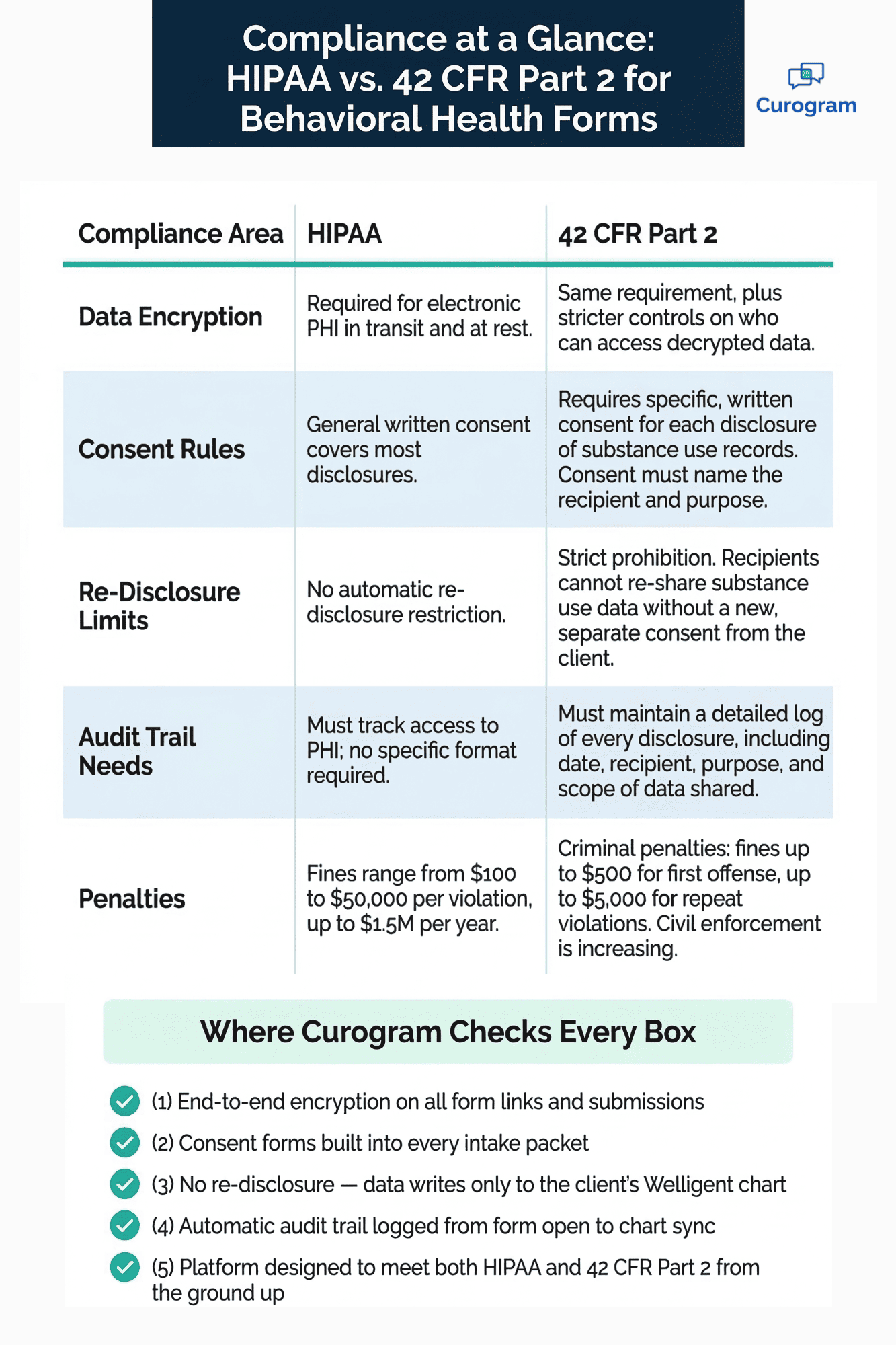
HIPAA vs 42 CFR Part 2 compliance comparison chart for behavioral health intake forms

"The Door" to Data: Mobile-First, App-Free Assessments

If the clipboard and the portal are the two barriers, then Curogram is the door that gets clients through.

The idea is simple: Meet clients where they already are - on their phones.

Here's how it works:

Your staff sends a secure text link to the client's mobile number. The client taps the link, and a form opens right in their phone's browser. No app download. No account sign-up. No password to remember. They fill it out and hit submit. That's it.


This approach strips away every piece of friction that makes the old methods fail. And that matters, because in behavioral health, friction kills completion.

Think about the people your agency serves. Many of them don't have a laptop or a home internet plan. But most have a phone. Based on our internal research, the vast majority of clients in behavioral health settings access digital tools through their mobile device first.

By sending forms like the GAD-7 and PHQ-9 via SMS, you put the most critical clinical tools in the palm of the client's hand. They can fill them out on the bus, in a shelter, or sitting in a park. They do it at their own pace, in a place where they feel safe.

That comfort factor is a big deal. When a client fills out a PHQ-9 in a noisy waiting room, they might rush through it or downplay their symptoms.

When they fill it out in private on their phone, they're more likely to answer honestly. And honest answers lead to better care plans.

Let's walk through a real-world example:

Say your agency runs a substance use treatment program. A new client calls in on a Monday. Your front desk books an intake for Wednesday at 10 a.m. Right after the call, your system sends a text:

"Hi Alex, your intake visit is set for Wednesday at 10 a.m. Please tap the link below to fill out your pre-visit forms. It takes about 15 minutes."

Alex gets the text. He taps the link. The forms open in Safari or Chrome. He sees a GAD-7, a PHQ-9, a consent form, and a release of information document. He fills them out that night while watching TV.

By Wednesday morning, his case manager already has a full picture. The PHQ-9 shows a score of 18. The GAD-7 shows a score of 14. Both are flagged as severe. The case manager walks into the session ready with a focused care plan instead of a blank screen.


This is what it means to bypass the Welligent Connect portal without losing data quality. In fact, you gain data quality because the client is more at ease and the data flows in clean.

There's also an access equity angle here. Not every client speaks English as a first language. Not every client has strong reading skills. Curogram lets you build forms in multiple languages and use plain, simple wording. You can even add visual scales for mood or pain ratings.

The Magic of "Write-Back": Eliminating Manual Entry

Getting clients to fill out forms on their phones is a huge step forward. But the real power of Welligent behavioral health intake forms integration with Curogram comes from what happens after the client hits submit.

This is where write-back technology enters the picture.

Let's start with the problem it solves. In most agencies today, even when forms are digital, staff still do a lot of manual work. A client fills out a form online. It generates a PDF. Someone downloads that PDF, opens the Welligent chart, and re-types the data field by field.

That process has three big flaws:

  • It's slow. Typing up a single intake packet can take 15 to 30 minutes per client. Multiply that across a day's worth of new clients and you've lost hours of staff time.

  • It invites errors. When a human copies data from one screen to another, mistakes happen. A PHQ-9 score gets typed as 12 instead of 21. A date of birth gets flipped. A consent date gets missed. These small errors create big problems down the road when it's time for audits or outcome tracking.

  • It wastes talent. Your intake staff were hired to do case work, not to be typists. Every minute they spend on data entry is a minute they're not building client rapport or moving cases forward.

Write-back solves all three problems at once.

Here's how it works with Curogram and Welligent:

When a client fills out a form on their phone, Curogram doesn't just create a static PDF. It captures every answer as structured data. Each field maps to a specific field in the Welligent system.


When the client hits submit, three things happen in seconds:

  1. The form gets scored. For tools like the GAD-7 and PHQ-9, Curogram adds up the answers and assigns a total score. No manual math needed.
  2. A clean PDF gets created and filed in the client's Welligent chart for the record.
  3. The structured data, including scores, dates, and all text fields, writes directly into the matching fields in Welligent. No copy-paste. No re-typing. No human touch needed.

This is what it means to eliminate manual data entry in Welligent. The data goes from the client's phone to the chart in a straight line.

Let's look at the time savings:

Say, your agency does 25 new intakes per week. Without write-back, each one takes about 20 minutes of data entry. That's over 8 hours per week, or roughly one full staff day, spent just on typing.


With write-back, that data entry step drops to near zero. Your staff might spend 2 minutes per client doing a quick review of the chart. That's less than 1 hour per week for the same 25 clients.

Task

Without Write-Back

With Write-Back

Data entry per intake

~20 min

~2 min

Weekly total (25 intakes)

~8.3 hrs

~0.8 hrs

Monthly total

~33 hrs

~3.3 hrs

Annual total

~400 hrs

~40 hrs


That's roughly 360 hours saved per year. Based on our internal data, agencies that adopt write-back typically save their intake team up to 10 hours per week in admin work alone.

But it's not just about time. Write-back also makes your data cleaner and more reliable.

When a human types a PHQ-9 score by hand, there's always a chance for a mistake. With auto-scoring and direct data sync, the number that the client entered is the number that ends up in the chart.

This has real impact for outcome tracking. Many agencies need to show trends in PHQ-9 or GAD-7 scores over time to meet grant or funding requirements. If those scores are entered wrong, the trend data is useless. Write-back keeps that data chain tight from start to finish.

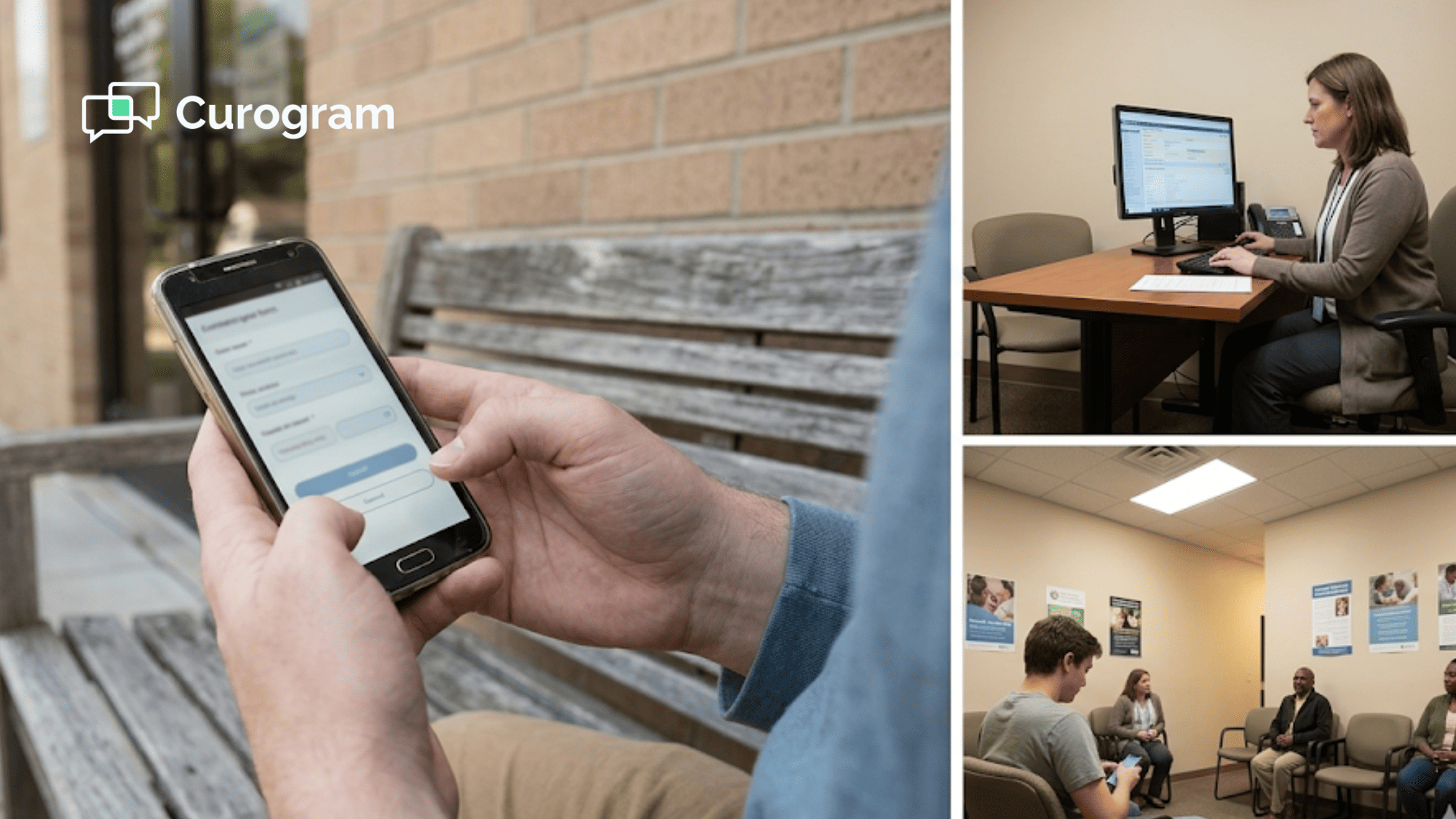
Young adult completing a PHQ-9 behavioral health form on their phone at a bus stop

There's a compliance benefit too. When you can show a clear, unbroken data trail from the client's phone to the Welligent chart, audits become much simpler. You can prove exactly when a form was filled out, what the client entered, and when it was logged in the system.

For agency directors, the value is clear. Write-back cuts labor costs, reduces errors, and speeds up the entire intake pipeline. For intake staff, it means less time at the computer and more time with clients.

Ironclad Compliance for Behavioral Health

When you collect mental health data, security isn't optional. It's the law.

Every agency that handles substance use treatment records must follow strict federal rules. The most important of these is 42 CFR Part 2, which goes beyond standard HIPAA rules. It adds extra layers of protection for people in substance use and behavioral health programs.

If you send a PHQ-9 or a substance use screening by text, that data must be encrypted in transit and at rest. The form itself must live on a secure, compliant platform. And the data trail must be airtight from the moment the client opens the form to the moment it's stored in Welligent.

Curogram's secure forms are built with these rules baked in. Every form link is encrypted. Every submission travels through secure channels. And the write-back process logs a full audit trail so you can prove exactly what happened and when.

For agency directors, this solves a constant worry. You don't have to wonder if your intake process would survive a state audit or a federal review. The compliance is built into the tool itself.


How Curogram Bridges the Gap Between Client Access and Clinical Data

The biggest challenge in behavioral health intake isn't the forms themselves. It's the gap between the client and the chart.

On one side, you have a person who may be in crisis, without stable housing, or dealing with trust issues. On the other side, you have a clinical record system that needs clean, structured data to drive care.

Curogram sits right in the middle. By using simple text messages to deliver mobile-first psychosocial assessments, Curogram meets the client where they are. There's no app, no portal, and no password. The client taps a link, fills out their forms, and that's it.

On the other end, Curogram's write-back engine takes that raw data and pushes it into Welligent in real time. Scores get calculated. PDFs get filed. Structured fields get filled. No one on your staff touches a keyboard.

This bridge matters because it respects both sides of the equation. It respects the client's time, comfort, and access level. And it respects the agency's need for clean, compliant, audit-ready records.

Based on our internal data, agencies that switch to this model see not only a drop in admin hours but also stronger client retention in the first 30 days. When people feel heard from the very start, they're more likely to come back.

Conclusion

The old way of handling intake in behavioral health is broken. Clipboards and portal logins don't work for the people your agency serves.

Clients in crisis need something simpler. They need a text message, a tap, and a clear set of questions they can answer on their own time. That's what Welligent behavioral health intake forms integration with Curogram delivers.

With this approach, your agency can bypass the Welligent Connect portal and reach clients on the device they actually use every day. You can send full clinical tools like the GAD-7 and PHQ-9 by SMS, collect honest answers, and eliminate manual data entry in Welligent through real-time write-back.

The result is a faster, cleaner, and more human intake process. Clients feel respected. Staff get their time back. And the data in your charts is more accurate from day one.

Compliance doesn't take a back seat either. With 42 CFR Part 2 compliant forms and full HIPAA coverage, you can trust that every piece of data is handled the right way.

If you're ready to tear down the paper barrier and the login wall, it starts with one step.

See how Curogram works with your Welligent system in a live demo. Book a demo with us and find out how much time your team can save in the first week alone.


Frequently Asked Questions

How does Curogram auto-score tools like the GAD-7 and PHQ-9 after a client submits?
Curogram adds up the client's answers the moment they hit submit. The total score and risk level are written directly into the matching fields in Welligent, so staff don't need to calculate anything by hand.
Why don't clients need an account or login to fill out Curogram forms?
To keep access as easy as possible for people in crisis or without stable internet, Curogram uses encrypted one-time links sent by text. Clients tap the link and start filling out forms right away in their phone's browser.
How does write-back keep intake data more accurate than manual entry?

Write-back maps each form answer to a specific Welligent field and sends it directly, with no human re-typing. This removes the risk of copy errors, flipped numbers, and missed fields that come with manual data entry.

How does Curogram meet the stricter rules of 42 CFR Part 2 for substance use data?

Every form link is encrypted, submissions travel through secure channels, and a full audit trail is logged from open to submit. These safeguards go beyond standard HIPAA rules to meet the added protections required for substance abuse treatment records.

How can agencies build their own custom intake packets in Curogram?

Curogram's form builder lets you create any mix of consent forms, release of information documents, and clinical tools. You can add custom fields, set required questions, and choose which Welligent chart fields the answers map to.


Protect Grant Funding in Behavioral Health With SMS Texting

Protect Grant Funding in Behavioral Health With SMS Texting

💡 The best way to protect grant funding in behavioral health is to reduce client no-shows with SMS reminders. Automated text reminders reach...

Read More
Streamlining Behavioral Health Intake with Online Forms in InSync

Streamlining Behavioral Health Intake with Online Forms in InSync

💡 Digital intake in InSync helps behavioral health clinics streamline intake. With online intake, patients complete forms using secure links that...

Read More
Secure Texting for Opus EHR: Bridging the Gap in Behavioral Healthcare

Secure Texting for Opus EHR: Bridging the Gap in Behavioral Healthcare

💡 HIPAA compliant texting for Opus EHR helps addiction and mental health centers speed up patient intake and keep care teams in sync. Engages...

Read More