13 min read

How to Intercept Negative Feedback in Behavioral Health Using SMS

How to Intercept Negative Feedback in Behavioral Health Using SMS
💡 The best way to intercept negative feedback in behavioral health is with automated SMS surveys tied to your Welligent system.
  • Curogram sends a short text survey after each visit
  • Low scores route to an internal dashboard, not a public review site
  • Case managers respond in real time via secure 2-way text
  • The process meets HIPAA and 42 CFR Part 2 standards
  • Staff resolve issues in minutes instead of days
This approach helps agencies internalize 1-star reviews in human services before they go public. It keeps clients in care and protects your online image.

A client walks into your office for their weekly session. They wait 45 minutes past their time slot. No one tells them why. They leave upset, pull out their phone, and leave a 1-star review on Google.

You never even knew they were unhappy.

This is the story that plays out every day in human services. The frustration is real. The client had no easy, private way to tell you. So they told the whole internet instead.

Now that review sits on your Google page. It pushes down the good ones. It shapes how new referrals see your agency. And worst of all, the client may never come back to care.

The good news? You can stop this before it ever happens.

When you intercept negative feedback in behavioral health through SMS, you catch the problem early. You give the client a private space to vent. And you give your team a chance to fix it, fast.

Curogram makes this possible by linking with Welligent. After each visit, a quick text survey goes out. If the score is low, the system keeps it off public sites. Instead, it flags the case for your staff. A case manager can then follow up right away through a secure text chat.

No portal login. No phone tag. Just a quick, direct message.

This article will show you how to use this tool to protect your agency's name, keep clients in care, and give your staff a simpler way to handle complaints. If you run a human services agency on Welligent, this guide is for you.

The Danger of the Unresolved Grievance

In most business sectors, a bad experience means a lost sale. A customer goes to a rival. The business moves on. But in behavioral health, the stakes are much higher.

When a client feels ignored or mistreated at your agency, they don't just switch providers. They may drop out of care entirely. For someone in a foster care program, substance use treatment, or mental health recovery, that gap in care can have life-changing results.

This is what makes the unresolved grievance so harmful. It's not just a bad review. It's a broken link in someone's path to stability.

The Clinical Cost

Think about a parent in a family services program. They show up to a required check-in. The lobby is packed. They wait an hour. No one explains the delay. They leave feeling like they don't matter.

That parent may skip their next visit. Then the next one. Before long, the case is flagged as "non-compliant." The court gets involved. The outcome spirals.

All because of a wait time issue that nobody caught.

In clinical terms, this is called a barrier to care. And for at-risk groups, even small barriers can end the whole care plan.

The Public Fallout

Now let's look at what happens on the public side. That same parent goes home, still upset. They pull up Google and type the name of your agency. They leave a 1-star review that says something like, "Waited over an hour. No one cared."

That review is now live for everyone to see. Future clients, funding partners, referral sources — they all see it.

And here's the thing: most people don't scroll past the first few reviews. One or two bad ones near the top can undo months of good work.

Based on our internal research, agencies that use automated review systems see 90% of their clients leave 5-star reviews. That shows how many people are willing to share good feedback — when asked the right way. But if your agency has no system in place, only the angry voices get heard.

Why Portal-Based Feedback Fails

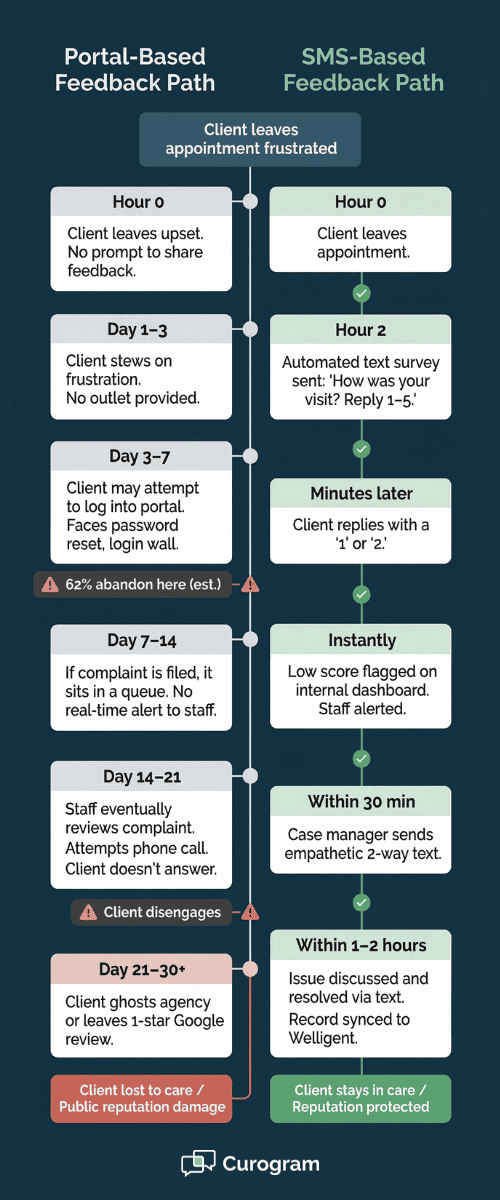
Many agencies rely on their EMR portal to collect feedback. In Welligent, that would mean asking the client to log in to the Welligent Connect portal, find the right form, and submit a written complaint.

Let's be honest — that almost never happens.

Most clients don't even know the portal exists. And even if they do, they're not going to jump through login hoops just to share a complaint. They want to be heard now, not after three clicks and a password reset.

This is why portal-based systems create a blind spot. Your case managers don't see the frustration. They can't act on something they don't know about.

By the time the agency finds out — through a Google review, a survey weeks later, or a dropped case — the damage is already done.

The Real Risk

Here's a simple way to think about it:

Scenario

Response Time

Outcome

Client vents via text survey

Minutes

Issue resolved, client stays in care

Client files portal complaint

Days to weeks

Delayed response, possible dropout

Client leaves Google review

Immediate (public)

Reputation damage, hard to reverse

Client says nothing

Never

Silent dropout, lost to care


The unresolved grievance is not just a PR problem. It's a clinical risk. It's a retention issue. And for agencies that serve mandated or high-need clients, it can mean the difference between a successful outcome and a closed case.

The goal is simple: catch the frustration before it becomes public and before the client walks away.

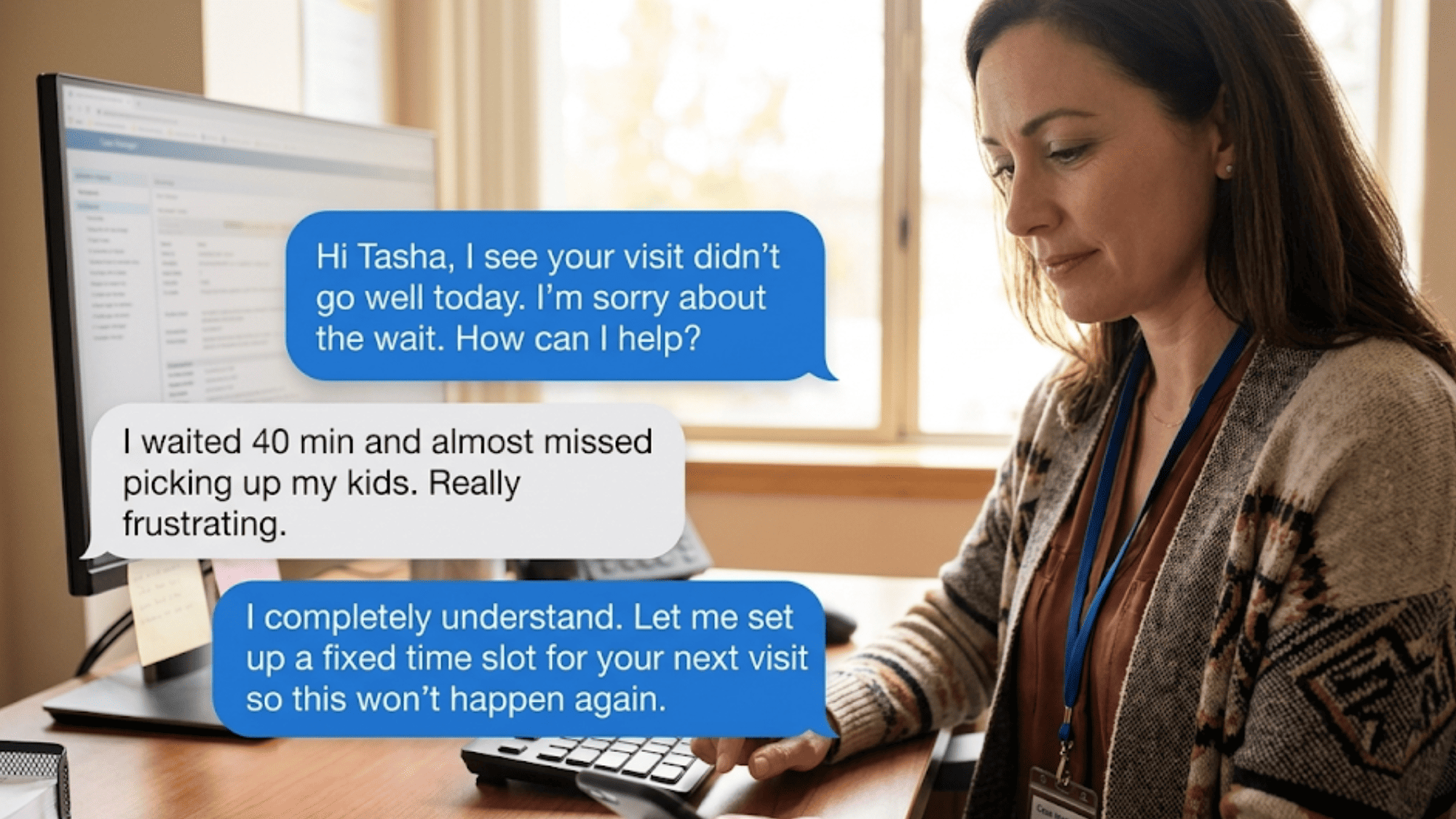
Case manager sending an empathetic follow-up text to a client after a low satisfaction score

Internalizing the Negative: The Dashboard Catch

So how do you catch a bad experience before it becomes a public problem? You give the client a private outlet — one that takes no effort on their part.

That's exactly what Curogram's survey system does when paired with Welligent.

The Private Outlet

After a client completes a Welligent visit, Curogram sends a short text message. It might say something like, "How was your visit today? Reply with a number from 1 to 5."

No app to open. No portal to log into. Just a simple text reply.

This matters because your clients live on their phones. Text has a 98% open rate. Most people reply within minutes. Compare that to email or a patient portal, where open rates may be as low as 20%.

By meeting clients where they already are, you remove the barrier to honest feedback. And you get it while the feeling is still fresh.

The Smart Filter

Here's where the system gets clever:

When a client replies with a 4 or 5, the system knows they had a good experience. It then sends a follow-up message with a link to leave a Google review. This drives your public rating up.

But when a client replies with a 1 or 2, the system does something different. It does not send a review link. Instead, it keeps the response internal.

This is what it means to internalize 1-star reviews in human services. The negative feedback stays inside your agency. It goes to a dashboard, not to Google. This is a huge deal for protecting your public image.

Based on our internal data, one practice saw 1,064 new 5-star reviews in just three months using this kind of smart filtering. That number shows what's possible when you guide happy clients toward public reviews and route unhappy ones to private follow-up.

The Internal Alert

Once a low score comes in, Curogram flags it on your agency's dashboard. The alert includes the client's name, their score, and the time of their visit.

Your team sees the flag right away. No delay. No waiting for someone to check a report at the end of the week. The alert is instant.

This is important because speed matters. A client who scored a 1 today might not answer your call next week. But if a case manager reaches out within the hour, the window to fix the problem is still open.

How This Works in Practice

Let's walk through a real example:

Maria is a case manager at a community mental health agency. She uses Welligent to track her caseload. On Tuesday at 3 PM, one of her clients — let's call him James — finishes a group session. At 5 PM, James gets a text asking how his visit went. He replies with a "2."

Within seconds, Maria sees a flag on her Curogram dashboard. She clicks it and sees that James scored his visit low. She can now choose to bypass the Welligent Connect portal and reach out to him directly through a secure text.


This is the dashboard catch in action. It turns what could have been a public complaint into a private, fixable moment.

Why This Beats the Traditional Way

Without this system, here's what would have happened:

James would have left unhappy. He might have told a friend not to go to the agency. He might have left a harsh review. Or he might have just stopped showing up.

Maria would have had no idea. She'd see his empty chair at the next session and wonder what went wrong.

With Curogram's dashboard, Maria knows about the issue the same day. She can act right away. And James feels heard.

That's the power of giving clients a private voice — and giving staff the tools to listen.

From Feedback to Intervention: 2-Way Text Resolution

Catching the feedback is only half the job. The real magic happens in what you do next. This is where case manager text follow-up turns a complaint into a chance to build trust.

The Action Step

Let's go back to Maria and James. She sees his low score on the dashboard. Now what?

Maria clicks on the alert and opens a secure text chat with James. She types a simple message:

"Hi James, I saw your visit today didn't go well. I'm sorry about that. Can you tell me what happened so I can help make it right?"

That message takes less than 30 seconds to write. But to James, it means the world.

He's used to being overlooked. He's used to filling out forms that go nowhere. But here's a real person, reaching out, asking what went wrong. That kind of personal touch can be the thing that keeps him in care.

Why Text Works Better Than Phone Calls

You might be wondering — why not just call James?

Here's the problem with phone calls in human services. Many of your clients lead complex lives. They might be at work. They might share a phone with someone. They might have anxiety around phone calls.

Text messages let clients respond on their own time. They can think about what they want to say. And they can do it without anyone nearby hearing the conversation.

For agencies that serve foster care families, people in recovery, or court-mandated clients, this layer of privacy matters. A text feels safer than a call.

Plus, your staff can handle multiple text chats at once. A case manager can run three or four follow-up chats at the same time from one dashboard. Try doing that with phone calls.

The Empathy Play

The way you word that first message matters. It sets the tone for the whole exchange.

Here are some examples of messages that work well:

Situation

Sample Text

Long wait time

"I'm sorry about the long wait today. That's not the experience we want for you. Can I help?"

Staff interaction issue

"I heard your visit didn't go smoothly. I'd like to understand what happened so we can do better."

Scheduling mix-up

"It looks like there was a mix-up with your time slot. I want to make sure this gets fixed for next time."


Notice the pattern. Each message is short. It shows empathy. It asks an open question. And it puts the focus on the client, not the agency.

This approach works because it meets the client where they are — frustrated but still open to being heard. If you get that moment right, you can turn an angry client into a loyal one.

Compliance: Keeping It Safe and Legal

One big concern with texting in health care is privacy. You're dealing with sensitive data. For behavioral health agencies, the rules are even stricter because of 42 CFR Part 2 secure messaging rules.

Here's how Curogram handles this:

Curogram acts as the secure "door" to Welligent's data "vault." The 2-way text chat between your case manager and the client happens through an encrypted channel. It meets both HIPAA and 42 CFR Part 2 standards.

That means the conversation about James's complaint is private. It's not floating around in a regular SMS thread. It's protected at the same level as his clinical record.

And once the issue is resolved, the full text exchange can be synced back into James's Welligent chart. That gives your agency a complete, audit-ready record of the Welligent client grievance resolution process.

This is a big win for compliance teams. If a funder or reviewer asks, "How did you handle this complaint?" you can pull up the full record right from Welligent.

Infographic comparing portal vs SMS grievance resolution timelines in behavioral health agencies

A Full Example: Start to Finish

Let's map out a real case from start to finish:

  • Step 1 — The Visit: A client named Tasha attends a family services session at your agency. She arrives on time but waits 40 minutes in the lobby.

  • Step 2 — The Survey: Two hours after her visit, Tasha gets a text: "How was your visit today? Reply 1–5." She replies with a "1."

  • Step 3 — The Filter: The system sees the low score and does not send a review request. Instead, it flags Tasha's response on the Curogram dashboard.

  • Step 4 — The Alert: Her case manager, David, sees the flag. He opens a text chat through the dashboard.

  • Step 5 — The Follow-Up: David sends: "Hi Tasha, I see your visit today wasn't great. I'm sorry for the long wait. What can I do to help?"

  • Step 6 — The Resolution: Tasha replies that she almost missed picking up her kids because of the delay. David responds with an apology and offers to set up a specific time slot for her next visit so she won't have to wait.

  • Step 7 — The Sync: David marks the issue as resolved. The full text thread syncs back into Tasha's Welligent record for audit and review.

Total time from alert to resolution? About 10 minutes.

Compare that to the old way: a phone call that goes to voicemail, a follow-up letter that gets ignored, and a client who stops showing up.

The Ripple Effect

When you resolve a grievance quickly, the impact goes beyond that one client.

Tasha feels heard. She tells other parents in the program that the agency cares. Word of mouth in community health settings is powerful. One good recovery from a bad experience can shape how the whole client base views your agency.

On the flip side, one unresolved complaint can spread fast. Clients talk to each other. A single bad story can discourage others from engaging in their own care plans.

That's why case manager text follow-up isn't just about damage control. It's about building a culture of trust. And in human services, trust is the foundation of every clinical outcome.

Staff Efficiency: Faster Resolution, Less Churn

Let's talk about what this means for your team's time and energy. When a client drops out of care, the work doesn't stop. In fact, it often gets harder.

Your staff has to track the client down. That means phone calls, letters, home visits, and sometimes court follow-ups. Each touchpoint takes time and money. For agencies already stretched thin, this is a drain you can't afford.

Now, think about what it costs to prevent that dropout instead. A 2-minute text message. That's the trade-off. Two minutes of case manager text follow-up today versus hours of outreach next month.

The Numbers Behind Retention

Based on our internal data, 35% of clients who received SMS outreach scheduled a follow-up within one month.

Over 1,240 clients were brought back into care from recall messages alone. These numbers come from healthcare settings using Curogram, and the same logic applies in human services.

When you catch a problem early and fix it fast, clients stay. When you don't, they disappear.

Freeing Up the Phone Lines

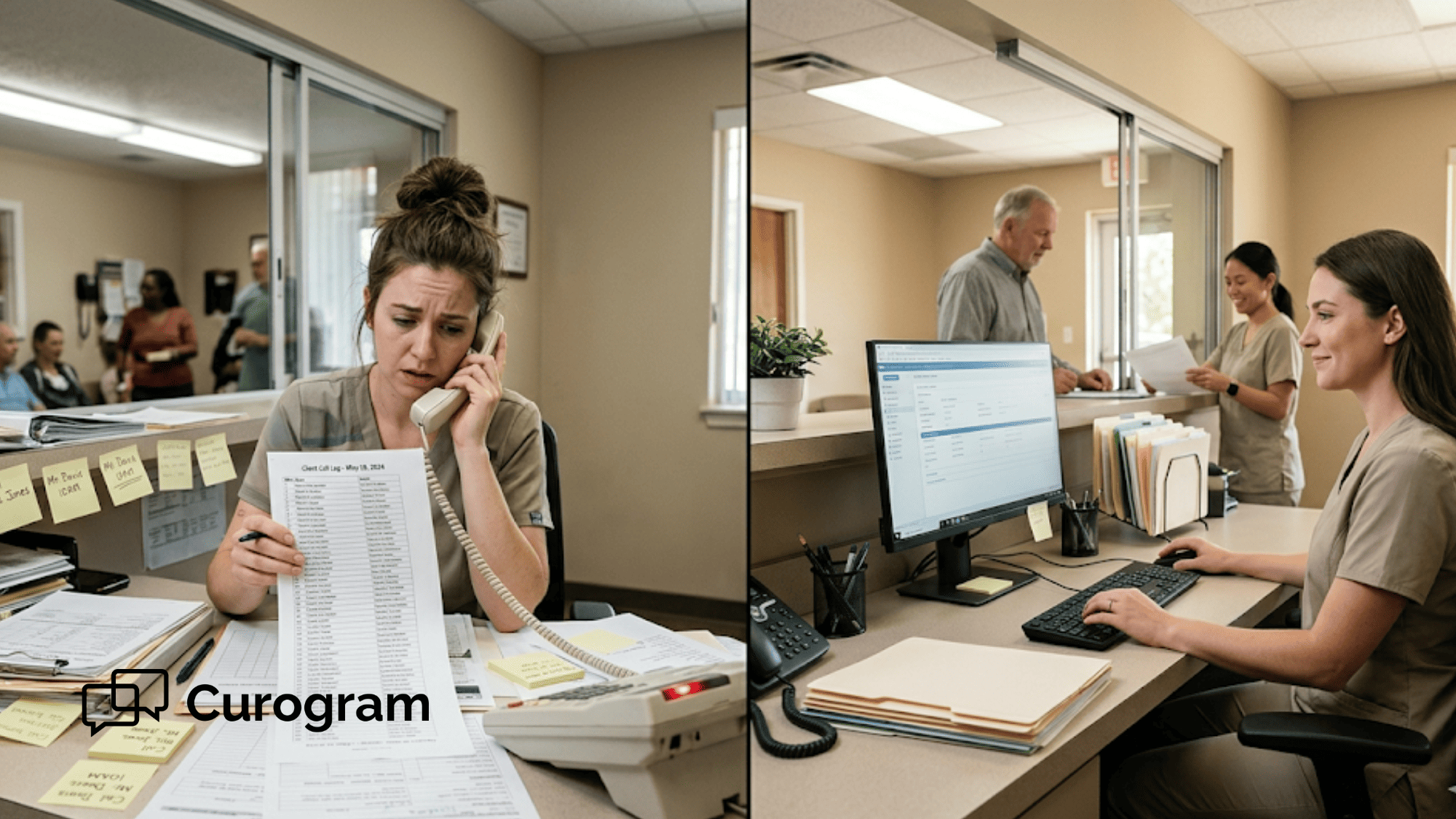
Every grievance that gets resolved by text is one less call your front desk has to handle. And since Curogram lets staff manage multiple text chats from one screen, the same person can handle three or four follow-ups in the time it would take to make one phone call.

This is especially useful for agencies that need to bypass the Welligent Connect portal for faster outreach. Instead of waiting for a client to log in, your team reaches out directly.

The Mission Side

At the end of the day, human services isn't about metrics. It's about people.

You protect your public image, yes. But more importantly, you protect your clients. You make sure that a long wait time or a billing mistake doesn't turn into a reason someone stops getting the help they need.

That's the mission. And tools like Curogram make it easier to keep that promise every day.


How Curogram Helps Agencies Turn Complaints Into Kept Clients


Curogram was built for one core idea: make it easy for health care teams to talk to their clients through text. For human services agencies using Welligent, this means faster response times, better client retention, and a cleaner online reputation.

The platform connects with Welligent to pull visit data. It then sends surveys at the right time, filters the results, and gives your staff a clear path to act. No extra apps. No login walls. Just a text-based system that works the way your clients already use their phones.

One key feature is the smart review filter. Happy clients get guided toward leaving a 5-star Google review. Unhappy clients get routed to your team for a private follow-up.

Based on our internal data, agencies using this feature saw 90% of surveyed clients leave 5-star reviews and over 1,000 new reviews in just three months.

But the real value is on the grievance side. When a low score comes in, your staff sees it right away. They can open a 2-way text chat, resolve the problem, and sync the record back into Welligent — all without picking up the phone.

This is how you intercept negative feedback in behavioral health using SMS. You build a safety net that catches complaints before they become public, and you equip your team with a tool that makes follow-up fast and simple.

Curogram also keeps things compliant. Every text thread is encrypted and meets 42 CFR Part 2 secure messaging standards, which is critical for behavioral health and substance use programs.

If your agency runs on Welligent and wants to improve how it handles client feedback, Curogram gives you a direct, private channel to turn problems into trust.

Conclusion

Every agency deals with unhappy clients. The question is whether you find out about it from a private text or a public review.

The old model is broken. Clients don't file portal complaints. They don't call the front desk to say they're upset. They either post online or walk away from care.

A better model exists. When you use automated SMS surveys tied to Welligent, you open a private line between your clients and your team. Low scores stay inside your walls. Your staff gets instant alerts. And a quick, empathetic text can turn a complaint into a reason for the client to stay.

This isn't just about protecting your Google rating. It's about keeping people in care. It's about making sure a long wait time or a missed call doesn't end someone's treatment plan.

The tools are simple. The impact is real. And the setup takes far less time than you'd expect.

Agencies that invest in grievance resolution today will be the ones that keep their clients, their funding, and their reputation tomorrow.

Ready to stop losing clients to problems you didn't know about? Request a demo to see how Curogram connects with Welligent to intercept complaints and keep your clients engaged.


Frequently Asked Questions

How can we tailor the auto-reply message when a client gives a low score?
You can fully edit the text that goes out after a 1 or 2 rating. Most agencies use a warm reply like, "We're sorry to hear that. A team member will reach out shortly," which buys time while alerting your staff.
Why does routing low scores away from Google matter for human services agencies?
Public 1-star reviews can hurt funding, referrals, and community trust. Routing low scores to your internal dashboard lets you fix the issue first and protect your agency's image at the same time.
How does the follow-up text conversation get saved in Welligent?

The 2-way text thread syncs back into the client's Welligent record through Curogram's integration. This gives your compliance team a full, audit-ready log of the resolution without any manual data entry.

How quickly can a case manager respond after a low score alert?

Most agencies respond within minutes. The alert appears on the Curogram dashboard in real time, so your staff can open a text chat with the client as soon as they see the flag.

Why is texting more effective than calling for grievance follow-up in behavioral health?

Many clients in human services avoid phone calls due to anxiety, shared phones, or busy schedules. Texting gives them a private, low-pressure way to share what went wrong — and they can reply on their own time.