
Patient Recall for Osmind Practices: Recovering Lapsed Patients
 Jo Galvez : Jun 12, 2026, 11:00:00 AM
Automate outreach to psychiatric patients who have lapsed from care. SMS recall campaigns with write-back to Osmind.

A client stops showing up. No phone call, no formal goodbye, no note in the chart explaining why. They simply disappear from the schedule.
For a lot of practices, that is a minor annoyance. For IDD and foster care programs, it can mean a vulnerable person loses access to care they truly need.
Welligent is strong at tracking client records and service history. It was never built to reach back out when someone lapses. That is where Curogram for Welligent comes in, closing the loop your EHR leaves open.
Now think about how these clients actually slip away. An IDD client usually does not manage their own appointments. A foster care placement changes, and suddenly the person who used to bring them in is gone.
The service does not end on purpose. It just fades out, one missed visit at a time.
Here is the hard part.
Recalling these populations is not as simple as firing off a text and hoping for a reply. The message has to reach the right person, and that person changes more often than you would like.
Your staff knows this already. They feel it every time they try to track down who is responsible for a client now. It takes time most teams do not have.
So the work piles up, and clients who genuinely need care drift further away. The longer the gap grows, the harder the return becomes.
This is a solvable problem. It just needs a system that understands how these populations move, who speaks for them, and when to reach out. That is exactly what patient recall for IDD and foster care programs on Welligent is built to deliver.
Let us walk through why these clients lapse, why generic tools fail them, and how the right setup brings them back.
When a typical patient cancels, it is often a choice. They feel better, they switch providers, or they simply forget. IDD and foster care clients lapse for reasons that have little to do with their own decisions.
That difference matters more than it sounds. If you treat every lapse the same way, you keep aiming outreach at people who were never the reason care stopped.
The real fix starts with understanding what actually broke.
Many IDD clients depend on a caregiver to book visits, arrange rides, and remember dates.
When that caregiver changes, a ride falls through, or a residential placement shifts, the appointment quietly disappears.
The client did not choose to stop care. The system around them changed.
So the signal you are watching for is not a frustrated patient. It is a broken handoff. Catch that early, reach the new caregiver, and a single missed visit never turns into months away from care.
Foster care cases involve a web of people:
Caseworkers, foster parents, sometimes biological parents, and the agency itself. When any one of those links changes, scheduled services can lapse with no one formally ending them.
Think about how fast a placement can change.
The foster parent who used to handle appointments may be gone within days, and the new caregiver may not even know a service was on the calendar. No one dropped the ball on purpose. The chain simply broke.
Welligent records service history and client details with care. What it does not do is automatically reach out when a client falls off the calendar. That outreach still lands on your staff, and it takes more than a quick call.
It takes knowing who to contact and tracking every change along the way.
You might assume an off-the-shelf recall tool would fix this.
Most of them work on one premise:
The patient gets the message and replies. For these populations, that assumption breaks down fast.
Here is where generic tools fall short:
The result is wasted outreach and clients who stay lost. Recall for IDD and foster care has to reach the right person, not just the first name listed.
The cost adds up quietly. Say a program loses just 20 of these clients a month to outdated contacts. Over a year, that is 240 lapses no generic tool ever flagged. For your team, that is 240 missed chances to keep someone in care, and these are often the people who can least afford the gap.
Curogram was built to handle exactly this kind of complexity. It connects to your Welligent data and turns recall into a system that runs on its own.
Here is how it works:
Put together, these three pieces do the job your staff cannot do by hand at scale. The system watches every client, knows who to contact, and acts the moment someone lapses.
The payoff is real.
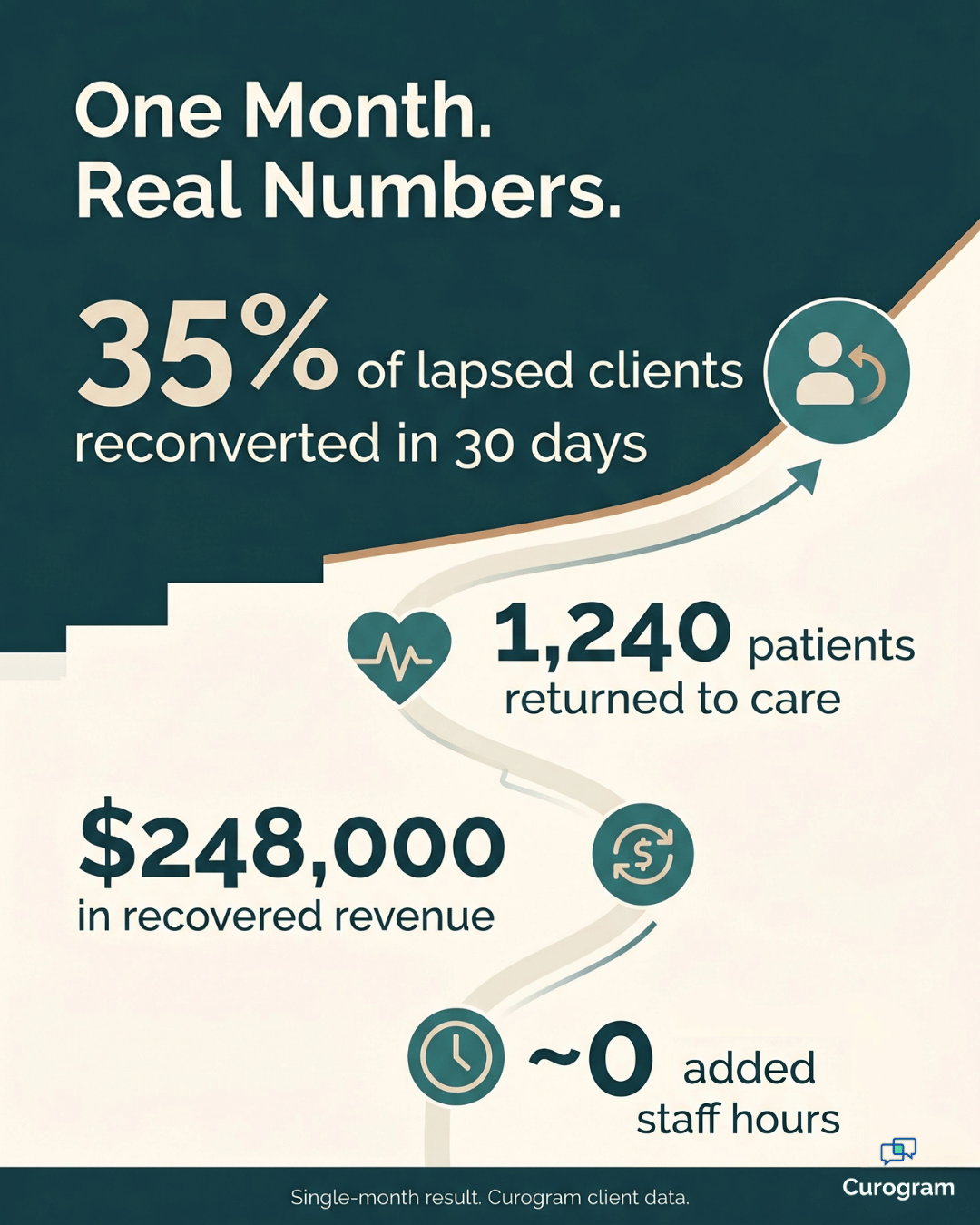
One Curogram client shows what this looks like at scale:
35% |
| Of lapsed patients reconverted within 30 days 1,240 patients returned to care $248,000 in estimated recovered revenue ~0 added staff hours |
Curogram client data — Optima Medical, Scottsdale, AZ · eCW integration.
Look at what those numbers mean in plain terms.
Reconverting roughly a third of lapsed clients is not a rounding error;
It is hundreds of people back in care from a single month of automated outreach.
For an IDD or foster care program, that is hundreds of fewer gaps where something could go wrong.
For IDD and foster care programs, the clinical win matters as much as the money. A lapsed client may need ongoing behavioral support, medication management, or day program services. Automated recall keeps them from falling through the cracks.
You can also see how Curogram serves behavioral health practices across an entire network.

Once recall runs across your sites, the next question is who can see how it performs. Recall is not just a frontline task. It is a window into how your whole network is performing.
Curogram gives different people the view they need.
| Who | What they see |
|---|---|
| Agency leadership | Campaign results across every site and program, including which locations have the highest lapse rates and which populations respond best |
| Site-level staff | Their own recall queue, so they can follow up with clients and caregivers who reply |
| Compliance teams | A logged trail of every recall attempt and response, ready for accreditation and audit |
That last row matters more than it looks. When every outreach is documented, you are not scrambling to prove anything at audit time. The record is already there, waiting.

Visibility is not the goal on its own, though. The goal is what you do with it. When leadership can see that one site has double the lapse rate of another, they can move support where it is needed instead of guessing.
For your team, that turns a vague worry into a specific, fixable problem.
Seeing all of that in one place is the real payoff. Getting your first campaign live is simpler than most teams expect. Curogram's team sets up your recall by population and program type during a two to four week deployment, so you are not building anything from scratch.
The smart move is to begin small. Choose the population with the highest lapse rate and the most straightforward contact routing. Land a clear win there before you take on anything harder.
Starting here does two things at once. It gives you a fast, visible result that builds buy-in with leadership. It also lets your team learn the workflow on the simplest case before the routing gets complicated.
From there, you grow into the more complex groups at your own pace. Recall runs quietly in the background, and your staff steps in only when a client or caregiver responds. That is exactly where their time belongs.
Within a few weeks, recall stops feeling like a project and starts feeling like part of how your programs run. The clients who used to slip away now get a nudge before the gap grows.
That is exactly the outcome you are after.
Every lapsed client is a person who needed care and quietly stopped getting it. For IDD and foster care programs, the stakes are higher than a missed revenue target. These are clients who may not have anyone else watching the calendar for them.
Welligent gives you a strong record of who they are and what they need. What it cannot do on its own is notice when they go missing and reach out to bring them back.
That gap is exactly what patient recall for IDD and foster care programs on Welligent is meant to close.
Curogram handles the hard parts your staff cannot scale. It knows who to contact, updates that contact when life changes, and follows up the moment a client slips past their service window. Your team stops chasing and starts connecting.
That shift gives your staff back hours and gives your clients back their care.
The numbers back it up. One practice brought 1,240 lapsed patients back in a single month and recovered an estimated $248,000, with almost no extra staff time. Imagine that same engine running across your IDD and foster care programs, quietly protecting continuity of care.
This is not about adding more work. It is about removing work that should never have been manual in the first place.
You already have the client records. You already have the service history. What you need is the outreach layer that turns that data into clients walking back through your doors.
It sounds simple. With the right setup, it finally is.
Ready to see it work with your own Welligent instance? Book a Demo with Curogram and watch recall run for your IDD and foster care populations. Bring your toughest lapse problem, and we will show you how the system reaches the right person every time.
 Jo Galvez : Jun 12, 2026, 11:00:00 AM
Automate outreach to psychiatric patients who have lapsed from care. SMS recall campaigns with write-back to Osmind.
 Aubreigh Lee Daculug : Jun 29, 2026, 2:00:00 PM
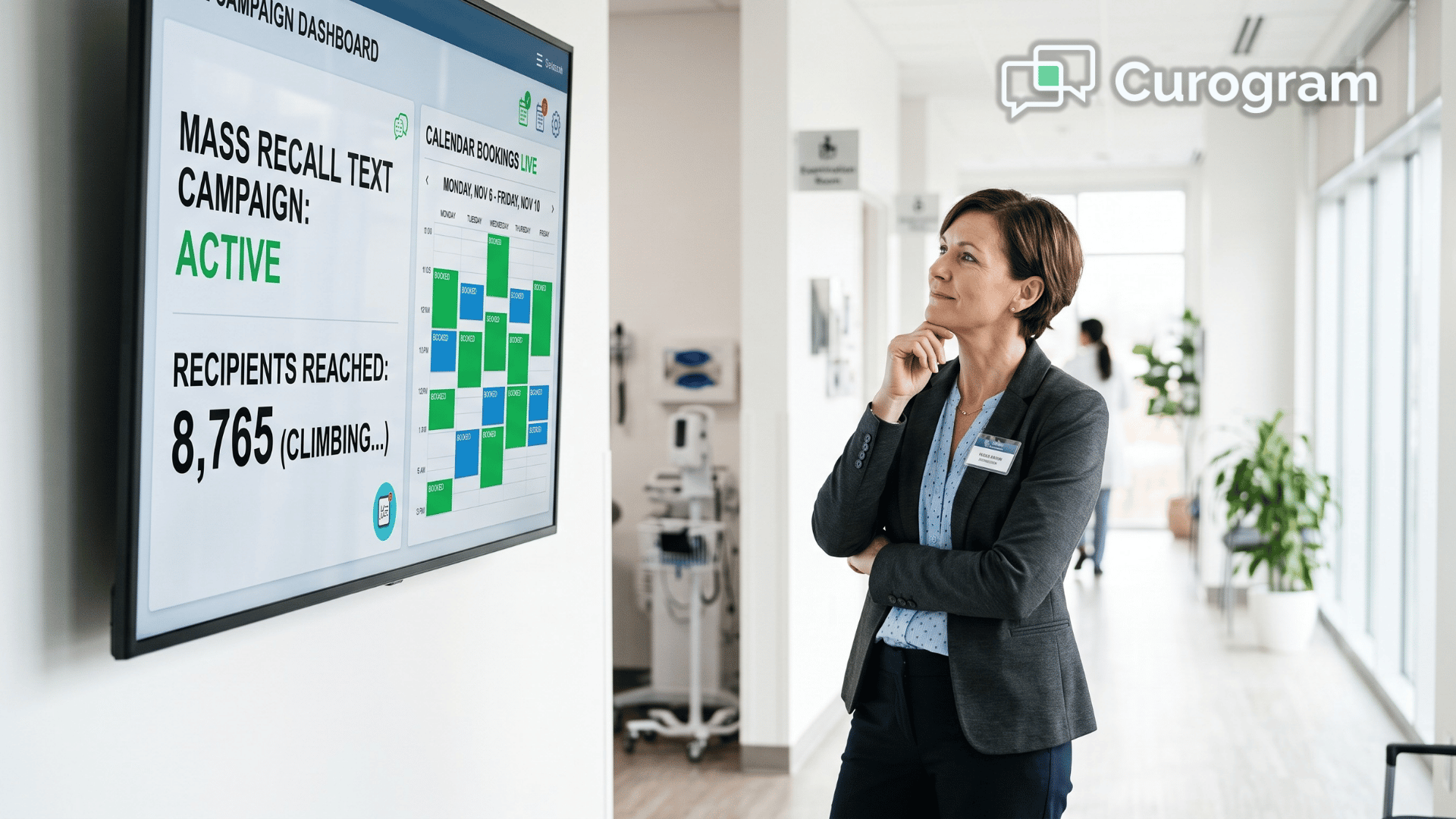
CharmHealth Bulk SMS caps outreach. Recall 10,000+ patients in one campaign—a comparable clinic recovered 1,240. Book a demo.

.jpg?width=30&name=square-formal-photo%20(1).jpg) Mira Gwehn Revilla : Mar 13, 2026, 11:00:00 AM
Mira Gwehn Revilla : Mar 13, 2026, 11:00:00 AM
Protect your mission and grant funding. Learn how Welligent automated appointment reminders SMS via Curogram reduce no-shows and ensure consistent...