

6 min read
Patient Recall for Osmind Practices: Recovering Lapsed Patients
Jo Galvez
:
June 12, 2026
Curogram closes that gap. It finds patients with no upcoming visit and sends SMS recall texts that invite them to schedule. Patients can reply, and their status writes back to the Osmind chart.
This matters most in psychiatry. A lapsed patient may stop medication with no doctor watching, which carries real risk.
Based on our internal data, automated recall reconverted 35% of lapsed patients within 30 days. That brought 1,240 patients back to care. Manual recall, by contrast, returns just 5% to 10%. Recall runs in the background, so staff save hours each week.
Let’s look at a patient finishing a hard stretch. Their mood lifts, and the medication works. Then they miss one visit, then another, and quietly drift out of care. In psychiatry, this exit is common, and it can be risky.
Why does it happen so often? Patients feel better and assume they are done. Stigma creeps back after early progress. Small barriers also pile up, like cost, a long drive, or a busy week.
Osmind shows you when each patient was last seen. What it cannot do is reach out and bring them back. Curogram for Osmind closes that gap. It runs the outreach the chart was never built to do.
It handles patient recall for a psychiatric practice using Osmind without piling work on your team.
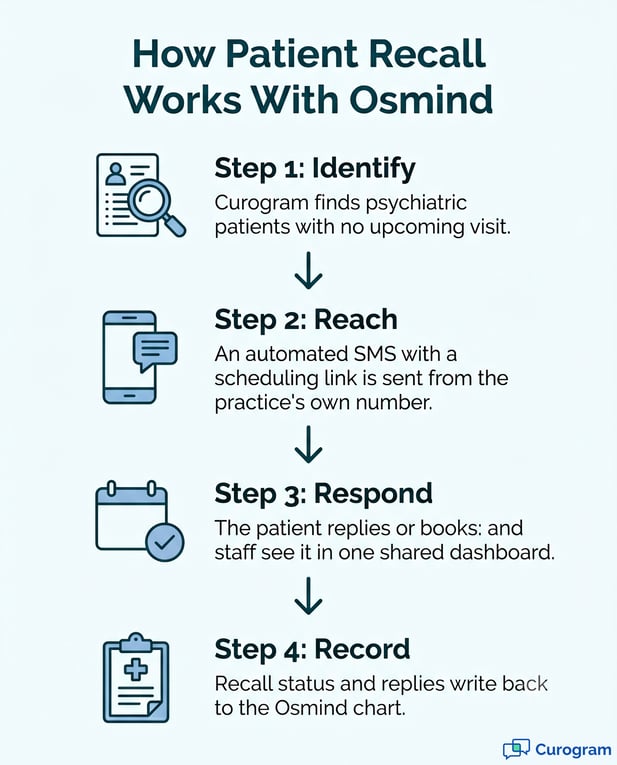
First, it finds patients with no upcoming visit. Then it sends a warm text that invites them to book. The whole flow runs on its own.
Manual recall, by contrast, is slow and draining. Staff pull lists, dial numbers, leave voicemails, and log replies by hand. It eats hours every week. Even then, only a small share of patients ever return.
Automated recall flips that math. Every lapsed patient gets a message, not just the few your team can reach. The work runs quietly in the background. Your schedule fills with patients you already know and trust.
For a busy practice, that shift is huge. You recover both care and revenue without chasing brand-new patients.
You protect people who might otherwise vanish from treatment for good. That is care and growth in a single, simple move.
Below, we look at why patients lapse and what automation replaces. We cover how recall works with Osmind, the impact it brings, and how to start. We will keep it plain, with no heavy jargon to wade through.
Why Psychiatric Patients Lapse, And Why Manual Recall Fails
Lapsed care is not a small issue in psychiatry. It is a pattern with real clinical stakes. Two forces drive it. The first is why patients leave, and the second is why old recall methods miss them.
Why psychiatric patients drop out of care
Psychiatric patients lapse at higher rates than most other fields. A few reasons repeat again and again. When medication starts working, some patients believe they no longer need care.
For others, stigma returns after early progress, and they pull away. Small barriers also add up, like cost, transport, or a packed week. Some patients just forget to rebook.
For patients on medication management, this is more than a missed slot. Stopping an SSRI, mood stabilizer, or antipsychotic with no guidance carries real risk.
A lapse in care can quickly turn into a lapse in treatment. That is why early outreach matters so much.
Why manual recall cannot keep up
Manual recall asks a lot of your staff. They pull lists of patients with no upcoming visit. They call each one, leave voicemails, and track replies in a spreadsheet. This burns hours every week, and the work never really ends.
The payoff stays thin. Based on our internal data, passive return rates sit around 5% to 10%. That means most lapsed patients are never reached at all.
Osmind records when a patient was last seen. It does not run the outreach that brings them back. So that job falls on people who are already stretched too far.
What Automated Recall Replaces In The Psychiatry Workflow
Automated recall does not add a new task. It removes one. To see the value, compare the old workflow with the new. The shift is bigger than it first looks.
|
Step |
Manual recall |
Automated recall with Curogram |
|---|---|---|
|
Finding patients |
Staff pull lists by hand, often once a quarter |
Found on their own, every day |
|
Outreach |
Calls and voicemails, one by one |
SMS texts with a scheduling link |
|
Tracking |
Notes in a spreadsheet |
Write-back to the Osmind chart |
|
Reach |
Only the few staff can call |
Every lapsed patient |
|
Return rate |
Roughly 5% to 10% |
About 35% within 30 days (internal data) |
From manual lists to daily alerts
In the old way, staff pull lapsed-patient lists by hand. This often happens once a quarter, if at all. Because the task is dreaded, it slips and gets delayed.
Automated recall finds these patients on its own, every single day. No one has to remember, and no one falls through the cracks. The list is never stale, and the timing is never late.
From phone tag to two-way texting
Phone calls and voicemails turn into SMS texts with a scheduling link. Messy spreadsheet notes turn into clean write-back to the Osmind chart.
The core shift is simple here. Recall stops being a project staff dread and becomes a process that just runs.
For a practice with 200 to 500 active patients, manual calling cannot scale. There are too many names and far too few hours.
Automated recall reaches every lapsed patient, not just the few staff had time to dial. That is how you close the gap for good.

How Curogram's Recall Campaigns Work With Osmind
Curogram runs recall as a steady background process. It works alongside Osmind, not on top of it. Here is how each step fits together with your chart.
Finding and reaching lapsed patients
Curogram flags patients who have not booked a follow-up within a window you set. You might pick 60 days since the last medication visit. Or you might pick 90 days since the last therapy session.
Each flagged patient then gets a text from your practice's existing number. The message is warm, and it carries a simple link to schedule. Patients can act in seconds.
Two-way replies
Patients can text back at any time. They may ask a quick question or confirm they want a slot.
Your staff see every reply in one shared dashboard. Nothing slips through, and no one digs through voicemail.
Write-back to the chart
Recall status and patient replies flow back into the Osmind record. This builds a clear, documented trail of each outreach attempt.
Your chart stays current with no manual notes. That record also helps with audits and continuity of care.
Proven results from recall
The numbers make the case. Based on our internal data, recall campaigns reconverted 35% of lapsed patients within 30 days. That brought 1,240 patients back to care, with an estimated $248,000 in recovered revenue.
The added staff time was close to zero, since the process is fully automated. You can see more in our full guide to patient recall. Passive return sits near 5% to 10%, so recall lifts results by about 25 to 30 points.
That works out to a 3x to 7x gain over doing nothing. For a psychiatric practice, the win goes beyond money. A patient who returns is a patient whose treatment stays on track.
Clinical And Operational Impact Of Systematic Recall
Recall pays off in two ways at once. It supports patients, and it supports the practice.
In psychiatry, both of these gains carry real, lasting weight. The clinical side and the business side rise together.
Better care and continuity
Each patient who returns is a patient whose treatment was preserved, not dropped. For people on psychiatric medication, that continuity can be the line between progress and relapse.
Recall also eases the load on your staff. Cold-calling lapsed patients is often the most dreaded task at the front desk. Automation removes it and lifts that quiet emotional weight off your team.
Stronger schedules and revenue
Every returned patient means at least one billable visit. Often it means more, as the patient settles back into steady care. Few growth levers are this clean or this kind.
For a mid-size Osmind practice with 5 to 20 providers, recall is a real growth lever. It fills empty slots with no new patient acquisition at all.
You earn more from patients you already serve, at no extra ad cost. The schedule fills itself over time.
Getting Started With Recall On Osmind
Starting recall on Osmind is simple. Setup is light, and the payoff comes fast. You will not need to overhaul a single thing in your day. The system fits the way you already work.
Setup and training
Our team configures the Osmind integration for you. We also build recall templates shaped around your practice. Staff training takes about 10 minutes.
There is very little for your team to manage each day. Setup is done with you, not dumped on you.
A smart, phased rollout
Start with medication management patients who lapsed 60 or more days ago. Once that runs smoothly, expand to therapy and interventional treatment patients. This phased start keeps things easy to track and easy to trust.
Ready to see it work? Book a free demo and watch patient recall run inside your own Osmind instance. You can also see how Curogram serves behavioral health clinics.
Frequently Asked Questions
Several forces line up at once. When medication works, some patients believe they are cured and stop coming in. Stigma can return after early progress, and small barriers like cost or transport add up. Many simply forget to rebook, since nothing prompts them.
Curogram watches for patients who have not booked a follow-up within a window you choose. You might set 60 days after a medication visit, or 90 days after therapy. It then flags those patients for outreach. The whole check runs on its own, every day.
Curogram writes recall status and patient replies straight into the Osmind record. This creates a clear trail of each outreach attempt. Your staff do not have to copy notes by hand. The chart stays current on its own.
Manual calling reaches only a few patients, so many lapse with no notice. For someone on psychiatric medication, that gap can be risky. Automated recall texts every lapsed patient, which protects continuity of care. More returns mean fewer patients left without supervision.
Almost none. After a short setup, recall runs in the background with no daily effort. Based on our internal data, campaigns brought back 1,240 patients with close to zero added staff hours. Your team can focus on care instead of cold calls.