

9 min read
Mass Messaging & Patient Recalls for Modmed | Reactivate Patients
Aubreigh Lee Daculug
:
May 26, 2026
Table of Contents
Practices use it to recall overdue patients, fill same-day cancellations, and reactivate patients who haven't been seen in 12+ months. Modmed's EMA stores the data — Curogram activates it.
One multi-location practice recovered 1,240 patients and hit a 35% reconversion rate, turning a dormant database into measurable revenue with two-way text campaigns sent from the practice's own phone number.
Your Modmed database is bigger than you think. A dermatology office open for a decade may sit on 15,000 patient records. An ophthalmology group with three providers? Often north of 20,000.
And somewhere in that database, hundreds of patients are overdue for care right now. Some canceled a procedure last year and never rebooked. Others finished treatment, walked out, and quietly disappeared from your schedule.
The records are still there. The relationships are still there. The revenue is still there.
Most of it sits frozen.
EMA was built to document encounters, not to chase down patients who slipped through. So overdue annual exams pile up. Mohs follow-ups go uncontacted. Same-day cancellations leave $400 chairs sitting empty while the front desk dials a waitlist one number at a time.
The database keeps growing. The outreach engine doesn't exist.
That's the gap this article is about. If you run a Modmed specialty practice — dermatology, orthopedics, ophthalmology, pain management — your patient list is already a revenue asset.
You just don't have a fast, compliant way to talk to it at scale. Klara handles one-to-one messaging beautifully. It isn't designed to text 2,000 overdue patients before lunch.
That's where mass messaging patient recalls Modmed specialty practices need to operate differently. Not individual outreach. Whole-segment outreach. In minutes, not weeks.
Below, we'll walk through how dormant databases quietly bleed revenue, why manual recall calls almost always stall around call number 50, and how Curogram's mass messaging Modmed patient engagement layer turns those sleeping records into booked appointments — with numbers from real campaigns to show what's possible.
The Database You Built and Forgot You Had
Every Modmed practice accumulates a patient archive that quietly grows with every encounter. After three or four years, you're sitting on tens of thousands of records.
Each one represents a person who already trusted you once.
They walked through your door. They handed over their insurance card. They let your provider examine them. That trust took marketing dollars and clinical hours to earn.
Then most of them quietly stopped coming back.
Some moved. Some forgot. Some meant to schedule and life got in the way.
A dermatology patient skipped last year's skin check.
A cataract evaluation patient never made it to surgery.
A post-op orthopedic patient never returned for their six-month follow-up.
None of these are angry patients. They're just unreached patients.
EMA knows all of them. It knows their last visit date, their diagnosis codes, their provider, the procedures they had. What it doesn't do is send any of them a message.
That's the asset problem at the heart of every specialty practice — the database is rich, but it's passive. It stores history. It doesn't generate revenue.
What dormant really costs you
Let's put a real number on it. A 12,000-patient dermatology practice typically has:
| Patient segment | Approx. count | Avg. visit value | Revenue at risk |
|---|---|---|---|
| Overdue for annual skin checks | 3,200 | $200–$400 | $640,000 – $1.28M |
| Canceled cosmetic consults (12 mo) | 450 | $300–$600 | $135,000 – $270,000 |
| Mohs patients overdue for surveillance | 180 | $1,500–$3,000+ | $270,000 – $540,000+ |
That's a midsize practice with a low seven-figure recovery opportunity sitting inside its own EHR. None of those patients need to be acquired. They're already yours.
For your team, this means the next dollar of growth probably doesn't come from new marketing. It comes from reactivating the patients you already earned.
When Cancellations Quietly Drain the Schedule
Cancellations hurt twice. Once when the slot empties, and again when no one fills it.
Picture a Modmed orthopedic practice running eight surgical consults a day at $350–$500 each.
A patient cancels at 9 a.m. for a 2 p.m. slot. The front desk pulls the waitlist and starts dialing. Voicemail. Voicemail.
A callback at 3 p.m. — too late. The chair stayed cold for the rest of the afternoon.
The compounding cost of one empty chair
One unfilled cancellation looks small on its own.
Stacked across a week, then a year, the numbers get loud:
- One unfilled slot per day: $350–$500 lost
- Five per week: $1,750–$2,500
- Across a full year: $91,000–$130,000 in provider time gone
The frustrating part is that someone on your patient list would have taken that slot. You just couldn't reach them fast enough through one-by-one phone calls.
To fill cancellations Modmed specialty practice SMS workflows have to move at the speed of the cancellation itself — which means minutes, not hours.
The Recall Calls That Never Get Made
Specialty practices don't just lose revenue when patients disappear. They lose continuity of care.
Ophthalmology patients need annual exams. Dermatology patients need cancer surveillance. Orthopedic post-op patients need structured follow-ups. Pain management protocols require documented contact for controlled substance compliance.
These aren't optional touches — they're clinical obligations.
Why phone-based recall always stalls
EMA flags overdue patients clearly. Your clinical team knows who they are. But manual recall calls collapse fast.
Most front desks reach 10–15 patients an hour. After 50 calls, the staffer gets pulled to a checkout, a phone tree, or a chart request. The list goes back in a drawer.
The math doesn't work. If you have 3,200 overdue patients and a staffer can reach 60 a day, that's a full year of dedicated calling — and you don't have a full-time recall caller. So it doesn't happen, and the care gap widens.
A Different Way to Talk to the Whole List at Once
This is where mass text outreach dermatology orthopedics ophthalmology Modmed practices use changes the math entirely.
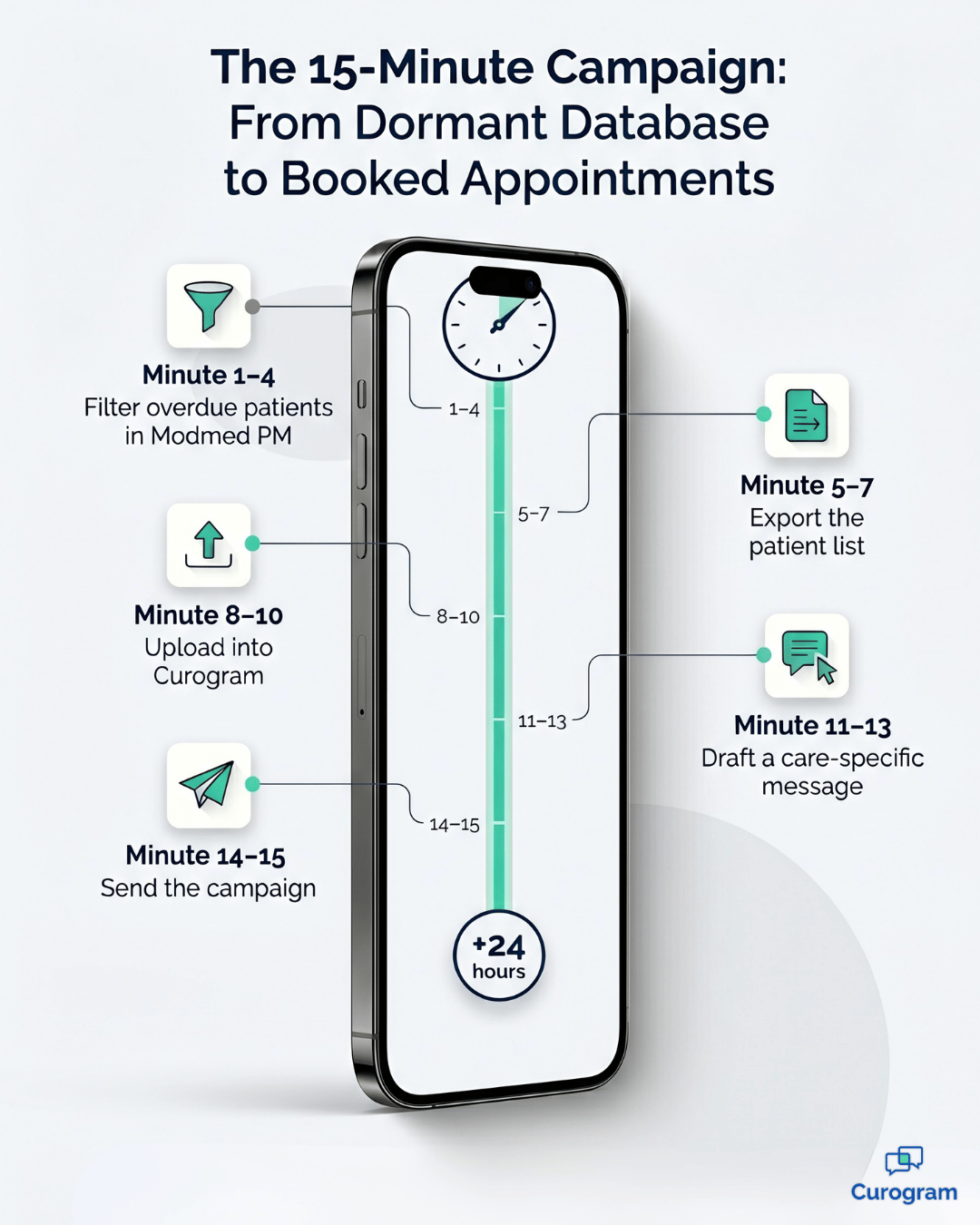
Instead of dialing one patient at a time, your administrator exports a filtered list from Modmed's PM — say, every patient overdue for an annual skin check by 90+ days — and uploads it to Curogram. They draft a short, care-specific message. They send it.
Within minutes, all 2,000 patients receive a personalized text from your practice's own phone number.
Some reply right away. Some click the scheduling link. Some text a question back, and your front desk answers in a two-way conversation — same platform, same dashboard.
That's the shift. One staffer can run a campaign that would take a phone bank a month to attempt.
What Curogram's campaigns actually do
Curogram supports four main campaign types that map cleanly to specialty workflows:
- Recall campaigns target patients overdue for specific services — annual skin checks, eye exams, post-surgical follow-ups — with care-specific language.
- Cancellation fill campaigns blast same-day or next-day openings to interested patients or waitlists.
- Seasonal campaigns drive volume for time-sensitive services like flu shots, allergy testing, or back-to-school physicals.
- Reactivation campaigns re-engage patients not seen in 12+ months with a low-pressure "we'd love to see you again" message.
Each campaign is HIPAA-compliant, sent from your practice's number, and built for two-way replies. A patient never feels like they got a marketing blast. They feel like their doctor's office texted them.

How It Connects to Your Modmed Workflow
The integration is honest and practical. You export a patient segment from Modmed's PM system — last visit date, appointment type, diagnosis code, provider, location, whatever filter you need. You upload that segment into Curogram. You compose and send.
The end-to-end loop in four steps
For the front desk, the workflow is small enough to learn in one sitting:
- Filter and export the patient segment from Modmed's PM
- Upload the list into Curogram and pick a template
- Send the campaign from your practice's phone number
- Reply to two-way responses inside Curogram's dashboard and book
Direct real-time sync with EMA's patient database may depend on API marketplace approval, but the export-upload workflow runs today and covers the vast majority of recall use cases without delay.
The point isn't deep technical wiring — it's that your team can launch a recall campaign this afternoon and book real appointments by tomorrow morning.
Where This Lands in Different Specialties
Mass outreach pays off differently depending on the specialty, but the pattern is the same:
High-value procedures and clinical recall obligations both sit untouched inside the EHR.
Dermatology
Practices reactivate overdue skin-check patients and fill same-day cosmetic cancellations within hours instead of days.
Orthopedics
Practices recover canceled surgical consults — which carry $2,000–$10,000+ procedure value downstream — and rebook post-op follow-ups that would otherwise lapse.
Ophthalmology
Practices recall cataract evaluation patients, one of the highest-volume, highest-revenue procedure pipelines in the specialty.
Pain management
Practices keep treatment protocols intact and meet controlled substance compliance touch points without a dedicated caller.
The common thread across every specialty
When you reactivate dormant patients Modmed EHR database records, you're not buying new patients. You're collecting on relationships that already exist.
The procedure values change, the clinical urgency changes, but the underlying mechanic stays identical — the people who already trust your practice are the cheapest, fastest source of next quarter's revenue.

What 35% Reconversion Actually Looks Like
Numbers should mean something.
Here's what a documented Curogram multi-location campaign delivered:
- 1,240 patients recovered across the practice
- 35% reconversion rate on recall outreach
- Campaigns set up in 15 minutes, not weeks
For every 100 overdue patients contacted, 35 rebooked. That's the difference between a database that sits and a database that earns.
A worked ophthalmology example
A Modmed ophthalmology practice with 18,000 patient records runs a single recall campaign aimed at 2,000 patients overdue for annual eye exams. Within 30 days, 700 patients respond — a 35% response rate. Of those, 420 schedule appointments, which is 60% of responders.
At an average visit value of $250, that single campaign generates $105,000 in scheduled revenue from a text blast that took 15 minutes to set up.
Then the practice runs a second campaign — 500 patients overdue for cataract evaluations. 175 respond. 90 schedule consultations.
At $3,500–$5,000 per cataract procedure, the downstream surgical pipeline crosses $300,000.
In practice, this means one administrator running two campaigns in an afternoon unlocked over $400,000 in scheduled and downstream revenue.
A Real-World Outcome
A common hesitation: is this safe to do at scale? It is — provided you use a platform built for it.
What stays in the text and what stays in the chart
HIPAA-compliant mass texting Modmed practices recall workflows route through Curogram's secure infrastructure under an active BAA. Messages reference appointment types ("you're due for your annual eye exam") without exposing protected health information in the SMS body.
The text prompts the patient to schedule. The clinical detail stays in the EHR where it belongs.
For your team, that means you can run Modmed patient recall campaigns text messaging at full volume without legal exposure. The platform does the compliance work in the background, and your front desk just sees scheduled appointments.
Stop Letting Your Best Asset Sit Idle
Your Modmed practice already did the hardest work. You earned every patient in that database — through reputation, referrals, and clinical care.
The question now isn't whether you have growth potential. It's whether you can reach it.
Right now, somewhere in your EMA, there are hundreds of patients overdue for care they actually want to receive.
There are dozens more who canceled this month and would have rebooked if someone had texted. There's a steady stream of same-day cancellations that should never have stayed empty. And every week that passes, more patients drift further from their last visit and harder to reactivate.
The numbers are real. 35% of recalled patients rebooked. 1,240 patients recovered. $105,000 in scheduled revenue from a single 15-minute campaign setup.
These aren't projections — they're documented outcomes from a practice using Curogram alongside Modmed.
You don't need a marketing team.
You don't need a phone bank. You don't need to acquire new patients. You need a way to talk to the ones you already have, all at once, without breaking compliance — and that's exactly what mass messaging is built for.
Schedule a Demo. Bring a count of your overdue patients — annual exam recalls, canceled consults, post-op follow-ups, 12-month dormant — and we'll calculate the recall revenue potential of your specific database before the call ends.
Frequently Asked Questions
Yes. Curogram's mass messaging is fully HIPAA-compliant, with a BAA in place and secure infrastructure handling delivery. Recall messages can reference appointment types — "you're due for your annual eye exam" — without disclosing protected health information in the text body. The SMS acts as a prompt to schedule, while clinical detail stays inside the EHR.
Yes. Every mass message supports two-way replies. When a patient texts back, the response lands in Curogram's dashboard as a normal two-way conversation. Your staff can schedule, answer questions, or send follow-up info from the same screen. To the patient, it feels like a personal text from their doctor's office — not a marketing blast — which is exactly why response rates land where they do.
Targeted, every time. You export a filtered list from Modmed's PM — by last visit date, appointment type, diagnosis, provider, location, or any combination — and upload that exact list to Curogram. You decide who receives each message. That means you can run multiple campaigns in parallel: a recall blast for overdue annual exams, a cancellation fill for one provider's afternoon slot, and a seasonal promo for a new service, each with its own messaging.
Most campaigns go from filter to send in about 15 minutes. The longest part is usually building the right segment inside Modmed's PM — once you have the patient list, uploading it to Curogram, drafting the message, and hitting send takes only a few minutes. There's no developer setup, no marketing agency, and no waiting on IT. Your administrator or office manager can run the entire process the same day they decide to try it.
Documented Curogram campaigns have hit a 35% reconversion rate on overdue patient recalls, with roughly 60% of responders going on to schedule. Actual numbers depend on how overdue the segment is, how care-specific the message is, and how quickly your front desk replies to two-way responses. Newer overdue patients tend to convert higher than long-dormant ones, which is why most practices run recurring monthly campaigns rather than one big annual blast — steady outreach reaches patients before they drift further out.