9 min read
Patient Recall Campaigns for Modmed | Replace Calls with Texts
Aubreigh Lee Daculug
:
May 25, 2026
Table of Contents
Staff export an overdue patient list from Modmed, upload it, write one message, and send. Hundreds of patients are reached in minutes.
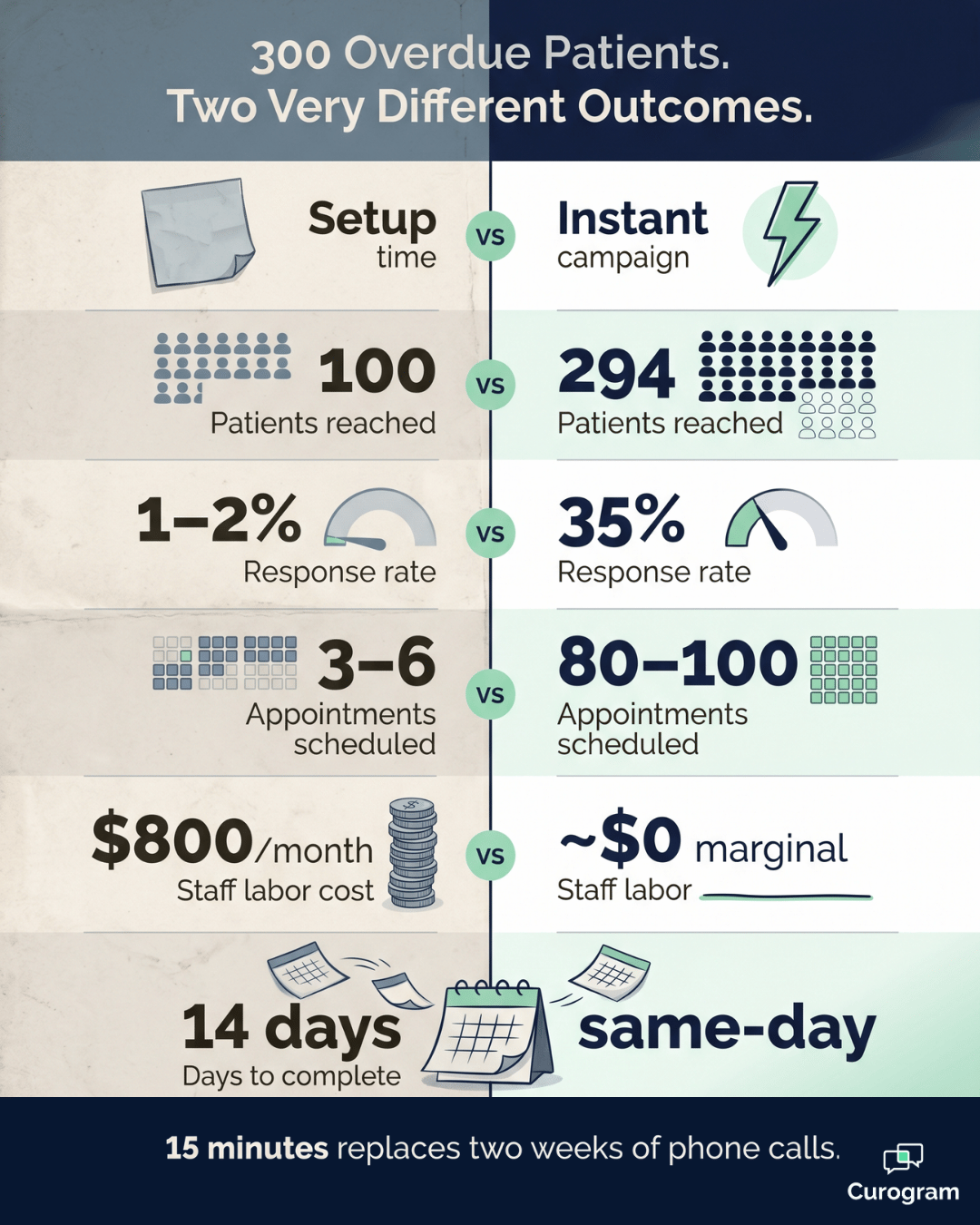
Phone-based recalls reach only 1–2% of overdue patients. Mass texts hit a 35% reconversion rate and a 98% open rate.
A 15-minute campaign replaces two weeks of phone work — with no extra staff time, full TCPA opt-out controls, and HIPAA-grade security baked in.
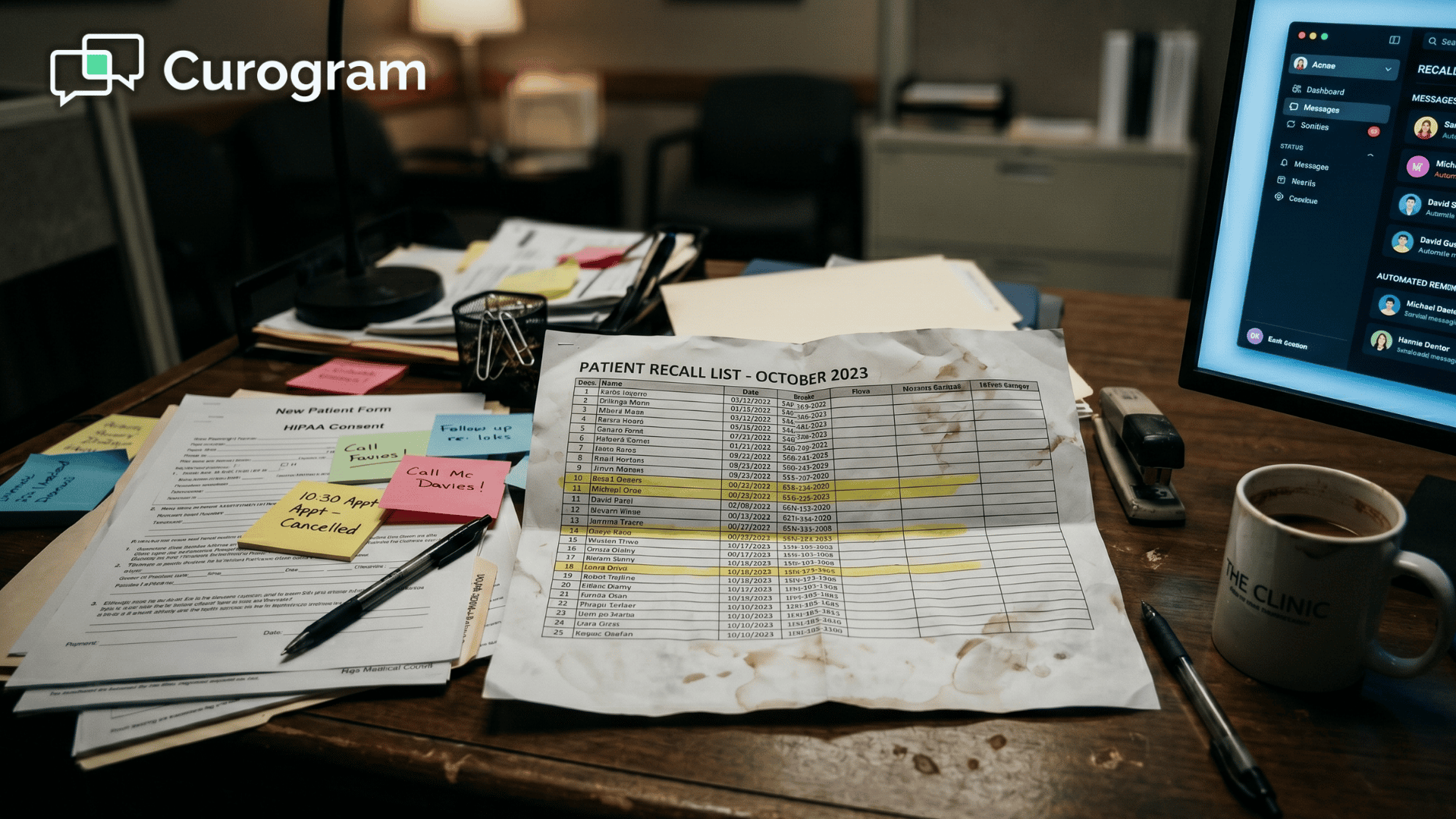
The Practice Administrator drops a thick printout on the front desk. Three hundred overdue patients. A yellow sticky note on top: "Please call these to schedule."
You already know how this ends.
The coordinator stares at the list between check-ins, insurance calls, and the line forming at the window. She makes 12 calls before lunch. Nine go to voicemail. One patient picks up, says she'll "call back later," and never does. Two actually schedule.
By Friday, 35 calls have been made out of 300. By the next Monday, the printout is buried under intake forms. By month-end, it's gone. Quietly.
This is the manual recall grind — and it's happening in nearly every Modmed specialty practice right now.
The problem isn't effort. Your staff want to help these patients. The problem is the medium. Phones don't scale. Voicemails don't get returned. And front desk teams already juggle 80+ calls a day before a single recall is attempted.
Here's the part that stings: those overdue patients aren't ignoring you on purpose. They just don't answer unknown numbers. They'd respond to a text in three minutes — if you sent one.
That gap, between what your patients will read and what your staff can physically dial, is where revenue leaks out of your practice every week. Annual exams missed. Surgical evaluations forgotten. Recurring care drifting away.
This article walks you through a smarter system: how mass text campaigns let front desk staff at Modmed practices recall hundreds of overdue patients in 15 minutes — HIPAA-compliant, two-way, and built around the workflows your team already runs.
The phone list isn't broken because your staff isn't trying. It's broken because phones are.
Why The Printed Spreadsheet Always Loses
Every Modmed practice has tried manual recall at least once. The pattern is so consistent it could be a checklist.
Step one: pull a report of overdue patients from Modmed's PM.
Step two: print it.
Step three: hand it to a front desk coordinator with the words "between other tasks."
Step four: wait for results that never come.
The Math Of A "Normal" Recall Week
Look at the math from a real week.
Day one: 12 calls, 4 patients reached, 1 scheduled.
Day two: 8 calls during a busy morning, 3 reached, 0 scheduled.
By Friday: 35 calls made, 12 patients reached, 3 scheduled. The list of 300 patients has barely been scratched.
By week two, the list is under three other binders. By month-end, the recall initiative has produced 3–5 appointments. From 300 overdue patients.
That's a 1–2% conversion rate — and it cost roughly 10 hours of staff time.
No Practice Administrator celebrates that result. But almost every one accepts it. Because the alternative — adding a full-time recall caller to payroll — costs more than the recalls would generate.
What This Actually Looks Like For Your Coordinator
Walk a day with the person holding the list.
A front desk coordinator at a Modmed ophthalmology practice gets 200 names. Patients overdue for annual eye exams. She squeezes 15 calls into the morning. Eleven go straight to voicemail. She leaves polite messages. Two patients answer but promise to "call back to schedule" — they won't. Two actually book.
After lunch, the lobby fills. Phones light up. A walk-in needs help. She gets five more calls done before the day collapses into the usual afternoon rush.
By Friday, 25 patients reached. Four scheduled. One hundred and seventy-five names still untouched.
She knows those patients need care.
She just can't reach them while doing everything else the front desk is already responsible for:
- 40-patient daily check-in flow
- 80+ inbound phone calls
- Insurance verification and pre-authorization
- Co-pay collection, intake forms, walk-ins
The administrator understands. There simply isn't enough staff time for front desk patient recall in Modmed specialty practice operations done by phone. That feeling — wanting to help but not having the bandwidth — is the silent driver of front desk burnout.
Why Voicemail Eats Your Recall Pipeline
The numbers tell a brutal story.
Between 60% and 70% of recall calls go straight to voicemail. Of those, fewer than 10% result in a callback. Plug those rates into a list of 300 patients and the picture gets ugly.
98% |
| SMS open rate — patients see your text within 3 minutes of receiving it. |
Text Lives Where Phone Calls Die
That number isn't theoretical. The same patients who ignore your phone calls would have opened your text within three minutes of getting it. Voicemails, by contrast, sit unheard for days.
Phone recalls don't fail because your staff aren't trying hard enough. They fail because the medium is wrong.
The Hidden Cost Of A Coordinator On Hold
Time spent on recalls isn't free.
A front desk coordinator earning $20 per hour, dedicating two hours a day to recall calls, costs the practice $40 in direct labor. Per day. Roughly $800 a month.
$800/month |
| Direct labor cost of manual phone recalls — for 15 to 20 appointments scheduled |
Now layer on the opportunity cost.
Those two hours weren't spent on the work that pays the practice back faster:
- Insurance pre-authorization follow-up (recovers denied claims)
- Patient experience improvements (drives reviews and retention)
- Schedule optimization (lifts daily provider productivity)
For $800 in monthly labor, the practice gets 15–20 appointments.
A mass text recall campaign achieves 100+ appointments from the same list — and the marginal staff time cost is close to zero. The ROI gap isn't a small bump. It's an order of magnitude.
Mass Text Campaigns Built For Modmed Operations
Here's the shift: stop calling, start texting.
Curogram is a HIPAA-compliant mass patient outreach platform built for Modmed front desk teams.
The Modmed staff recall campaign workflow mass text process replaces weeks of phone calls with a 15-minute campaign. Export the patient list from Modmed's PM. Upload it to Curogram. Write the message. Send.

Built On The Dashboard Your Staff Already Use
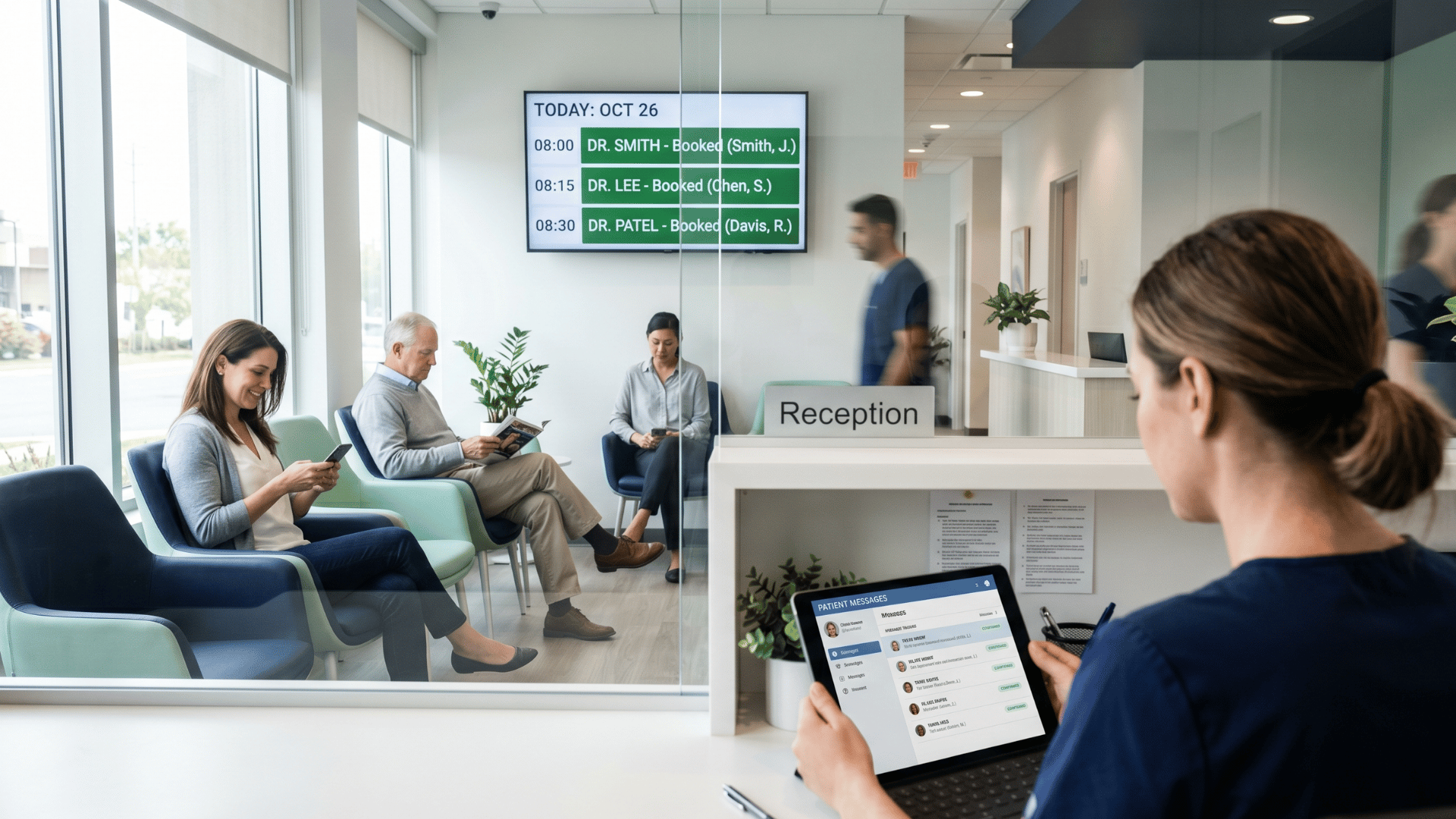
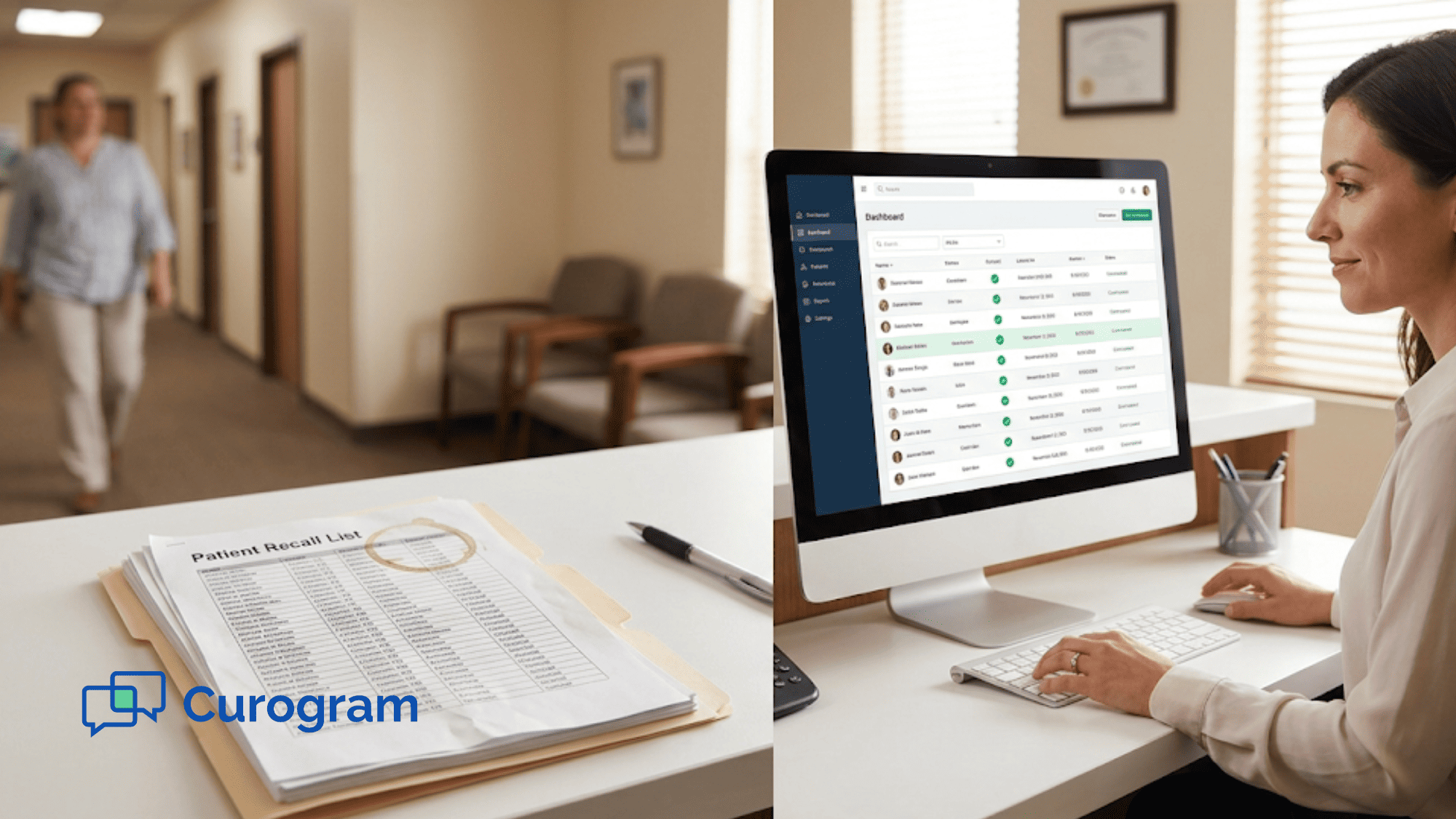
Patients don't get a voicemail. They get a text from your practice's phone number. If they want to schedule, they reply. Those replies flow into the same Curogram dashboard your staff already use for appointment reminders and patient communication.
No new tab. No new login. No new tool to learn.
This is automated recall HIPAA-compliant Modmed clinic operations — the practical version, not the brochure version. The platform handles the heavy lifting. Your staff handle the conversations that actually matter.
Set Up A Campaign In 15 Minutes
The workflow is short enough to fit into a coffee break.
- Export the list from Modmed. Filter by last visit date, appointment type, provider, or diagnosis. A standard CSV with patient name and phone number is all you need.
- Upload to Curogram. Map the columns. The system handles deduplication and opt-out scrubbing automatically.
- Compose the recall message. Use a saved template or write fresh. Personalize with first names. The message goes out from your practice's phone number — not a random short code.
- Send. Five hundred patients receive the text at once. Responses populate the dashboard in real time.
That's the entire build. Fifteen minutes from "I should run a recall" to "the recall is live." The results — replies, schedules, reactivations — start arriving within hours.
15 minutes |
| Total time to launch a recall campaign reaching 500+ patients — versus two weeks of part-time phone calls. |
This is what we mean by Curogram recall campaigns Modmed staff productivity:
The campaign itself takes less time than one round of phone calls used to take.
Fill Same-Day Cancellations Before The Slot Goes Cold
Recall campaigns aren't only for annual exams. They're also how smart practices recover from last-minute cancellations.
Imagine a Mohs surgery cancels at 9:00 AM. That slot is worth $2,500 if filled, zero if lost.
The coordinator opens Curogram, pulls a pre-built list of patients evaluated for Mohs but not yet scheduled, and sends a quick text:
"We have an opening for your Mohs procedure tomorrow. Reply YES to confirm or call us to discuss."
One Hour From Cancellation To Confirmed Booking
Forty patients get the message. Six reply within an hour. Two can make the slot. The $2,500 procedure is filled by 10:00 AM.
The same workflow applies to cataract surgery, cosmetic consultations, and surgical consults. Any high-value slot you would have lost is now in play — without your team making a single phone call.
How This Fits Different Specialties
Modmed lives across dermatology, ophthalmology, orthopedics, pain management, and beyond. Mass texting bends to each.
The campaign type changes, but the workflow stays the same:
- Dermatology — Quarterly recall campaigns for annual skin checks. Creates a recurring revenue engine that operates almost on autopilot.
- Ophthalmology — Cataract evaluation recalls targeting your highest-value patients. Each recalled patient represents potential $3,500–$5,000 in surgical revenue.
- Orthopedics — Cancellation fill campaigns that protect the surgical pipeline by keeping evaluation slots full when patients drop.
- Pain Management — Re-engagement campaigns that ensure controlled substance patients maintain the visit frequency compliance requires.
Across every specialty, the principle is the same:
Reduce manual phone recalls Modmed staff are stuck doing, and replace them with outreach that actually scales.
15 Minutes Replacing Two Weeks Of Work
Numbers make this real.
What Recovery Looks Like Across A Network
One multi-location practice using Curogram recovered 1,240 patients across a series of recall campaigns. Not contacted. Recovered — meaning they actually scheduled and showed up.
That's the difference between a recall list that sits on a desk and a recall system that runs in the background of your operations
From Chasing Patients To Receiving Replies
The deeper change isn't about speed. It's about who's doing the work.
Today, your staff chase. Outbound. Interruptive. Low success rate. Every call is a fresh attempt to convince a patient to call back. Most of those attempts disappear.
With mass text, the workflow inverts. Patients come to staff. Inbound. Patient-initiated. High conversion. Instead of leaving voicemails, your team responds to incoming scheduling requests.
Morale lifts because the front desk isn't drowning in a task that feels futile. Productivity rises because the hours previously spent on phone recall are returned to the team — to handle insurance, intake, and patient experience.
The recall list stops being a punishment.
What This Looks Like Over A Year
A Modmed dermatology practice with four providers runs a quarterly recall campaign.
Each quarter, 800 patients overdue for annual skin checks receive a text. 280 respond — that's 35%. Of those, 200 schedule within 30 days.
Doing The Math On Quarterly Recall Revenue
At $250 per visit, the quarterly recall generates $50,000 in scheduled revenue. Annualized: $200,000. From 15 minutes of campaign setup per quarter.
The coordinator who previously spent 10 hours per quarter on recall phone calls?
She redirects that time to insurance pre-authorization follow-up. The practice recovers an additional $8,000 in previously denied claims. The campaign pays for itself many times over — and it runs in 15 minutes.
Your Front Desk Was Hired To Help Patients, Not Leave Voicemails
The summary is simple: manual phone recalls fail because staff don't have the time, patients don't answer, and voicemails don't generate callbacks. The medium is wrong, and no amount of effort fixes that.
Modmed's PM system already holds the patient list. The missing piece is reaching those patients in a channel they actually use.
HIPAA-compliant recall campaigns Modmed front desk operations teams can execute through Curogram deliver 35% reconversion in 15 minutes — replacing weeks of phone calls that produce 1–2% results.
Your overdue patients aren't gone. They want to hear from you. They just don't pick up the phone.
Curogram reaches them where they respond: via text. The platform plugs into your existing Modmed workflow, runs on the dashboard your staff already use, and gives the Practice Administrator a recall system that actually scales.
Bring your overdue patient count to the demo.
We'll walk through a recall campaign tailored to your specialty, show the 15-minute setup live, and project what a 35% response rate looks like against your current list.
Schedule a Demo today and see how Curogram replaces the printed phone list for good. Fifteen minutes of your time, a clear look at recoverable revenue, and a workflow your front desk team will actually thank you for.
Frequently Asked Questions
Curogram supports both one-time and recurring campaign workflows. You can save campaign templates and patient list filters, which turns a quarterly recall into a 5-minute refresh instead of a 15-minute rebuild. Many practices set a quarterly cadence for annual exam recalls and fire off cancellation fill campaigns as needed.
Yes. Curogram includes built-in opt-out management. Patients reply STOP to any text and are removed from future messaging automatically. Opted-out patients are excluded from every subsequent campaign without staff having to track it manually. This keeps you compliant with TCPA regulations and respects patient preferences at the same time.
Most responses arrive within 1–2 hours of sending. SMS messages are typically opened within 3 minutes of receipt, and patients who plan to respond usually do so immediately. Expect the majority of campaign responses inside the first 24 hours, with a tail of replies coming in over the next 2–3 days. Staff manage all of it from the Curogram dashboard in real time.
Curogram integrates with Modmed's PM and EHR, so patient data flows between the two without double entry. Staff pull the overdue patient list from Modmed, run the campaign in Curogram, and responses tie back to the patient record. The Curogram dashboard sits alongside Modmed in daily use, not on top of it. Most front desk teams are fully trained on Curogram in under 10 minutes because the workflow mirrors how they already think about patient outreach.
Yes. The export from Modmed can be filtered by provider, appointment type, last visit date, diagnosis code, or any other field Modmed tracks. That filtered list uploads directly to Curogram, so a campaign aimed at Dr. Smith's overdue cataract evaluations only goes to those specific patients. This level of targeting is what pushes reconversion rates to 35% — messages feel personal because they actually are.