
Mass Texting & Patient Recalls for Azalea Health
 Jo Galvez : Jun 25, 2026, 12:00:01 PM
Lapsed patients drift away, and schedule gaps go unfilled. See how Curogram runs mass text recalls for Azalea Health.
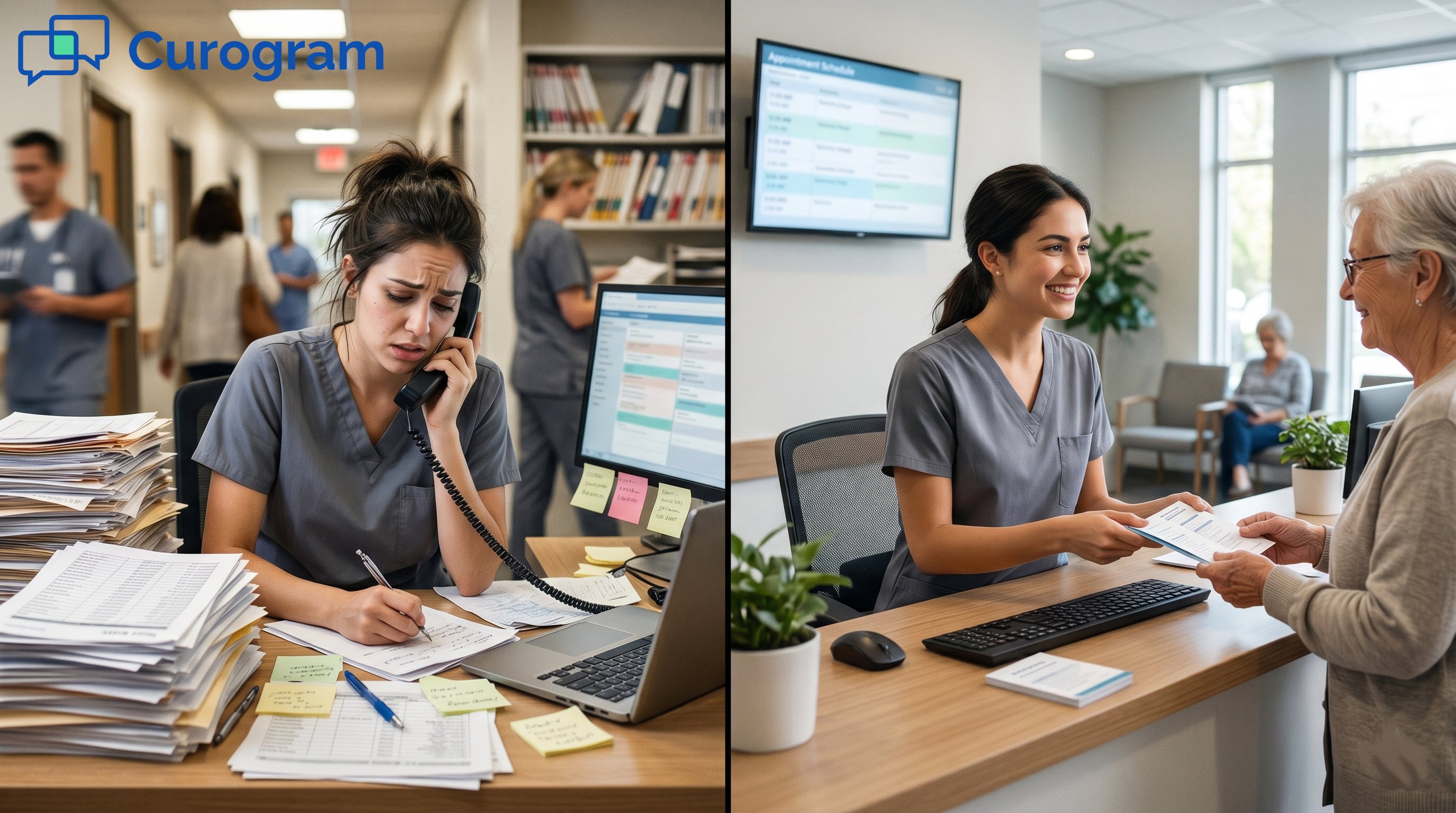
There's a list of patients who should have returned to your practice for care months ago. They are overdue for follow-ups, they are good for revenue, and yet nobody has called them.
Now, picture the one person who is supposed to make all of those calls each day. She also checks in patients, answers the ringing phone, and handles the billing between every other task.
On a two-person front desk, that recall list never moves, because someone first has to pull the report. Then that same person has to dial each number, leave a voicemail, and try again the following week. This is not a failure of effort at the desk; it is simply a failure of arithmetic.
Two people cannot greet patients, handle billing, answer the phone, and still work a long recall list. So the calls quietly get skipped, and the backlog grows a little heavier every single month.
This is exactly where automated patient recall campaigns for the Azalea Health front desk change the entire equation.
Curogram finds the overdue patients for you and then texts them to rebook, with nobody dialing one by one. Your Azalea Health record already knows who is past due, but it cannot reach out on its own.
This problem hits hardest at rural clinics, FQHCs, and community hospitals, where the staff are stretched thin. Time is short, so you need to stop manually calling lapsed patients and let the system do it. The payoff is real and easy to measure, and one practice brought back 1,240 patients this exact way.
This article walks through how that whole picture changes once the recall list starts working on its own. We cover why the backlog builds, how Curogram clears it, and the results you can reasonably expect.
Every practice carries some kind of recall backlog, the quiet pile of overdue patients who never get a call. Azalea Health can show you exactly who they are, but acting on that list is the hard part.
The data is right there in front of you, yet the hands needed to use it are not.
On a lean front desk, one person schedules appointments and handles billing from the moment the doors open. Recall calls sit at the very bottom of every shift, because they are important but never truly urgent.
So they keep waiting, and then they quietly vanish from the day without anyone deciding to drop them. There is always a patient at the window, and a phone ringing, and the recall list loses every time.
Picture a busy Tuesday, with a full waiting room and a phone that simply will not stop ringing. The intent to make those calls is always there, but the hours to make them simply are not.
Azalea Health can pull a full list of your overdue patients in just a matter of seconds. But a report does nothing on its own, because someone still has to open it and act. On a busy desk, that someone almost never has the spare hour the work quietly demands.
So the file gets saved for later, and later has a stubborn habit of never quite arriving. Maybe you open it once a quarter, scan hundreds of names, find no clear start, and close it.
Now picture the calls themselves, where you dial a number, wait through the rings, and leave a voicemail. Then you redial the very next week, and the week after that, with little to ever show. For a recall workflow on a rural front desk, this is hours of work that rarely pays off.
Most of those calls reach voicemail, many of the numbers are stale, and few patients ever call back. Every single call is a small gamble on whether they answer and whether the number even still works.
Skipped recalls are not just harmless busywork left undone; they are lapsed care and revenue walking out.
The cost hides in plain sight, sitting on a spreadsheet that nobody ever has the time to clear. Each overdue patient is a slot a known person could fill. Instead, that slot simply stays empty.
Then the clinic spends money on ads to find strangers, while its own loyal patients quietly drift away. It is a strange trade, paying to chase new faces while known patients sit there completely unbooked. Multiply one empty slot across a full year, and the lost visits quietly add up to real money.
There is a real care cost too, since a patient who skips a check-up can drift off track. A missed recall is not only a missed dollar. Quite often, it is a missed medical problem.
The administrator feels this every week, knowing exactly who should come back, but is unable to reach the phone.

Curogram is the reactivation line, and it works your entire recall list for you from start to finish. The backlog clears without a single phone call, and your team only steps in for the rare exception.
Think of it as a tireless caller that never skips a name and never runs out of time. You do not have to babysit it, since you set it up once and simply let it run.
The idea is simple, because Curogram watches who is overdue and quietly reaches each of them by text. Patients reply to book, and the schedule fills itself while your staff is busy with other work. Text is also where patients live now, since most people read a text within just a few minutes.
A voicemail can sit ignored for days, but a simple text message reliably earns a quick reply. There is no script to memorize and no calling queue to clear before the day can really begin. The patient gets a friendly, warm text, taps to pick a time, and feels invited rather than chased.
Automated recall campaigns flag the patients who are past their window and text each one to rebook. There is no list to build and no number to dial, so you fill schedule gaps without dialing. You set the rules a single time, and the system then runs those same rules on repeat.
You decide the timing yourself, whether that is six months for a cleaning or a year for wellness. Curogram watches the calendar for you and sends each message at exactly the right moment.
Mass texting handles the big sends too, reaching your whole panel with a single, simple message. A weather closure, a flu clinic, or a schedule change all become one quick message to everyone. That means you can broadcast closures to patients in seconds, with no phone tree and no callbacks.
Before, that meant a tall stack of calls or a handwritten sign taped onto the front door. It works for good news too, so a new provider or holiday schedule reaches the whole panel instantly.
The recall logic runs directly off your Azalea Health record, so the right patients get the right message. Rebookings land back on the schedule on their own, with no report pulling, dialing, or re-entry. This fit really matters for a small site, where only a self-running tool can ever truly survive.
Curogram lets you automate recalls for a small clinic without adding even a single new daily task. Your data stays inside Azalea Health where it belongs.
Curogram simply reads it and writes bookings back. It also keeps your stack simple, with recalls, reminders, and texting all living in one single place.
That means overdue patient outreach for Azalea Health runs steadily, with no extra tool for anyone to manage. Setup is light, your team is not the one running it, and once it is on, it keeps going.
AT A GLANCE
|
The task |
Manual calling |
Curogram recall |
|---|---|---|
|
Finding overdue patients |
Pull a report by hand |
Reads from Azalea Health |
|
Reaching each patient |
Dial and leave voicemails |
Automated text to rebook |
|
Staff time per campaign |
Hours of phone work |
Near zero, fully automated |
|
Filling open slots |
Slow and easy to skip |
Fills from your own panel |
Manual recall vs. Curogram automated recall

Here is what really changes once the reactivation line is running itself: the backlog simply stops growing. Overdue patients start coming back on their own, and the front desk finally gets its hours back.
The change is not a small one, since a chore that never ended now ends on its own. It also changes how the whole week feels, because that quiet, constant pressure simply lifts away.
These results are not just theory, because one multi-location practice ran all its recalls through Curogram.
The campaign was fully automated, with no staff dialing at all, and the numbers really speak for themselves. These were real patients who came back, not rough estimates and not hopeful projections on a slide.
The practice did not hire more staff or add phone hours; they turned on a campaign and waited. Scale that same simple math to your own panel: find the overdue patients, text them, and watch them book.
In that practice, recall texts alone brought back a remarkable 1,240 patients onto the schedule.
No one worked a call list, since the system found them and the patients booked themselves by reply. That figure comes directly from Curogram client data from clinical settings, not from any rough guess.
For a lean desk, 1,240 visits is a serious number, amounting to months of filled slots without extra calls. Those visits did not come from ads; they came from patients the practice already had on file. That is the cheapest form of growth a practice can possibly find.
The reach was strong too, since 35% of the patients who got a recall text booked within a month.
That is a busy desk's dream running on autopilot, per Curogram client data from clinical settings. Think about that ratio, where one in three texted patients came back fast with no staff time spent.
A 35% reconversion rate is very hard to hit by hand, and a tired caller can never match it. The system reaches everyone, every single time, without ever needing a break or a quiet afternoon.
The real shift shows up in the daily work, where your staff no longer dials a long list.
They handle only the few replies that need a human touch, and everything else simply happens by itself. Recalled patients then flow into your automated appointment reminders and confirmations, so they arrive ready.
The time savings are real, since hours once lost to dialing now go straight back to the desk. The same two people now handle more patients, with the same calm day and no dreaded call list.
Instead, there is just a steady stream of patients booking themselves right back in throughout the week.
Exceptions stay rare, like a patient asking a question or wanting one very specific day on the calendar. Revenue follows the visits, it compounds as patients rebook, and the desk finally owns the list again.

The recall backlog is not really a staffing problem at its core; it is a calling problem. Azalea Health flags exactly who is overdue, and Curogram then reaches them with no calls required. Think of it this way: Azalea Health is built for your records, while Curogram is built for their return.
One tool holds the data, and the other turns that data into real, booked visits on the calendar. Neither one replaces the other, because they really work best together as a closely matched pair. Your record knows exactly who lapsed, but it simply cannot pick up the phone and reach out.
The reactivation line can do exactly that, and it never gets tired or too busy to dial. For a lean front desk, this is truly the only kind of recall program that ever lasts.
It does not depend on a free hour that never comes, so it runs quietly in the background. Most of all, it removes the guilt of a list that no one could ever reach.
It scales right along with you, so adding a new location just keeps the recalls flowing as before. There is no new hire to train and no new list to dread at the start of each week. It also does all of this safely, since Curogram is HIPAA compliant and honors every single opt-out.
The payoff here is clear and well proven, not just a hopeful promise on a sales page. One practice saw 1,240 patients return from recall texts alone, with absolutely no staff dialing involved.
Their schedule is filled from their own panel rather than from a costly and never-ending ad spend. Those returning visits added up to real, recovered revenue for the practice.
Numbers like that are not luck; they come from reaching every overdue patient reliably and on time. A person simply cannot do that for very long, but a steady system can do it for good. Best of all, your staff finally gets their time back, and the dread of the call list disappears.
They spend their hours on the patients right in front of them, instead of stuck on a phone. Every month you wait, the backlog grows, more patients lapse, and more open slots simply sit empty. You already have the patients, the data, and a clear way to reach them, so only the switch remains.
So stop letting overdue patients pile up just because nobody has the time to make the calls. Let the system handle the outreach, because reactivation should never cost your staff a single phone call.
Ready to see it work for yourself? Book a free demo today.
 Jo Galvez : Jun 25, 2026, 12:00:01 PM
Lapsed patients drift away, and schedule gaps go unfilled. See how Curogram runs mass text recalls for Azalea Health.
 Jo Galvez : Jun 25, 2026, 3:00:00 PM
Overdue patients rarely return on their own. See how Curogram texts Azalea Health recalls that brought 35% of lapsed patients back, no portal, any...

 Aubreigh Lee Daculug : Jul 8, 2026, 10:00:01 AM
Patients drift away. See how eClinicalWorks sends friendly recall texts patients can book from in one reply—no app or phone call.