
9 min read

Why Patients Respond to Text Recalls, Not Phone | Meditab IMS

Why Patients Respond to Text Recalls, Not Phone | Meditab IMS
💡 Overdue Meditab IMS patients respond to text recalls instead of phone calls because texting matches how patients actually communicate in 2026.

Text messages carry a 98% open rate. Phone calls reach patients only 25% to 30% of the time and usually land in voicemail that goes unreturned.

Texts collapse the gap between intent and action. Patients read in three seconds and reply with a single tap — no phone tree, no hold time, no callback needed. 

One multi-location Meditab IMS practice recovered 1,240 overdue patients at a 35% reconversion rate after switching from phone-based recalls to Curogram's text campaigns. Same patient list. Different channel. Radically different result.

Your front desk has been calling the same overdue patient for three weeks straight. No answer. No callback. No appointment. Meanwhile, that same patient just texted their daughter back in under sixty seconds.

This isn't a staffing issue. It's not a lazy patient issue either. It's a channel mismatch — and it's quietly costing your practice thousands of dollars in lost revenue every single month.

Phone calls used to work. In 2026, they don't. Patients screen calls from unknown numbers, ignore voicemails, and rarely call back because returning a missed call now means sitting on hold, navigating menus, and dedicating real time to a task they didn't start.

The recall list keeps growing while your staff keeps dialing the same numbers.

Here's the part most practice managers miss. The same patients who never picked up the phone will reply to a text within minutes.

They aren't avoiding your office. They're just avoiding your medium of choice.

When it comes to patient communication preferences, healthcare texting now wins by a wide margin. Text messages get a 98% open rate. Phone calls reach patients only 25% to 30% of the time. The difference isn't small — it's a different universe entirely.

If you're running Meditab IMS, your EMR already knows exactly who needs to come back. The list is right there in the system: overdue annuals, missed follow-ups, lapsed specialty referrals, untreated chronic conditions.

What's missing isn't data — your IMS database has plenty. What's missing is a channel patients actually answer.

This is the case for why overdue Meditab IMS patients respond to text recalls, not phone calls, and how patient engagement transforms when you stop dialing and start texting.

We'll cover why phone-based recall keeps failing, what changes when you switch channels, and the real numbers behind text-driven reactivation across specialty practices.

What Really Happens to Your Recall Calls in 2026

Most front desk managers think their recall list is full of disengaged patients. It isn't. It's full of patients who never heard the call.

The Phone Has Quietly Become a Closed Door

Patients under 55 screen almost every call from a number they don't recognize. Patients over 55 are catching up fast, thanks to a steady flood of robocalls and spam dialers.

When your practice calls a recall patient, the sequence plays out in a fraction of a second:

  • The patient sees an unfamiliar number
  • They assume it's a robocall or spam
  • They decline before the second ring finishes

That's the start of why patients ignore recall phone calls. Meditab IMS users know the data is accurate — the patient is overdue, the contact info is current, the clinical need is real. The breakdown happens between the dial tone and the patient's thumb.

98% vs. 25–30%

Text message open rate compared to phone call answer rate. Most recall calls never reach the patient at all — they're declined or sent straight to voicemail.

What the Patient Actually Experiences

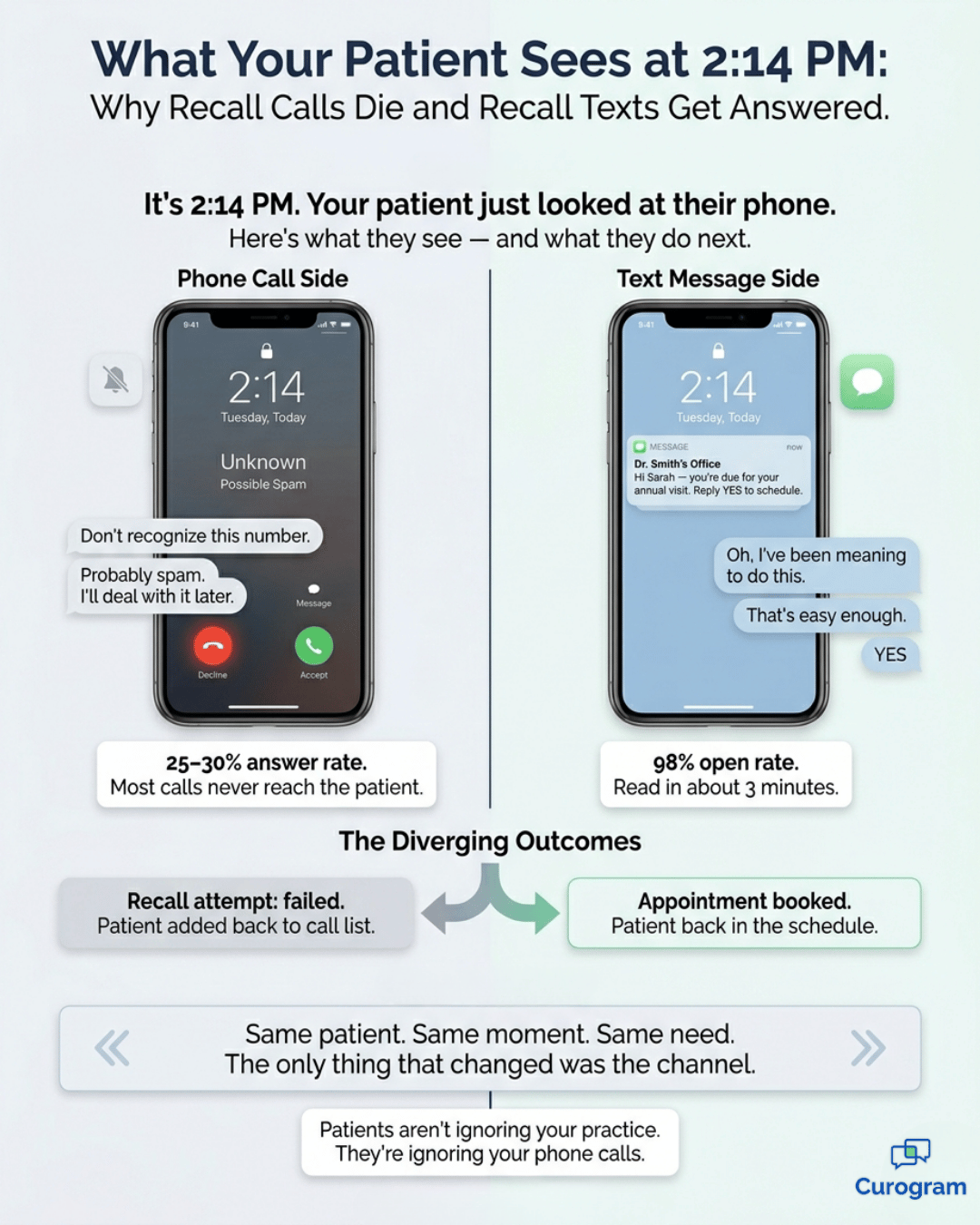
Walk through a typical recall attempt from the patient's side. A call comes in at 2:14 PM on a Tuesday. The patient is in a meeting, on a job site, or driving the kids home. They silence it.

A voicemail follows:

"Hi, this is Dr. Smith's office. You're due for your follow-up. Please call us back at your convenience."

The patient plans to call later. Later never comes.

Your staff tries again Thursday. No answer. By the third attempt next week, the calls feel like pressure — and the patient who genuinely needs that colonoscopy follow-up now has a small, quiet aversion to your practice.

The Generation Gap That Isn't Really a Gap

Many practices still believe older patients prefer phone calls. The data says otherwise.

Texting is now the most-used communication channel across every age group with mobile phones. Adults 18 to 49 overwhelmingly prefer text for non-emergency communication. Adults 50 to 64 are closing in fast.

Even patients 65 and older — a core demographic for primary care, gastroenterology, and pain management — text their families daily and prefer simple, low-pressure messages they can answer on their own time.

The truth is simpler than the stereotype. Patients of all ages prefer whatever feels easiest. A text they can read at a stoplight beats a phone call that demands their immediate attention.

The Emotional Cost of a Phone Call

For patients overdue for something they're nervous about — a colonoscopy, a biopsy, a specialist visit — the phone call adds anxiety on top of avoidance. A ringing phone from the doctor feels like a confrontation.

A text feels like an invitation. Same information. Same office. Completely different emotional response.

That shift alone moves patients from "I'll deal with it later" to "let me schedule this right now."

Reaching Patients on the Channel They Actually Use

Once you understand the problem is the channel, the fix becomes obvious. Stop trying to make patients answer phones they've already stopped answering. Reach them where they're already replying — text.

Infographic comparing a patient's phone screen during a recall call versus a recall text from their doctor.

One Message. One Tap. Booked.

Curogram sends recall texts that patients can read, think about, and respond to on their own schedule. No phone tree. No hold time. No pressure to act in the moment they're caught off guard.

The patient reads the message in three seconds. Decides they want to schedule. Replies. The appointment is booked in a single text exchange that takes under a minute on their end.

That's the engine behind text message patient reactivation in Meditab IMS practices. The barrier between "I should schedule" and "I just scheduled" almost disappears.

What the Recall Text Actually Says

Curogram's recall messages are short, polite, and easy to act on. Reply "YES" to schedule. Tap a link to pick a time. That's the whole interaction.

Patients don't need to call back, log into a portal, or remember a password. They don't even need to leave their lock screen. Two taps, and the appointment is on the calendar.

How It Connects to Your Meditab IMS Workflow

When a patient replies to a recall text, the response lands in Curogram's unified inbox alongside the patient's context. Your staff sees who the patient is, what they were recalled for, and what they need — all in one view.

The scheduling conversation happens by text. The appointment then flows into Meditab IMS. Your front desk handles a quick chat instead of chasing a missed call across multiple attempts.

This is what overdue patient engagement looks like when Meditab IMS text outreach is built on a channel patients actually use.

The EMR drives the list. Curogram delivers the message. The patient does the rest with their thumb.

45% vs. under 10%

Patient reply rate on recall texts compared to phone-based outreach. More than four times the engagement from the exact same recall list.

Why It Works for Every Patient Type

Different patients respond to texts for different reasons, but they all respond:

  • The anxious GI patient avoiding their colonoscopy finds a gentle text easier to face than a ringing phone
  • The busy parent overdue for a child's vaccination can handle the message during a lunch break
  • The older pain management patient can show the text to their adult child for help scheduling

Every demographic gets the same benefit — the channel demands the least possible effort.

The recall campaign patient experience around text message IMS workflows feels less like a chase and more like a quick check-in. That subtle shift in tone is half the reason it works.

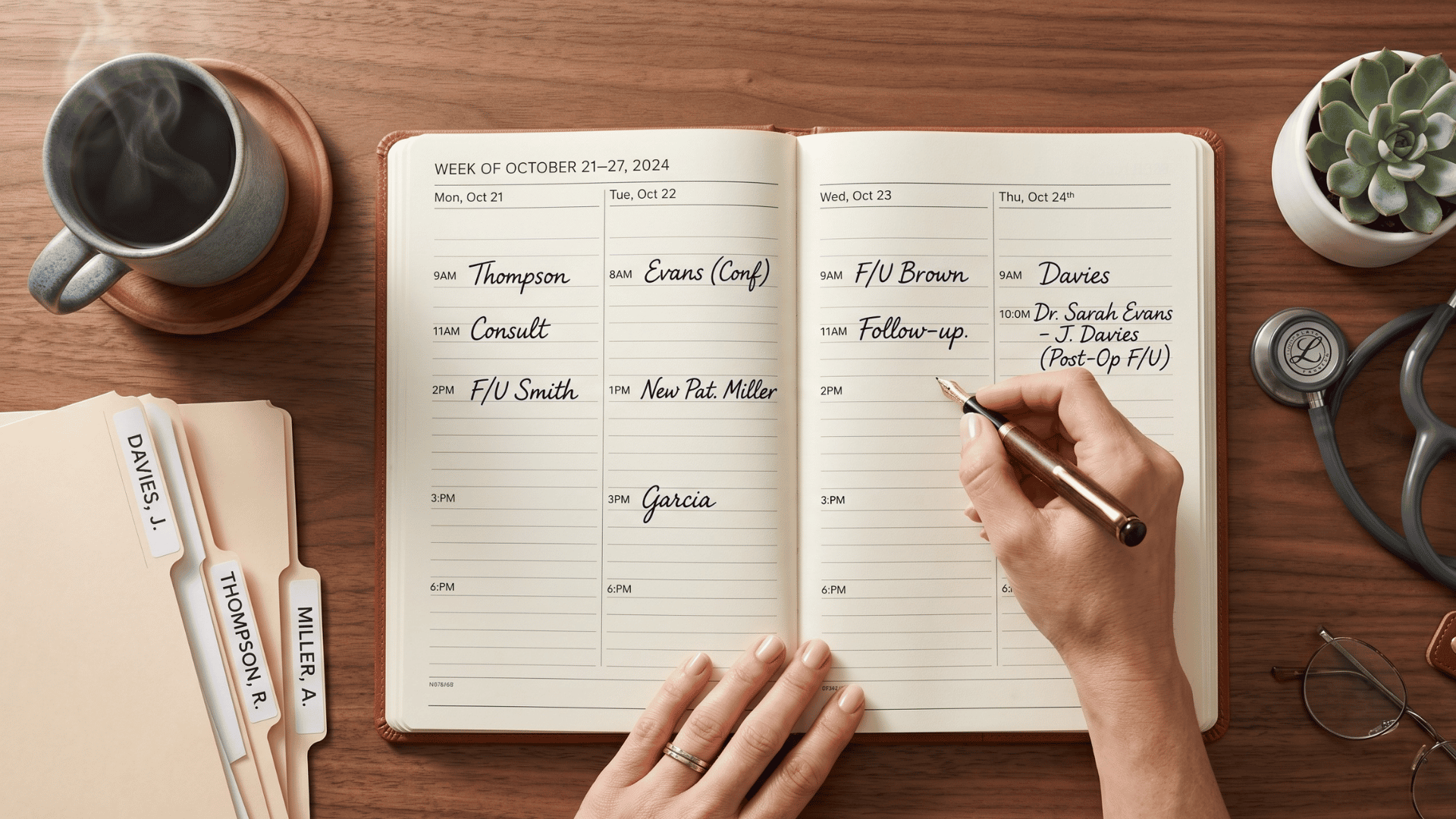
Clinician's planner filling with new appointments after switching to text-based patient recall outreach.

What the Numbers Look Like When Texting Replaces Dialing

The case for texting isn't theoretical anymore. The data from practices that have switched is consistent, and the gap between channels is large enough to change a practice's annual revenue.

Same List. Different Channel. Different Outcome.

A multi-location Meditab IMS practice switched from phone-based recall to Curogram's text campaigns. The patient list didn't change. The clinical need didn't change. Only the channel changed.

The result:

1,240 patients recovered at a 35% reconversion rate from text recalls alone.

Phone calls had already failed on most of those patients — sometimes for over a year. One text campaign brought them back.

The Side-by-Side That Tells the Story

Beyond reach and reply rates, text recalls also produce something phone calls can't — a clean record of what actually happened. That matters for both compliance and confidence in your numbers.

Delivered, read, replied — vs. "call attempted"

The compliance trail text recalls leave behind. With phones, you can only document that a call was made. With Curogram, you see every step of the conversation: who got the message, who opened it, and who responded.

In dollars, the patient recall response rate gap between text vs phone for a medical practice gets bigger fast. If a practice has 1,000 overdue patients and the average recall appointment is worth $250, a 5% reconversion through phone calls returns about $12,500.

Reach every patient in seconds. Use mass messaging for urgent closures, health alerts, or clinic news with a 98% open rate with Curogram.

A 35% reconversion through text recalls returns about $87,500 from the same list — a difference of $75,000 from changing one variable.

The Frictionless Return

When scheduling takes one text reply instead of returning a phone call, patients act on the impulse to schedule rather than deferring it. The delay between "I should book this" and "it's booked" collapses.

That immediacy comes from what gets removed from the patient's path:

  • No callback to a number they don't recognize
  • No hold music or phone tree
  • No waiting until business hours to act
  • No social pressure of declining a live caller

Texts are answered in the same moment they're read. Phone calls invite the patient to come back later, which usually means never.

A Real-World Snapshot

A dermatology practice sends a recall text to 200 patients overdue for their annual skin check. Within 72 hours, 78 patients have responded. Sixty-two have appointments on the books.

Several of those patients had been on the recall list for over a year and had ignored three phone attempts each. The text reached them in minutes. Same patients, same office, same need — just a channel that didn't ask too much.

Stop Chasing Patients. Start Reaching Them.

Your overdue patient list isn't a sign of disengaged patients. It's a sign of a broken channel. The recall data is sitting in your Meditab IMS system right now — names, dates, reasons, and contact info. The work isn't finding patients. It's reaching them.

Phone calls fail because they ask too much of the patient. Pick up an unknown number. Listen to a voicemail. Call back during business hours. Wait on hold. Most patients won't do any of that for a reminder.

Texts succeed because they ask almost nothing of the patient. Read in three seconds. Reply with a tap. Done. The path from intent to booked appointment collapses into a single thumb movement.

For practices using Meditab IMS, the win isn't theoretical.

Multi-location groups have recovered over 1,000 patients per campaign at reconversion rates of 30% to 35%. That's not staff hours rescued — that's revenue brought back. A single recall text run can outperform a quarter of phone calls.

The same patients who screened your calls will book through texts. The clinical need is the same. The reminder is the same. Only the channel changes — and the channel is the whole game.

If you're still relying on phones to chase down overdue patients, you're playing a game where the rules changed five years ago. Patients moved to text. Your recall strategy needs to move with them.

Curogram plugs into Meditab IMS without disrupting your workflow, layers HIPAA- and TCPA-compliant text recalls on top of your existing patient data, and gives your front desk one inbox to manage every reply. No more dialing into voicemail. No more recall lists that just keep growing.

Schedule a Demo to see how text-based recalls work inside your Meditab IMS setup. Bring back the patients who never stopped needing you — they just stopped answering calls.


Frequently Asked Questions

Won't patients find recall texts intrusive or spammy?

The opposite, actually. Patients overwhelmingly prefer texts to phone calls for non-urgent medical communication. A recall text is brief, relevant, and easy to act on — something like, "You're due for your annual visit. Reply YES to schedule." Patients appreciate the simplicity because they can respond immediately or ignore the message without the social pressure of declining a live call. Every message also includes a clear opt-out, and those opt-outs are always respected.

What about patients who don't text or don't have a mobile phone?

Curogram's recall campaigns focus on patients with mobile numbers on file, which is the vast majority of any modern practice. For the small group without mobile access, your existing phone-based outreach stays in place as a fallback. The goal is to move 80% to 90% of recall outreach to text — which frees up staff time so the remaining 10% to 20% of phone-only patients actually get the focused attention a real call requires.

How do we know the text was actually delivered and read?

Every message sent through Curogram comes with a delivery confirmation. You can see which texts were delivered, which bounced from invalid numbers, and which received replies. That's a stronger compliance record than phone-based outreach can ever produce — with a phone call, you can only document that a call was made, not that the patient heard the voicemail or even received it. Text recalls create a clean audit trail for every step of the conversation.

How long does it take to set up text recalls with our Meditab IMS system?

Most practices are live with Curogram in a matter of days, not weeks. The integration with Meditab IMS doesn't require ripping anything out or rebuilding workflows — Curogram works as an add-on layer that pulls your recall lists from IMS and sends the messages on top of your existing setup. Your staff gets trained on the inbox in a single session, and the first recall campaign can usually go out within the same week. There's no long onboarding, no IT project, and no disruption to scheduling or charting workflows your team already knows.

What happens when a patient replies with a question instead of just "YES"?

Real conversations happen, and Curogram is built for that. If a patient texts back asking about insurance, available times, or what the visit is for, the message lands in your unified inbox where any staff member can reply directly from their computer. The exchange feels like a normal text thread for the patient and like a manageable chat queue for your team — no juggling personal cell phones, no missed messages, and no calls back-and-forth. Once the patient is ready to book, the appointment moves into Meditab IMS the same way any other scheduled visit would.


Mass Texting & Recalls for Meditab IMS Practices | Patient Outreach

Mass Texting & Recalls for Meditab IMS Practices | Patient Outreach

💡 Mass text messaging and patient recall campaigns at Meditab IMS practices close the gap between IMS InTouch's individual appointment reminders...

Read More
Office Ally Patient Recall Text | Bring Patients Back

Office Ally Patient Recall Text | Bring Patients Back

💡 When a patient stops coming in, it rarely means they had a bad experience. More often, life got busy, their treatment plan ended, and nobody...

Read More
Office Ally Recall Campaign | 5-Minute Text Broadcast

Office Ally Recall Campaign | 5-Minute Text Broadcast

💡 Running an Office Ally recall campaign used to mean printing a call list, blocking off staff hours, and hoping the phones got answered. Most...

Read More