Collecting Co-Pays for MD Systems Practices Before the Visit
💡 Collecting co-pays for MD Systems practices works best when you collect before the visit, not after. Here's how a text-to-pay workflow helps: ...
12 min read
Mira Gwehn Revilla
:
March 23, 2026
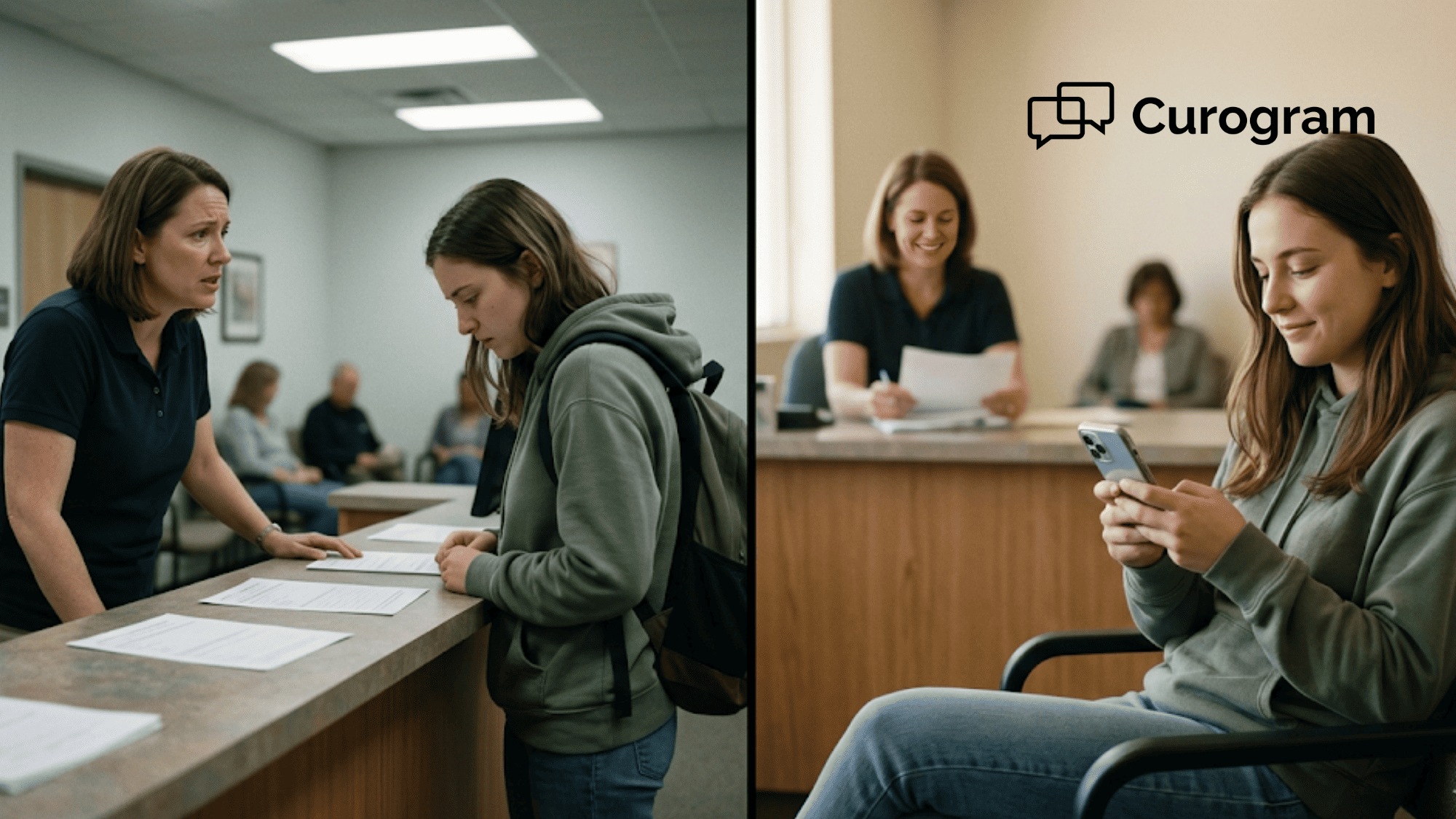
Picture this. A client walks into your agency for her weekly session. She's already anxious. Then your front desk coordinator, following protocol, asks for her past-due $15 co-pay. Out loud. In a lobby full of people.
She won't come back next week.
This scene plays out daily in behavioral health agencies across the country. It's what we call the "Waiting Room Shakedown," and it quietly destroys the trust your team works so hard to build.
The fix is simple: move the money talk off the front desk and onto the client's phone. When you collect sliding-scale fees discreetly in Welligent through a secure text-to-pay tool, you protect the client and the care.
Curogram makes this possible. It sends a safe SMS payment link to the client's phone. No app to download. No portal to log into. Just a quick tap to pay, done from the couch, the car, or the waiting room itself.
This article is for agency directors and front desk staff who want a better way to handle billing in human services.
We'll walk through why lobby-based collections hurt your mission, how behavioral health mobile payments protect the client, and what it takes to stay within 42 CFR Part 2 rules while doing it.
You'll also see how this approach frees your front desk team from the role of debt collector, and how it syncs with Welligent so your ledger stays clean.
If your agency serves clients on a sliding scale, the way you ask for payment matters just as much as the care you provide. Let's look at a better path.
When a client feels embarrassed at the front desk, one of two things happens: They either pay under stress and leave feeling worse, or they skip their next visit to avoid the same moment.
That second outcome is the dangerous one. A missed session means a gap in care. For clients in crisis, that gap can lead to relapse, harm, or worse.
Consider a small agency that sees 40 clients per day. If even 5% of those clients skip a visit because of a bad front desk experience, that's 2 missed sessions daily. Over a month, that adds up to roughly 40 lost visits, along with lost revenue and lost care.
Based on our internal research, automated SMS tools can reduce no-show rates by up to 75% by removing these kinds of barriers. The link between front desk friction and missed visits is well-known in the field, and it's entirely avoidable.
Clients on a sliding-scale fee plan are often the most vulnerable. They may have low income, unstable housing, or limited support systems. They already carry the weight of stigma simply by seeking help.
Asking these clients for small balances in a public space adds another layer of stress. A $10 co-pay may seem minor to the agency, but to the client, the public act of being asked for it can feel like a punishment for being poor.
Here's how the experience compares:
|
Scenario |
Client Feeling |
Likely Outcome |
|
Asked for balance in a quiet, private room |
Respected, in control |
Pays willingly, returns for next visit |
|
Receives a private text link to pay on their phone |
Empowered, no stress |
Pays on their own time, attends next visit |
|
Asked for balance out loud in a crowded lobby |
Ashamed, anxious |
May avoid next visit entirely |
The pattern is clear. The more private the payment, the better the outcome for the client and the agency.
If your team uses Welligent and you still collect co-pays at the front desk, you're not doing anything wrong on purpose.
But you are creating a moment that works against your mission. Every awkward billing exchange is a small crack in the relationship your clinicians are trying to build.
In the next section, we'll show how moving that exchange to the client's phone changes the entire dynamic.
The fix to the "Waiting Room Shakedown" is not to stop collecting fees. Your agency needs that revenue. The fix is to change where and how the client pays.
Curogram does this by sending a secure SMS payment link straight to the client's phone. No app download. No portal login. Just a text with a link that says something like, "You have a balance for your upcoming visit. Tap to pay securely."
That's it. One tap, and they're done.
When you move billing to the client's phone, you remove the social pressure that comes with a face-to-face ask. The client can pay from their living room the night before a session.
They can pay from their car in the parking lot. They can even pay while sitting in the waiting room, with no one the wiser.
This shift turns a stressful demand into a calm, self-managed task. The client stays in control. And because the text uses plain, neutral language, no one can tell what the message is about, even if the phone screen is visible.
|
For example: Imagine a client named Maria. She owes $12 from her last visit. Instead of hearing about it at the front desk, Maria gets a text at 4 p.m. the day before her session. She taps the link, pays with Apple Pay in under 10 seconds, and shows up the next day with no stress. The front desk sees a "Paid" status and greets her with a smile. |
That's how billing should feel in behavioral health.
Many Welligent users already know about the Welligent Connect portal. It's a patient-facing platform, but it comes with friction. Clients need to create an account, remember a password, and log in.
For clients who are in crisis or who have limited tech skills, this is a wall. They may not have email access. They may not trust online portals. They may simply forget their login.
When you bypass the Welligent Connect portal with a native SMS link, you skip all of that. The client taps a link in a text message. No account. No password. No app. The payment page loads in their phone's browser, and they can pay with a credit card or Apple Pay.
This approach is what makes frictionless co-pay collection in human services actually work. It meets the client where they already are, on their phone, using a format they already trust: a text message.
There's a big gap between asking someone to pay and empowering them to pay. The first puts the agency in charge. The second puts the client in charge.
When a client gets a text-to-pay link, they decide when, where, and how they pay. There is no line.
No eye contact with a coordinator. No public exchange. This matters for all clients, but it matters most for those in behavioral health settings where shame and stigma are already barriers to care.
Based on our internal data, practices that simplify their billing process through SMS see faster payment times and higher collection rates. This makes sense: when it's easy and private, people are far more likely to pay.
|
Traditional Front Desk Collection |
Curogram Text-to-Pay |
|
Client asked in person, in public |
Client pays on their phone, in private |
|
Requires cash, check, or card swipe on-site |
Accepts Apple Pay, credit card via link |
|
Can cause shame or anxiety |
Preserves dignity |
|
Client may skip next visit |
Client returns with no stress |
|
Staff acts as debt collector |
Staff greets client warmly |
The right path is clear. Let's now look at how this stays fully compliant with 42 CFR Part 2 and HIPAA.

In behavioral health, privacy is not just a best practice. It's the law. And when it comes to substance abuse and mental health treatment, the rules go far beyond standard HIPAA.
42 CFR Part 2 is a federal rule that protects clients in substance use treatment programs. Under this rule, even the fact that a person receives services is highly protected.
You can't share it, confirm it, or hint at it, not to employers, not to family members, and not in a text message that shows a program name on someone's phone screen.
This is why many agencies hesitate to use digital billing tools. They worry that a text about a balance could reveal that a client is in treatment. And if that happens, the agency could face serious legal trouble.
Curogram was built with this problem in mind.
The key to 42 CFR Part 2 compliant text-to-pay is in the message itself. Curogram's payment texts are written in plain, general language. They do not name the agency. They do not reference the type of care. They do not include clinical details.
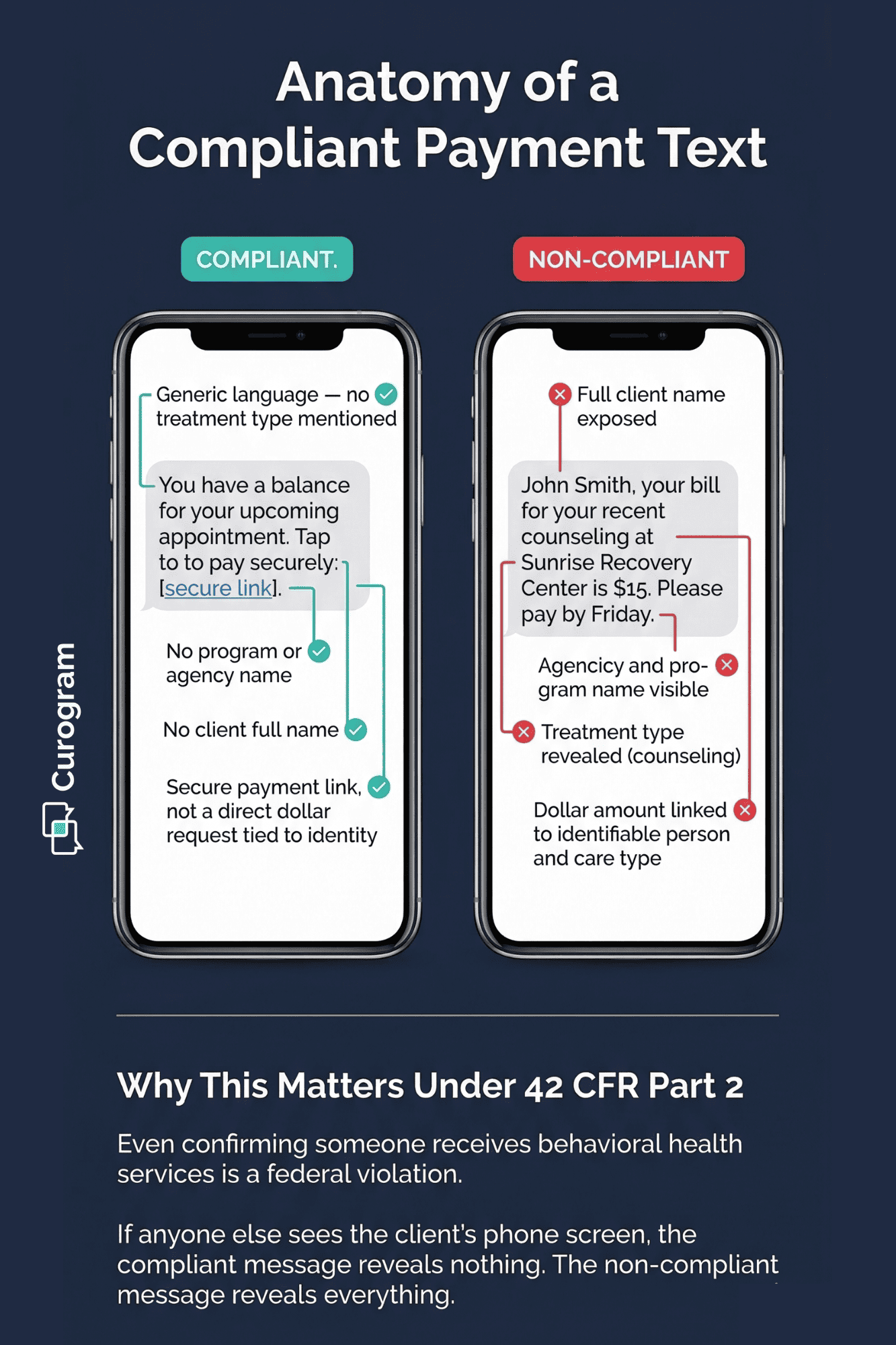
Here's what a compliant message looks like:
"You have a balance for your upcoming appointment. Tap to pay securely: [link]"
And here's what a non-compliant message would look like:
"John Smith, your bill for your recent counseling at Sunrise Recovery is $15. Please pay by Friday."
The second version links a real name with a treatment program and a dollar amount. If anyone else sees that text, the client's privacy is blown. Under 42 CFR Part 2, that's a violation.
Curogram avoids this by stripping out all identifying details. The text reads like it could be from any service provider: a dentist, an eye doctor, a gym. There is nothing in the message that ties the client to a behavioral health program.
Let's walk through a real-world scenario. A client named David is in an outpatient substance use program. He lives with his parents, who don't know about his treatment. He leaves his phone on the kitchen table.
If a text pops up that says, "You owe $10 to Sunrise Recovery Center,"
David's treatment status is now exposed to anyone who sees the screen. His privacy has been violated. His trust in the agency is gone. And under 42 CFR Part 2, the agency could face penalties.
Now imagine the same situation with Curogram.
The text says, "You have a balance for your upcoming appointment. Tap to pay securely."
David's father sees the screen. He assumes it's from a doctor's office or a utility company. Nothing about the message gives away what kind of care David is receiving.
That's the standard your agency needs to meet. And that's the standard Curogram delivers.
There are several layers of protection built into the system. Let's look at each one:
|
Layer |
What It Does |
Why It Matters |
|
Generic message text |
No program name, no treatment type |
Protects client identity if phone is seen by others |
|
Secure payment link |
Opens in a browser, no app needed |
Client doesn't need to download anything that could reveal the agency |
|
No stored clinical data in the SMS |
Balance amount only, no notes or diagnoses |
Even if the text is intercepted, no PHI is exposed |
|
Auto-sync to Welligent ledger |
Payment records go back to the EMR |
Staff never needs to manually update billing records |
|
HIPAA-grade encryption on the payment page |
Card details and payment info are protected |
Meets PCI and HIPAA requirements at the transaction level |
Each layer works together to preserve the therapeutic relationship through billing. Clients don't have to worry that paying a fee will expose their care status. And agencies don't have to worry about crossing a legal line.
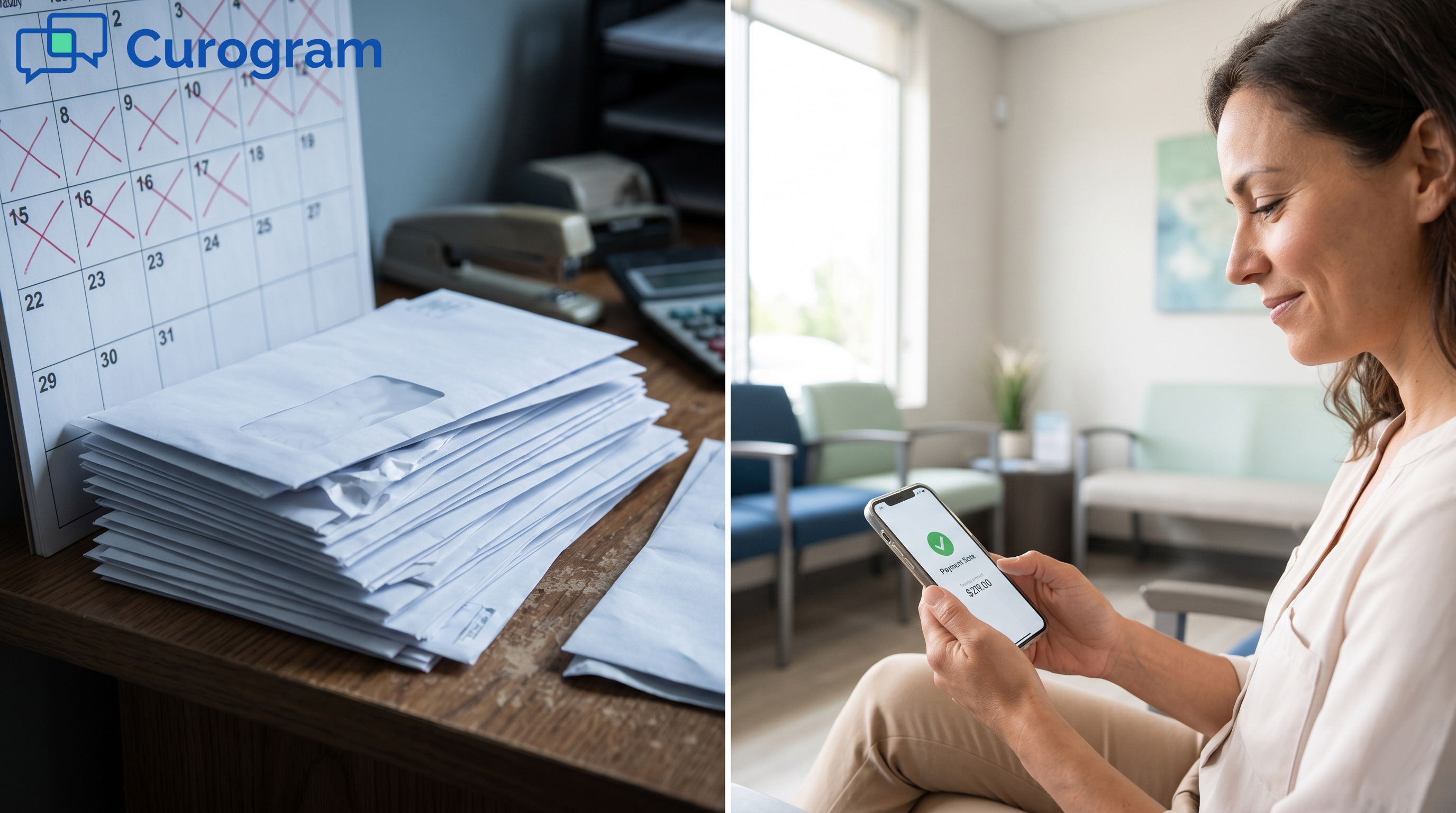
Once the client taps the link and completes the payment, the system syncs the data back to Welligent. This means the ledger is updated in real time. When the client checks in for their next session, the front desk sees a clean record.
There's no need to bring up the payment. No need to print a receipt. No need to ask, "Did you get that text we sent?"
The client walks in, checks in, and heads to their session. The front desk coordinator greets them the way they should, with warmth and focus on care, not on money.
This is what it looks like to preserve the therapeutic relationship through billing. It's not just about collecting the fee. It's about protecting the space where healing happens.

Even with the right tools, agencies can make errors. Here are three common mistakes to watch for:
Editing the default text template. Curogram provides a pre-written, compliant SMS template. If your staff edits it to include the program name, the type of care, or the clinician's name, the message is no longer compliant. Always use the default.
Sending follow-up texts with too much detail. If a client hasn't paid and your team sends a manual follow-up that says, "Your balance for group therapy is still due," that's a 42 CFR Part 2 violation. Keep all follow-ups as generic as the first message.
Discussing the text in the lobby. If a coordinator says, "I see you didn't respond to our text about your balance," in a shared space, that's the same problem as the original "Waiting Room Shakedown." The text is only part of the solution. The culture around billing needs to match.
Your agency already works hard to protect client privacy. You train staff, you use consent forms, and you follow the rules. But if your billing process hasn't caught up to those same standards, there's a gap.
Curogram closes that gap. It gives you a billing tool that is 42 CFR Part 2 compliant text-to-pay from the ground up, so you can collect what you're owed without putting your clients, or your agency, at risk.
Your front desk coordinators didn't sign up to be debt collectors. They entered the field to help people. But when the job includes asking vulnerable clients for money in a shared space, it creates stress for everyone involved.
This is a morale problem. And it's one that flies under the radar at most agencies.
When your team no longer has to ask for past-due balances at check-in, something shifts. Staff can focus on what they were hired to do: welcome clients, manage schedules, and support the care team. Based on our internal data, practices using automated SMS tools see staff productivity rise by over 30%.
That's not a small gain. For a front desk coordinator who handles 40+ check-ins per day, removing the billing ask from each one saves time, reduces awkward moments, and improves the tone of every interaction.
Because Curogram integrates with Welligent, the payment status updates on its own. When a client pays through the text link, the ledger reflects it right away.
So when the client walks in, the coordinator sees "Paid" on the screen. No question to ask. No balance to discuss. Just a warm hello and a smooth check-in.
This also cuts down on data entry errors. There's no need to manually log a payment or cross-reference a receipt. The system handles it.
How Curogram Helps Behavioral Health Agencies Protect Client Dignity While Getting Paid
Curogram is a HIPAA-compliant, two-way texting platform that plugs into your existing EMR. For agencies on Welligent, it fills a critical gap: the ability to collect sliding-scale fees through secure, private SMS links.
The setup takes about 10 minutes for staff. There's no learning curve. The platform works like standard texting, so your front desk team can start using it right away.
Curogram doesn't ask clients to download an app or log into a portal. The payment link goes out as a plain text message. Clients tap it, pay with a credit card or Apple Pay, and they're done.
Every message follows HIPAA and 42 CFR Part 2 rules. The default templates are built to protect client privacy. No program names. No clinical details. Just a clean, neutral prompt to pay.
And because the platform syncs with Welligent, your billing records stay current without extra work. The moment a client pays, the ledger updates. When they walk through your door, your team can greet them with a smile instead of a balance reminder.
Agencies that use Curogram aren't just fixing a billing problem. They're choosing to protect the space where trust is built. They're letting clients handle money in private. And they're giving front desk staff the freedom to do what they came here for: help people.
If your agency serves clients on a sliding scale and you want a way to collect without causing harm, Curogram is built for this exact challenge.
The way your agency collects fees sends a message, whether you mean it to or not. Ask for money in a public space, and you tell the client that revenue matters more than their comfort. Handle it in private, and you tell them they are safe here.
For agencies using Welligent, the shift is simple. Curogram's text-to-pay tool moves the billing exchange off the front desk and onto the client's phone. The client pays on their own time, in their own space, with no one watching.
This matters more in behavioral health than in any other field. Your clients are not just patients. They are people in vulnerable moments who trusted your agency with something deeply personal. That trust should never be tested by a $10 co-pay conversation in a crowded lobby.
By using a tool that meets 42 CFR Part 2 and HIPAA standards, you also protect your agency from legal risk. The messages are generic. The payments are secure. And the ledger syncs back to Welligent without manual work.
Your front desk team wins, too. They stop dreading the billing ask. They greet clients with warmth. They get back time and energy for the work that matters.
The path forward is clear. Keep your billing process as private as your care.
Ready to protect your clients and your mission? Request a demo to start taking the billing burden out of your lobby this week.
Portals require accounts, passwords, and logins that create barriers for clients in crisis or with limited tech access. A direct SMS link skips all of that, so clients pay with one tap and no extra steps.
The moment a client completes the payment through the text link, Curogram syncs the record to Welligent in real time. The front desk sees a "Paid" status at check-in with no manual data entry.
Your team can still handle it through their usual process, like a private conversation or a payment plan. Text-to-pay clears the majority of balances before the visit, so these cases become rare rather than the norm.
💡 Collecting co-pays for MD Systems practices works best when you collect before the visit, not after. Here's how a text-to-pay workflow helps: ...
💡 Text-to-Pay in StreamlineMD lets imaging and vascular practices collect payments faster through secure text messages. Patients get a direct...
💡 When you collect patient co-pays upfront in CollaborateMD using Curogram, you reduce bad debt and speed up cash flow before care begins. ...