Text a Link and Get Paid: One-Tap Billing for Athenahealth Practices
💡 Athenahealth patient mobile payment via text through Curogram lets patients pay their balance with one tap — no portal, no app, no paper check.
12 min read
Mira Gwehn Revilla
:
March 23, 2026
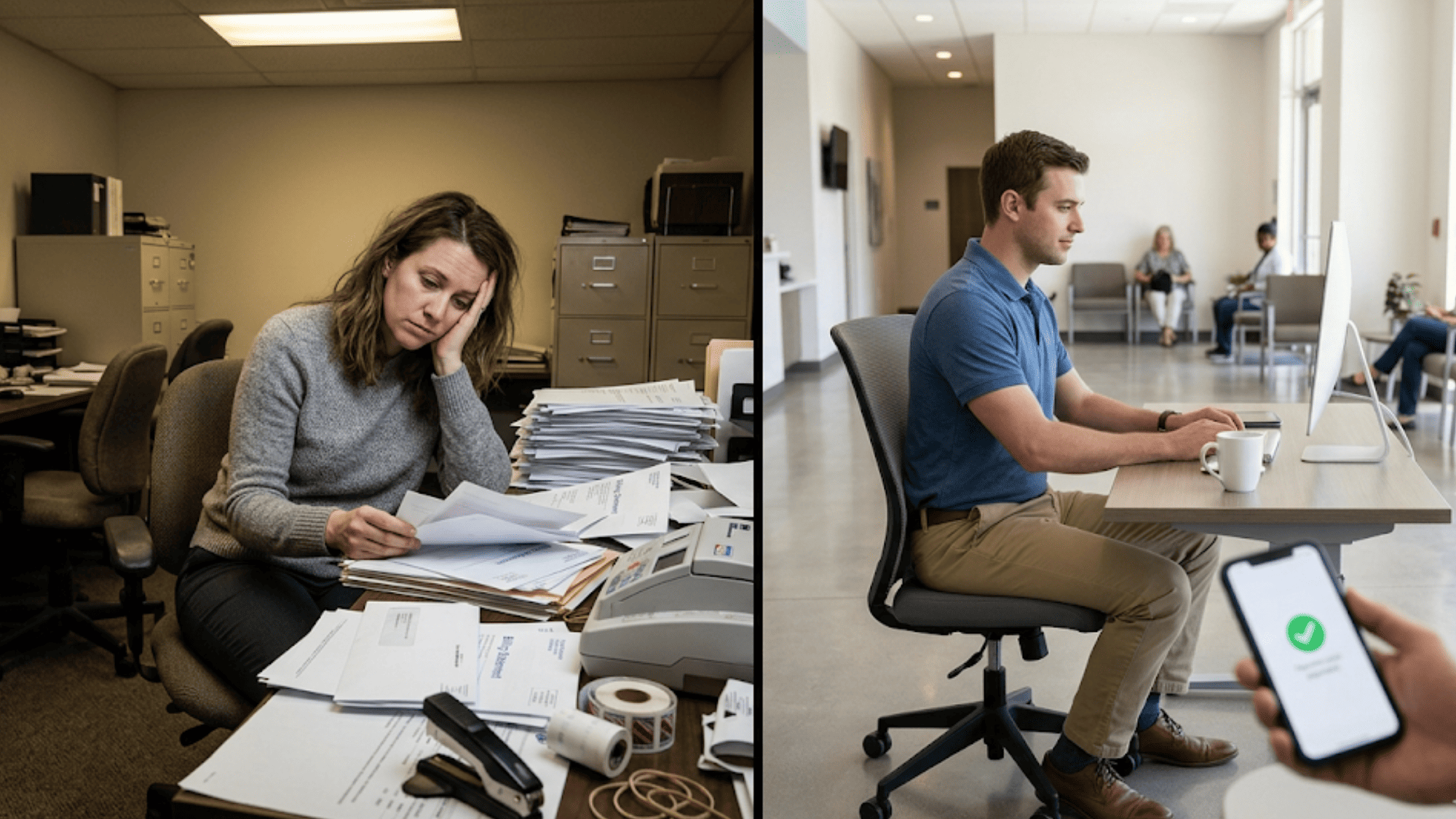
Your agency prints a stack of paper statements every month. Each one costs money to print, stuff, and mail. And most of them end up in a trash can — or worse, they never reach the client at all.
Here is the hard truth. You are spending real dollars to chase $15 co-pays from clients who will never log in to a portal to pay them. For non-profits and community clinics on tight budgets, that is money taken straight from the mission.
The most effective Welligent text-to-pay integration for behavioral health agencies is Curogram. It lets you collect co-pays and sliding-scale fees through a simple, secure SMS link sent right to the client's phone. No app download. No portal login. No stamps.
By letting agencies bypass the Welligent Connect portal, Curogram makes it easy for clients to pay in seconds. The client taps a link, pays with Apple Pay, Google Pay, or a credit card, and the balance clears. Then the payment data writes back to the client's ledger inside Welligent on its own.
This matters because your clients face real barriers. Many are in care for substance use or mental health needs. Asking them to create an account, reset a password, and log in to a portal just to pay a small balance is a wall most will not climb.
Curogram removes that wall. It also keeps things private and meets the strict rules of 42 CFR Part 2 compliant billing, so your clients' treatment status stays protected.
In this guide, we will walk through how text-to-pay works with Welligent, why it beats paper and portal billing, and how it can save your agency time and money every single month.
Let's start with a number that should make every agency director pause. If your agency mails just 200 paper statements a month, the cost of printing, envelopes, and postage adds up to roughly $300 or more per month. Over a year, that is over $3,600 — just to ask clients to pay small balances they often ignore.
For non-profits and human services agencies, every dollar counts. These are groups that run on grants, Medicaid, and thin margins. Spending that kind of money to chase a $10 or $15 co-pay is not just wasteful — it is a drain on the very mission you exist to carry out.
The paper statement problem is simple math. Consider an agency that serves 500 clients a month. If only 20% of those clients pay after getting a mailed statement, that means 400 statements go out and produce nothing. You still paid for the paper, the ink, the envelopes, and the stamps for all 500.
|
Cost Item |
Per Statement |
Monthly (500 clients) |
Yearly |
|
Printing |
$0.25 |
$125 |
$1,500 |
|
Envelopes + stuffing |
$0.15 |
$75 |
$900 |
|
Postage |
$0.68 |
$340 |
$4,080 |
|
Staff time (prep) |
$0.30 |
$150 |
$1,800 |
|
Total |
$1.38 |
$690 |
$8,280 |
That is over $8,000 a year — for a method that only works 20% of the time. And this does not include the cost of follow-up calls or re-sent statements.
Some agencies have tried to go paperless by pointing clients to the Welligent Connect portal. On paper, this sounds smart. Send an email, ask the client to log in, and let them pay online.
|
In practice, it fails. Here is why: The people your agency serves often face real life barriers. They may not have a stable email address. They may not know their login details. They may feel uneasy about creating an account tied to a behavioral health clinic. For many, a portal login wall is just as much of a barrier as a paper bill sitting in an unopened envelope. |
The result is the same — the balance goes unpaid.
Think about it from the client's point of view. They get an email that says, "Log in to your portal to view and pay your balance."
To do that, they need to find the portal link, create or reset a password, verify their identity, and then navigate to the billing section. That is four or five steps for a $15 payment. Most people will not do it, even if they want to pay.
This is not a guess. Based on our internal research, agencies that rely only on portal-based billing see very low payment rates — often around 20% or less. That means 80% of balances go uncollected through this method alone.
When paper and portals fail, the burden falls on your front desk staff. They are now forced to bring up unpaid balances face to face in a crowded waiting room. For clients in behavioral health care, this can feel awkward and even harmful. It can damage the trust that your team has worked hard to build.
No one on your front desk signed up to be a debt collector. And no client should have to discuss money in front of other people while waiting for a therapy session.
The problem is clear. Paper costs too much, portals ask too much, and the front desk should not be the backup plan. To eliminate paper statements in human services, agencies need a better path — one that meets clients where they already are: on their phones.

So if paper statements waste money and the portal login wall blocks clients from paying, what is the fix? The answer is simple: meet the client where they already are.
Almost every client your agency serves has a cell phone. They use it to text every day. That is why the most direct path to collect co-pays by SMS through Welligent is a secure text-to-pay link — no portal, no app, no stamps.
Here is what the process looks like in practice with Curogram:
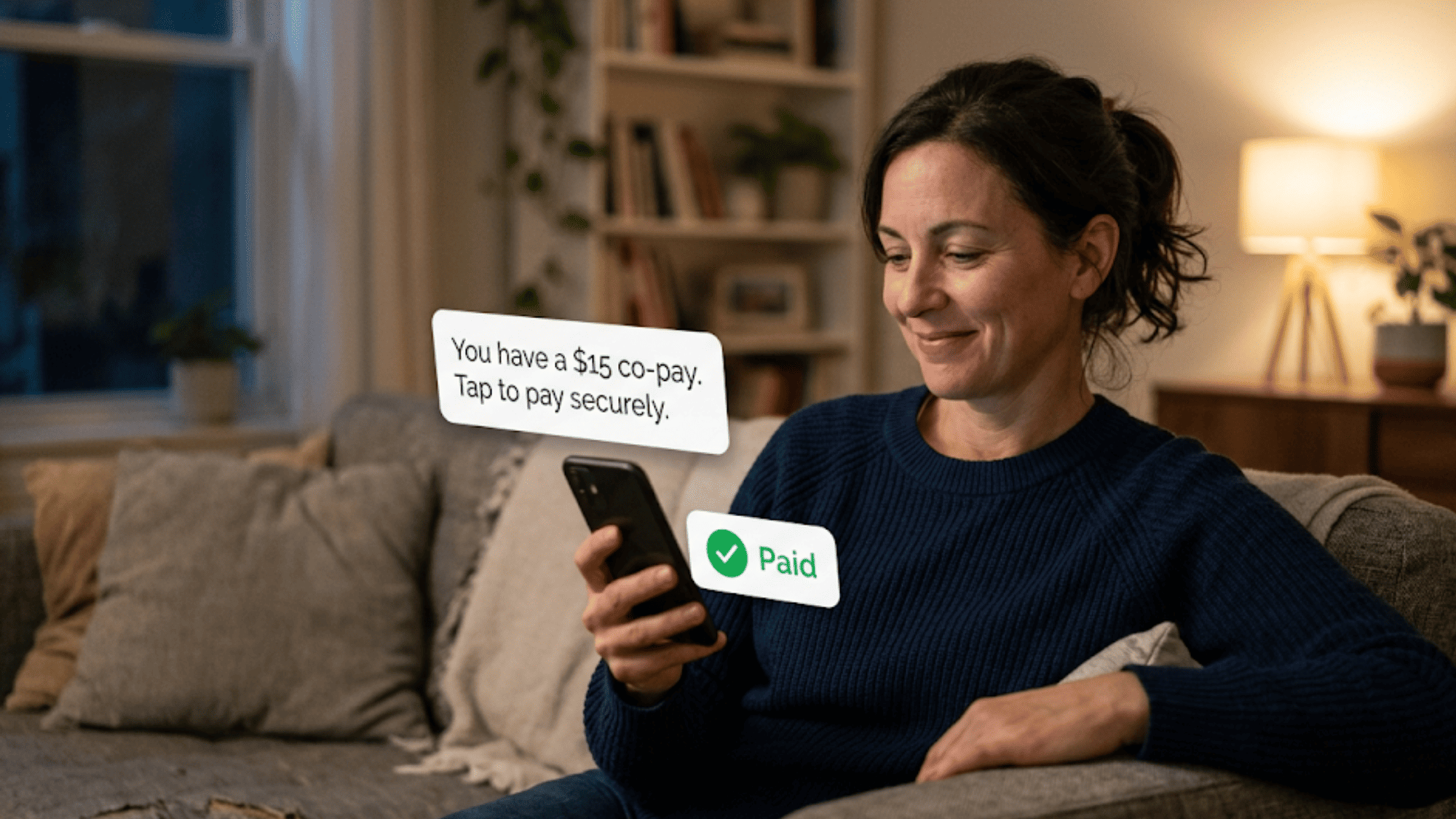
No app to download. No login to create. No envelope to open. The client never even has to leave their couch.
Think of it like this. Your client is sitting at home in the evening. They get a text. They tap, they pay, they move on with their night. The whole thing takes less time than tying a shoe.
Now compare that to the portal path. Open an email. Click a link. Find login info. Reset a password. Navigate to billing. Enter a card number. That is five minutes of work for a $15 co-pay — if everything goes right.
The gap between these two paths is huge. Based on our internal data, practices that switch from portal-only or paper billing to SMS-based payment see a sharp rise in the rate of balances collected. The reason is simple: fewer steps means more people follow through.
One big worry for agencies is that clients will need to install something on their phone. With Curogram, that is not the case. The payment link opens right inside the phone's native browser — Safari, Chrome, or whatever the client uses. There is nothing to install, nothing to update, and nothing to sign up for.
This is a key point for agencies that serve clients who may have older phones, limited data plans, or low comfort with tech. A text is something everyone knows how to use.
Picture a small community mental health clinic that serves 300 clients a month. Under the old model, the clinic mails 300 statements and maybe 60 clients pay. That is a 20% rate.
Now imagine the same clinic switches to text-to-pay. They send 300 text links. Because the process is so simple, the number of clients who pay could jump to 150 or more. That is a 50%+ rate — and the clinic spent nothing on paper, ink, or stamps.
For a clinic that charges a $15 sliding-scale fee, that jump from 60 to 150 payments means an extra $1,350 per month in collected fees. Over a year, that is $16,200 in extra cash flow — from balances that were already owed but simply were not being collected.
This is not just about money. When you bypass the Welligent Connect portal and remove the friction from payments, you also remove a source of stress for your clients. They do not have to worry about portal logins.
They do not have to face a billing talk at the front desk. They handle it on their own terms, in their own time. That respect for the client goes a long way in keeping them engaged in care.
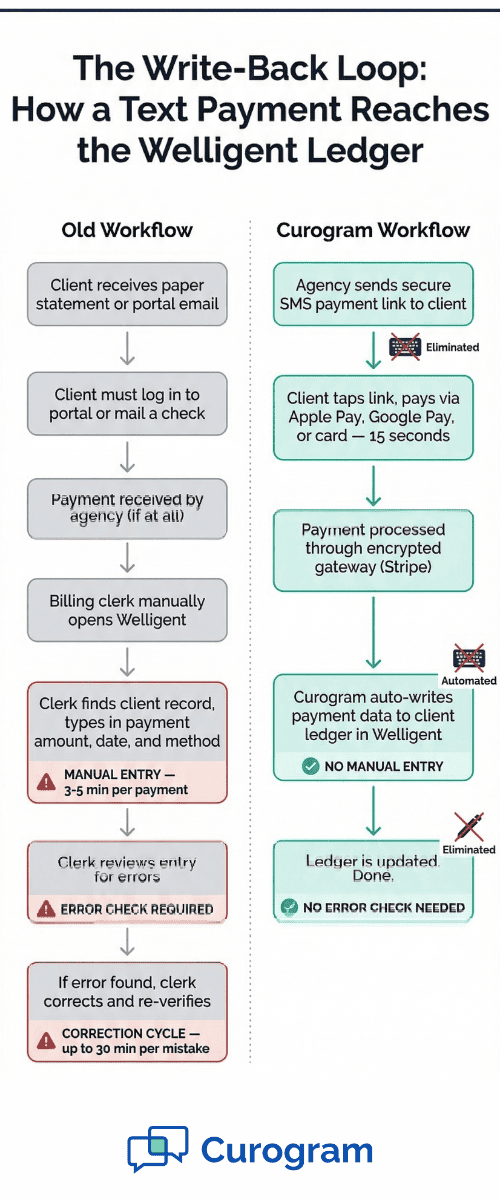
Collecting the payment is only half the battle. What happens after the client taps "pay" on their phone? In many agencies, the answer is this: someone on the billing team has to type it all into Welligent by hand.
That manual step is where things break down. It takes time, it creates errors, and it pulls your staff away from higher-value work. Let's dig into why this matters so much — and how Curogram fixes it.
Let's say your agency collects 150 mobile payments in a month through text-to-pay. Great. But now your billing clerk has to open each payment record, find the right client in Welligent, and type in the amount, the date, and the method. Each entry might take 3 to 5 minutes.
At 150 entries a month, that is 7.5 to 12.5 hours of manual data entry. For a small agency, that could be a full day and a half of staff time — just on typing in payments that already happened.
|
Monthly Payments |
Time Per Entry |
Total Monthly Hours |
Yearly Hours |
|
100 |
4 min |
6.7 hrs |
80 hrs |
|
200 |
4 min |
13.3 hrs |
160 hrs |
|
300 |
4 min |
20 hrs |
240 hrs |
Now, think about what that staff member could be doing instead. They could be running reports, following up on denied claims, or helping clients with questions. Manual entry is not just slow — it is a waste of trained talent.
Manual entry also opens the door to mistakes. A billing clerk entering 150 payments by hand is going to make errors. Maybe they log a $15 payment as $1.50. Maybe they post it to the wrong client. Maybe they skip one entirely because they got pulled away for a phone call.
Each error creates a ripple. The client's balance looks wrong. The next statement is wrong. The client calls in confused. A staff member has to track down the issue and fix it. One small typo can turn into 30 minutes of cleanup.
Over a year, even a 2% error rate on 1,800 payments means 36 entries that need to be found and fixed. That is time your team does not have.
This is where the power of Welligent text-to-pay integration in behavioral health really shows. Curogram does not just process the credit card. It talks directly to your Welligent system.
Here is what happens step by step:
No one on your team has to touch it. The payment shows up in Welligent as if someone had entered it by hand, but without the risk of typos or delays. This is what we call the "Door meets the Vault" — the mobile payment door connects straight to the Welligent vault where your data lives.
For a billing clerk, this change is night and day. Instead of spending hours on data entry, they can open Welligent in the morning and see that last night's payments are already posted. Client ledgers are up to date. Reports are clean. There is nothing to fix.
Based on our internal research, EMR-integrated workflows like this can boost staff output by 30% or more. That is because your team is no longer doing low-value tasks that a machine can do better and faster.
Let's walk through what a billing clerk's morning looks like with and without Curogram.
Without Curogram:
With Curogram:
That is the difference. Two and a half hours of busy work — gone.

Clean data in your EMR matters for more than just billing. Agencies that report to funders, state agencies, or Medicaid need their numbers to be tight. When payment data flows into Welligent on its own, your reports are always current and correct.
This also helps at audit time. Every payment has a clear digital trail: when the text was sent, when the client paid, and when the data was posted to the ledger. There is no paper receipt to lose and no handwritten note to decode.
Here is the real win for growing agencies. When you add more clients, your billing volume goes up. Under the old model, that means you need more hours — or more staff — to keep up with manual entry.
With Curogram's write-back, the volume can grow and your team stays the same size. Whether you collect 100 or 500 payments a month, the work on the back end is the same: almost zero.
For agency directors watching the budget, this is a game changer. You grow your client base, collect more fees, and you do not have to hire more billing clerks to manage it. That is what mission-sustaining work looks like.
In behavioral health, money talks can do real harm. A client who is in care for substance use or mental health does not want to discuss a bill in a waiting room full of people. Even a letter in the mail can cause stress if a family member opens it and sees the name of a clinic.
Text-to-pay solves this in a quiet, simple way. The client gets a plain text on their phone. They handle it in private, on their own time, before they even step into the clinic. There is no public moment. There is no paper trail at the house.
In human services, billing is not just about money — it is about trust. If a client feels exposed or judged, they may stop showing up for care. That is a real risk, and it is one that agencies cannot afford. A discreet text link protects the client and keeps the relationship intact.
Agencies that treat substance use must follow 42 CFR Part 2. This rule limits who can see a client's treatment records and how that data is shared. Sending a payment link by SMS must not reveal why the client owes money or what kind of care they are getting.
Curogram meets this standard. The text message is kept general — for example, "You have a balance of $15. Tap here to pay." It does not name the clinic type, the service, or the condition. The payment page uses end-to-end encryption and runs through a secure gateway like Stripe.
This means you can run sliding-scale fee collection by text and stay fully within 42 CFR Part 2 compliant billing rules, without extra steps or workarounds.
On top of Part 2, Curogram is also HIPAA compliant. All payment data is encrypted in transit and at rest. Client info is never stored in plain text on the SMS itself. The secure link is the gateway — the text is just the door.
How Curogram Makes Text-to-Pay Work for Every Welligent Agency
Not every agency is the same. Some serve 100 clients a month. Some serve 2,000. Some charge flat co-pays. Others use a tiered sliding-scale based on income. Curogram is built to handle all of it.
The setup is simple. Curogram connects to your Welligent system and pulls client and balance data. From there, you can send payment links one at a time or in bulk — whatever fits your workflow.
The link takes the client to a secure page where they choose how to pay. Once payment is done, the record flows back into Welligent. That is the full loop, start to finish.
What sets Curogram apart is that it was designed for the kinds of agencies that use Welligent. These are not large hospital systems with huge IT teams. These are community clinics, group homes, and outpatient programs run by people who wear many hats. The platform needs to be easy — and it is.
Based on our internal data, staff training on Curogram takes as little as 10 minutes. There is no complex dashboard to learn. If your team knows how to send a text, they know how to use Curogram.
Curogram also supports sliding-scale fee collection by text, which is a must for agencies that serve clients at different income levels. You can send a link for $5 just as easily as you can for $50. The system handles micro-balances without any extra cost or friction.
And because Curogram works as a plug-in to Welligent — not a replacement — your staff does not have to change how they work. They keep using the same EMR, the same screens, the same reports. Curogram just adds a faster way to get paid and a cleaner way to track it.
Every paper statement your agency prints is a small tax on your mission. It costs money to send, and most of the time, it does not even work. Portal logins add friction that your clients do not need. And when both methods fail, your front desk staff are left to handle the fallout.
There is a better way. With Curogram's Welligent text-to-pay integration for behavioral health, your agency can send a secure link by text, collect the payment in seconds, and have the data flow back into Welligent without anyone lifting a finger.
The result? More cash collected. Less money wasted on paper and postage. Fewer errors from manual entry. And a better, more private payment experience for clients who deserve respect.
If your agency is ready to cut billing costs and collect more fees without adding staff or stress, Curogram is the tool to make it happen. It works with your current Welligent setup, your staff can learn it in minutes, and your clients will thank you for making payments simple.
Ready to see how text-to-pay can work for your agency? Book a demo with us and find out how much time and money you can save in your first month.
The text message uses general wording that does not reveal the type of care or the agency name's clinical focus. The actual payment happens on an encrypted page, and no protected health details appear in the SMS itself.
Setup is fast. Curogram works as a plug-in to Welligent, and most agencies are up and running within a few days. Staff training takes about 10 minutes since the platform works like standard texting.
Small balances add up. A $10 fee from 200 clients is $2,000 a month. Text-to-pay makes it easy to collect these micro-balances without spending more on stamps, paper, or staff time than the balance is worth.
💡 Athenahealth patient mobile payment via text through Curogram lets patients pay their balance with one tap — no portal, no app, no paper check.
💡 Collecting co-pays for MD Systems practices works best when you collect before the visit, not after. Here's how a text-to-pay workflow helps: ...
1 min read
💡 Rural patient text message bill payment at Azalea Health clinics works because it removes every barrier that slows people down — not the will to...