
How to Enhance the Patient Experience for Osmind Practices | Curogram
💡 Clinics using Osmind can boost patient satisfaction with frictionless medical billing for Osmind through mobile-first payment links.Curogram's...
9 min read
Jo Galvez
:
March 4, 2026
A loyal patient walks in for her twelfth visit this quarter. She smiles at the front desk. Then comes the line nobody likes: “Can I get that $30 today?”
The smile fades. She digs through her purse. The person behind her shifts their weight.
Your front desk team feels it too, that small, nagging guilt of acting like a toll booth instead of a welcome mat.
If you run a clinic on WebPT, you know this scene well. Physical therapy patients come back two, three, even four times a week. Each visit means one more round of “credit or debit?”
It slows the line. It drains your staff. And, more importantly, it chips away at the warm bond your team works hard to build.
The worst part? WebPT tracks the charge just fine. It records balances and logs what’s owed. But it doesn’t reach out and ask for the money on its own. That job still falls on your team, visit after visit.
There is a better path. What if the payment was handled before the patient walked through the door?
What if the money talk vanished, and the front desk could simply say, “Hi John, go right on back”?
That shift is real, and it’s already in play at clinics that connect Curogram to their WebPT system In this guide, we’ll walk through how to collect patient payments at the front desk for WebPT practices without the stress, the delays, or the cringe.
You’ll see how a simple text link sent the day before can change everything about your check-in flow.
Every clinic has a version of the same story. A patient shows up, the front desk pulls up their chart, and the mood shifts the moment money enters the picture.
Let’s break down why this small moment causes such big problems in day-to-day practice life.
Think about a patient who comes in for her tenth PT session. She owes a $30 co-pay. Your team member has to look her in the eye and say, “Can I get that $30 today?”
It’s not rude. It’s not wrong. But it still feels off.
Front desk staff didn’t sign up to be debt collectors. They signed up to greet patients, manage schedules, and keep the clinic running.
Asking for money over and over wears on morale. Based on our internal research, practices that reduce front desk administrative burden around payments report happier, more engaged teams.
Patients feel it too. Nobody wants to fumble for a credit card in front of a lobby full of strangers.
It turns a care visit into a retail moment. For those who come in three times a week, the ask starts to feel like a shakedown.
When you have to process a card swipe, print a receipt, and get a sign-off at check-in, every patient adds minutes. Stack that up across a full morning slate, and you’ve built a lobby logjam.
A clinic seeing 40 patients a day might spend two to three minutes per person on WebPT point of service collections. That’s up to two hours of staff time each day just on card swipes and receipts. Time that could go toward phone calls, form reviews, or simply being present for the person in front of them.
WebPT is a strong clinical tool. It tracks what patients owe and logs each charge with care. But it doesn’t send out a payment request on its own.
The system records the debt, but the human still has to collect it face-to-face. That’s where the gap lives, between knowing what’s owed and getting it paid before the patient arrives.
The real price of the awkward ask isn’t just time. It’s trust. When the front desk turns into a toll booth, the clinic’s warmth fades. Patients start to feel like a line item instead of a person.
That shift matters more than most people think. Patient loyalty in rehab care depends on comfort and rapport.
If every visit starts with a billing exchange, the care bond weakens. When the bond breaks, patients cancel, ghost, or leave reviews that sting.
Here’s how the friction adds up over a single week:
|
Friction Point |
Time Per Patient |
Daily Cost (40 Patients) |
Weekly Cost (5 Days) |
|
Card swipe and receipt |
1–2 min |
40–80 min |
3.3–6.6 hrs |
|
Awkward ask conversation |
30–60 sec |
20–40 min |
1.6–3.3 hrs |
|
Patient fumbling for wallet |
30–60 sec |
20–40 min |
1.6–3.3 hrs |
|
Total front desk drag |
2–4 min |
80–160 min |
6.6–13.3 hrs |
Those hours add up fast. And they’re all spent on a task that could happen before the patient ever walks through the door.
What if you could move the money talk to the day before? That’s the core idea behind pre-arrival collection — a simple shift that changes the entire check-in experience. Here’s how it works when you connect Curogram to your WebPT system.
The process is built around one thing: timing. Instead of asking for money at the counter, the system reaches out through a text message well before the visit.
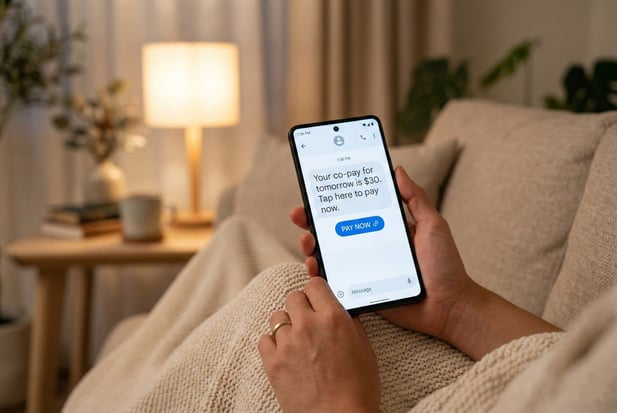
Twenty-four hours before the visit, Curogram pulls the data from your WebPT schedule. It checks the co-pay or past-due balance tied to that patient. Then it fires off a secure SMS link with a short, clear message.
The text might read: “Your co-pay for tomorrow is $30. Tap here to settle it now.” No login. No portal. Just a tap on their phone.
When the patient arrives the next morning, the dashboard shows “PAID.” No card needed. No receipt. No pause in the check-in flow. Your staff can simply wave them through to their session.
This is what it looks like to automate co-pay collection in physical therapy settings. The money is handled in the background, where it belongs.
Collecting at the desk isn’t just slower — it’s less effective. Patients are rushed, distracted, and focused on their visit. A text the night before catches them at home, on the couch, card in hand.
When the request arrives via text, the patient has time to act without pressure. There’s no line behind them. No clock ticking.
Based on our internal data, practices using SMS payment links see a clear lift in on-time collections compared to desk-only methods.
If a patient skips the desk payment, your team ends up sending statements, making calls, or writing it off. Pre-arrival texts cut that cycle short. The bill is in their hands before they even leave the house.
For front office leads and practice managers, the change feels huge from day one. Let’s zoom in on a typical morning under this model.
Your 8 a.m. patient already paid last night via text. Your 8:30 paid this morning while on the bus. Your 9:00 hasn’t paid yet, so the system flags it, and your team can collect at the desk as a backup. The rest of the morning runs smoothly.
Even if only 30% of your patients pay through the text link, that’s 30% less friction for your staff. It’s 30% fewer swipes, fewer receipts, and fewer awkward pauses.
Multiply that across weeks and months, and the savings in time and morale are hard to ignore.
Pre-Arrival vs. At-the-Desk Collection:
|
Factor |
At-the-Desk |
Pre-Arrival (Text-to-Pay) |
|
Time per patient |
2–4 minutes |
0 minutes at check-in |
|
Patient stress level |
Moderate to high |
Low (done at home) |
|
Staff involvement |
Every single visit |
Only flagged cases |
|
Card-on-file option |
Manual entry each time |
One-tap future payments |
|
Impact on check-in line |
Slows it down |
Clears it up |
The shift is simple, but the impact runs deep. You don’t need to rebuild your whole system. You just need to move the ask to a better time and place.

There’s a reason hotel check-ins feel so smooth. You don’t hand over cash at the front desk. The card is on file, the charge runs in the background, and the clerk just hands you a key.
Your clinic can deliver that same feeling, and it starts with rethinking how you handle patient payments.
Your patients don’t live in a world of card terminals and paper receipts anymore. They book rides with Uber, check into hotels with an app, and split dinner bills with a tap. They expect the same ease from their clinic.
When people pay for things without thinking about it, the whole experience improves. There’s no fumble, no pause, and no tension. The transaction fades into the background, and the relationship stays front and center.
That’s the bar your patients set when they walk into your clinic. If the first thing they face is a card reader, you’ve already fallen behind what they expect from every other part of their day.
Physical therapy is built on repeat visits. A patient might come in 20, 30, or even 40 times over a course of care.
Each visit that starts with a billing exchange chips away at trust. Contactless payment at a rehab clinic fixes that. It keeps the focus on the care plan, not the credit card.
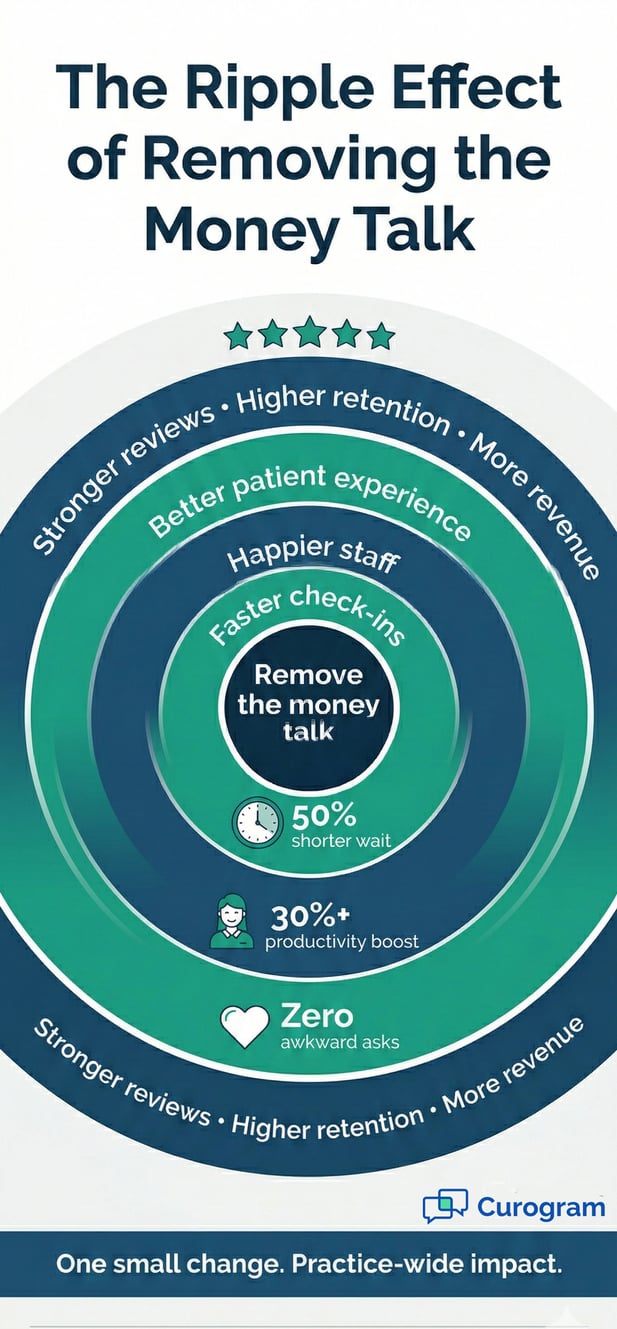
The shift to pre-arrival payment doesn’t just feel better. It shows up in the numbers. Here are the key wins clinics report when they flip the switch.
When the card swipe is gone, check-in becomes a 30-second hello. No terminal. No receipt printer. No awkward pause while the chip reads.
Based on our internal data, practices that boost staff output by 30%+ with tools like 2-way texting also see major gains when payment is handled before arrival.
Your team signed up to help people, not chase them for co-pays. When you take the money talk off their plate, you protect the warm, caring tone they bring to each visit.
That matters for retention. Happy staff stay longer, and staying longer means better patient care.
From the patient’s view, the change is almost invisible, and that’s the point. They get a quick text the day before. They tap a link, pay, and forget about it.
The next day, they walk in, hear “Go right on back,” and feel like a VIP. No line. No wallet. No stress. Just care.
That’s the kind of moment that improves the patient payment experience at a deep level. It’s not about the tech. It’s about how the tech makes people feel.
And in a world where online reviews shape new patient flow, those feelings matter. A smooth visit leads to a five-star review. An awkward billing exchange leads to silence — or worse.
The Check-In Experience — Before vs. After:
|
Moment |
Before (Manual) |
After (Pre-Arrival Pay) |
|
Patient arrives |
“Hi, can I get your co-pay?” |
“Hi John, go right on back!” |
|
Wait time |
2–4 min at the counter |
Under 30 seconds |
|
Staff role |
Cashier + greeter |
Greeter + care guide |
|
Patient mood |
Rushed, slightly annoyed |
Relaxed, ready for care |
We hear the same handful of questions from front office leads and practice managers when they first look into pre-arrival payments. Here are the answers to the ones that come up most.
Not every patient will tap the link. That’s okay. Your front desk can still collect the co-pay at check-in, the same way they always have. The old process doesn’t go away — it just becomes the backup.
If just 30% of your patients pay via text, that’s 30% fewer manual swipes and awkward pauses. Over a week, that adds up to hours of saved time and stress. The goal isn’t 100% adoption on day one. It’s steady progress.
You can send a gentle follow-up text an hour before the visit if the first one is ignored. The tone stays friendly, and the patient still has the choice. No pressure, just a reminder.
Yes. Once a patient pays through the text link, Curogram can tokenize their card. That means future visits can be settled with a single tap — no re-entering card details each time.
The card data is stored as a secure token, not a raw number. This meets PCI standards and keeps things safe. The patient gets speed. You get security. It’s a win-win.
For patients who visit two or three times a week, one-tap payments are a game changer. They pay once to set things up and breeze through every visit after that. It takes the repeat out of the repetition.
It does. As soon as the claim clears and the patient’s share shows up in WebPT, Curogram can text the bill. The patient gets a clear message with the amount owed and a link to pay right away.
Deductible balances often sit unpaid for weeks because the patient forgets or doesn’t get a statement in time. A quick text closes that loop while the visit is still fresh in their mind.
For bigger amounts, you can pair this with payment plan options or link to a secure portal. The key is meeting the patient where they are — on their phone, ready to act.
Pre-arrival text-to-pay doesn’t replace your current billing stack. It sits on top of it, filling in the gaps where human effort used to slow things down.

Money matters. It keeps your doors open and your staff paid. But it doesn’t have to be the first thing a patient deals with when they walk in.
Financial transactions are a must. No one disputes that. But they shouldn’t overshadow the patient interaction. The best clinics find ways to be paid and be personal at the same time.
When you use tools like Curogram to send a payment link ahead of time, you move commerce out of the lobby. The money still flows in.
The books still balance. But the patient never has to pause their care journey for a card swipe.
Once the money talk is gone, your staff can do what they do best — make people feel welcome. That’s the whole point of removing the awkward ask. You free your team to focus on the human side of healthcare.
Take the money talk out of the waiting room. It’s that simple. Every visit that starts with care instead of commerce builds loyalty that lasts.
Your patients deserve a check-in that feels like a welcome, not a cash register. And your staff deserves to feel proud of every greeting they give.
If you’re ready to see how much faster your check-in process can become, the move is easy.
Book a demo today and see how much faster your check-in process becomes.
💡 Clinics using Osmind can boost patient satisfaction with frictionless medical billing for Osmind through mobile-first payment links.Curogram's...
💡 Text-to-pay for Prime Clinical Systems lets medical practices send secure payment links to patients by SMS. Instead of mailing paper bills, your...
💡 Improving patient payment experience for Lytec practices starts with one change: remove the friction. Paper bills sit in piles because patients...