Text-Launched Video Visits for Tebra: No Login, No Barriers
💡 Tebra telemedicine works — but the portal login stops too many patients from joining video visits. Curogram fixes this with a one-tap text link.
8 min read
Aubreigh Lee Daculug
:
April 29, 2026
Your practice invested in FollowMyHealth. You got the integrated portal, the secure messaging, the digital forms, and yes, the telehealth video visits.
On paper, everything your patients need is one login away.
But that login is the problem.
Think about your last week of scheduling.
How many patients actually booked a virtual visit through the portal? How many asked for a phone call instead?
How many no-showed a telehealth slot because they couldn't figure out how to join?
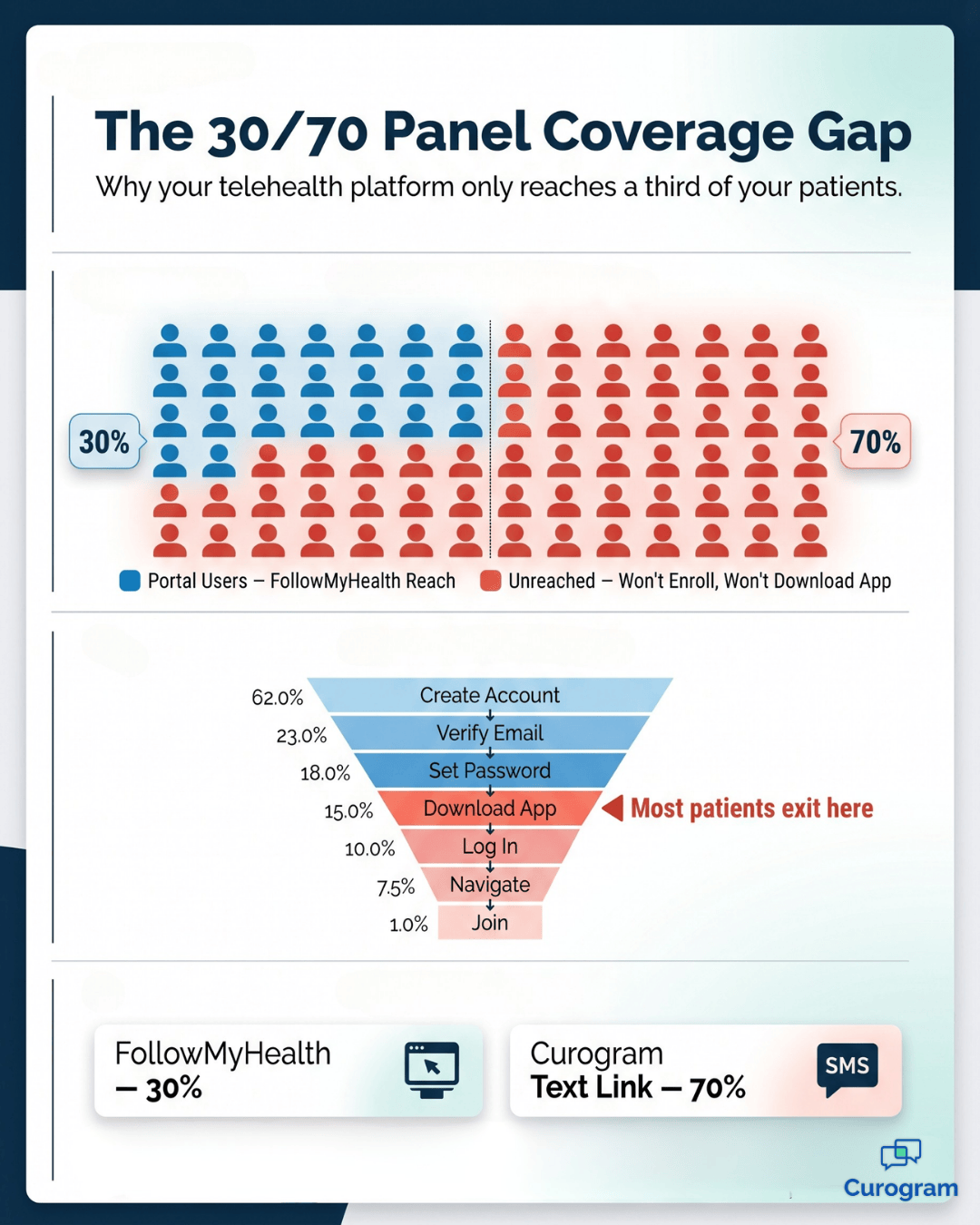
Here's the uncomfortable truth. FollowMyHealth is a strong platform for the 30% of your panel that's already engaged. The other 60% to 80% won't download an app, create a password, or troubleshoot an email verification.
They're not lazy. They're busy, older, or simply not interested in another account.
So your telemedicine tool sits idle for most of your patients. Your front desk picks up the slack. Phones ring. Slots go unfilled. Revenue walks out the door.
It sounds simple. It isn't.
The gap isn't your EHR. It isn't your clinical workflow. It's the delivery mechanism. A video visit that requires a portal account is a video visit most patients won't attend.
This guide walks you through how to expand Veradigm EHR telemedicine without asking patients to adopt anything new.
You'll see the real cost of portal dependency, why current fixes fall short, and how a Veradigm EHR telemedicine HIPAA video visit text link approach reaches every patient with a phone number, not just the ones already logging in.
The math, as you'll see, gets interesting fast.
FollowMyHealth offers a full telehealth stack. Integrated scheduling, HIPAA-compliant video, digital consent, and electronic visit summaries. The feature isn't the issue.
The path to the feature is.
To join a FollowMyHealth video visit, a patient has to clear a full sequence of steps before the visit starts:
Each step is friction. Each step is a reason to call your front desk instead.
Picture three patients your staff handled last week.
Mr. Johnson was scheduled for a virtual check-in. He got the FollowMyHealth invite on Friday but didn't recognize the sender.
On Monday, he called:
"I'm not setting up another app. Can we just do a phone call?"
Your team reschedules him. That's five to ten minutes of staff time, plus a lost telehealth slot.
Mrs. Chen tried to download the app on her iPhone 6. It needed iOS 13. She didn't update. She called.
Mr. Perez actually created the account. Two weeks later, he called to reset a forgotten password. Your team spent five more minutes walking him through the login.
Three patients. Three calls. Zero clinical value added.
This is what FollowMyHealth telehealth video visit limitations look like in practice.
Let's put numbers to the problem.
Say your practice has 5,000 active patients, and 35% use FollowMyHealth.
That leaves 3,250 patients outside your telehealth reach.
This means your telehealth investment is only working for about one in three patients. In practice, the other two-thirds are driving your phone volume and your no-show rate.
At $150 to $300 in lost revenue per no-show, and 500 preventable missed slots a year, that's $75,000 to $150,000 walking out the door annually—plus the hidden cost of fewer positive patient reviews and a weaker online reputation.
One office manager put it simply:
"We paid for a feature that only works for the patients who are already engaged."
That's the cost of portal dependency.
Most practices try to solve the adoption gap by pushing harder on the portal. More email reminders. More "sign up today" signs at the front desk. More staff training on how to walk patients through enrollment.
None of it moves the needle much. The patients who won't enroll aren't confused.
They've decided. A reminder doesn't change a decision.

Before we get to what works, it helps to name what doesn't.
Practices usually try one of three things when portal telehealth underperforms:
The third option is the worst of the three, and it's the one most practices settle into by default. That's not a strategy. That's resignation.
The real fix is to change the delivery, not the tool.
Here's where the workflow shifts. Instead of asking every patient to meet your telehealth platform halfway, you meet them where they already are: their text messages.
Curogram is the Allscripts Professional telehealth patient portal alternative designed for exactly this gap. It doesn't replace FollowMyHealth. It extends your reach to the patients FollowMyHealth can't touch.
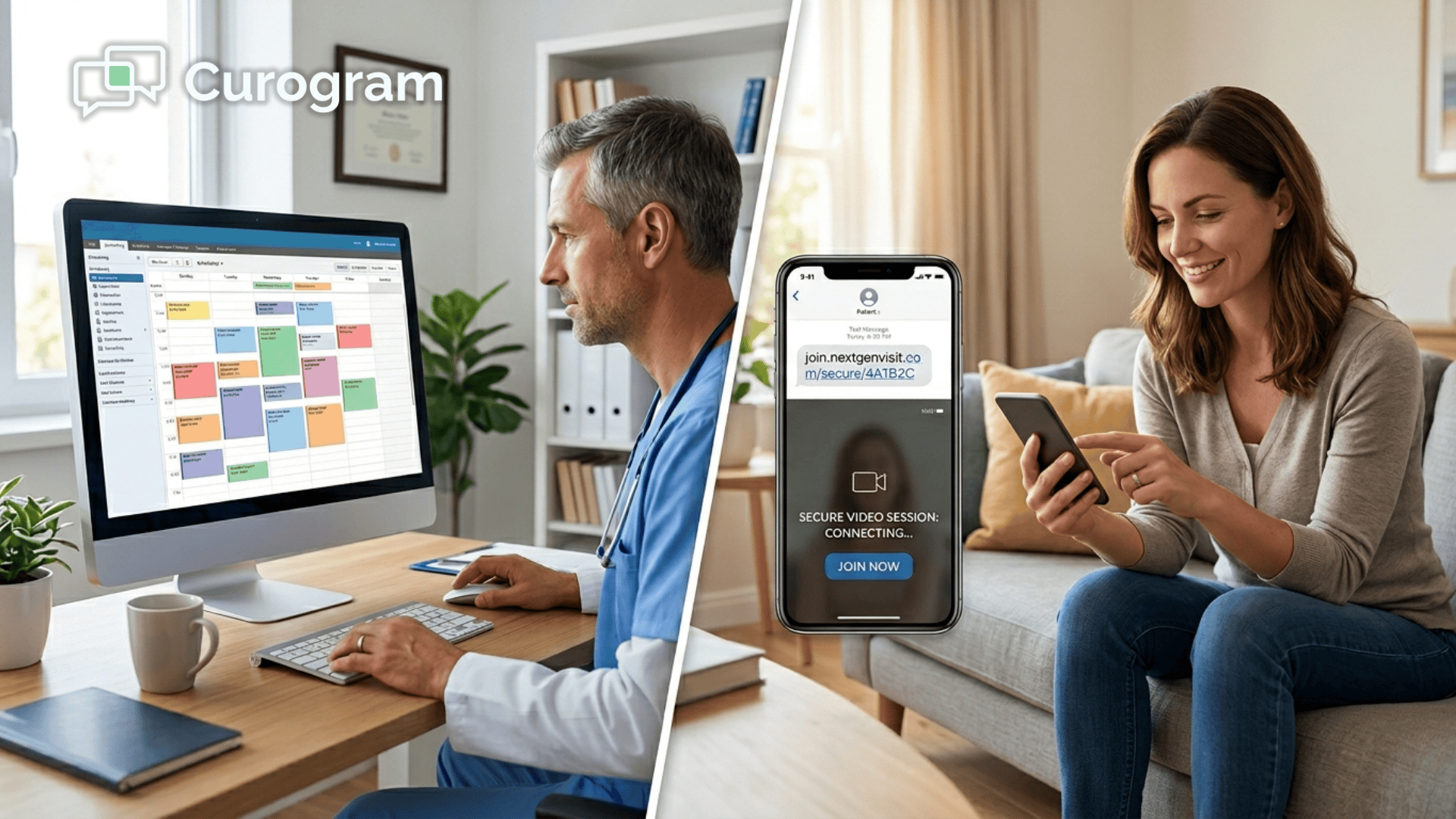
Your staff sends a HIPAA-compliant video link over SMS. The patient taps it. The visit opens in their browser. No app. No login. No password to forget.
One text. One tap. Visit starts.

The workflow is intentionally boring, and that's the point.
That's the full HIPAA compliant video visit Veradigm EHR workflow.
No enrollment step. No onboarding call. No "please download the app."
Patients open 98% of text messages, usually within three minutes—one of the reasons SMS appointment reminders (link) consistently outperform email and portal notifications.
Compare that to portal notification emails, which sit unread for days. When you're delivering a time-sensitive video visit link, the channel matters as much as the content.
For your panel of older patients, non-English-preferring patients, or patients on older phones, a text link doesn't ask anything of them. It just works.
That's Veradigm patient telehealth adoption text-first, and it's why practices see adoption numbers jump almost immediately.
The numbers shift fast when you take the barrier out. This is where the investment starts paying for itself.
Industry average no-show rates sit around 20% to 25%. Practices running text-first reminder and telehealth workflows typically see that drop to 10% to 12%. That's roughly a 53% improvement over industry average.
For a five-location practice running 200 telehealth visits a week, the math tells the story.
At a 22% portal-only no-show rate, you lose 44 visits a week, or about $457,600 a year at $200 per visit. Drop that rate to 11% with text-delivered telehealth, and you lose only 22 visits a week, or about $228,800 a year.
For your team, that's about a quarter-million dollars a year in recovered revenue, plus hundreds of hours of staff time no longer spent on rescheduling calls.
Most practices that add text-delivered telehealth see 35% to 50% growth in virtual visit volume within the first month.
By month three, certain visit types often fill faster than in-person slots, especially:
This isn't because your patients suddenly want more telehealth. It's because the patients who always wanted it can finally access it.
When patients can book and join virtual visits without calling, your front desk stops being the help desk. Curogram users consistently report inbound call volume dropping by about 50%.
That means your staff gets back to clinical coordination, insurance verification, and the work that actually requires a human.
Here's the real shift: telehealth stops being a feature for your engaged patients and becomes a workflow for your entire panel. FollowMyHealth keeps serving the 30% who love it. Curogram covers the other 70%. Nobody falls through the gap.
That's what it means to reach 100% of your panel with virtual care.
Your EHR is built for clinical documentation. FollowMyHealth is built for engaged patients. Curogram is built for the patients who prefer a text. Together, the three tools finally cover your whole panel.
You're not replacing anything. You're completing the picture.
If 30% of your patients love the portal, keep the portal. If the other 70% never will, stop asking them to. Send them a text. Let them tap a link. Let the visit start.
Here's what a demo actually shows you.
Your current FollowMyHealth telehealth reach, measured by portal adoption. Your potential reach with text-delivered video links. The difference, in visits per month and dollars per year, specific to your panel size and specialty mix.
Most practices we work with walk out of that conversation with two numbers they didn't have before. One is the revenue sitting in unreached patients. The other is the staff hours sitting in preventable phone calls. Both are larger than expected.
A Veradigm EHR telemedicine HIPAA video visit text link workflow doesn't require you to change your EHR, retrain your staff for weeks, or migrate anything. It slots in next to what you already have. Staff training typically takes about 10 minutes.
You get the reach. Your patients get the simplicity. Your finance team gets the recovered revenue.
Stop asking patients to adopt another app or portal account. Schedule a Demo with Curogram and see exactly how text-delivered telehealth links expand virtual visit adoption across your full patient panel.
Yes. Curogram's video sessions are HIPAA-compliant and encrypted end-to-end. The link expires after the appointment window, which prevents unauthorized access later. Patient identifiers aren't embedded in the URL itself, and each session is authenticated on the server side. From a compliance standpoint, a text-delivered telehealth link meets the same bar as portal-based telehealth. The only difference is how the link gets to the patient.
Curogram handles this with automated reminders and a simple resend workflow. If a patient doesn't click the link within an hour of the appointment, your staff gets a notification in the dashboard. From there, you can resend the link over SMS or email with one click, or call the patient directly. Most practices see click-through rates above 75% on the first send, and resends close most of the remaining gap.
No. This is an expansion strategy, not a replacement. Patients who are actively using FollowMyHealth will keep using it because they already prefer the full portal experience. Curogram targets the 60% to 80% who never will. Offering both options grows your overall virtual visit adoption without pulling engaged patients away from the portal. Think of FollowMyHealth as the channel for your engaged patients and Curogram as the channel for everyone else.
Most practices go live within two to four weeks. Curogram integrates with Veradigm EHR through the open API, so patient contact information, appointment times, and visit notes sync bi-directionally without a custom build. Staff training typically takes about 10 minutes because the workflow is simple: schedule the appointment, send the link, start the visit. There's no long onboarding period, no data migration, and no disruption to your existing FollowMyHealth setup.
It works for both. Practices use text-link video visits for medication management, behavioral health sessions, post-op check-ins, chronic care follow-ups, lactation consults, dermatology reviews, and patient education. Any visit type that doesn't require a hands-on exam is a fit. For multi-specialty groups, Curogram handles scheduling and video delivery across every department through the same workflow, so your pediatrics, geriatrics, and behavioral health teams all use the same one-tap process.
💡 Tebra telemedicine works — but the portal login stops too many patients from joining video visits. Curogram fixes this with a one-tap text link.
💡 Telehealth shouldn't add work to your nursing staff's plate. With Curogram, oncology patients join video visits by tapping one text link. Here's...
💡 Curogram's NextGen telemedicine workflow powered by Schedule-Triggered Video Launch lets clinicians initiate HIPAA-compliant video visits...