14 min read

Online Patient Forms in StreamlineMD: Faster Imaging Intake

Online Patient Forms in StreamlineMD: Faster Imaging Intake

💡 Online patient forms in StreamlineMD help radiology, vascular, and IR practices cut check-in time and boost exam readiness. Curogram's digital intake tools work with your EMR to end double entry. 
  • Patients fill forms on their phones before visits
  • Staff skip manual data entry into StreamlineMD
  • MRI metal screening and contrast forms stay complete
  • Wait times drop as lobby lines get shorten
  • Prep errors decrease for safer exams
Curogram's HIPAA-compliant forms sync with StreamlineMD workflows. This means faster check-in, better prep, and more exams done each day. Your team gains time back while patients feel more ready for their scans.

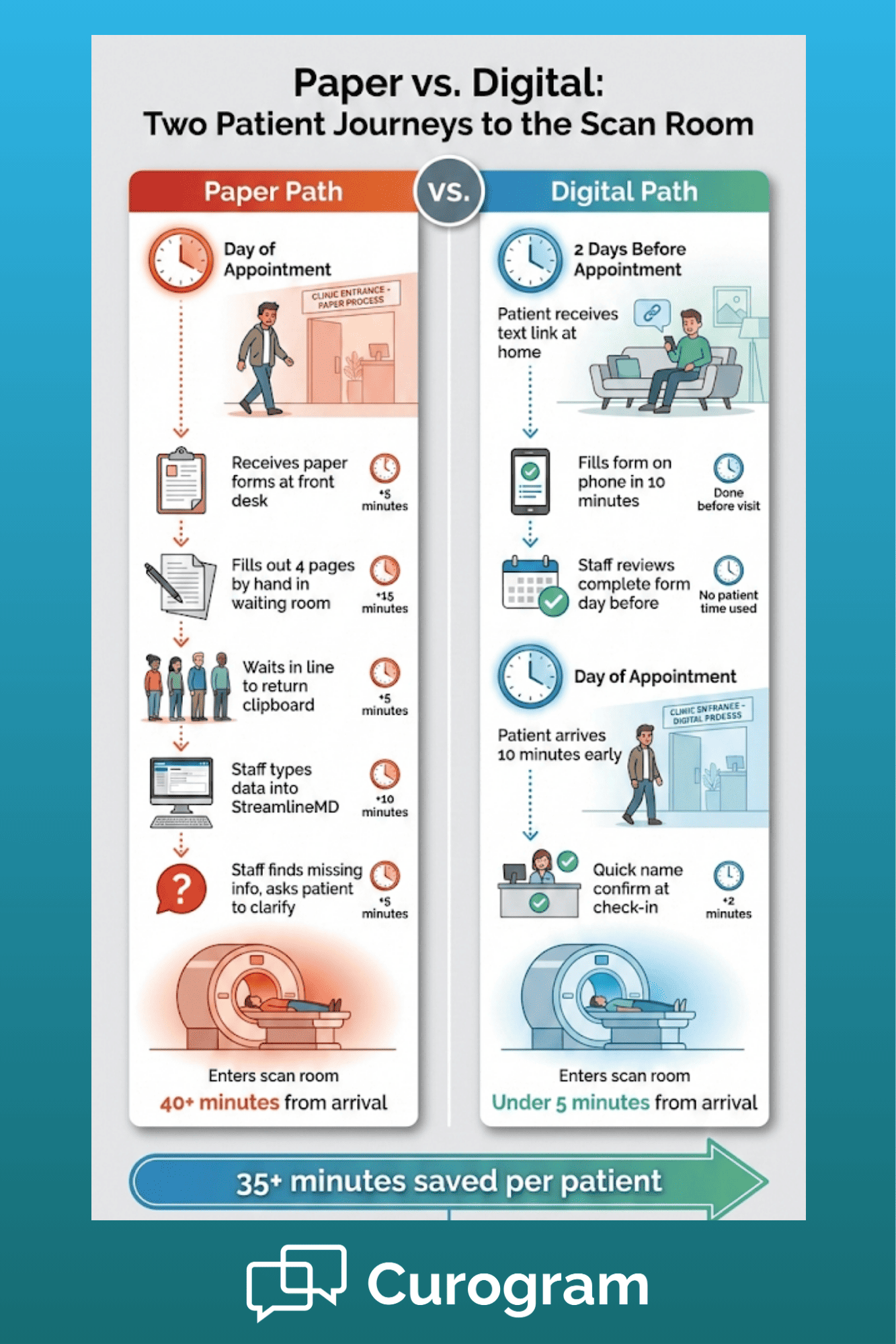
Picture this: A patient shows up for an MRI. They grab a clipboard. They fill out four pages by hand. The front desk types it all into StreamlineMD. Twenty minutes pass. The scan room sits empty.

This scene plays out daily in imaging centers across the country. It wastes time, burns out staff, and slows down your whole day.  Paper intake is broken. Patients arrive with gaps in their forms. Staff catch errors too late, and MRI prep fails when metal screening gets missed. Contrast studies stall when allergy info is wrong.

There is a better way.  Online patient forms in StreamlineMD change how your practice handles intake. Digital tools let patients complete their forms at home. The data flows into your system without any retyping. Your team sees complete info before the patient walks in.

Curogram makes this shift simple. The platform sends mobile-friendly forms that patients fill out on their phones. These forms match your exact workflow needs. MRI screening, CT contrast checks, vascular history forms are all done before arrival. The result is a faster check-in, fewer errors, and more exams per day.

StreamlineMD digital intake also protects your revenue. When patients prep right, they finish their exams. You bill for complete studies instead of failed ones.

This guide shows you how Curogram's online patient forms work with StreamlineMD. You will learn why imaging, vascular, and IR practices need digital tools. We cover the real costs of paper intake, and we show you the ROI of patient registration automation.

Ready to cut wait times and boost exam readiness? Let's dive in.

Why Imaging, Vascular, and IR Practices Need Digital Intake Tools

Imaging centers run on tight schedules, making every very minute counts. When intake slows down, the whole day falls apart.

Paper forms create a chain of problems that can hurt your bottom line. Let's look at why your practice needs to integrate with Curogram.

Paper Forms Slow Down Check-In and Increase Wait Times

Think about your busiest morning. Patients line up at the front desk. Each one needs a clipboard. Each one writes the same basic info they gave you last time. Names, dates, insurance cards—all captured again by hand.

A single patient might spend 15 to 20 minutes on paper forms. Multiply that by 30 patients a day. You lose hours of productive time before any scan begins.

Digital intake flips this process. Patients get a text link days before their visit. They fill out forms at home while watching TV. When they arrive, they check in fast.

Radiology Patients Often Arrive With Incomplete or Wrong Info

Paper forms get messy. Patients skip questions and  leave blanks. They write answers that staff cannot read.

For imaging, missing data is more than a hassle. It can cancel exams. Say, an MRI patient forgets to list their pacemaker. The tech finds out at the door of the scan room. Now, the whole schedule shifts. The patient leaves without their exam. Your practice loses that revenue.

Online patient forms catch these gaps early. Digital tools flag empty fields before submit. Patients cannot skip the metal screening section. Your team then reviews complete info the day before.

Vascular and IR Cases Require Detailed Medical History

Vascular surgery and IR cases carry real risk. These patients need careful review before any procedure. Contrast allergies, blood thinners, kidney function, diabetes—all of these affect safety. A paper form might miss a key detail, and the staff might not catch it until the patient is prepped.

Digital forms let you build custom questions for these high-risk visits. You can require answers about meds and past reactions. The system sends alerts when answers need review.

For example, a patient marks that they take Warfarin. The form flags this for your IR team. They call the patient to review prep steps days before the procedure. No surprises on the day of service.

Double Entry Into StreamlineMD Wastes Staff Time

Here is where paper really costs you money: Your front desk writes down patient answers. Then, they type those same answers into StreamlineMD. This double entry eats up hours each week. It also creates errors, such as:

  • A typo in the date of birth
  • A wrong digit in the phone number
  • A missed allergy that never makes it to the chart

Patient registration automation solves this. Data captured in digital forms can flow into your workflow. There's no need for retyping or copy errors. Staff can spend their time on tasks that matter.

When Curogram's engineers built their platform, they sat next to front desk staff for hours. They watched the real pain points. This research led to tools that match how imaging teams actually work.

Patients Expect Mobile-Friendly Digital Forms

Your patients live on their phones. They bank online, shop online, and expect healthcare to work the same way. A clipboard feels old, while a text link feels modern. When you offer mobile-friendly forms, patients notice. They feel like your practice respects their time.

Patient surveys show that people prefer digital intake. They want to fill forms from their couch, not your lobby. Meeting this expectation builds loyalty and drives good reviews. Digital tools are no longer a luxury. For imaging, vascular, and IR practices, they are a must-have.

Challenges StreamlineMD Practices Face With Traditional Paper Intake

While paper intake seems simple, the hidden costs add up fast. Let's break down the real problems that slow your practice.

Long Check-In Times and Bottlenecks in High-Volume Imaging Centers

Imaging centers live and die by schedule. An MRI suite that runs on time can do eight to ten scans a day. One that falls behind might only manage six.

Paper intake is where delays start. A patient arrives 10 minutes early. They still need 15 minutes to complete forms. Now, they check in five minutes late. The tech waits, and the machine sits idle.

This cascade effect hurts your throughput. One late patient pushes back the next. By noon, you are 30 minutes behind. By day's end, you might cancel a scan to catch up.

High-volume centers feel this pain most. If you run 50 or 60 exams a day, even small delays stack up. A five-minute slip on each patient equals four lost hours across the day.

Digital forms break this cycle. Patients finish intake before they leave home. They walk in ready to scan. The tech gets them on the table faster, so your schedule stays on track.

Prep Errors Caused by Missing or Incomplete Patient Info

Imaging prep is not optional. It is critical for safety and image quality.  MRI requires strict metal screening. A missed implant or device can cause serious harm. Paper forms make it too easy for patients to skip questions or write unclear answers.

Meanwhile, CT contrast studies need allergy info. If a patient reacts to iodine contrast, you need to know in advance. Missing this detail puts the patient at risk and your practice at legal exposure.

Vascular and IR procedures carry even higher stakes. These patients often take blood thinners. They may have kidney issues that affect contrast use. A paper form filled out quickly in the lobby might miss these key facts.

Online patient forms solve this by requiring complete answers. The system will not let patients submit until they fill every field. Staff can review responses the day before and catch any red flags.

Consider a common example:

A CT patient marks "no allergies" on paper. However, they actually had a mild reaction to contrast five years ago. They forgot or thought it didn't count. With digital forms, you can ask follow-up questions that jog their memory.

Staff Burnout From Repetitive Manual Data Entry

While your front desk team works hard, too much of their day goes to tasks that add no value. Typing paper forms into StreamlineMD is one of those tasks. It is slow, boring, and can lead to mistakes when staff rush to keep up.

A single form might take three to five minutes to fill out. With 30 patients a day, that is 90 to 150 minutes spent just on data entry. This time could go to answering calls, helping patients, or handling insurance questions.

Manual entry also burns out good employees. Nobody went into healthcare to type forms all day. High turnover at the front desk often traces back to repetitive work that feels pointless.

StreamlineMD digital intake changes this picture. When data flows from forms without retyping, staff get their time back. They can focus on patient-facing care, helping them feel better about their jobs.

Curogram was built with this in mind. The platform automates intake so your team can do work that matters. Less typing means less burnout, and less  burnout means lower turnover and better service.

The cost of paper extends far beyond the price of the paper itself. It costs you time, safety, and staff morale.

Infographic comparing paper intake versus digital patient forms showing time saved at each step from arrival to scan room

How Curogram's Online Patient Forms Integrate With StreamlineMD

The right digital intake tool does more than just replace paper. It fits into your existing workflow and makes every step faster.

Curogram's online patient forms connect with StreamlineMD to create a smooth process from start to finish. Here is how it works:

Seamless Digital Intake That Ends Double Entry

Double entry is the silent killer of front desk output. Staff type the same info twice—once from paper, once into your system. This is where errors creep in and time drains away.

Curogram ends this waste. When a patient fills out a form on their phone, that data goes straight to your workflow. Staff no longer transcribe by hand. The info arrives clean and ready to use. This matters most during busy hours.

Picture your morning rush:

Ten patients check in between 8:00 and 8:30. With paper, your front desk scrambles to keep up. With digital intake, patients walk in already entered. Staff greet them, confirm details, and move on.

The math is simple: If double entry takes five minutes per patient, and you see 40 patients a day, you lose over three hours daily to retyping. Over a year, that adds up to more than 750 hours. That is the same as adding a part-time employee just to handle data entry.

Curogram gives you that time back. EMR integration means data moves without manual steps. Your staff can use those hours for calls, patient questions, or other high-value tasks.

Custom Forms for MRI, CT, Ultrasound, Vascular, and IR Workflows

Every exam type has its own prep needs. A one-size-fits-all form misses the mark.
Curogram lets you build custom forms for each workflow. You control the questions and set the logic. This makes sure patients give you exactly what you need.

For MRI, metal and implant screening is critical. Your digital form can include detailed questions about pacemakers, cochlear devices, metal fragments, and surgical hardware. Patients answer on their phone with clear yes/no options. No more guessing what their handwriting means.

CT contrast studies need allergy and kidney function info. Your form can ask about past reactions, current meds, and recent lab work. If a patient marks a concern, the system can flag the response for staff review.

Meanwhile, ultrasound exams often require fasting. Your form can remind patients of prep rules and ask them to confirm they followed them. This heads off wasted scans when patients show up after eating.

Vascular and IR cases need the most detail. These procedures carry higher risk. Your digital forms can collect info on blood thinners, diabetes, kidney disease, and past surgeries. You can also include consent forms that patients sign on their device.

Think about how this plays out in practice:

An IR patient gets a text link three days before their procedure. They open the form and answer 20 questions about their health history. They sign the consent and confirm they will stop their blood thinner two days before.

Your staff reviews the submission the next morning. They see that the patient takes Plavix. They call to confirm the patient knows to pause the med. Everything is set before the patient arrives.

Compare that to paper:

The patient fills out the form in the lobby 30 minutes before the procedure. Staff catch the Plavix issue at check-in. Now, the procedure might cancel. The patient is upset, and the schedule is blown.

Custom digital forms prevent these last-minute problems. You get the info you need, when you need it.

Mobile-Friendly Forms Patients Complete Before Arrival

Most patients carry a smartphone. They use it for everything from banking to food orders. That said, they expect healthcare to meet them where they are.

Curogram's forms work on any phone or tablet. No app download needed. Patients click a link and start filling out fields. The design is clean and easy to read.

This mobile access changes when intake happens. Instead of the lobby, patients complete forms at home. They can take their time and can look up medication names. They can ask a family member for help.

The result is better data. When patients rush through paper forms in a crowded waiting room, they skip questions and make mistakes. When they fill out digital forms from their couch, they give you complete, accurate answers.

Mobile intake also cuts lobby crowding. Fewer people stand in line. Fewer clipboards pile up at the desk. The waiting room feels calmer and more modern.

For your staff, mobile intake means fewer forms to hand out and collect. They spend less time on clerical tasks and more time helping patients.

Consider the patient experience:

Patient X books an MRI for their shoulder. Two days before, they get a text from your practice. They click the link and spends 10 minutes on the form. They lists their meds, confirms they have no metal implants, and answer the screening questions.

On the day of their scan, Patient X walks in and gives their name. The front desk confirms their info in StreamlineMD. Within five minutes, Patient X is in the changing room. The whole visit feels smooth and professional.

Now, compare that to the traditional, paper-dependent way:

Patient X arrives 20 minutes early. They fill out four pages by hand and wait in line to hand in the clipboard. Staff type their answers while they waits. Thirty minutes pass before Patient X reaches the scan room.

Which experience would you rather offer? Which one builds loyalty and earns good reviews?

Mobile-friendly forms are not just a nice feature. They are how modern patients expect to interact with your practice.

Curogram makes it easy to meet that expectation while saving your team time and effort: Faster throughput, better data and happier patients. This is what happens when online patient forms work the way they should.

Workflow Improvements Enabled by Online Patient Forms

Digital intake does more than speed up check-in. It makes your whole operation run smoother. Here's how online forms change your processes for the better:

Increasing Patient Readiness Before Imaging or IR Procedures

Prep matters. When patients understand what to do, they show up ready.  Online forms give you a chance to teach before the visit. You can embed prep rules right into the form. The patient reads them and confirms they will follow them.

For example, a CT form might say:

"Do not eat for four hours before your scan. Confirm you will follow this rule."

The patient checks yes. They see the rule clearly and are more likely to comply.

IR procedures benefit even more. You can send detailed steps about stopping meds, fasting, and arranging a ride home. The form confirms the patient read and agrees to each one.

Higher readiness means higher completion rates. When fewer exams get canceled for prep failures, your schedule stays full and revenue stays strong.

Reducing Call Center Volume and Intake Inquiries

How many calls does your office get about intake? Patients ask what forms they need. They ask what to bring and how early to arrive.

Digital forms answer these questions upfront. The text message includes a link and clear steps. Patients know exactly what to do.

This cuts call volume. Staff spend less time on the phone repeating the same info. They can handle more complex questions or help patients with real issues.

Improving Data Quality Across Multi-Site Imaging Groups

If you run more than one location, you know the headache of keeping forms the same. Paper forms drift over time. One site uses an old version. Another site adds extra questions.

Digital forms fix this. You build one template, and every site uses the same version. Updates roll out instantly across all locations.

This keeps your data clean and your process tight. Staff at any site know exactly what to expect. Reports are easier to run when data comes in the same way every time.

Business and ROI Impact for StreamlineMD Practices

The benefits of digital intake are real and easy to measure. Here's how using digital forms provide financial and operational benefits to your practice:

Faster Check-In Increases Modality Use

When check-in takes less time, your scan rooms stay busy. MRI and CT machines earn revenue only when they run. This means that empty time is lost money.

Faster intake means more exams per day. Even one or two extra scans each day adds up over a month. This extra volume can cover the cost of new tools many times over.

Reducing Staff Costs by Cutting Manual Paperwork

Staff time is expensive. Every hour spent on data entry has a dollar value. When you end double entry, you free up hours each week.

You might not need to hire that extra front desk person. Or your current team can handle more patients without overtime. Lower labor costs go straight to your bottom line.

Better Prep Keeps Revenue Safe and Cuts Cancellations

A canceled exam earns nothing. Worse, it costs you the slot that could have gone to another patient.

When digital forms ensure proper prep, fewer exams fail. Contrast studies finish. IR cases proceed as planned. You protect the revenue you already booked.

Enhancing the Patient Experience Across the Entire Imaging Journey

Patient experience drives loyalty and reviews. Digital intake plays a big role in how patients feel about your practice.

Clear Digital Instructions Reduce Anxiety

Imaging exams can feel scary. MRI machines are loud, CT scans use contrast, and IR procedures carry real risk. When patients get clear prep info, they feel calmer. They know what to expect and arrive less anxious.

Online forms let you share detailed steps in a friendly format. You can include FAQs right in the form. This way, patients feel supported from the start. IR patients benefit most. When they understand the prep, they trust the process and feel safer walking into your facility.

Mobile Ease Improves Satisfaction and Loyalty

Patients notice when things are easy. A quick text link feels modern. When you offer mobile-friendly forms, patients feel respected. They do not waste time in your lobby and complete intake on their schedule.

This ease builds loyalty. Patients come back for future exams. They also tell friends about your practice and leave good reviews online.

A strong patient experience also helps with reputation. Curogram's automated surveys can ask for feedback after the visit. Satisfied patients share their stories, and your Google ratings climb.


Additional Automations That Support StreamlineMD Intake Workflows

Curogram offers more than just online patient forms. A full set of tools works together to improve your intake and beyond.

HIPAA-compliant texting lets you reach patients fast. You can send prep reminders and answer quick questions without a phone call.

Mass texting helps with schedule changes or clinic news. You can reach hundreds of patients in one click.

Appointment reminders cut no-shows. Patients get texts before their visit. They confirm or reschedule with a simple tap.

Reputation management asks for reviews after good visits. More five-star ratings bring in new patients.

Telehealth lets you offer virtual consults when needed. Patients can connect from home for follow-ups or prep questions.

Text-to-pay makes billing simple. Patients pay balances with a link, and cash flow improves without extra calls.

Each tool strengthens the others. Together, they create a seamless digital intake process that runs from first contact to final bill


Why Curogram Stands Out for StreamlineMD Practices


Curogram was built by people who understand front desk work. The founders sent their engineers to sit with clinic staff for hours. They watched the pain points and saw where paper failed. From data, they designed tools that match real workflows.

This hands-on approach shows in the product. Staff can learn Curogram in less than 10 minutes. The interface feels like texting on your phone. There's no steep learning curve or long training sessions.

Curogram integrates with almost any EMR, including StreamlineMD. This means data flows without double entry. Your team skips the manual typing that wastes hours each week.

The platform is also HIPAA-compliant from end to end. Patient data stays secure and you will meet privacy rules without extra steps.

Curogram also saves money. The pricing is lower than many major tools. You get a one-stop-shop for texting, forms, reminders, reviews, and more. There's no need to juggle three or four vendors.

Real results back up the claims. Practices using Curogram report phone call drops of up to 50%. No-show rates fall by as much as 75%. Wait times decrease as the need for paper forms disappear.
For imaging, vascular, and IR practices, these benefits matter. Your schedules are tight and the prep rules are strict. You need tools that can keep up.

Curogram gives you online patient forms that work the way your practice works: Custom fields for MRI screening, consent capture for IR cases, and mobile access that patients actually use.

When you pair Curogram with StreamlineMD, you get a digital intake system that saves time, cuts errors, and boosts revenue. Your staff stays happy, and the patients stay ready, ensuring your practice stays ahead.

Conclusion

Paper intake holds your practice back. It wastes time, creates errors, and frustrates staff. For imaging, vascular, and IR centers, the stakes are even higher.

Online patient forms in StreamlineMD fix these problems at the root. Patients fill out forms on their phones before they arrive. Staff skip the manual retyping that eats up hours each day.

The benefits stack up fast. Check-in times drop, prep gets done right, and MRI screening catches metal issues early. Contrast allergies also show up before the exam, not during it.

Curogram makes this shift simple. The platform sends mobile-friendly forms that match your exact workflow. Your staff can also learn the system in minutes. The tools feel natural because they work like texting.

The ROI is clear. Faster check-in means more exams per day. Fewer cancellations protect your revenue. Lower call volume frees staff for better work.

Patient experience also improves. People notice when intake is easy. They feel respected, encouraging them to leave good reviews and come back for future care.

StreamlineMD digital intake is not a future goal. It is what patients expect today. Practices that make the switch now will pull ahead of those that wait.

Curogram gives you the tools to get there. HIPAA-compliant texting, smart reminders, automated reviews, and patient registration automation all work together. One platform handles it all.

Ready to cut intake time and boost exam readiness? Book your demo today to see how Curogram plus StreamlineMD can change your workflow.


Frequently Asked Questions

How do online patient forms reduce prep errors for MRI exams?
Digital forms require patients to answer every metal screening question before they submit. Staff review complete responses the day before, catching implants or devices that would cancel the scan.
Why does StreamlineMD digital intake improve front desk output?
It prevents double entry. Staff no longer type paper answers into the system by hand. This saves hours each week and cuts copy errors that slow down check-in.
How can imaging centers use patient registration automation to cut cancellations?

Automated forms collect prep info early. Patients confirm fasting, meds, and allergy details days ahead. Issues surface before the visit, so staff can fix them in time.

What makes Curogram's forms better for vascular and IR procedures?

You can build custom fields for high-risk cases. Consent capture, blood thinner checks, and kidney function questions all fit in one mobile form. Patients complete everything before arrival.

How quickly can staff learn to use Curogram with StreamlineMD?

Most teams learn the system in under 10 minutes. The interface works like texting, so there is no steep curve. Staff start using forms the same day.


Digital Intake Workflow in StreamlineMD for Imaging Practices

Digital Intake Workflow in StreamlineMD for Imaging Practices

💡 StreamlineMD practices use online patient forms to cut intake delays and boost exam readiness for radiology, vascular, and IR workflows. ...

Read More
Online Patient Forms in Veradigm with Curogram

Online Patient Forms in Veradigm with Curogram

💡 Online patient forms in Veradigm enable imaging centers to transition away from paper-based intake that causes delays and errors. Patients...

Read More
Online Patient Forms for GE Centricity | Curogram

Online Patient Forms for GE Centricity | Curogram

💡 Online patient forms in GE Centricity help specialty clinics cut down wait times and reduce errors. GE Centricity digital intake connects...

Read More