13 min read

Digital Intake Workflow in StreamlineMD for Imaging Practices

Digital Intake Workflow in StreamlineMD for Imaging Practices
💡 StreamlineMD practices use online patient forms to cut intake delays and boost exam readiness for radiology, vascular, and IR workflows. 
  • Patients complete pre-registration forms before their visit from any device
  • MRI metal screening and CT contrast checks happen ahead of time
  • Staff review data early and catch missing details before the patient arrives
  • E-signature intake captures consents without paper or delays
  • Multi-site centers use the same form templates for all locations
A digital intake workflow in StreamlineMD removes manual data entry and phone call backlogs. Curogram powers this process with HIPAA-compliant forms that sync with your system. The result is faster check-ins, fewer canceled exams, and a better patient experience. 

A patient shows up for an MRI. They haven't filled out their screening form. The tech asks about metal implants. The patient isn't sure. Now, the exam is on hold. The schedule backs up, while other patients wait longer.

This scene plays out daily in imaging centers across the country. Paper forms cause delays, phone calls pile up, and staff scramble to fix gaps in patient records. Meanwhile, the MRI suite sits empty.

The fix is simple: move intake online.

When radiology and IR practices adopt a digital intake workflow with StreamlineMD, they prevent these problems before they start. Patients complete forms at home, and staff can check the data before the visit. As a result, exams are more likely to run on time.

Think about how your front desk spends their day. How many hours go to phone calls asking the same questions? How often do you chase down missing allergy info or consent forms? What if that time went to patient care instead?

Online patient forms make this shift possible. They capture the right data early and flag issues before the patient walks in. They cut the admin load for your team.

In this blog, you'll see how StreamlineMD practices use online forms to fix common intake problems. Whether you run a single imaging suite or a multi-site network, these use cases will show you what's possible. The goal is simple: fewer delays, better data, and happier patients.

Let's break down the workflow step by step.

Intake and Prep Challenges Across Radiology, Vascular, and Interventional Care

Imaging centers face a unique problem. Every exam has specific prep rules, every patient brings different health risks, and every delay costs time and money. Without integration for automation, StreamlineMD systems may find it hard to keep up.

Manual Paper Forms Slow Down Check-In

Think about your busiest morning. Patients line up at the front desk. Each one fills out a clipboard form by hand. Staff squint at messy handwriting. They type data into the system. Errors sneak in. The line grows longer.

Moreover, patients often arrive with missing data. They forget their med lists. They don't know their implant details. They skip questions about allergies. For MRI, CT, or ultrasound exams, this missing info can halt the entire process.

MRI and CT Exams Require Accurate Screening Details

An MRI tech needs to know about pacemakers, metal clips, or joint replacements. A CT scan with contrast needs allergy history and kidney function data. Ultrasound exams may need fasting status confirmed. Without this info, the exam can't happen safely.

IR cases also depend on timely risk checks and drug history. A patient on blood thinners may need to stop their meds days before a procedure. If this isn't caught early, the case gets canceled. The patient goes home frustrated, and the slot stays empty.

Multi-site imaging centers can also struggle with form mismatches. One location uses a three-page intake packet, while another uses two pages. Questions vary, and staff at each site do things their own way. This creates gaps when patients move between locations.

The Cost of Broken Intake

Here's what happens without a fix:

Staff spend hours on data entry. Patients wait in crowded lobbies. Exams get pushed back or canceled. Providers lose trust in the schedule.

The root cause is the same: Intake happens too late and relies on paper. By the time problems surface, it's too late to fix them without disrupting the day.

Consider a typical vascular surgery center:

A patient arrives for a leg angiogram. They forgot to bring their med list. They didn't know to hold their blood thinner. The nurse discovers this at check-in. Now, the team faces a choice: proceed with added risk or cancel and reschedule. Neither option is good.

Another real-world example:

Picture a busy outpatient MRI center. The schedule shows 20 scans for the day. Three patients arrive without their metal screening forms. One has a pacemaker that wasn't flagged. The tech must call the cardiologist to confirm it's MRI-safe. That takes 30 minutes. The entire afternoon shifts.

Canceled exams mean lost revenue. Delayed cases frustrate patients. Staff burnout also rises, and the cycle repeats.

The solution is moving intake ahead of the visit. When patients complete forms at home, staff have time to review. They catch issues early and reach out with questions before the appointment. As a result, the patient arrives ready, and the  exam runs on time.

Pre-registration forms let you collect all the data you need in one place. E-signature intake captures consents without paper, and when forms sync with StreamlineMD, staff don't retype anything.

Using Online Forms to Improve Radiology Intake and Exam Readiness

Radiology exams have strict prep rules. Miss one step and the exam fails. Online forms help you catch problems before the patient arrives.

Collecting MRI, CT, and Ultrasound Prep Data Before the Visit

Every scan type has different needs. MRI requires metal screening and implant history. CT with contrast needs allergy checks and kidney health info. Ultrasound exams often need fasting confirmed.

With online forms, patients answer these questions at home. They have time to check their records and can ask family members about past surgeries. They aren't rushed by a busy waiting room.

For MRI, the form asks about pacemakers, cochlear implants, metal fragments, and joint hardware. Patients can upload photos of implant cards or list device details. This gives your team real data to review, not guesses scribbled on paper.

For CT exams, forms ask about prior contrast reactions, kidney disease, and current meds like metformin. If a patient reports a past reaction, your staff can plan ahead. They can order pre-meds or switch to a non-contrast scan.

For ultrasound, forms confirm fasting status for abdominal or gallbladder studies. Patients get a clear reminder of what to eat or avoid. When they arrive, the tech already knows they're prepped right.

Reducing Delays From Missing or Incorrect Information

The biggest time drain in radiology is chasing missing info. Online forms fix this by moving the work upstream.  Patients complete forms ahead of time. Your staff see the responses before the visit. They flag any blanks or concerns and call the patient to clarify, not on exam day, but days before.

Picture this:

A patient books an MRI for next Monday. The system sends them a form link right away. They fill it out by Wednesday. Your intake team reviews it Thursday. They notice the patient listed a spinal cord stimulator but didn't note the model. They call to get the details. By Monday, the tech has everything needed to scan safely.

Without online forms:

The same scenario plays out differently. The patient arrives Monday with a half-filled paper form. The tech sees the stimulator note. They stop the exam. They call the device rep. The schedule backs up.

Fewer day-of surprises means fewer reschedules. Your team gains control of the day.

Streamlining Check-In for High-Volume Imaging Centers

Busy centers can't afford long check-in times. Online forms let patients skip the paperwork on arrival. When a patient completes their form at home, check-in becomes a quick ID and insurance verify.

This speeds throughput for MRI and CT rooms. Each suite can turn over faster. Techs spend more time scanning, less time waiting for patients to finish forms. It also cuts lobby crowding. Fewer people sit in chairs filling out papers. The waiting area stays calm. Patients feel less rushed, and staff feel less stressed.

For centers running 30 or 40 scans a day, even five minutes saved per patient adds up. That's two to three extra hours of productive time each day.

Online forms also help with volume spikes. When flu season hits or a referral surge comes, your team can handle more patients without adding staff. The digital intake workflow scales with demand.

The result is a smoother operation. Patients move through faster. Exams start on time, and your imaging equipment stays in use, not idle.

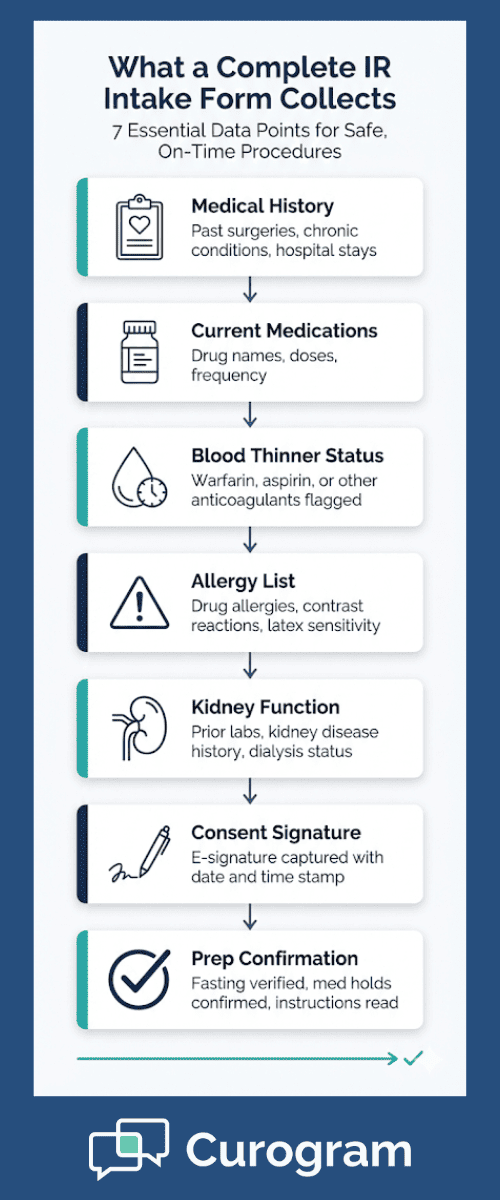
Infographic showing seven sections of a complete IR intake form for digital intake workflow

Supporting Vascular and IR Procedures With Detailed Digital Intake

Vascular and IR cases carry higher stakes than routine imaging. These patients often have complex health histories. They take multiple meds and may face more risks during procedures.

This is why intake must be thorough and timely. Online forms give your team the detail they need, when they need it.

Pre-Procedural Risk Assessment Completed in Advance

IR patients often have serious conditions. They may have heart disease, diabetes, or kidney problems. They may take blood thinners or other drugs that affect bleeding. All of this matters for procedure planning.

With pre-registration forms sent before the visit, patients report their full medical history. They list all current meds with doses and note past surgeries and hospital stays. They can also answer questions about allergies and anesthesia reactions.

This data flows into your system before the patient walks in. The clinical team can review it days ahead. They spot issues early and adjust plans if needed.

Take anticoagulant use as an example:

A patient on warfarin may need to stop the drug three to five days before a procedure. If your team learns this at check-in, it's too late. The procedure gets canceled. The patient made the trip for nothing.

However, if your form asks about blood thinners a week before the visit, your staff can act. They call the patient. They coordinate with the prescribing doctor. As a result, they set a safe timeline to pause the drug. The procedure happens on schedule.

This same logic applies to kidney function. Some IR procedures use contrast dye. Patients with poor kidney health face higher risks. If your form asks about kidney disease or prior lab results, you can order updated labs early. You can switch to a safer dye or adjust the plan.

The goal is simple: no surprises on procedure day. Online forms make that possible.

Digital Consent and Pre-Procedure Instructions

While consent forms are a legal must, paper consents create problems. Patients rush through them. They don't read the fine print and sign without fully understanding.

Digital consent flips this script. Patients review the form at home. They have time to read each section. They can look up terms they don't know and can ask questions before they arrive.

E-signature intake captures their approval securely. The signed form syncs with StreamlineMD. Your team has a clear record, no scanning or filing needed.

Pre-procedure instructions also benefit from digital delivery. IR cases often require fasting, bowel prep, or med changes. Paper handouts get lost. Verbal instructions get forgotten.

With online forms, patients receive instructions inside the form itself. They see what to eat, what to avoid, and when to stop certain meds. They can review these steps multiple times. Some systems even send reminders closer to the date.

For example:

A patient scheduled for a uterine fibroid procedure might need to fast for eight hours and stop aspirin three days before. The form explains this clearly. A reminder text follows two days out. Another reminder comes the night before.

When the patient arrives, they're ready. The nurse confirms compliance with a quick check. No delays or last-minute scrambles.

Faster Workflow for IR Nurses, Techs, and Coordinators

IR teams juggle many tasks. Nurses prep patients, techs set up equipment, and coordinators manage the schedule. Everyone needs accurate info to do their job.

Online forms put all required data in one place. The nurse doesn't have to hunt for the med list. The tech doesn't have to ask about allergies again. The coordinator sees who's ready and who needs follow-up.

This improves clinical readiness on arrival. When the patient walks in, the team already knows their history. They've reviewed the risks and prepped the right supplies.

Here's an example:

Think about a typical IR suite running three cases in a morning. Without digital intake, each case starts with 10 to 15 minutes of chart review and patient questions. That's 30 to 45 minutes of lost procedure time.

With online forms, that prep happens before the patient arrives. The team reviews overnight. By morning, they're ready to start on time. Each case runs smoother. The day ends on schedule.

Coordinators also benefit from better visibility. They see which patients have completed forms and which haven't. They can send reminders to those who lag and can reschedule patients who won't be ready.

This shifts the workload from reactive to planned. Instead of fixing problems as they come, the team prevents them ahead of time.

For multi-location IR practices, this becomes even more valuable. Each site uses the same form templates. Data flows to the same system. Staff at any location can see patient records. This creates a seamless handoff when patients move between sites.

The end result is a faster, safer workflow. Patients spend less time waiting. Staff spend less time on admin tasks. Procedures start on time, and your IR suite runs at full capacity.

Consider the math:

If your IR suite does 10 cases a day and you save 15 minutes per case, that's 150 minutes or two and a half hours saved daily. Over a week, that's more than 12 hours. That time can go to extra cases, staff breaks, or earlier end times.

Reducing Administrative Burden Through Digital Intake Automation

Admin tasks pile up fast in imaging centers. Data entry, phone calls, and form chasing eat hours each day. Online forms automate these tasks and free your staff for higher-value work.

Eliminating Manual Transcription Into StreamlineMD

Paper forms require retyping. A patient fills out a clipboard form. A staff member reads the answers. They enter each field into StreamlineMD by hand. Spelling mistakes can happen here as numbers get flipped.

Digital forms eliminate this step. Patient responses flow straight into your system. This saves real time. If each form takes five minutes to transcribe and you see 40 patients a day, that's over three hours of data entry. With online forms, that time drops to nearly zero.

It also reduces errors. When patients type their own info, fewer mistakes occur. And when data syncs directly, there's no chance of transcription errors.

Preventing Phone-Based Intake Backlogs

Call centers spend much of their day on intake questions. They confirm addresses, collect insurance details, and ask about allergies and meds. Each call takes minutes. The queue grows long.

With online forms, patients submit this data on their own time. They fill out forms at night or on weekends. They don't wait on hold or play phone tag.

Your call center sees fewer intake calls. Staff can focus on complex issues like prior authorizations or referral questions. They handle more calls per hour because each one is simpler. For practices with limited phone staff, this is a game changer. You serve more patients without hiring more people.

Streamlining Workflows Across Multi-Location Facilities

Multi-site imaging networks face a unique challenge. Each location may use different forms, different questions, and different processes. This creates chaos when patients move between sites.

Digital intake solves this with unified templates. All locations use the same forms. All questions match. All data flows to the same system.

When a patient visits Site A for an MRI and Site B for a CT, their info is already on file. Staff at Site B don't start from scratch. They see the full history. This also helps with quality control. Managers can audit form use across all sites. They can spot gaps and fix them system-wide.

Preventing Incomplete Exams and Avoidable Delays

Even small gaps in prep can ruin an exam. A patient who ate before a fasting ultrasound. A CT patient who didn't hold their metformin. These mistakes waste time and resources. Online forms help you prevent them.

Ensuring Patients Understand Prep Requirements

Prep instructions often get lost. Patients forget what they were told on the phone. They lose the paper handout.

With online forms, instructions live inside the form. Patients see them as they answer questions. They can't miss them.

  • For radiology cases, the form might say: "Do not eat or drink for six hours before your exam."
  • For IR cases, it might say: "Stop taking aspirin 72 hours before your procedure."

The message is clear and hard to ignore.

Reducing Repeat Exams and Operational Disruptions

A failed exam often means a repeat visit. The patient comes back, and the schedule changes. Equipment time is wasted twice.

When patients prep correctly the first time, repeat exams drop. Your schedule becomes more stable, and your team can plan with confidence.

Improving Technician and Provider Efficiency

Techs and providers want to focus on clinical work. They don't want to spend their day fixing intake errors.

Online forms shift this burden away from them. The data arrives complete. The prep is confirmed. They walk into a ready patient, not a puzzle to solve.
.

Enhancing the Patient Experience With Modern, Mobile-Friendly Forms

Patient experience matters. Satisfied patients return, leave good reviews, and refer friends. Online forms show patients that your practice values their time.

Forms Patients Can Complete at Home

Filling out forms at home is less stressful than doing it in a busy lobby. Patients can take their time. They can gather their med bottles or call a family member for help. They feel in control of their care.

This reduces anxiety, especially for patients facing their first MRI or a nerve-wracking IR procedure. When they arrive, they know what to expect. The paperwork is done. They can focus on the exam.

Clear, Structured Instructions Increase Confidence

Well-structured forms do more than collect data. They teach and guide patients through prep steps. They answer common questions before they're asked.

When patients understand what's happening, they feel more confident. They trust your team. They follow instructions better.

Simple Digital Experience Improves Satisfaction

A modern intake process signals a well-run practice. Patients expect digital tools today. They book flights, order food, and manage bank accounts on their phones. Healthcare should be no different.

When your forms work smoothly on any device, patients notice. They feel cared for. That impression carries into the exam room and beyond.


Related Workflow Improvements for StreamlineMD Practices

Online forms are just one piece of a bigger puzzle. StreamlineMD practices can layer other tools to boost results.

HIPAA-compliant texting lets you send form links and reminders securely. Mass texting helps you reach large patient panels with updates or recalls.

Appointment reminders cut no-shows and keep your schedule full. Reputation management tools help you collect reviews and build your online presence.

Telehealth expands access for follow-ups or consults. And text-to-pay speeds up collections after the visit.

Each tool connects with your forms to create a smooth patient journey. Together, they reduce friction at every step.


How Curogram Powers Your Digital Intake Workflow


Curogram brings all these pieces together for StreamlineMD practices. The platform offers HIPAA-compliant online patient forms that work on any phone, tablet, or computer.

Patients receive a link via text. They tap to open the form. They answer questions at their own pace. When they submit, the data syncs with your system.

Curogram's forms are fully customizable. You can build templates for MRI screening, CT prep, IR risk checks, and more. You can add e-signature intake for consents. You can embed prep instructions so patients see them as they fill out the form.

The platform also connects with other Curogram tools. Appointment reminders nudge patients to complete their forms before the visit. Two-way texting lets staff follow up on missing data. Text-to-pay handles billing after the procedure.

For multi-site practices, Curogram offers unified templates. Every location uses the same forms. Every patient gets the same experience. Staff see all data in one place.

Setup is also fast. Curogram engineers worked alongside front desk staff in real clinics to build a system that fits actual workflows. Most teams learn the platform in under 10 minutes.

The results speak clearly. Practices using Curogram report faster check-ins, fewer phone calls, and happier patients. Staff spend less time on admin work and more time on care.

If your current intake process relies on paper, phone calls, or fragmented digital tools, Curogram offers a better path. It's the missing link between your patient and your StreamlineMD system.

Conclusion

Paper forms belong in the past. For radiology, vascular, and IR practices, the cost of manual intake is too high. Delays stack up, exams get canceled, and staff burn out. Patients leave unhappy.

Online patient forms fix these problems at the source. When patients complete pre-registration forms at home, they arrive ready. Staff catch issues before the visit. Exams start on time. Your schedule stays on track.

A digital intake workflow with StreamlineMD removes the manual steps that slow you down. No more retyping from clipboards. No more phone calls to chase missing data. No more last-minute consent scrambles.

E-signature intake captures approvals securely. Prep instructions reach patients before they forget. Your team reviews data days ahead, not minutes before the scan.

When you pair StreamlineMD with Curogram, you get a seamless system. Forms go out automatically. Reminders follow, data syncs without effort, and your staff focus on care, not paperwork.

Whether you run a single MRI suite or a network of imaging centers, online forms scale with you. They bring the same results to every location. The transition is simple: Move intake online, collect data early, and review before the visit. Let your team do what they do best.

Your patients expect a modern experience. Your staff deserve better tools. Your practice needs smoother workflows.

Discover how StreamlineMD and Curogram work together to reduce admin burden. Book your demo today to see how digital forms transform intake for radiology, vascular, and IR practices.


Frequently Asked Questions

How do online forms reduce MRI delays for imaging centers?
Online forms collect metal screening and implant history before the visit. Staff review responses early, flag issues, and resolve them days ahead, so exams start on time without last-minute surprises.
Why is e-signature intake important for IR procedures?
E-signature intake lets patients review and sign consents at home with time to understand risks. This eliminates paper bottlenecks, creates secure records, and ensures informed consent before arrival.
How do digital forms help multi-site imaging practices stay consistent?

Digital forms use unified templates across all locations. Every site collects the same data, follows the same process, and feeds info to the same system, removing gaps when patients move between sites.

Why should radiology practices move away from phone-based intake?

Phone-based intake clogs call centers with routine questions, creates hold times, and increases staff workload. Online forms let patients submit data anytime, freeing staff for complex tasks.

How does Curogram integrate with StreamlineMD for digital intake?

Curogram sends form links via text. Patients complete forms on their device. Responses sync with StreamlineMD without manual entry. The two systems work together for a seamless intake workflow.


Online Patient Forms in StreamlineMD: Faster Imaging Intake

Online Patient Forms in StreamlineMD: Faster Imaging Intake

💡 Online patient forms in StreamlineMD help radiology, vascular, and IR practices cut check-in time and boost exam readiness. Curogram's digital...

Read More
Online Patient Forms in Veradigm with Curogram

Online Patient Forms in Veradigm with Curogram

💡 Online patient forms in Veradigm enable imaging centers to transition away from paper-based intake that causes delays and errors. Patients...

Read More
Reduce Admin Workload in StreamlineMD: The ROI of Digital Forms

Reduce Admin Workload in StreamlineMD: The ROI of Digital Forms

💡 Online patient forms help StreamlineMD radiology, vascular, and IR practices save money and boost revenue. Faster check-in cuts wait times and...

Read More