8 min read

SUD Behavioral Health Client Texting: No Portal, No App Needed

SUD Behavioral Health Client Texting: No Portal, No App Needed
💡 Behavioral health and SUD clients open texts far more often than they open a portal. Texting with no portal and no app removes the barriers that push vulnerable clients out of care.
  • Texts reach clients at about a 98% open rate; portal use in behavioral health stays near 15–20%.
  • No app, no account, and no login means no extra steps for a client in crisis.
    SMS shows no behavioral health app icon on a shared phone, which protects privacy.
  • Curogram supports 42 CFR Part 2 texting privacy with consent and disclosure controls built in.
  • Curogram practices see no-show rates 53% lower than the industry average, based on our internal data.
For SUD and behavioral health programs, SMS meets clients on the phone they already carry. That is why they text back.

A text message gets read. A portal login often does not. That gap matters most for the clients who are hardest to reach.

Many behavioral health and SUD programs lean on a patient portal to stay in touch. The idea sounds clean. Send a message, the client logs in, they reply. But the people who need care most rarely get past the login screen.

Think about a client in early recovery. They may share a phone. They may forget a password. They may skip one more app that feels like a chore. Each step is a chance to drop off.

Sigmund AURA gives your team a portal with secure messaging through aura.sigmundemr.com. It works well for charts and clinical notes. Yet portal barriers hit behavioral health populations harder than most. Logins, resets, and downloads pile up fast for someone in crisis.

Here is the part that changes the math. Texts reach people at a rate portals cannot match. No app. No account. No icon on a shared screen. Just a message on the phone they already hold.

This is the case for behavioral health client texting with no portal and no app for SUD care. It meets clients where they are, not where a system wishes they were. For programs under 42 CFR Part 2, that privacy is a clinical safeguard, not a perk.

This article breaks down why behavioral health clients ignore the patient portal. It shows how SMS closes the gap. And it lays out what changes when the channel is as simple as a text.

The short version: your clients already carry the tool. They just need you to use it.

The Villain: The Portal Wall

A portal sounds helpful. In behavioral health, it often becomes a wall. The clients who need contact most are the ones least likely to get through it.

The Barrier

Sigmund AURA's portal messaging asks clients to log in through a separate system at aura.sigmundemr.com. They must create credentials and keep track of them. For most people, that is a small task. For behavioral health and SUD clients, it is a clinical barrier.

This is the heart of why behavioral health clients ignore the patient portal. The login is one more step between a person and their care. And every step costs you a few more clients.

The Agitation

Picture a real moment. A client in early recovery from opioid use disorder gets an email. It asks them to log in and confirm their MAT appointment. They cannot recall the password.

The reset link goes to an inbox they rarely open. So they give up. The appointment is missed. The team never learns why.

Now picture a client with severe anxiety. The login screen alone feels like too much. The many steps trigger avoidance — the same pattern their treatment is built to ease. The tool meant to help becomes a trigger.

The Drop-Off

Portal use in behavioral health runs an estimated 15–20% or lower. For SUD clients, the rate is often worse. The reasons are not laziness. They are real-world facts of the population.

Common portal barriers for behavioral health populations include:

Barrier

What it looks like in practice

Shared or lost phones

A client's app and login live on a device they no longer use.

Changed numbers

New SIM, new phone, new gaps in contact.

Cognitive load

Active use or crisis makes multi-step logins hard to finish.

Stigma

A labeled app icon on a shared screen risks exposure.


Each portal-only touchpoint becomes a chance to lose someone. That is the core problem with SMS vs portal engagement in SUD care: the channel itself decides who stays.

The Result

Clinicians feel the fallout. A client is fully present in session. Then they vanish between visits. The bond holds, but the tool fails.

The quiet thought in many programs sounds like this. "We are not losing clients because we cannot help them. We are losing them because our tools build the same walls we are trying to take down." When the channel fails, the care plan fails with it.

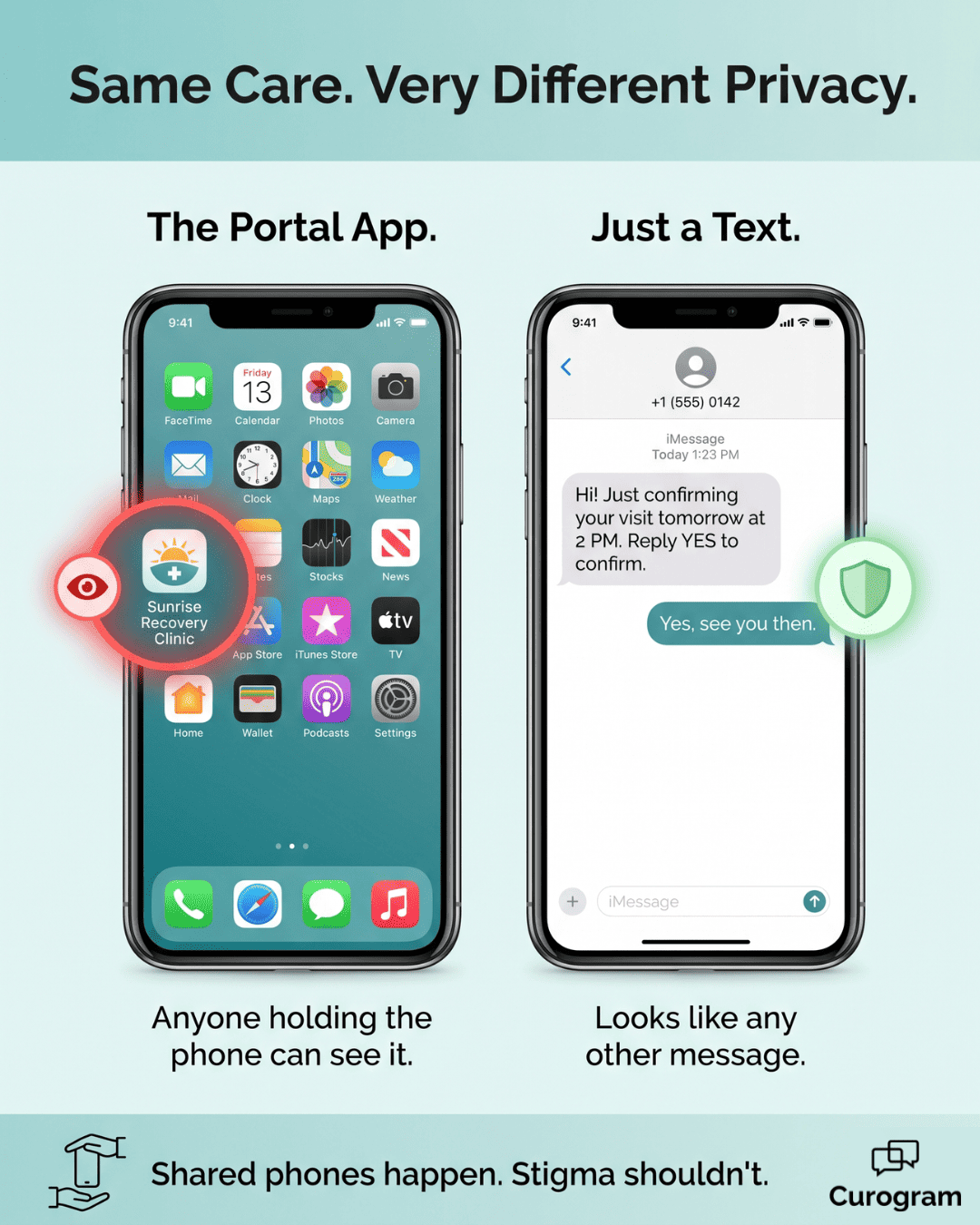
Comparison of a labeled behavioral health portal app versus a private SMS text thread

The Guide: Meeting Clients on the Phone They Already Carry

The fix is not a better portal. It is a channel that asks nothing of the client. A text arrives. They read it. They reply. That is the whole flow.

The Solution

Curogram's SMS-first model removes every step between your practice and the client. There is no portal to find and no screen to learn. The message lands in the same inbox they check all day.

For substance use disorder client communication, this matters more than it may seem. Less friction means more replies. More replies mean more clients who stay in care.

The Feature: Zero-Download Engagement

Curogram's Zero-Download Engagement model means no app to install and no account to set up. The client uses plain SMS — the same texting they use with friends and family. There is nothing new to learn.

This is the value of client texting in behavioral health with no download. For SUD clients, it also means no labeled app icon on a shared phone. A portal or app can expose someone. A text cannot.

The Integration

Curogram runs alongside Sigmund AURA as a contact layer. Your practice sends texts from one dedicated number. Client replies show up on the Curogram dashboard. Clinical notes stay in Sigmund, where they belong.

The client never sees the tools behind the text. They do not know an EHR sits in the background. They just see a message from their counselor's office and reply. The tech does the work so the client does not have to.

The SUD and Behavioral Health Fit

Many clients live with conditions that strain focus and memory. Addiction, ADHD, depression, and psychosis all tax the same mental energy a login demands. Asking them to recall a password is asking a lot.

A text has near-zero mental cost. It does not compete with the very symptoms treatment is trying to ease. That simplicity is clinically useful. It lowers the bar to staying engaged instead of raising it.

Here is a simple way to see the difference:

Step

Portal path

SMS path

Get the message

Check email, find the link

Phone buzzes

Open it

Log in, maybe reset password

Tap the text

Reply

Learn the portal screen

Type back

Privacy on a shared phone

Labeled app icon visible

Looks like any text


Fewer steps win. For people in recovery, fewer steps can be the difference between care and a missed week.

The Success: The Channel That Matches How Clients Actually Communicate

The best channel is the one people already use. Your clients text every day. So the smart move is to meet them there, not somewhere new.

The Metric

The numbers tell a clear story. Texts get opened at about a 98% rate, most within minutes. Portal use in behavioral health sits near an estimated 15–20%. That is not a small gap. It is a different world of contact.

Reach is only half the value. The other half is what reach does to outcomes. Curogram practices see no-show rates 53% lower than the industry average, based on our internal data. Fewer missed visits means more clients held in care.

One example shows the scale. Atlas Medical Center cut no-show rates from 14.20% to 4.91% in just three months, based on our internal data. That result was about 3X better than the industry average. The driver was simple: reminders and replies on a channel people actually use.

This is the real lesson of SMS vs portal engagement in SUD care. A portal can hold a perfect record and still reach no one. A text reaches almost everyone. When you compare the two side by side, the channel that wins is the one that gets opened.

A quick view of the contrast:

Measure

Patient portal (BH/SUD)

SMS texting

Open or use rate

~15–20% (estimated)

~98%

Steps to reply

3–5

1

App or login needed

Yes

No

Works after a number change

Often no

Follows the number

Visible app icon

Yes

No


The Shift

The mindset has to move. The old view treats tech as a barrier the client must cross. The better view makes the tech disappear.

The best tool is one the client never notices. They do not see a platform. They do not see an EHR link. They see a text from a person they trust, and they answer. When the tech fades, the relationship leads.

This shift is more than style. It changes who you can reach. A portal asks the client to come to the system. A text brings the system to the client. For people on the edge of care, that direction matters.

The Outcome

Picture a client leaving a residential SUD program for outpatient care. The first outpatient session is confirmed by text. Intake forms arrive on their phone, not on a clipboard.

They fill the forms out on the bus. They walk in, sit down, and start therapy. No early arrival for paperwork. No portal to fight. The handoff held because the channel held.

That is treatment continuity in real life. Care does not break at the seam between programs. The text carried the client across the gap. And the client never had to learn a thing.

Strong substance use disorder client communication is not about more messages. It is about the right channel at the right moment. SMS gives you both. It shows up, gets read, and keeps people connected when it counts.


SUD client confirming a care reminder by text at a bus stop mid-commute
Why a Text Beats a Portal for Your Hardest-to-Reach Clients

Curogram was built on one idea. The channel should never be the reason a client falls out of care. For behavioral health and SUD programs, that idea is not a feature — it is the whole point.

Curogram gives your practice 2-way HIPAA-compliant texting that needs nothing from the client. No app. No account. No portal. The client uses plain SMS on the phone they already own. You get a clean dashboard where every reply lands in one place.

The platform is HIPAA compliant and SOC 2 Type II certified. Messages are encrypted on the way and at rest. Full audit trails are kept for every thread. For SUD programs, Curogram supports 42 CFR Part 2 texting privacy with consent and disclosure controls built in.

It works next to Sigmund AURA, not instead of it. Sigmund holds your charts, notes, and ASAM assessments. Curogram handles the contact that keeps clients showing up. Your team texts from one number, and clinical records stay where they should.

The proof shows up in the numbers. Curogram practices see no-show rates 53% lower than the industry average, based on our internal data. Atlas Medical Center cut no-shows from 14.20% to 4.91% in three months. Those gains come from a channel people open.

There is also built-in consent and opt-out support. Clients can opt in or out at any time, by text or at intake. Curogram tracks it for you, so you meet HIPAA and TCPA rules without manual work.

The result is care that travels with the client. The phone they already carry becomes the bridge to treatment. That is the simplest fix for your most fragile touchpoints.

Conclusion: Your Clients Already Have Their Phones

Portal-based contact fails the people who need engagement most. The logins, resets, and downloads form a wall. The clients on the edge of care rarely climb it.

SMS texting clears that wall. It reaches behavioral health and SUD clients with zero tech barriers. No app. No account. Just a text on the phone they already hold.

The roles are clear. Sigmund AURA serves the chart with your notes and ASAM assessments. Curogram serves the client with the contact that keeps them in care. The portal supports the record. The text supports the person.

So stop asking your most fragile clients to use a portal they will never open. The cost of that ask is measured in missed visits and broken handoffs. The fix is already in their pocket.

Imagine what engagement looks like when the channel is as easy as a text. Fewer no-shows. Smoother handoffs. Clients who reply because replying takes one tap.

Curogram makes that the default, not the exception. It meets clients where they are and works quietly beside the EHR you already trust. The phone does the rest.

Your clients already carry the only tool they need. Schedule a quick demo and watch 2-way HIPAA-compliant texting work alongside your Sigmund AURA setup.


Frequently Asked Questions

How is SMS texting kept HIPAA compliant for behavioral health communication?

Curogram is HIPAA compliant and SOC 2 Type II certified. Every message is encrypted in transit and at rest, with full audit trails. For SUD programs, it supports 42 CFR Part 2 texting privacy through built-in consent and disclosure controls.

Why does texting work better than a portal for clients in active recovery?

Recovery often strains focus and memory. A portal demands logins, resets, and many steps. A text needs one tap. Lower mental load means more replies and fewer missed visits from the clients who need contact most.

Why is SMS safer than a portal or app for clients who share a phone?

A portal or app shows a labeled icon on the home screen. That can expose someone's care to others. A text looks like any other message, so it protects privacy on shared or borrowed devices.

How can clients opt out of texts if they prefer not to get them?

Clients can opt in or out at any time. They reply to a text or set it during intake. Curogram tracks opt-outs for you, so your practice meets both HIPAA and TCPA rules automatically.

How does Curogram texting fit alongside Sigmund AURA without changing clinical notes?

Curogram runs as a contact layer beside Sigmund AURA. Your team texts from one dedicated number, and replies land on the Curogram dashboard. Clinical notes and ASAM assessments stay in Sigmund, untouched.