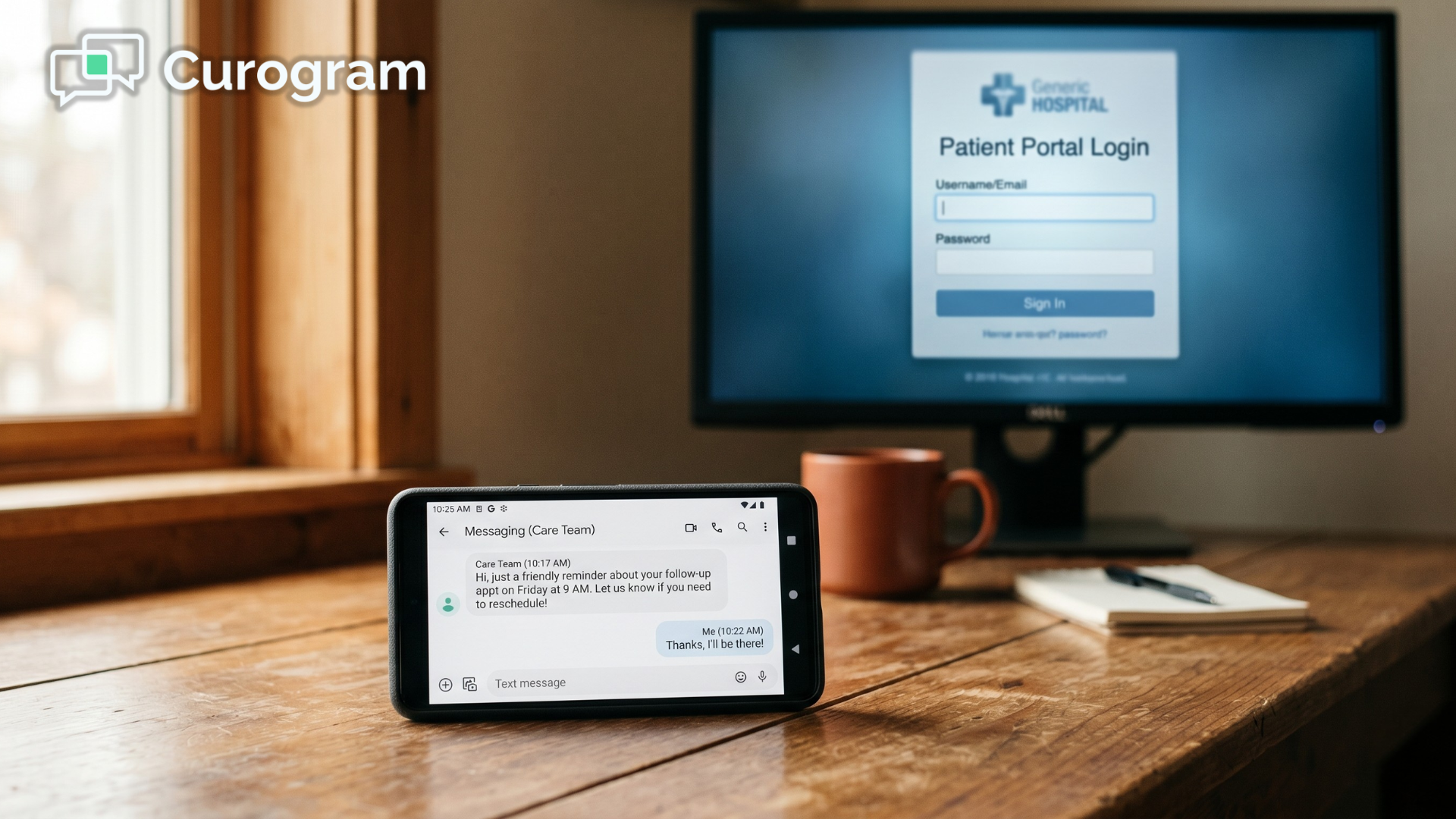

Curogram's HIPAA-compliant 2-way texting removes those barriers for Netsmart practices. Consumers reply on the phone they already use — no download, no login, no portal.
SMS reaches 98% open rates, while myHealthPointe portal logins stay in single digits.
Atlas Medical Center cut no-shows from 14.2% to 4.91% with text-based engagement. For mental health and substance use teams, texting is the difference between reaching consumers and losing them.
Your portal numbers look great on paper. Hundreds of consumers signed up. Leadership is pleased.
Then you check who actually logged in this month. The number is tiny.
This is the quiet problem inside behavioral health. The people who need to hear from you most are the ones least likely to open an app, remember a password, and dig through a portal to find your message.
Think about the consumer you worry about — the one managing depression, an active addiction, or an unstable living situation. Now ask them to download an app, create an account, verify an email, and tap through three screens just to confirm a visit.
Each step is a door they can quietly walk out of.
So they don't reply. They miss the reminder. They fall off the schedule. And your team reads it as "non-compliance" when it was really a communication problem all along.
Here's the part that stings. Those same consumers will read a text within minutes. The phone in their pocket already does everything you need.
The barrier isn't the person. It's the channel you're asking them to use.
You already feel this in your no-show numbers. A reminder nobody saw isn't a reminder at all. It's an empty chair on tomorrow's schedule and a staffer scrambling to fill it.
That gap has a name. We call it the Portal Paradox — the belief that offering a portal means people will use it. In behavioral health, that assumption quietly breaks.
This article closes that gap. We'll look at why patients don't use patient portals in behavioral health, what those missed connections actually cost you, and how a simpler channel reaches the consumers your portal keeps losing.
No new app. No login. Just a text they'll answer.
Why a Full-Featured Portal Still Loses the People It's Built For
A portal with every feature — and one fatal flaw
On paper, myHealthPointe does everything. Netsmart's portal handles appointment requests, lab results, reminders, assessments, consents, and secure messaging. It's a complete toolset.
But a feature only counts if someone uses it. In behavioral health, the consumers who need engagement most are the least likely to finish portal onboarding.
The six-step gauntlet between you and your consumer
Walk through what you're actually asking a consumer to do — and where each step quietly loses them:
- Spot the portal invite email among everything else. It lands between promotions, spam, and a hundred unread messages. If they're not checking email daily — and many aren't — it's gone. Most never open it.
- Find and open the app store. This sounds easy until you're the one doing it on a low-storage phone with a shaky signal. They have to remember the exact app name and not grab the wrong one. Plenty stall right here.
- Download the app and wait for it to install. The download bar crawls. A "storage full" warning pops up, and now they have to delete photos just to make room. Most decide it isn't worth it and close the screen.
- Create a username and password. They have to invent a password that meets the rules, then remember it later. For someone juggling a lot, that detail slips fast. They forget it, hit "reset," lose patience, and quit.
- Verify their email address. The app sends a confirmation link — to the same email they may not be able to open. No access means no verification, and the whole process dead-ends.
- Log in and navigate to the actual message. Even if they make it this far, the message is buried under tabs and menus they've never seen. They tap around, can't find it, and give up.
Six steps. Six exits. And that's the best-case version, where nothing crashes and every link works.
For someone managing severe depression, ADHD, or substance withdrawal, every line above is a place to quietly give up. The energy it takes to push through all six is energy they may not have on a hard day — which is often the exact day you most need to reach them.

Why "enrolled" never became "engaged"
The reviews tell the story. myHealthPointe ratings cite recurring crashes and login confusion, and consumers who do download it often struggle to get back in.
So myHealthPointe adoption rates look fine at sign-up and collapse at actual use. Organizations report strong enrollment counts but single-digit active logins.
Single digits
Share of enrolled consumers who actually log in — even when sign-up counts look healthy.
That's the Portal Paradox in action. The patient portal barriers behavioral health teams run into aren't about effort or willpower — they're structural. Consumers miss reminders buried in an app they forgot they had.
They want to reach you, but won't fight an interface to do it.
The portal becomes a wall between your organization and the people it exists to serve.
This is the real reason why patients don't use patient portals:
Behavioral health populations carry the heaviest load. Unstable housing, shared devices, limited data plans, and the daily weight of their condition all stack against a six-step login.

Reach Consumers on the One Channel They Never Ignore
So if the portal is the wall, what's the door?
It's the device already in their hand. Curogram's 2-way texting works as a zero-barrier connection. A consumer gets a text from your practice number and replies the way they'd text anyone else.
No app. No login. No portal to learn.
This is what behavioral health patient texting with no portal login really delivers — the message meets the consumer in the inbox they check all day, not in an app they'll never open.
SMS reaches people through the channel with a 98% open rate. Messages arrive as plain texts on any phone, smartphone or basic flip phone alike. That matters for no-app texting behavioral health consumers who may not have the storage, data, or device to run the latest app.
98% |
| SMS message open rate — versus single-digit portal logins. |
And it works alongside Netsmart, not instead of it. Consumer conversations happen over text while clinical documentation stays in your EHR. No migration. No rebuilt workflow. No disruption to your team's day.
The fit for behavioral health is the part that's easy to miss.
The same channel quietly solves problems the portal can't:
- Substance use treatment: no app icon means nothing sensitive shows up on a shared or monitored phone.
- ADHD or executive dysfunction: a text is one tap to read, not a six-step climb back into an account.
- Limited tech access: a plain SMS still lands when a data plan is tight or the phone can't run the latest app.
That's the real story of SMS vs portal engagement for mental health populations. The portal asks the consumer to change their behavior. Texting meets their life exactly as it already is.
What Happens When Replying Is as Easy as Texting a Friend
The results land where you feel them — on the schedule
Numbers tell this story better than promises. When you move communication to the channel consumers already use, the results show up where they matter most — on your schedule.
53% lower
No-show rate versus the industry average. Atlas Medical Center dropped from 14.2% to 4.91% after switching to text-based engagement.
Above 75%
Of consumers confirm appointments by 2-way text, while portal response rates stay in single digits.
What that looks like in real dollars
What does that actually mean for your schedule? Let's put real money on it.
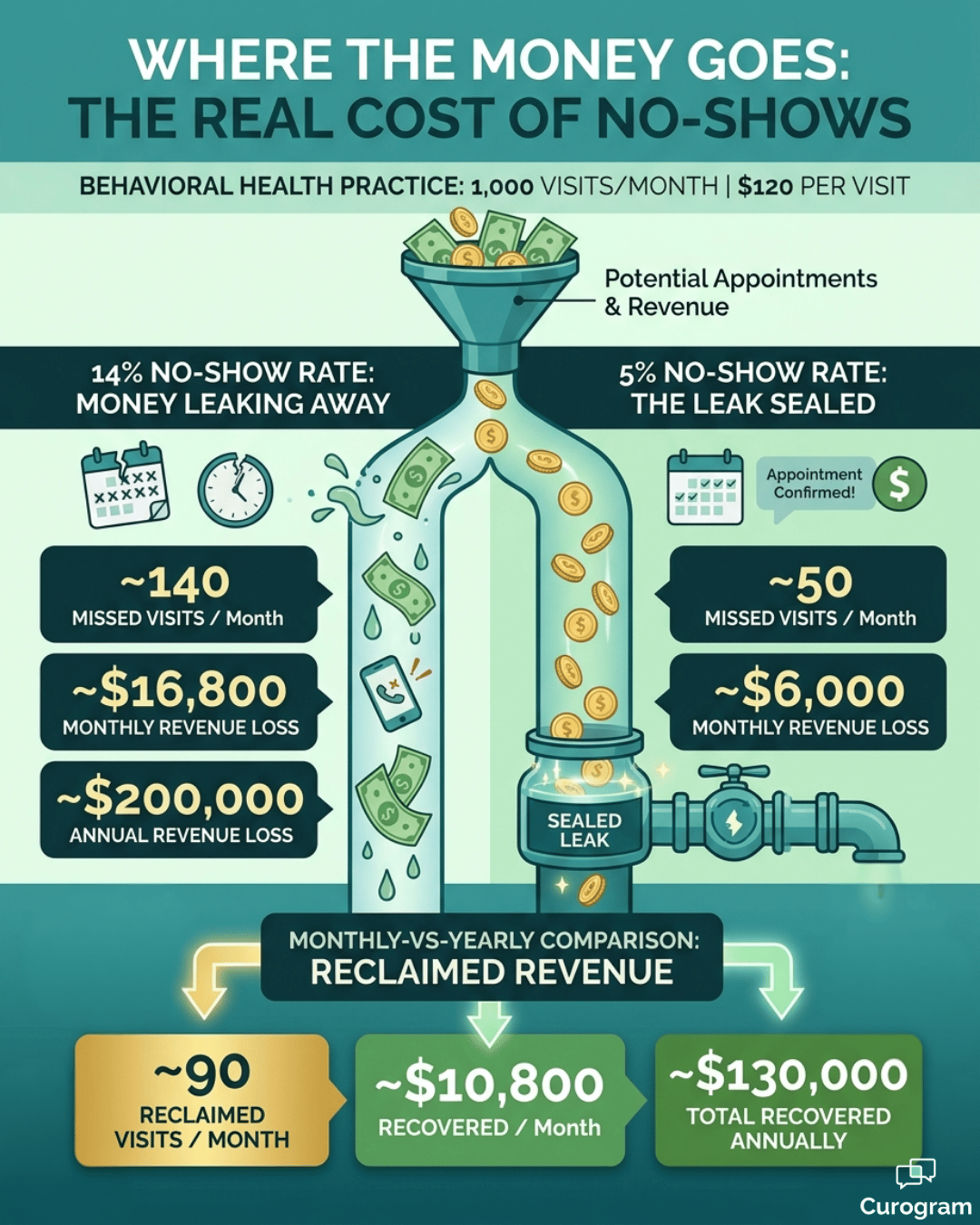
Say your practice averages 1,000 visits a month with a 14% no-show rate. That's about 140 missed visits. At an average visit value of $120, you're losing roughly $16,800 every month — close to $200,000 a year.
Now drop that no-show rate to 5%, the range Atlas reached. Missed visits fall to about 50 a month. You've recovered around 90 visits, or roughly $10,800 monthly — about $130,000 a year — without adding a single new patient.
For your team, that's more than revenue. It's about 90 consumers a month who stayed connected to care instead of slipping off the schedule. (These figures are a sample scenario to show the math, not a guarantee.)
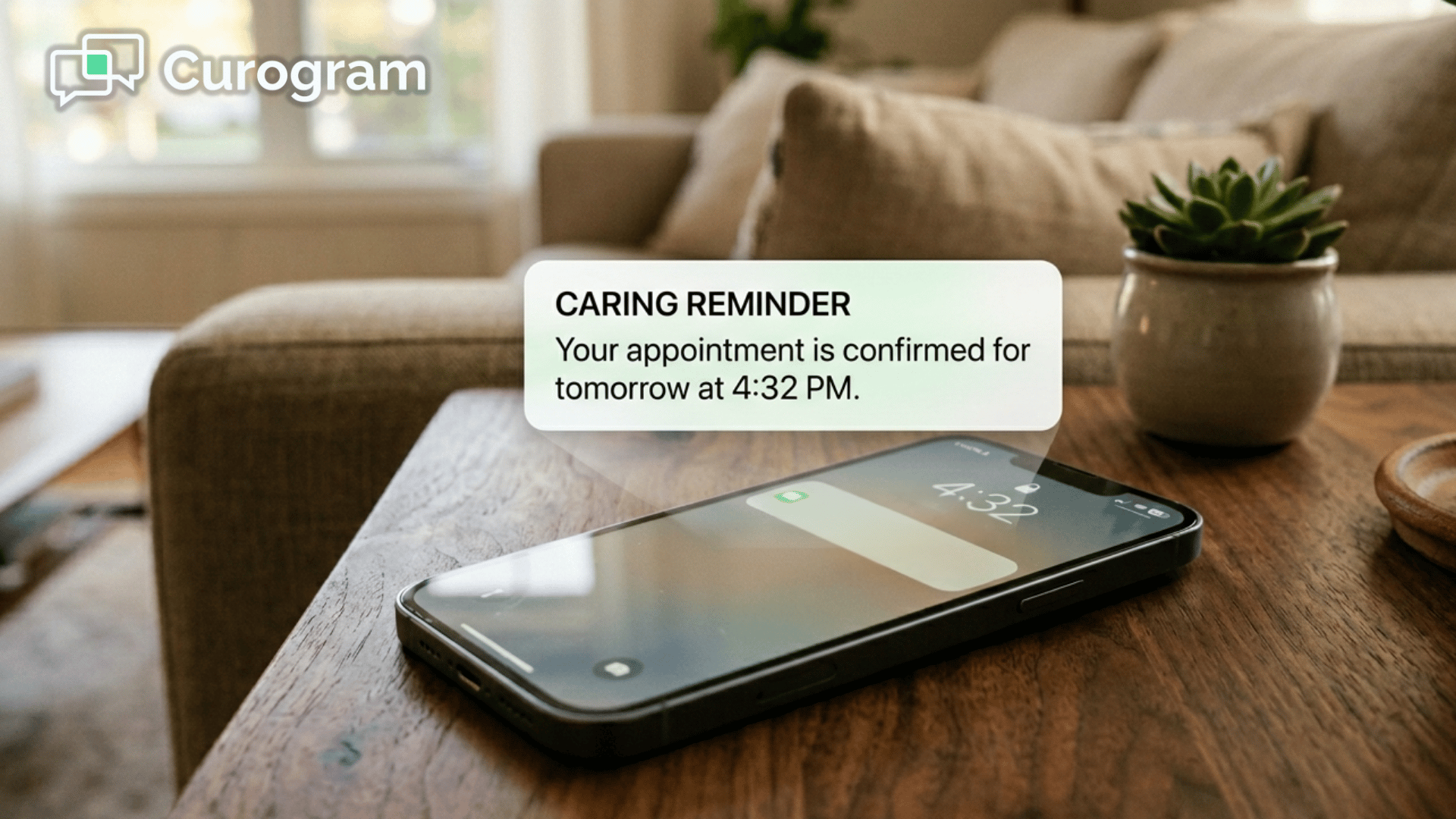
The experience flips, too. Instead of "download an app to reach your provider," it becomes "reply to this text." Engagement stops being a hurdle.
Appointment adherence improves. Treatment continuity holds. And you finally measure something real — actual conversations, not portal sign-ups that never became logins.
Stop Building Walls. Start Sending Texts.
Behavioral health consumers reply to texts for one simple reason. Texting removes every barrier a portal creates — no download, no password, no maze of menus.
That's the whole insight. The people hardest to reach aren't unreachable. They're just on a different channel than the one you've been asking them to use.
Think of it as a clean division of labor. Netsmart holds your clinical record — thorough, compliant, and complete. Curogram handles the conversation — fast, simple, and on the device your consumers already carry. One keeps your documentation solid. The other keeps your people connected.
You don't have to choose between them. Curogram sits alongside myHealthPointe and Netsmart without replacing a thing. Your clinical workflow stays right where it is. What changes is how easily your consumers can hear from you and answer back.
And the stakes are real. Every missed reminder is a consumer drifting from care. Every ignored portal message is a relationship cooling off.
In behavioral health, those gaps cost more than revenue — they cost continuity for people who can least afford to fall through. Reaching them isn't a nice-to-have. It's the work.
So here's the honest question. How much of your "engagement" is real, and how much is a sign-up count that never turned into a single login?
Your consumers already have their phones. They already know how to text. The only thing between them and your message is a portal they were never going to open.
Stop asking them to download another app they won't use. Meet them where they already are.
Schedule a demo with Curogram and see exactly how text-based engagement reaches the consumers your portal keeps losing — right alongside the Netsmart system you already trust.
Frequently Asked Questions
Yes. Curogram is fully HIPAA compliant and SOC 2 Type II certified. For substance use treatment, it also supports 42 CFR Part 2 confidentiality requirements. You can keep reminder texts discreet, with no sensitive clinical details in the message body.
No. They send and receive standard text messages on the phone they already own. There's no app to install, no account to set up, and no portal to navigate. Any phone that can text works with Curogram.
Yes. Curogram includes built-in opt-in and opt-out workflows. A consumer can reply to unsubscribe at any time, and their preference takes effect right away. This keeps you aligned with both TCPA rules and behavioral health consent standards.
No. Curogram sits alongside your existing system, not on top of it. Clinical documentation stays in Netsmart, and myHealthPointe keeps doing what it does. Curogram simply adds a text channel for the everyday conversations — reminders, confirmations, and quick questions — so you reach consumers who would otherwise never log in.
More than reminders. You can send appointment confirmations, follow-ups, recall messages to re-engage consumers who've fallen off the schedule, and real 2-way conversations when someone needs to reply. Because texts hit a 98% open rate, the messages your team sends actually get read — not buried in a portal inbox.